AI Model Supply Chain Security in Enterprise Deployments
Enterprises securing AI deployments need runtime controls, not just governance frameworks.
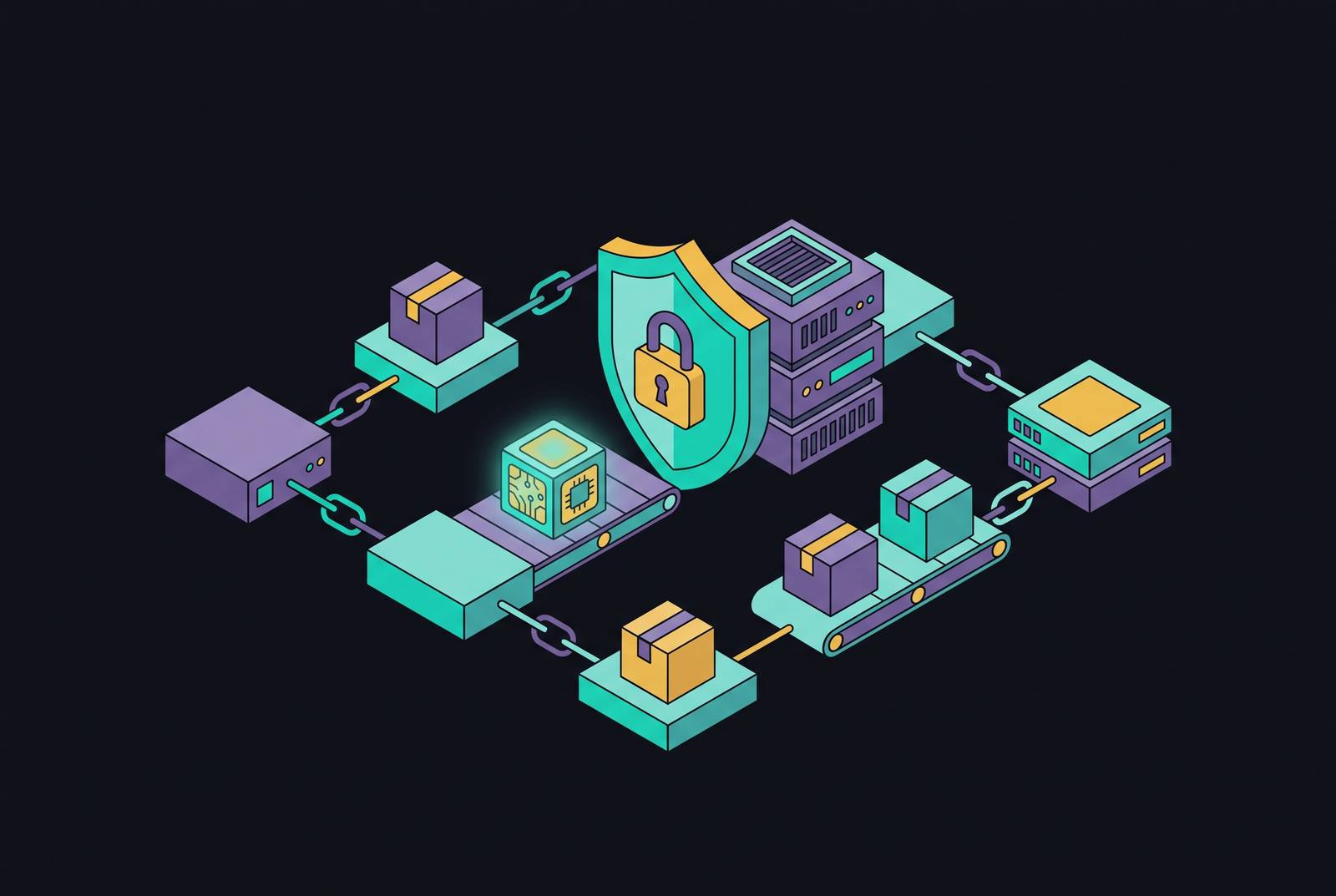
Enterprise AI systems now run on a supply chain nobody fully controls: models pulled from public registries, packages wrapping AI frameworks, fine-tuning pipelines built on borrowed code, and inference dependencies that can update without notice. Traditional software security spent years building tools for code dependencies and package registries: software composition analysis, software bills of materials, signed builds. None of that tooling was built to inspect a model's weights, and a compromised model can be far harder to detect than a malicious package flagged by conventional scanning tools. The attack surface multiplies rather than adds: one bad framework, one poisoned registry entry, and every system downstream inherits the problem at once. Two events from 2026 make the stakes concrete, and neither leaves much room for argument.
The LiteLLM compromise: what the largest AI supply chain breach of 2026 exposed
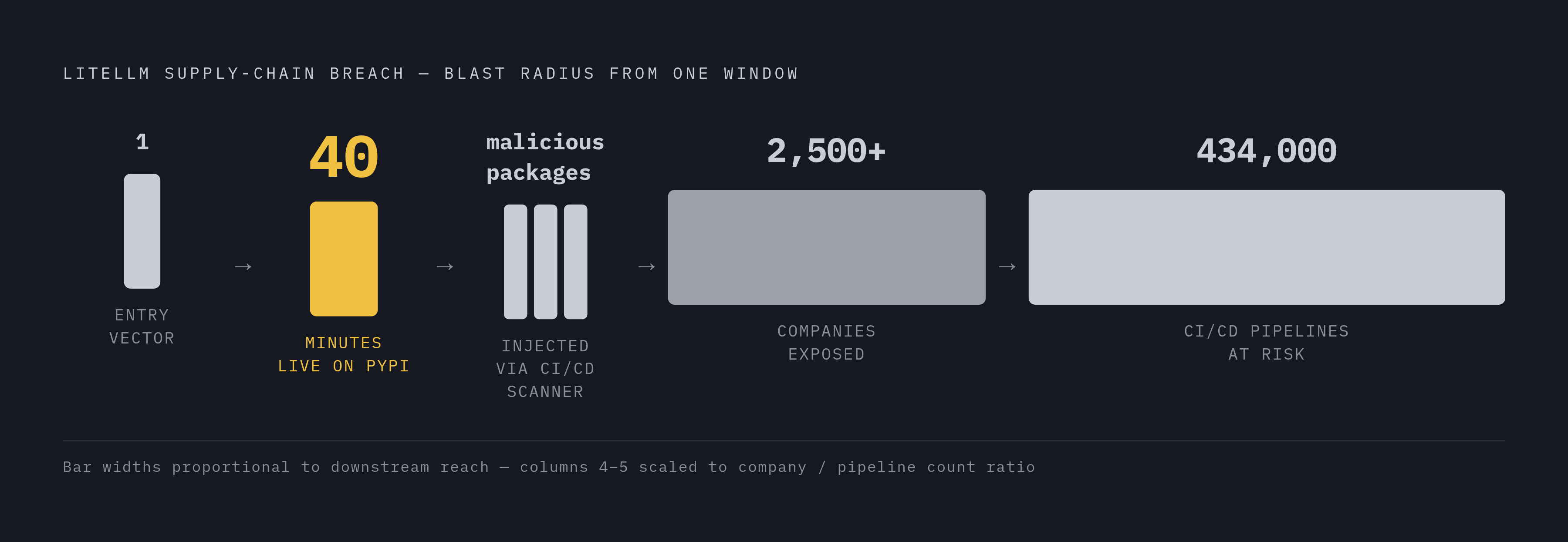
In March 2026, someone slipped malicious code into two PyPI package versions of LiteLLM, the open-source AI gateway framework thousands of engineering teams use to route requests across model providers. The entry point wasn't a leaky API or a phished developer account. It was a security scanner built into LiteLLM's own CI/CD pipeline, a tool that existed to catch exactly this kind of tampering, turned into the thing that let it through. The attacker didn't beat the defense; it wore the defense's badge and walked in the front door.
The packages sat live on PyPI for roughly 40 minutes. Forty minutes doesn't sound like much until you count what it touched: more than 2,500 companies and around 434,000 CI/CD pipelines were exposed in that window. Anyone who ran a routine pip install during that stretch pulled a compromised package into their build process, no questions asked, because that's what package managers are built to do. Trust, unchecked, is just a fast way to distribute a problem.
Nearly 500 malicious models in public registries and what they are designed to do
Around the same period, researchers turned up close to 500 malicious AI models sitting in the same public registries enterprises pull from every day for base models and fine-tuned variants. The payloads inside them read like a greatest-hits list from classic malware: credential theft, remote code execution, full system compromise. What's changed is the delivery vehicle, and that should worry security teams more than the payloads themselves.
Model weights are binary blobs, not source code, so the static analysis tools built for scanning code don't apply to them. Worse, the serialization formats commonly used for model weights can carry hidden payloads that execute at load time, before a single inference request ever runs. A model doesn't have to do anything malicious to be malicious; it just has to get loaded. It just has to get loaded.
Many enterprises lack a defined process for scanning a model artifact before it lands in a fine-tuning pipeline or a serving environment. It gets pulled, it gets loaded, it runs. Only 29% of organizations report feeling prepared to secure agentic AI deployments, so the large majority are ingesting models into production with no meaningful gate in front of them. That's most of the industry, not a minority problem, driving without a seatbelt and calling it agile. That's most of the industry, driving without a seatbelt and calling it agile.
What the dominant governance frameworks (NIST AI RMF, ISO/IEC 42001, and the EU AI Act) cover and where supply chain security falls through the cracks
Three frameworks dominate enterprise AI governance conversations in 2026, and each does something genuinely useful. NIST's AI Risk Management Framework organizes work around four functions, Govern, Map, Measure, Manage, and it's voluntary and technology-neutral, which has helped it gain broad adoption as a common reference point for AI risk inside US enterprises. ISO/IEC 42001:2023 is the first certifiable AI management system standard, built on the same plan-do-check-act structure as ISO 27001, and vendor qualification processes are beginning to reference it as a benchmark. The EU AI Act is the one with teeth: binding law, penalties up to €35 million or 7% of global annual turnover, whichever number stings more. Its Article 50 transparency rules took effect August 2, 2026, while the tougher high-risk obligations under Annex III got pushed to December 2027 by the Digital Omnibus. NIST also launched an AI Agent Standards Initiative in February 2026, aimed at agents that act autonomously and interoperate across systems, but a standards initiative is a conversation starter, not a control that runs at 2am when a pipeline pulls an unvetted model.
None of these frameworks specifies the runtime architecture that actually enforces what they ask for. They tell an organization what to govern (accountability, transparency, data protection, model validation) without saying where or how those controls execute against a live request or at the moment a model enters the environment. A rule that says "models must be validated before deployment" is a policy statement. A system that actually blocks an unvalidated model from being served is something else entirely, and the frameworks stop at the first one, leaving the second to whoever's building the pipeline. A framework that covers every principle on paper but enforces none of them in production is weaker, in practice, than a narrower system that enforces three principles on every single request that hits it.
The evidence trail proves the point. Even now, 48% of organizations report needing a week or more just to produce compliance audit evidence when asked. That's a sign that governance still lives in spreadsheets and quarterly reviews, disconnected from the actual AI traffic moving through production systems in real time, not a documentation problem. That's a sign that governance still lives in spreadsheets and quarterly reviews, disconnected from the actual AI traffic moving through production systems in real time.
The enforcement architecture: how a governed AI layer closes supply chain gaps that policy alone cannot
Enterprises solved a nearly identical problem once before. Nobody lets applications talk directly to backend services anymore, that's what API gateways are for, centralizing access so it can be governed instead of sprawling across a thousand point-to-point connections. The same logic applies to AI, and the industry is slowly re-learning a lesson it already paid tuition for.
A governed AI layer, applied at the supply chain boundary, does a specific set of jobs. It centralizes model ingestion through one policy-enforced path instead of letting individual developers pull whatever they want from public registries into whatever environment they're working in. It maintains an approved model catalog, functioning the way an internal npm mirror or a private container registry already does, as a vetted stand-in for the open internet. It ties model access to identity, so introducing a new model into the environment requires actual authorization, not just a valid API key and good intentions. And it generates immutable logs of every model pull, every version bump, every dependency change, which happens to be exactly the audit evidence NIST and ISO 42001 demand but never tell anyone how to produce.
MCP servers make the underlying problem easier to see because they compress it. These servers typically hold live credentials for databases, internal APIs, and other services, and when agents connect to them directly, every agent ends up needing every credential. Compromise one agent and the blast radius is everything the server touches, not just that agent's slice of it. Worse, without a gateway sitting in the middle, there's no way to answer a basic operational question: which agent called which tool, how many times, at what cost. It's an absence of the most basic visibility a security team needs to do its job, not a minor gap in reporting. It's an absence of the most basic visibility a security team needs to do its job.
The Enterprise-Managed Authorization extension to the MCP spec, tries to close part of this by making enterprise identity providers the authoritative source for MCP server access, replacing scattered per-server OAuth consent flows with one auditable trail. It's a real improvement, but it addresses access, not the threats specific to MCP itself, things like rug-pull attacks, tool poisoning, and cross-server shadowing, which need detection built into the gateway layer, not just a cleaner front door.
Runtime governance alone still arrives too late to prevent vulnerabilities like the one found in LiteLLM, though. A pre-deployment verification framework described in a 2026 arXiv paper (2606.04037) offers a useful complement: it generates machine-verifiable Trust Certificates for enterprise AI agents before they ever go live. In a pilot spanning four regulated industries, researchers built 1,800 test scenarios against 125 primary-source regulatory requirements, injected 25 deliberate faults, and found that ontology-grounded scenario generation caught 48.3% regulatory coverage against a persona-based baseline of 33.1%. The framework's three-way verdict, Approved, Conditional, Rejected, is precisely the kind of gate a model ingestion pipeline is missing today. Runtime controls catch what's already moving. Pre-deployment checks catch what shouldn't move. A supply chain needs both, because the LiteLLM breach did its damage in the 40-minute window the compromised packages were live.
What enterprise MCP gateways offer today, and where the gaps remain
By mid-2026, the MCP gateway market split cleanly into two camps: open-source projects optimized for speed and developer experience, and enterprise platforms layering on governance, compliance, and managed operations.
TrueFoundry tackles the N×M integration mess, the problem of every client needing to talk to every server, through a Virtual MCP Server abstraction that routes everything through one control plane. It runs at 3 to 4 milliseconds of latency (roughly 10ms under load) and handles over 350 requests, and the centralization itself cuts down the sprawl of direct connections that makes supply chain compromise hard to spot. Lunar.dev's MCPX ships a core open-source version under MIT license, with an enterprise tier adding hosted deployment, identity provider integration, and automated risk scoring. Its more interesting bet is hardened tool variants that rewrite tool descriptions and constrain what actions they're allowed to take, which represents one of the more substantive attempts at a pre-approval gate available today. Docker's MCP Gateway takes a container-native approach: every MCP server runs isolated, with resource limits and cryptographic image signing that addresses artifact integrity at the container layer. Scaling it to enterprise use typically means adding identity and audit infrastructure that the container-native approach does not itself provide. And in the corporate-consolidation column, Palo Alto Networks announced its intent to acquire Portkey on April 30, 2026, closing the deal May 29, 2026, pulling a network security vendor's resources and threat intelligence directly into the AI gateway layer.
None of these fully close the ingestion gap. Most gateways govern traffic after a model or MCP server is already deployed, they don't stop an unvetted model from entering the pipeline in the first place, which is exactly the stage where the LiteLLM compromise did its damage. Approved model catalogs aren't yet a standard feature anywhere; most platforms simply assume the model showing up at the gateway is already trustworthy. And enterprises running multiple gateways across different agent frameworks still have no single, unified policy layer tying it all together.
What's emerging instead is a broader category: a single governed layer that connects AI systems to internal and external resources, ties access to identity through existing providers, catches shadow AI and prompt injection as it happens, and surfaces cost and usage data in real time. That's the abstraction the supply chain needs solved at, above any one gateway or any one framework. The tools above are the early drafts. The finished version doesn't exist yet, and given how fast the threat side is moving, in windows as brief as the forty minutes the LiteLLM packages were live, that gap is the one worth watching.
Sources
- Toward Pre-Deployment Assurance for Enterprise AI Agents: Ontology-Grounded Simulation and Trust Certification
- elementum.ai
- LiteLLM Supply Chain Attack: 2,500+ Companies Exposed in the Largest AI Supply Chain Breach of 2026 | CloudSEK
- Your AI Gateway Was a Backdoor: Inside the LiteLLM Supply Chain Compromise | TrendAI (US)
- Security Update: Suspected Supply Chain Incident | liteLLM
- labs.cloudsecurityalliance.org
- vishleshan.ai
- lunar.dev