RBAC Design for AI Agents in Enterprise Environments
Traditional RBAC assumes human sessions that agents simply don't create.
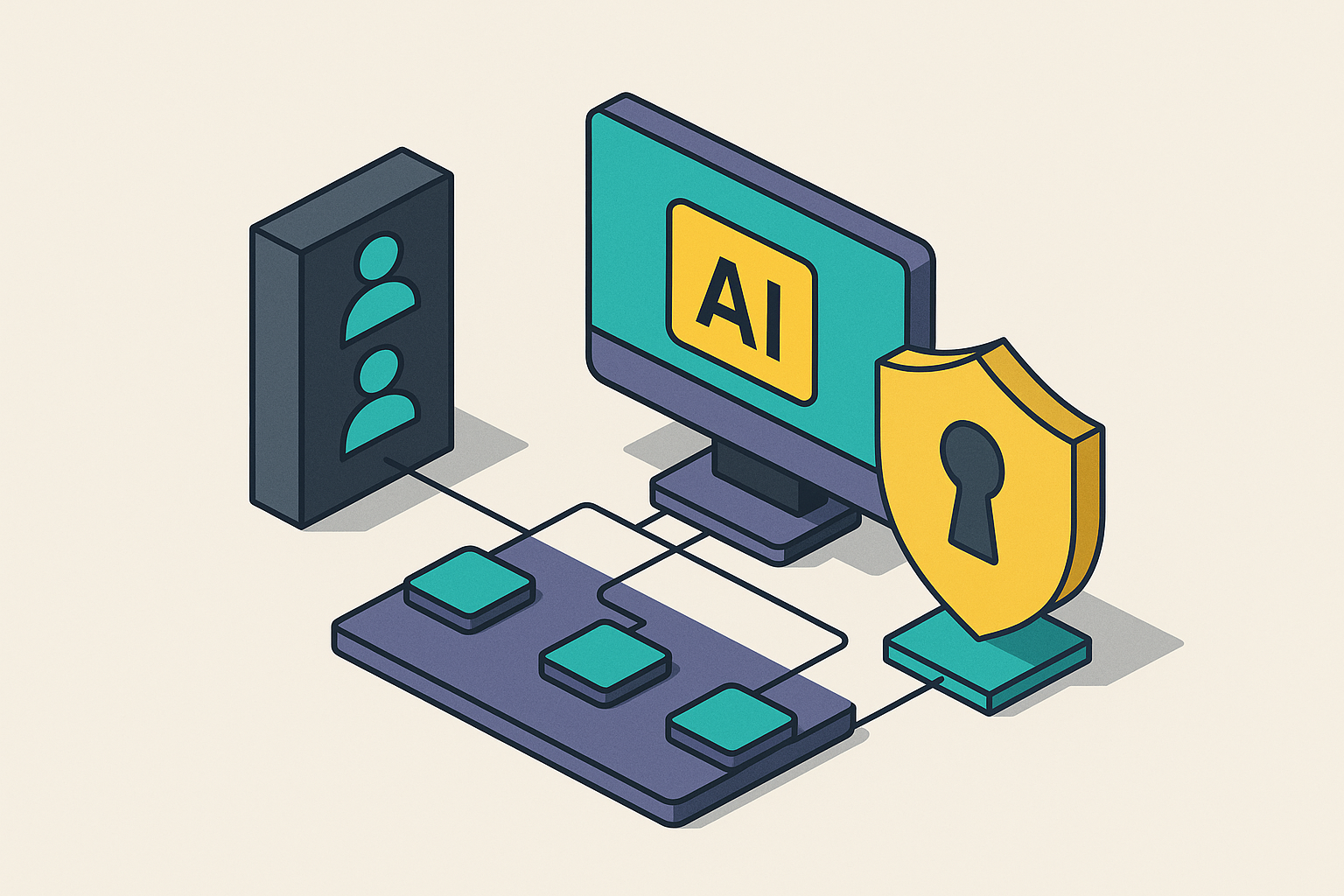
Traditional RBAC was built around a stable, human-initiated session boundary. A person logs in, receives entitlements tied to a role, acts within that session, and logs out. Agents violate every assumption embedded in that model simultaneously.
Traditional RBAC was built on a session boundary that agents simply never produce. A human logs in, acts, and logs out; an agent never sits down and never stands up, so the load-bearing assumption of RBAC collapses before anything else does. Roles compound the problem: an agent assigned something like "data analyst" might legitimately read a database, call an external API, write to a Slack channel, and invoke a code interpreter inside a single workflow, which means any role broad enough to cover all of it violates least-privilege, and scoping each action through static roles becomes unmanageable at fleet scale. In multi-agent chains the exposure is concrete rather than theoretical, because agents receive boundaries through prompts but no programmatic enforcement exists, and LLMs hallucinate tool calls and find creative interpretations of vague instructions, so what the instructions miss is usually the consequential case.
They don't log in interactively. Their actions chain across multiple systems within a single task, and their "intent" is inferred from instructions rather than expressed by a conscious person making a deliberate choice. The session concept, which is the load-bearing wall of traditional RBAC, simply doesn't translate to a process that never sits down and never stands up. Think of it like handing a master key to a ghost: the locks were designed for someone you can see coming and going.
Static roles compound the problem in a specific, observable way. An agent assigned something like "data analyst" might legitimately read a database, call an external API, write to a Slack channel, and invoke a code interpreter inside a single workflow. Granting a role broad enough to cover all of that violates least-privilege; scoping each action individually through static roles becomes unmanageable at fleet scale. Enterprises discover this consistently, and consistently after the fact.
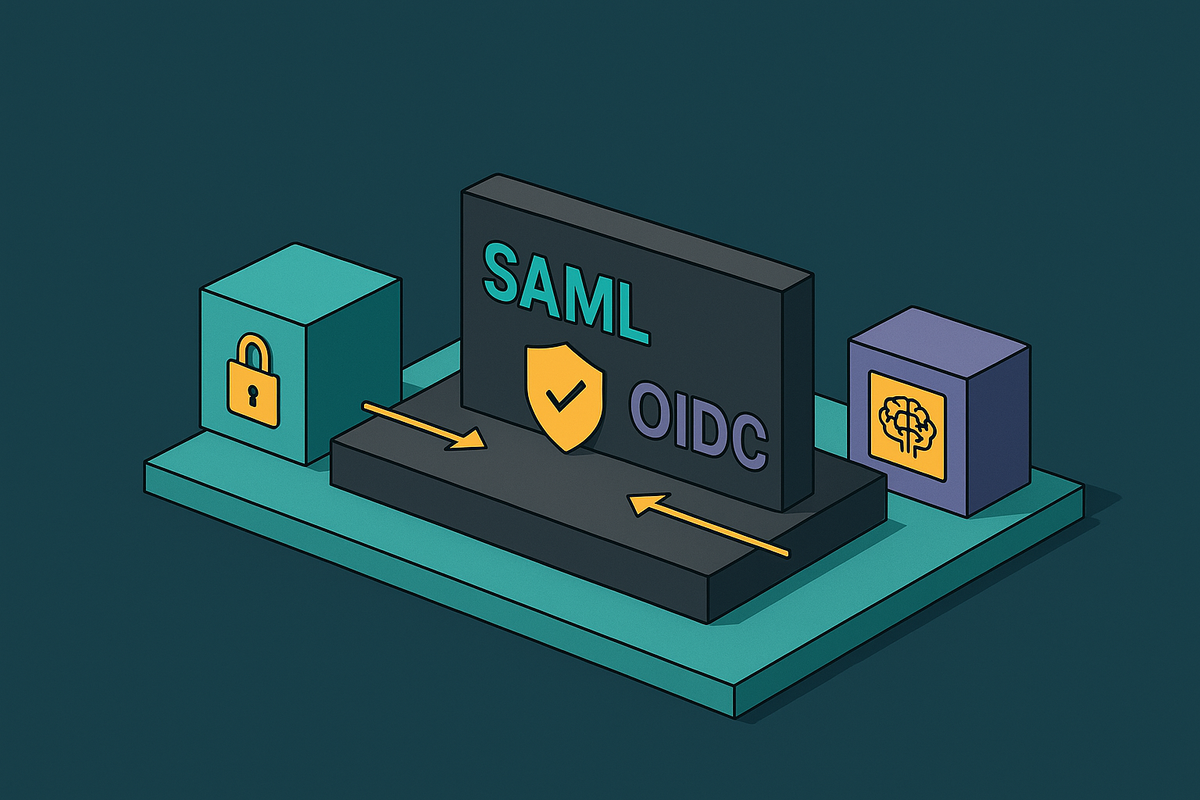
Legacy identity providers weren't architected for non-human identities at this volume. SAML, OAuth 2.0, and OIDC were designed around human principals initiating access through a well-defined login event. Long-lived, static credentials issued to agents don't expire when a task completes, which means standing access outlives any legitimate purpose. Entro Security observed by mid-2025 that non-human identities vastly outnumber human identities in enterprise environments, with the ratio growing sharply in just one year. Most enterprise IdPs have limited visibility into NHIs outside their specific cloud ecosystems, so the actual exposure is larger than any single team's dashboard reveals.
Multi-agent chains are where risk stops being theoretical. BCG's 2025 analysis of agent governance found that a substantial share of incidents occurred when agents received boundaries through prompts but no programmatic enforcement existed. LLMs hallucinate tool calls. They find creative interpretations of vague instructions. Prompt-based governance is optimism, not enforcement, and what the instructions miss is usually the consequential case.
How Should Agent Identity Be Established Before Assigning Any Permissions?
Agent identity must be cryptographically grounded, not reliant on an API key living in a.env file that gets committed to git by someone in a hurry.
The right architecture involves short-lived certificates from trusted PKIs, hardware security modules for key storage, and workload identity federation that ties agent identities to organizational infrastructure. Long-lived static API keys and shared secrets fail by design: they don't expire when a task completes, leaving a standing credential attached to whatever permissions the agent was initially granted.
Each agent should be registered as a distinct, named non-human identity with an owner of record. Security teams that have audited their agent fleets have turned up service principals carrying admin-level credentials, all owned by employees who left the company months earlier. Each one is a door left open on an empty building. Microsoft Entra Agent ID, which reached general availability in April 2026, formalizes this through "agent identity blueprints": reusable templates that define an agent type's owners, sponsors, access envelope, and audit behavior, applied consistently across every instance. An agent identity in Entra is architecturally a specialized service principal with no credentials of its own; it acquires short-lived tokens through its blueprint, so there is nothing static to exfiltrate.
Okta's approach for agentic contexts works differently but lands in the same place. The orchestrator submits a user token and requested scope, initiating what Okta calls the Cross-App Access flow; Okta evaluates the agent access policy and returns a short-lived, one-time-use downscoped token. Permission lives only as long as the task. Okta's integration catalog covers agent platforms including Boomi, DataRobot, and Google Vertex AI, giving security teams a single console to discover sanctioned agents and surface unsanctioned ones. Because it layers over non-Okta identity providers, teams keep their existing human identity infrastructure and add agent identity security on top rather than ripping out what already works.
Underneath both approaches sits the same architectural principle: an agent's identity should be scoped to its function, not issued as a general-purpose service account that happens to run a specific task. A customer support agent identity should carry only the access envelope appropriate for customer support workflows. Applied consistently, that constraint is what prevents an agent from becoming the lateral movement vector nobody planned for.
NIST's AI Agent Standards Initiative, launched in early 2026, is organizing around exactly these concerns, including agent identity, portable credentials, and cross-plane governance schemas. For enterprises building now, that initiative marks the direction the industry is consolidating around, which is worth knowing before you design something that will need to be retrofitted in eighteen months.
Choosing the Right Authorization Model: Where RBAC Works, Where ABAC Fills the Gaps, and How to Blend Them
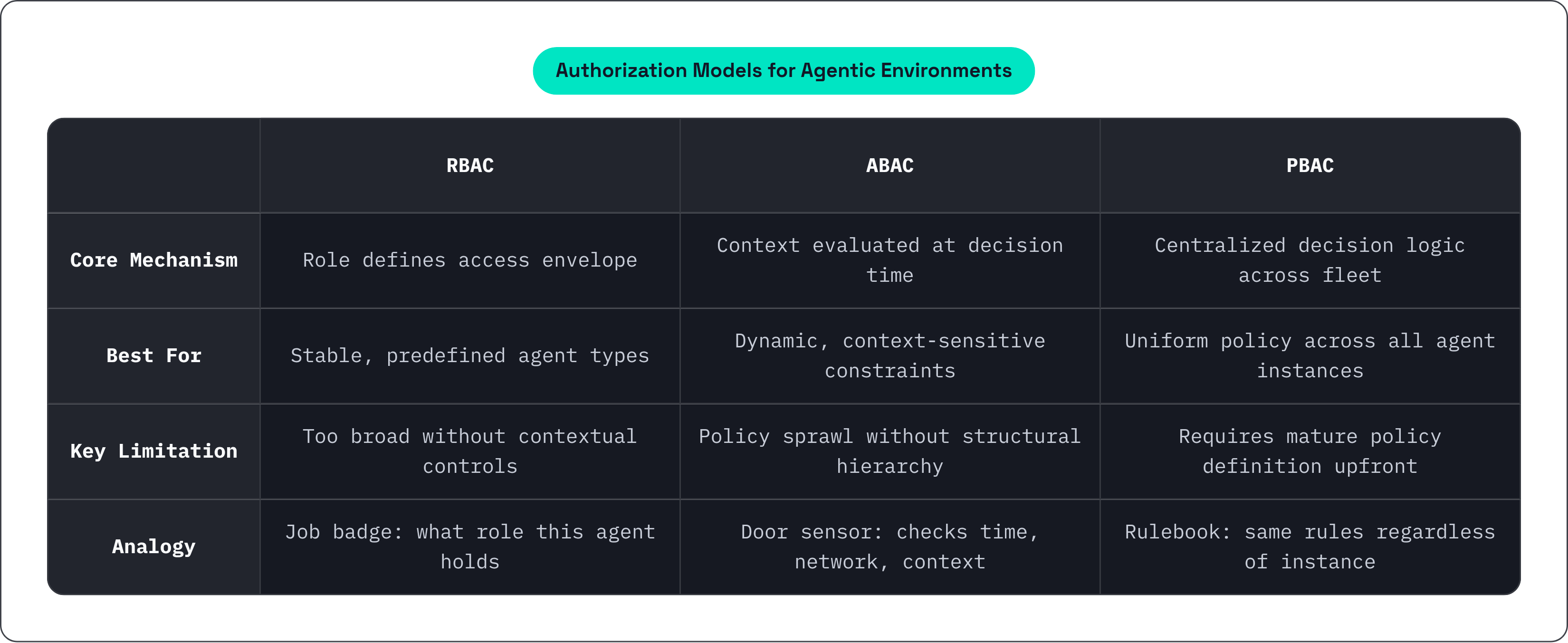
Not every authorization model fits every agent problem, and applying the wrong one at scale is expensive to undo. Role-Based Access Control works cleanly for predefined agent types with stable, predictable requirements; a document retrieval agent that always needs read access to a specific document store is a textbook RBAC case. Attribute-Based Access Control enables context-aware decisions evaluated at decision time: the same agent accessing a file at 9am on a corporate network faces a different policy evaluation than that same agent connecting at 2am from an unrecognized endpoint. Policy-Based Access Control centralizes decision logic across an entire fleet so rules apply uniformly regardless of which agent instance is connecting.
RBAC is the job badge that tells the system what role this agent holds. ABAC is the door sensor that checks time, network, data classification, and task context before granting entry. Neither works well alone in agentic environments, because RBAC without contextual constraints grants too broadly, and ABAC without structural hierarchy produces policy sprawl that nobody can audit coherently.
The layering is tractable if you define the layers before deployment rather than after. Use roles for coarse-grained structure by defining agent types, such as retrieval agents, code execution agents, and orchestrators, each with baseline access envelopes. Layer attribute-based rules for contextual constraints, restricting actions based on data sensitivity, time window, source system, or the human identity on whose behalf the agent is acting. Centralize policy decision logic so the same rules apply across all agents rather than per-deployment configurations that drift over six months and become unreconcilable.
The World Economic Forum's agent governance framework makes a directly relevant point here: governance levels should be dynamically calibrated to agent autonomy and authority in real time, not applied as static checkboxes at deployment. That dynamism is precisely where pure RBAC falls short and ABAC earns its place.
Least privilege is the non-negotiable baseline underneath all of this. Grant only the permissions needed for the specific task, for the duration of that task, to the specific systems that task requires, with nothing carrying over to the next invocation.
Scoping Tool-Level Permissions Inside MCP and Agentic Frameworks
AI agents in production operate by calling tools: external APIs, databases, file systems, code interpreters. MCP, introduced by Anthropic in late 2024, provides a standard mechanism for LLMs and agents to call external tools via JSON-RPC, replacing a proliferation of bespoke connectors. The initial specification shipped without a comprehensive authentication framework, which left enterprises unable to safely deploy MCP servers at scale. The tool integrations were real; the governance layer was not.
Tool-level permissions must be as granular as the tool itself. An agent authorized to "use the CRM tool" should not automatically inherit the ability to delete records, export bulk data, or access fields outside its task scope. Tool ACLs should be defined per tool, per agent role, and ideally per task context, not at the server level where the granularity disappears before it reaches anything that matters.
The MCP gateway is the enforcement layer that makes tool-level permissions real. A gateway sits in front of MCP servers and enforces authentication, routing, and policy at the point where agent requests meet tool infrastructure. Without one, requests go directly to MCP servers with no enforcement point and no visibility; governance exists in documentation but nowhere in the actual call path.
Several capable options now occupy this space:
- Kong AI Gateway added MCP capabilities in late 2025, covering OAuth 2.1 per the June 2025 MCP specification update, MCP Tool ACLs, and Prometheus-based observability across LLM, MCP, and agent-to-agent protocol types on a single platform.
- Microsoft's open-source MCP Gateway handles stateful session routing and Kubernetes lifecycle management, with Entra ID authentication in cloud mode so every call filters to resources the signed-in principal is permitted to see.
- Amazon Bedrock AgentCore Gateway provides a fully managed centralized MCP tool server with unified routing, authentication, and tool discovery.
The control plane and gateway distinction matters architecturally. A gateway without a control plane gives enforcement without policy; you can block requests but have no unified definition of what should be blocked and why. A control plane without a gateway gives policy without enforcement; the rules exist but no infrastructure layer applies them to actual agent calls. In a well-architected enterprise AI stack, the gateway is the mechanism by which the control plane's rules reach the tool layer.
Handling Delegation and Trust in Multi-Agent Chains
Multi-agent orchestration is the norm in production systems. A typical agentic workflow involves an orchestrator receiving a user request and delegating subtasks to specialized worker agents, each of which calls its own tools and sometimes spawns further agents. Each hop in that chain is a potential trust boundary where the downstream agent needs to act with appropriate permissions rather than the full permissions of the orchestrator or the original user.
Permission amplification is the failure mode to engineer against. If worker agents inherit the orchestrator's full permission scope, a compromised or misbehaving worker gains access to everything the orchestrator held, which is far beyond what the subtask requires. Prompt injection is a live attack vector precisely here: a malicious instruction embedded in retrieved content can hijack an agent's tool calls mid-chain, using whatever permissions the agent currently holds. A chain that appeared well-governed at the top can be weaponized from the middle.
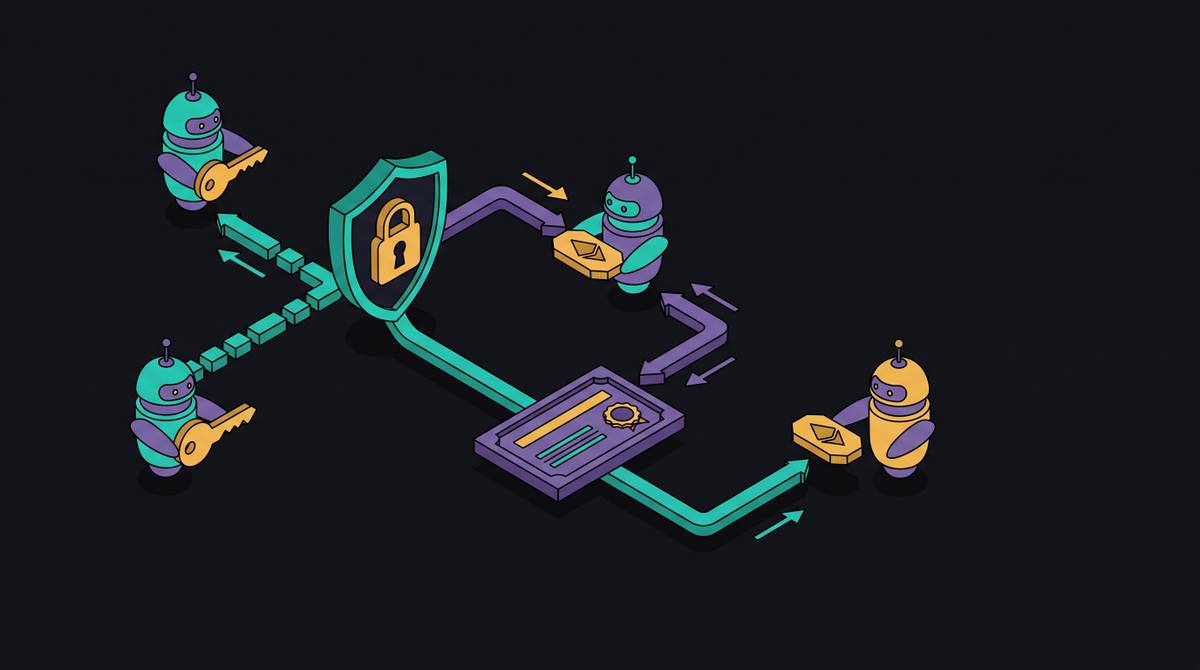
Delegated tokens should be downscoped at every handoff. Okta's Cross-App Access flow is a working model: the orchestrator cannot pass its own token to a worker agent; instead it requests a new, task-scoped, short-lived token from the identity provider, constrained to what the subtask actually requires. The user's original consent boundary constrains what any agent in the chain can do on that user's behalf, and no agent escalates permissions beyond what the user explicitly authorized.
Explicit trust levels between agents matter structurally, too. Orchestrator-level agents warrant stricter identity verification and narrower tool ACLs precisely because they control downstream behavior. Agent-to-agent calls should be authenticated rather than implicitly trusted because they originate from inside the same system. Trusting a request because it came from inside your own network is the same logic that leaves an internal door unlocked because the neighborhood seems safe; internal origin is not a trust signal.
For high-stakes actions, including bulk data export, calls to financial systems, and irreversible operations, define explicit autonomy limits and require human approval before the agent proceeds. The WEF framework's principle of progressive governance applies directly: calibrate governance in real time to actual autonomy and authority, not configured once at deployment and forgotten until something goes wrong.
What Observability and Audit Infrastructure RBAC for Agents Actually Requires
Audit logs for AI agents need to answer a fundamentally different set of questions than audit logs for human users. A human audit trail establishes that a specific person performed a specific action at a specific time. An agent audit trail needs to establish who authorized the task, which agent instance executed it, which tools it called, what data it accessed, and whether it acted within the permissions it was granted. Delinea's 2026 survey of IT decision-makers found that a large share of organizations cannot always explain why a non-human identity or AI agent performed a privileged action. That is squarely an audit infrastructure failure, and the infrastructure problem has to be solved before the compliance question becomes answerable.
Every agent call to a tool should emit a structured log entry capturing the agent identity, the task context, the specific tool and method invoked, the data classifications touched, and the authorization token used. Token lifetime and scope should be part of the log record, not inferred after the fact. Without that structure, a post-incident investigation becomes a cross-referencing exercise across systems that weren't designed to talk to each other.
Observability at the MCP gateway layer surfaces per-call metrics that aggregate audit logs miss. How many times did agent instance X call the bulk export method this week? Which agent roles are consistently bumping against permission boundaries? Gateway-level observability tools that surface this kind of fleet-level signal turn the gateway from a passive enforcement point into an active intelligence layer.
Anomaly detection on agent behavior is qualitatively different from user behavior analytics. Human users have recognizable patterns: business hours, typical data volumes, familiar application sequences. Agents don't. An agent legitimately calling an API a thousand times in an hour is indistinguishable from an agent doing something catastrophic unless the detection logic operates at the task and workflow level, flagging deviations from defined task scope rather than absolute volume thresholds. You might say the only thing worse than an agent with too many permissions is an agent with too many permissions and nobody watching — a recipe for a breach that writes itself.
Centralized policy management is the prerequisite for audit coherence. If each deployment team configured its own agent permissions independently, the audit trail exists in fragments across multiple systems with no common schema. You cannot audit compliance with policies that aren't uniformly defined, so the governance model has to be centralized before audit infrastructure can be meaningful. Periodic access reviews for agent identities should follow the same cadence as reviews for human privileged access, including automated expiration of agent credentials when the owning team or sponsoring project no longer exists.
The Delinea finding reflects a prioritization gap that is entirely predictable: enterprises deploying agents at speed and treating governance as something to address later. The tooling exists now. "Later" has a way of showing up as a breach notification.