MCP Gateway Architecture for Enterprise Deployments
A central gateway enforces authentication and policy across AI agents and tools.
MCP is the protocol Anthropic released in late 2024 that lets AI agents talk to tools, databases, and APIs through one common interface instead of a custom integration for every pair. Every major AI lab adopted it fast, and it now sits under the Linux Foundation's Agentic AI Foundation, which tells you it stopped being a Anthropic side project a while ago. BCG's framing is the right one to start with: without MCP, the number of integrations you need grows roughly as the square of the number of agents and tools you have; with it, growth is linear. That's not a nice-to-have. That's the difference between a system that works at ten agents and one that collapses at fifty.
Here's what nobody tells you in the demo. One agent, three tools, a couple of direct calls, everything works and looks clean on a slide. Add forty more agents and two hundred more tools and you've got the N×M problem: every agent needs to reach multiple tools, and every tool needs to authenticate and trust every agent that shows up. Each connection is its own login handshake, its own access rule, its own gap in the logs where nobody's watching. MCP itself doesn't save you here, because the protocol was built to move data, not to police it. Authentication, access control, auditing: none of that ships with MCP. It's on whoever implements it.
So what happens in practice is that ten different teams implement ten different versions of "security," and at least a few of them implement none. A developer needs an agent to hit an internal API by Friday, so they spin up a local MCP server, skip the enterprise login system because it's slower, and skip logging because nobody asked for it. That's shadow IT with a new coat of paint, except now it's shadow MCP, and instead of an unsanctioned Dropbox folder you've got an AI agent with unlogged access to production data. The fix isn't a memo telling developers to be more careful. It's a piece of infrastructure that makes the careful path the only path.
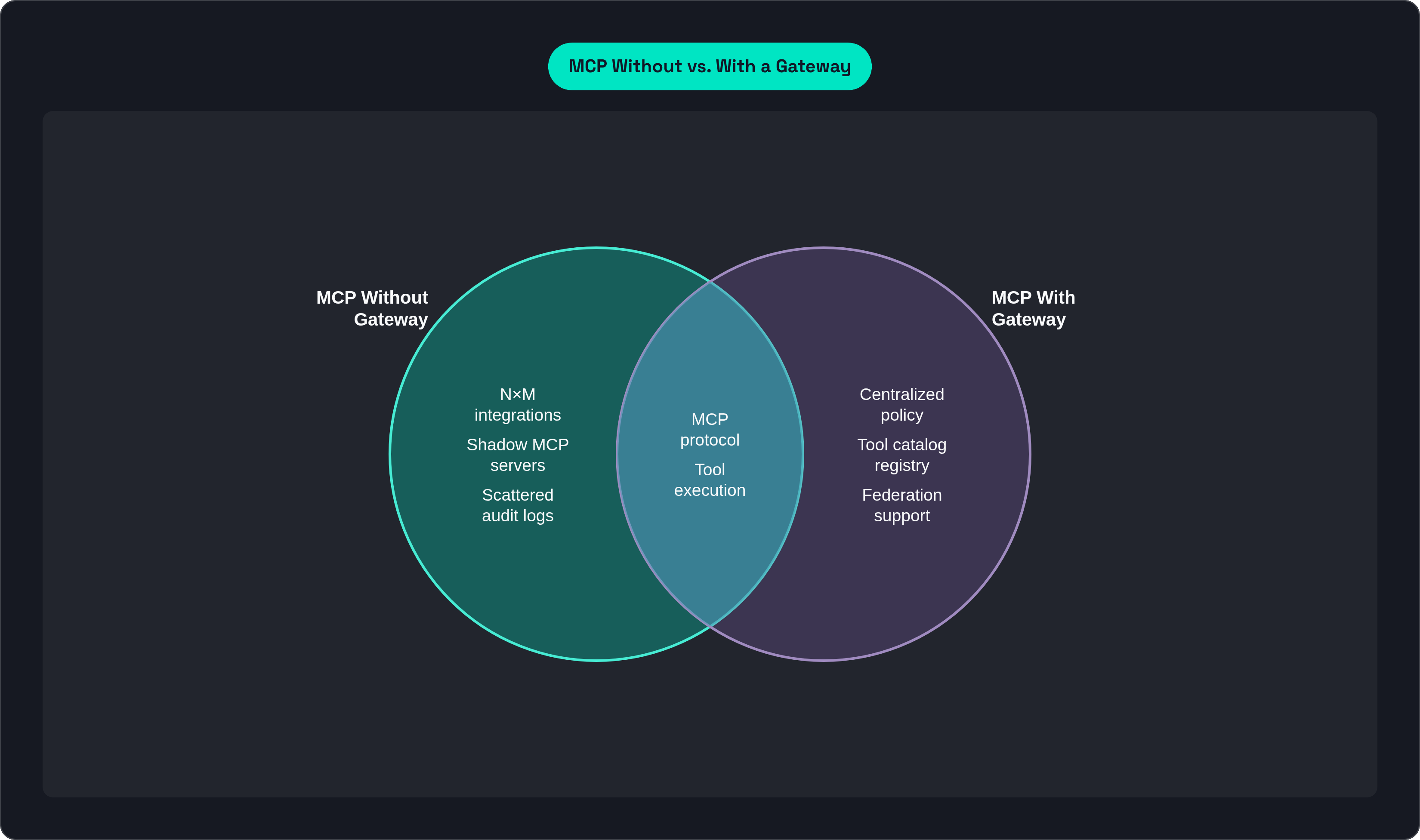
What an MCP gateway actually is and what problem it solves structurally
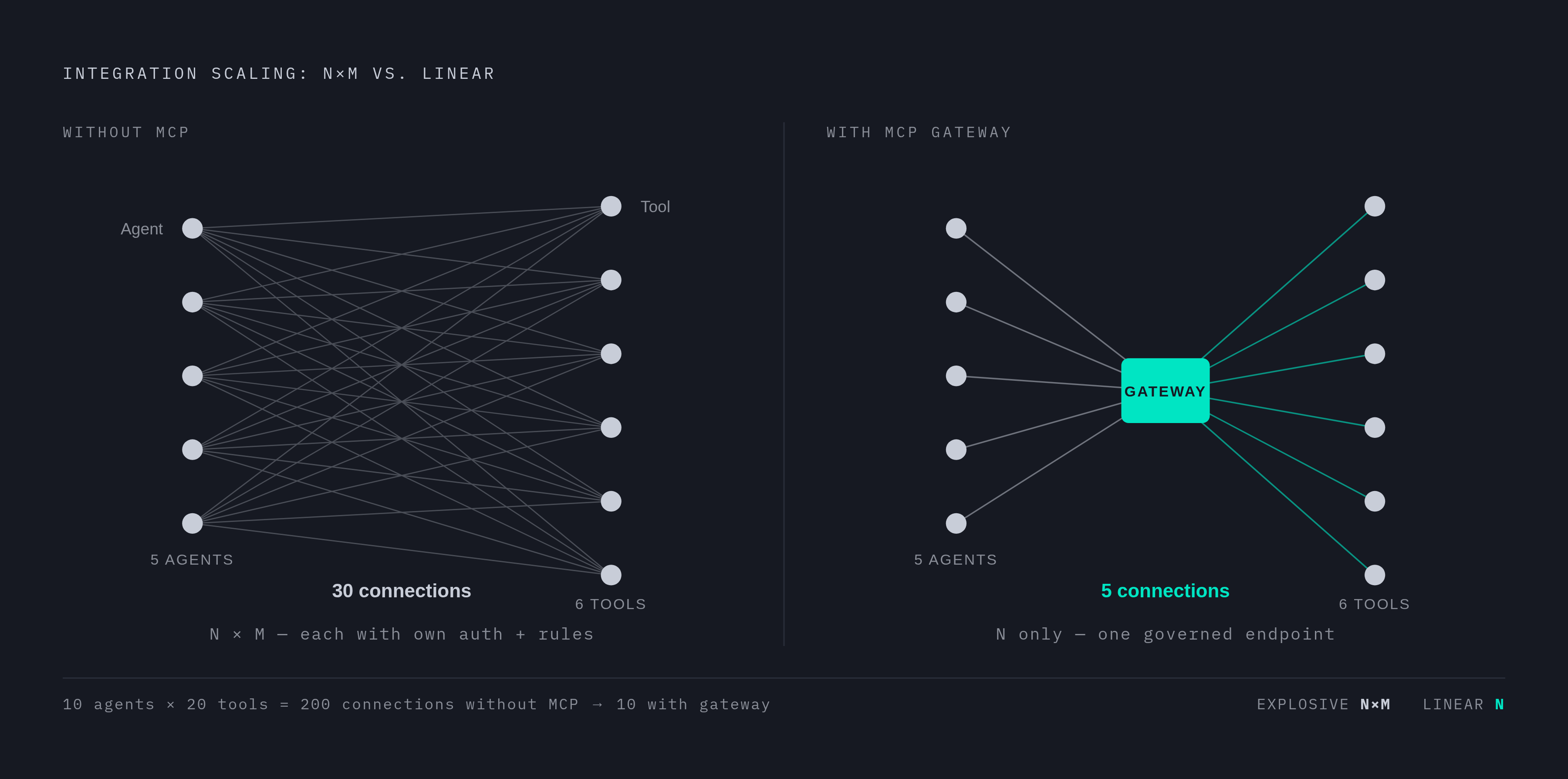
An MCP gateway is a centralized service that sits between every agent and every MCP server, and it looks at, and governs, all the traffic passing through. It routes each request to the right server, checks it against policy before it ever touches a tool, logs what happened, and gives the whole organization one place to find and access approved tools instead of forty scattered ones.
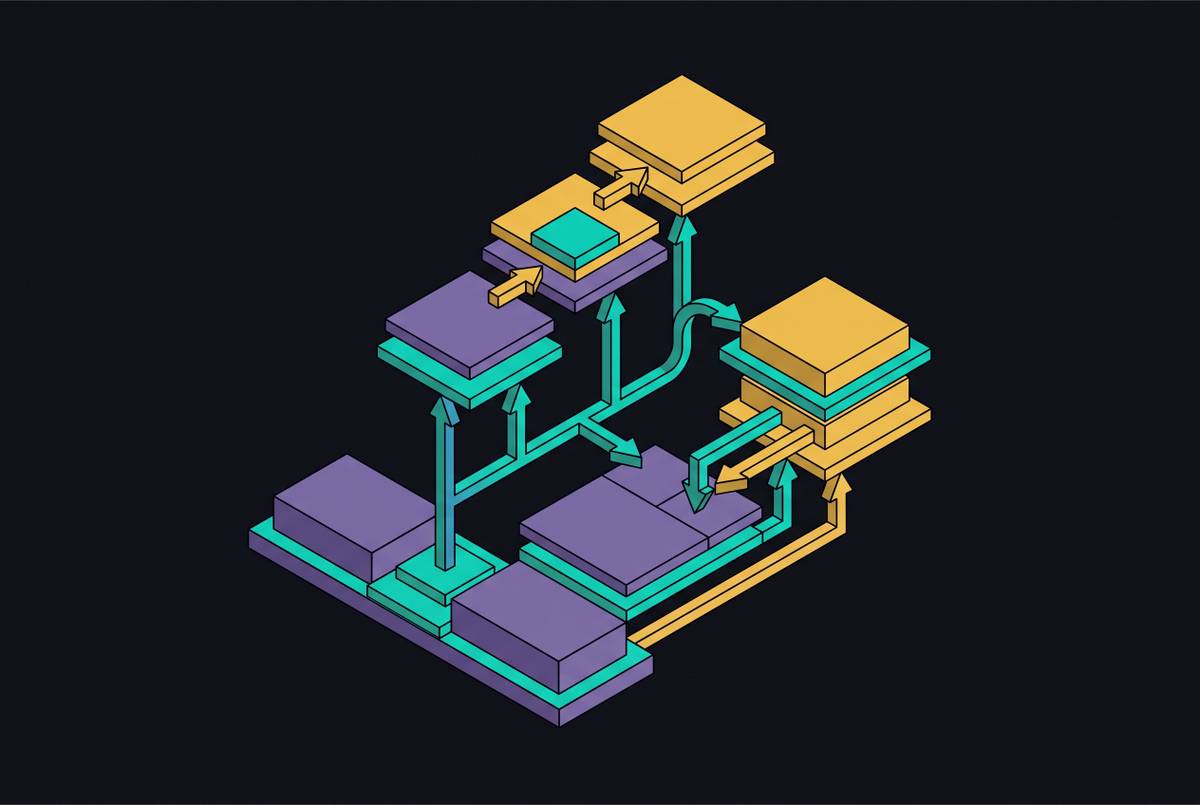
Split the stack into two planes and this gets easier to reason about. The execution plane is the MCP servers themselves: the things that actually connect to GitHub, Postgres, Slack, or some internal billing API, run the action, and hand back a result. The control plane is the gateway: it decides which agent gets to reach which tool, under whose identity, and with what limits attached. The gateway doesn't replace MCP servers. It sits above them and makes the rules stick.
Gartner's guidance on this is blunt: treat MCP servers like production APIs, because structurally, that's exactly what they are. That's not a stretch. We've run this experiment before, just with a different acronym. Before API gateways existed, teams exposed services directly to whoever needed them, and governance was whatever each team felt like doing that quarter. Authentication got reinvented service by service, logging lived in a dozen incompatible formats, and nobody had one clean answer to "who called this and why." MCP without a gateway is that same story with a fresh coat of AI paint. Write the policy on paper all you want; without a gateway sitting in the request path, nothing enforces it. Put the gateway in place, and the rule you wrote down is the rule that actually runs.
Authentication and identity enforcement as the gateway's first responsibility
Everything downstream, every decision about which tools an agent can touch and what data it can see, depends on one prior fact: knowing exactly who or what is making the request. Get that wrong and the rest of the policy stack is decoration.
Two questions have to get answered on every single call. Which human, or which service account, authorized this? And which agent or orchestration process is the one actually acting on their behalf right now? A gateway answers both by plugging into the identity systems the enterprise already runs, such as Microsoft Entra ID, using OAuth 2.1, OIDC, and SAML. No request gets a free pass because of where it came from. That's Zero Trust in practice, not as a slogan: authenticate first, every time, before anything reaches a server.
This matters because an agent acting for a user should never have more reach than that user does. If an agent can touch a database an employee couldn't log into directly, something's broken, and it's usually broken because access was granted to the agent separately instead of being bound to the human it represents. This is exactly the hole shadow MCP opens up: a server standing up outside enterprise auth means there's no identity check at all, and every action it takes happens completely off the books.
Role-based access control at the tool layer takes this one level deeper. It's not just "can this agent talk to this server," it's "can this agent call this one specific function inside that server." And critically, those permissions run through the same identity system used for human employees, not a side system built just for AI that someone forgot to reconcile. Onboard a new agent the same way you'd onboard a new hire: change a policy in the identity system you already have, not a custom integration built from scratch.
How gateways manage tool discovery, schema filtering, and token economics
Without a gateway, every agent has to go find and enumerate MCP servers on its own, and there's no single list anywhere of what tools exist or which ones are actually approved for use. A gateway fixes that by acting as a live catalog: servers register themselves and announce their tools on startup, agents query the catalog instead of knocking on each server's door, and a new tool becomes usable the moment it's registered, no agent reconfiguration required.
Then there's the cost side, which is easy to ignore until the invoice shows up. Every tool description, every parameter, every argument passed through MCP eats tokens in the model's context window. A backend exposing a few hundred functions and dumping the full catalog into every single interaction is both expensive and, more often than not, worse for accuracy, because the model now has to sift through noise to find the one tool it needs.
Progressive disclosure is the pattern that fixes this. Instead of handing an agent the entire tool catalog, the gateway applies policy server-side and returns only the subset that's relevant to this user, this context, this permission scope. Smaller context window, lower inference cost, and an agent that picks the right tool faster because it isn't wading through two hundred irrelevant options.
The private registry piece closes the loop on trust. An enterprise curates its own list of approved MCP servers, and agents are configured to trust only that list. Point a compromised dev environment at some malicious server out in the wild, and it simply won't be discoverable, because it's not in the registry. Sync that registry continuously against public vulnerability feeds, and if a server that used to be approved turns out to have a hole in it, it comes off the list and every agent loses access immediately, not after next quarter's security review. The gateway only allows connections to what's on the registry, so registry and gateway function as one closed system against unapproved tools.
Federation: how the gateway handles distributed MCP infrastructure across business units and clouds
Large enterprises don't run one cloud, one region, or one clean architecture. They run several clouds, multiple business units with their own tooling, and usually a pile of legacy on-prem systems nobody's fully documented. Point agents at all of that directly, or worse, spread them across several separate gateways, and you've just rebuilt the N×M problem you were trying to escape, dressed up in cloud-native language.
Federation is the actual answer. The gateway becomes a federation layer, and agents see one governed tool catalog, full stop. Which upstream server or gateway actually handles a given request gets decided behind the scenes, invisible to the agent making the call. From where the agent sits, there's one MCP endpoint, even though what's behind it might span three clouds and a data center in another country.
That single point of discovery is what lets a business unit's newly acquired MCP servers get folded into the estate without anyone touching the existing agents. Data residency and sovereignty rules get enforced right there in the routing layer, so the agent developer never has to think about which region a request is legally allowed to touch. One policy model covers the whole sprawling footprint instead of one policy per business unit.
None of this is free. Federation adds real architectural complexity, and depending on how it's implemented, it can add latency too, since a request may now hop through an extra layer before it reaches the actual server. Organizations should size their federation setup to how distributed they actually are; a company running out of two data centers doesn't need the same federation architecture as one spread across six clouds and four continents.
Security enforcement at the gateway layer: prompt injection, PII, and secrets in transit
Identity and RBAC get you a long way, but they don't cover the whole threat. An agent can be authenticated correctly, have exactly the right permissions, and still get talked into doing something it shouldn't, because the danger isn't always about who's asking, it's about what they're being told to do.
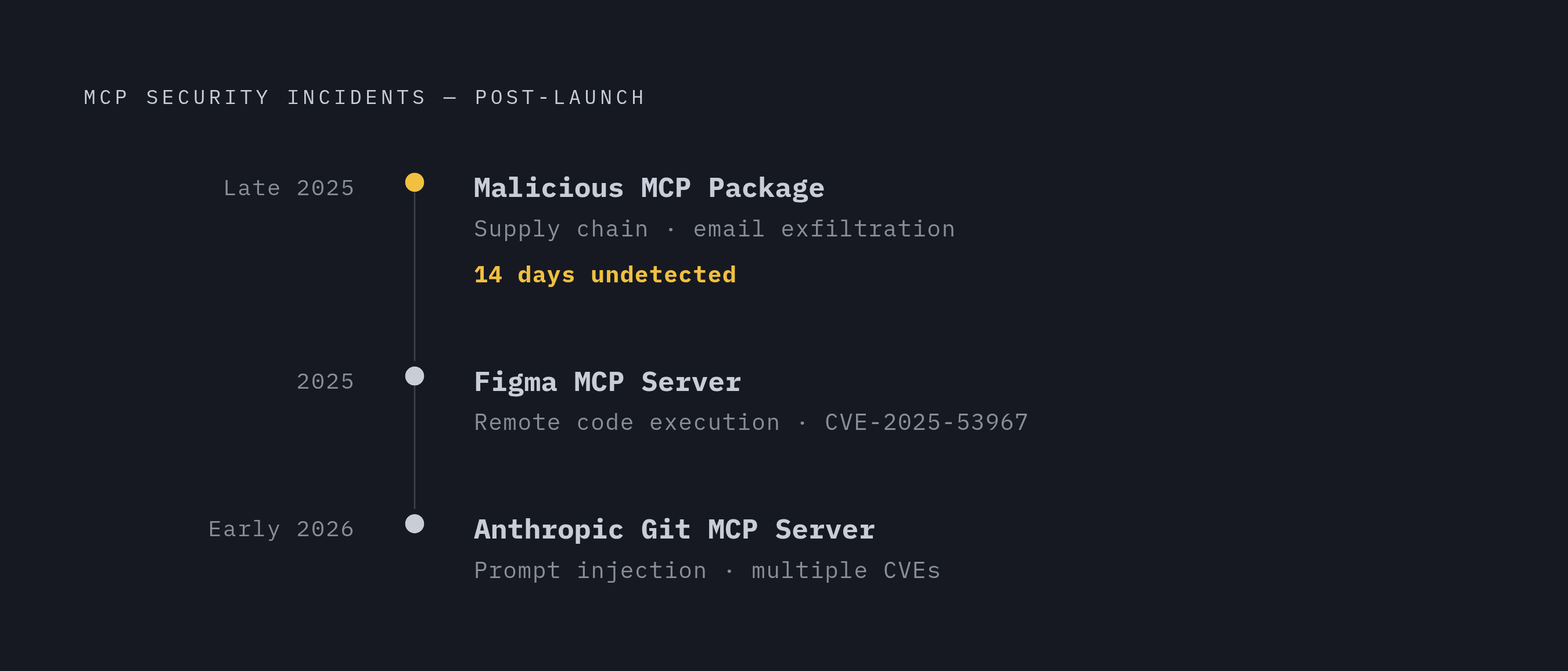
Remember, MCP shipped without security built in; that job was handed entirely to whoever implemented it, and the first year after release produced a real run of serious vulnerabilities in the wild. A few are worth naming because they're not hypothetical. In late 2025, the first known malicious MCP package sat undetected for two weeks quietly pulling email data off compromised systems. Figma's MCP server carried a remote code execution flaw through command injection, tracked as CVE-2025-53967. And Anthropic's own official Git MCP server turned up multiple prompt injection holes in early 2026, discovered by researchers poking at the exact tool meant to be a reference implementation.
That's the vulnerability class a gateway is positioned to catch: prompt injection buried in a tool's response that redirects an agent's next move, lookalike tools quietly swapped in for trusted ones, API keys and credentials riding through MCP traffic in plaintext, personal data leaking out through a tool call that should never have left a governed boundary in the first place.
The gateway is the one place every one of those requests and responses actually passes through, which makes it the one place inspection can be applied consistently no matter which agent or server is involved. Build the scanning into the gateway and every integration inherits it automatically. Leave it to each server to bolt on its own defenses and you get exactly what MCP's first year proved you'd get: wildly inconsistent coverage, with the weakest server setting the real security bar for the whole organization. Real-time scanning at the gateway, checking for PII patterns, credential formats, and known injection signatures before a request goes out or a response comes back, is the runtime half of this defense. The private registry from the last section is the supply-chain half. You need both; neither one covers for the other.
Observability: what the gateway sees that nothing else in the stack can
Without a gateway, whatever logging exists lives scattered across individual agents and servers, assuming it exists at all, and there's no single place to go look and ask what agents did today, what tools they touched, or where data actually moved. That's not a minor gap. That's the difference between having an audit trail and having a shrug.
A gateway sitting in the middle of every request sees things nothing else in the stack can piece together on its own: a full, tamper-resistant record of every action every agent took across every tool, which teams and identities are burning through which tools and at what volume and cost, and the anomalies that actually matter, like an agent suddenly calling a tool it's never touched before, or a spike in requests hitting a sensitive system at 3am. It also picks up plain operational signal: latency and failure rates across the whole MCP footprint, which is health monitoring, not just security.
Cost is its own problem worth calling out directly. Inference spend is driven in part by how big your tool schemas are and how often they get called, and without gateway-level telemetry there's no way to trace a dollar back to the team, agent, or workflow that spent it, which means there's no lever to pull when the number gets uncomfortable.
Regulated industries have to be able to show, after the fact, exactly what an AI system did with a specific piece of data. A log that lives only inside an agent's runtime, or only in a server's own output, isn't an audit trail; it's a fragment, and fragments don't hold up under a compliance review. Observability is also what actually lets an organization scale AI access at all: you can't safely widen who gets to use what if you can't see what's happening, and the alternative is running a manual security review for every new use case, which is a fine way to make sure nothing ships this year. The same telemetry that flags a cost anomaly is the telemetry that flags an unauthorized MCP connection; detection and observability aren't two systems, they're one.
How the major gateway implementations differ in their architectural approach
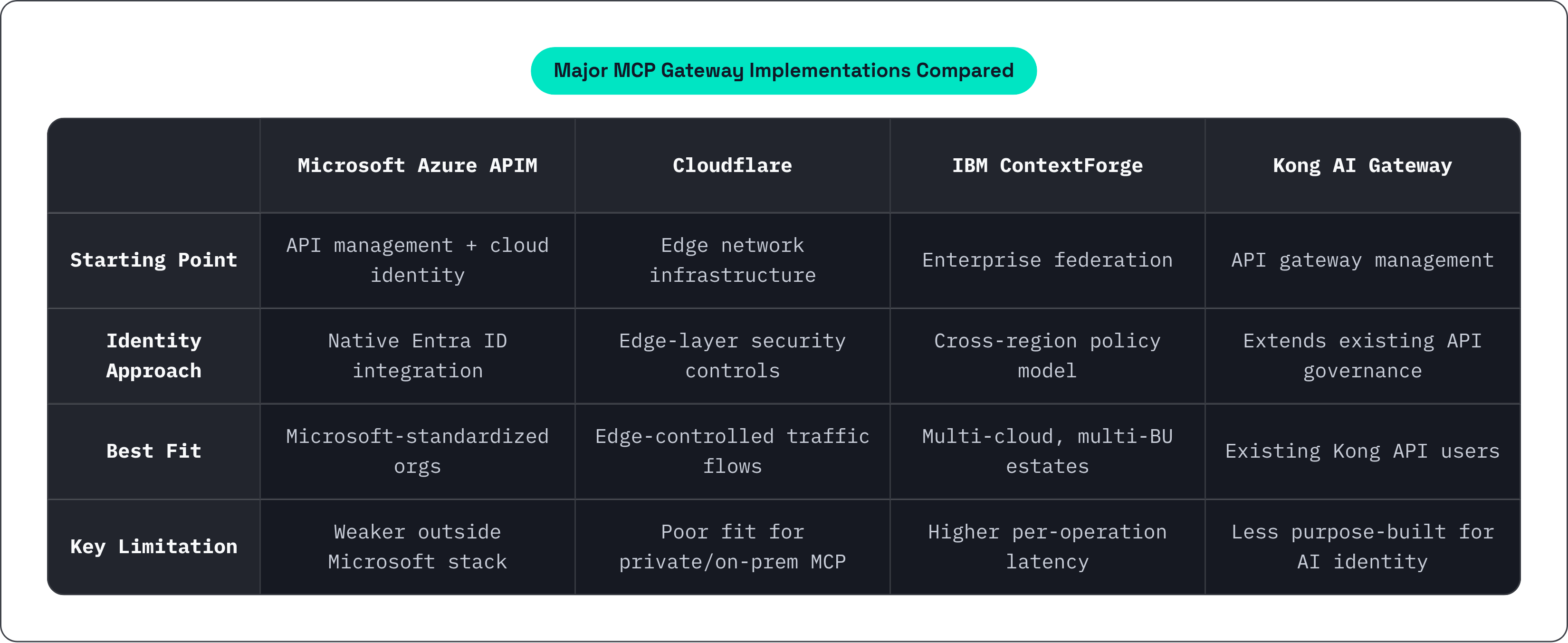
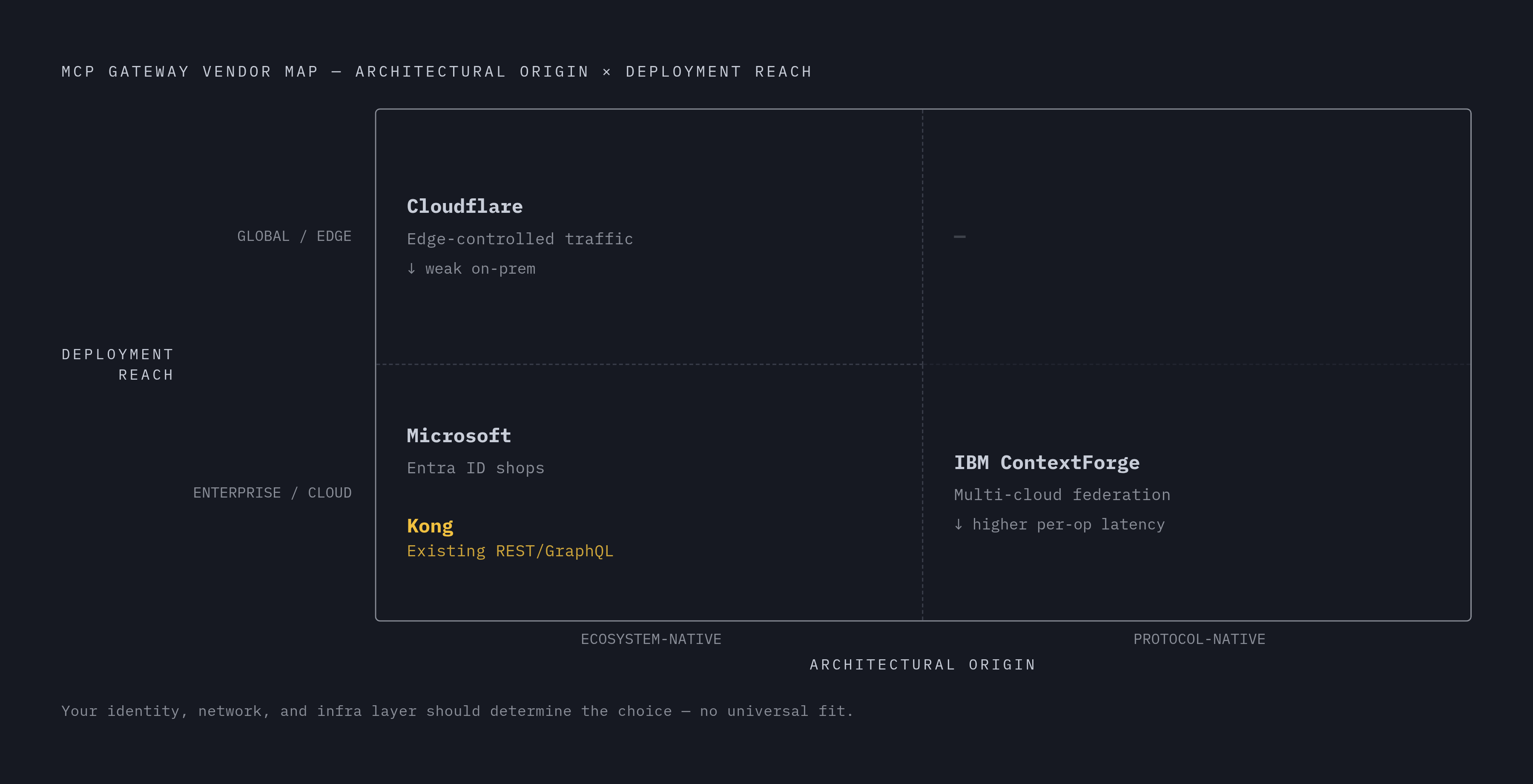
Vendors walked into this space from very different starting points, API infrastructure, edge networking, enterprise identity, and that history shows up directly in what each one is strong at and where the gaps sit.
Microsoft built its approach on Azure API Management, which is mature, battle-tested infrastructure, paired with native Entra ID integration. If an organization is already standardized on Microsoft's cloud and identity stack, identity enforcement basically comes for free, no extra wiring required. That's the clear fit: shops where Microsoft already owns the identity layer.
Cloudflare took the network-edge route, combining its AI Gateway, MCP Server Portals, and Cloudflare Gateway into one security layer sitting at the edge of the network. That's a strong position if the edge is already your control point for traffic generally. It's a weaker fit if most of the MCP estate lives inside a private cloud or on-prem, where the edge isn't where the interesting traffic actually flows.
IBM's ContextForge takes the most ambitious swing at federation, built for organizations whose MCP footprint is genuinely scattered across regions, clouds, and business units that don't share infrastructure. That ambition comes with a cost: it runs higher per-operation latency than other options in this category, which matters a lot if you're running latency-sensitive workloads and less if you're not.
Kong's AI Gateway comes at this from API management roots, extending the same gateway model that's handled REST and GraphQL traffic for years into MCP traffic, which makes it a natural fit for organizations that already run Kong for API governance and don't want a second, separate system just for AI.
None of these is a universal right answer. The honest way to pick is to look at where your identity, your network, and your infrastructure already live, and choose the gateway that extends what you've got instead of asking you to rebuild it.