MCP Server Lifecycle Management at Enterprise Scale
Most enterprises are deploying MCP servers without governance frameworks to track or control them.
MCP servers are multiplying inside enterprises faster than anyone can track them, and most companies have no idea how many they're running, who owns them, or when they were last checked for security holes. The protocol Anthropic released in late 2024 to connect AI agents to internal tools and data now sits behind thousands of production deployments, and the vast majority never went through a formal security review. This is a full lifecycle governance gap spanning how servers get created, who can call them, what they do once live, and how (or whether) they ever get shut down.
The pace here is worth sitting with for a second. Within about 18 months of release, MCP had backing from every major AI lab and had become a Linux Foundation project under the Agentic AI Foundation. SDK downloads run in the tens of millions per month. The public registry lists thousands of servers. Adoption grew dramatically in 2025, and most of that growth happened faster than governance frameworks could keep up. Nobody planned for this. Companies just woke up one day already living in it.
Treating this as a deployment problem misses what an MCP server actually is. Getting one running tells you nothing about who's allowed to call it, what data flows through it, or when it should be retired. Every MCP server is a live wire into internal APIs, SaaS platforms, and often sensitive records, with a lifecycle that keeps demanding attention long after launch. Skip the lifecycle thinking, and every new server becomes a blind spot, and those blind spots compound the way unpatched vulnerabilities always do: quietly, until they don't.
What the enterprise MCP adoption curve actually looks like, and where most organizations are stuck
Obot's four-stage adoption arc, published in June 2026, lays out where companies sit on this curve pretty clearly. Stages one and two look like individual developers wiring up isolated use cases with zero cross-team coordination. Stage three, MCP at Scale, means enterprise-wide adoption, multiple MCP workflows running in production together, and infrastructure that actually meets compliance and SLA requirements. Most organizations with any real MCP footprint are stuck somewhere between one and two, and getting to stage three means treating MCP management as a platform responsibility rather than a side project someone's DevOps team picks up when they have time.
What stalls the climb from stage two to stage three is almost always the same handful of things. Servers get provisioned ad hoc by whichever team needed one that week, with no central registry keeping track. Access control gets handled per-server, inconsistently, often with a shared API key that five different people have copied into five different config files. There's no audit trail linking an agent's identity to the tool it called to the data it pulled. And nobody has a process for taking a server down, so they just pile up, and ownership gets fuzzy fast.
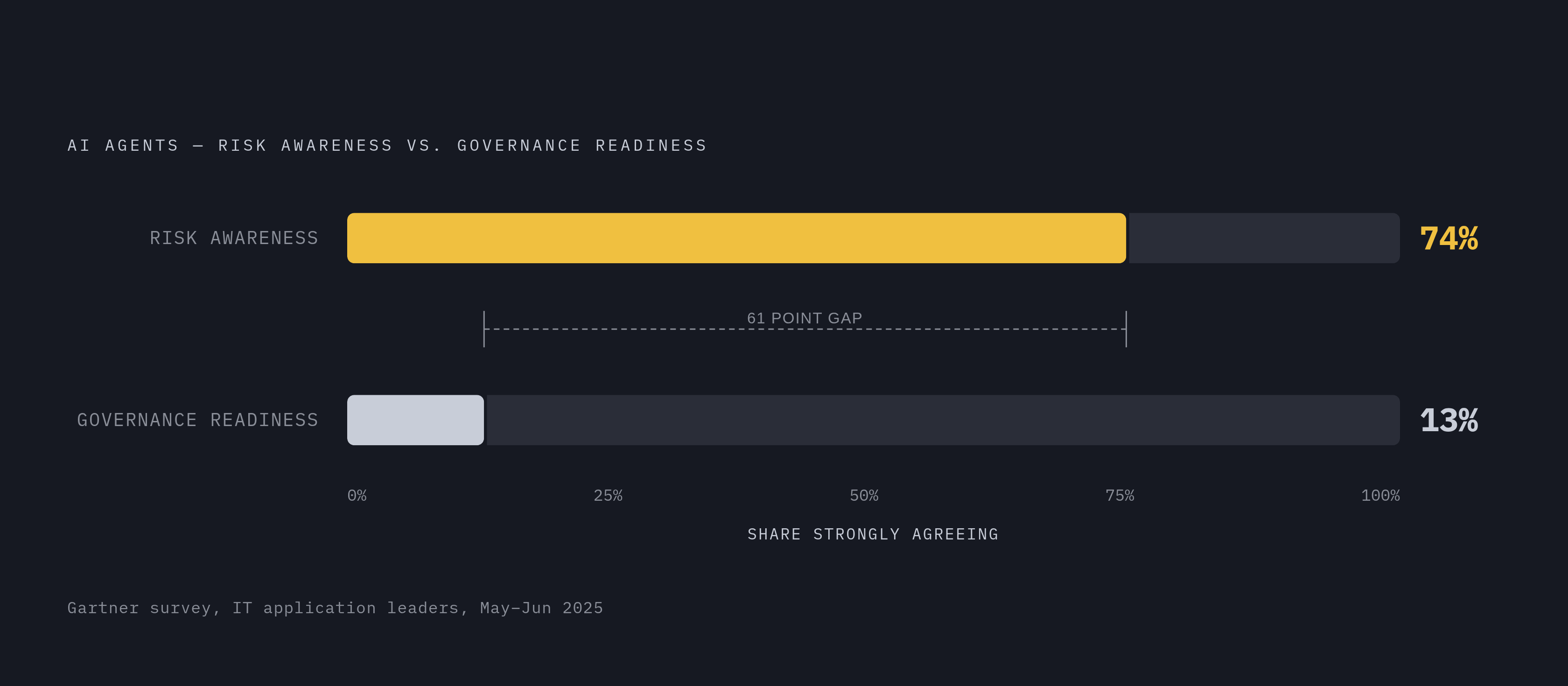
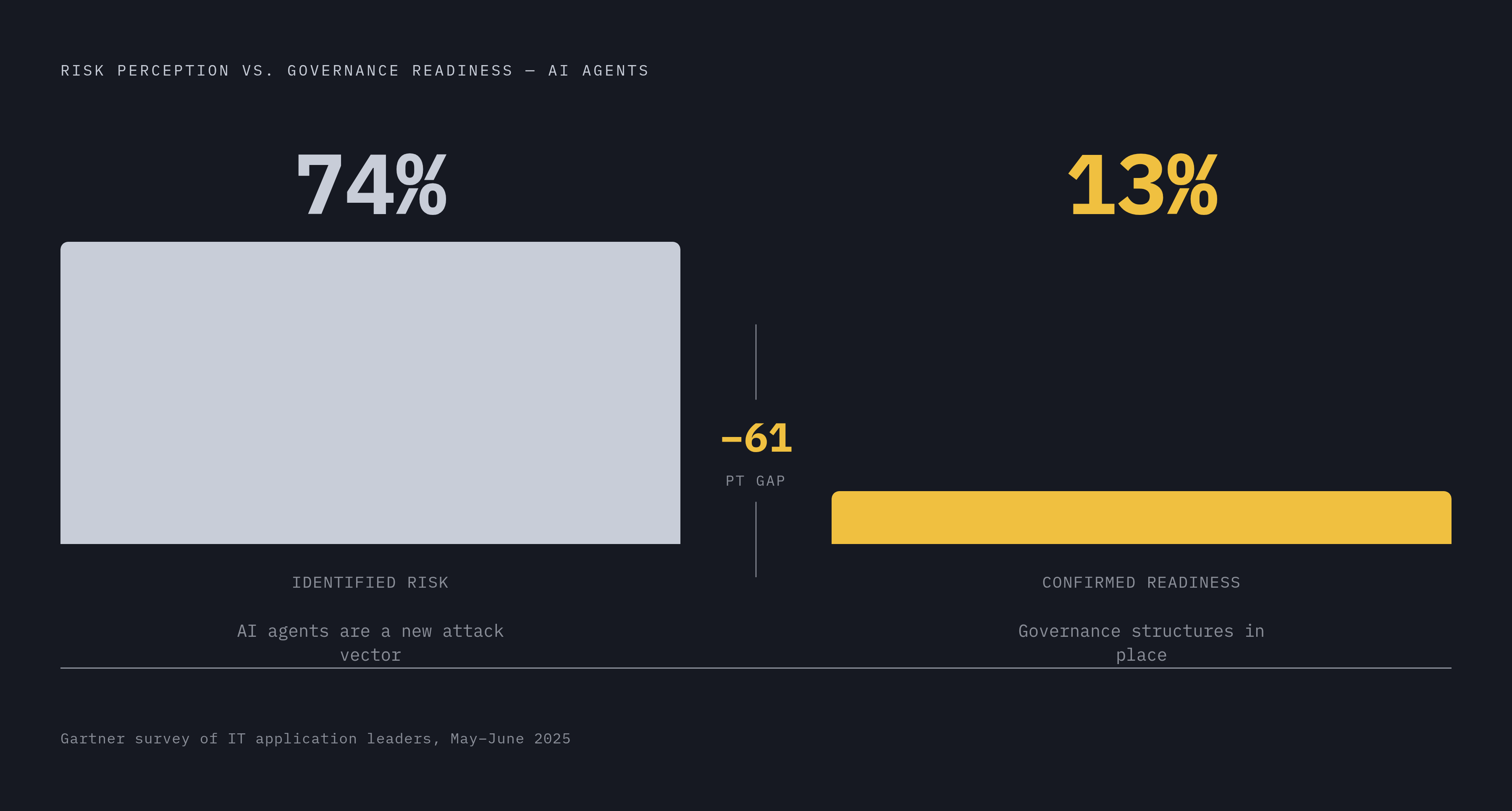
The gap between how fast companies deploy and how confident they feel about governing it is not a hunch, it's measured. A Gartner survey of IT application leaders conducted in May and June of 2025 found only 13% strongly agreed they had the right governance structures in place for AI agents. Meanwhile 74% said they believed AI agents represented a new attack vector. Read those two numbers together and you get the whole article in miniature: everyone sees the risk, almost nobody has closed the gap.
The four lifecycle phases every enterprise MCP server passes through
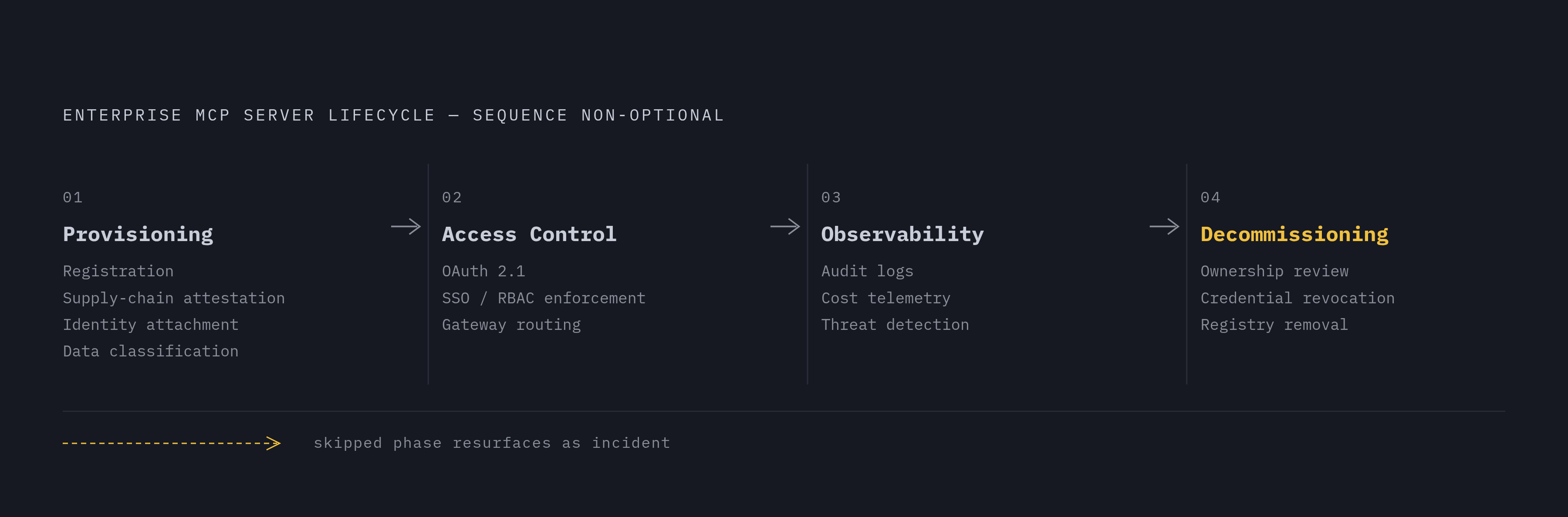
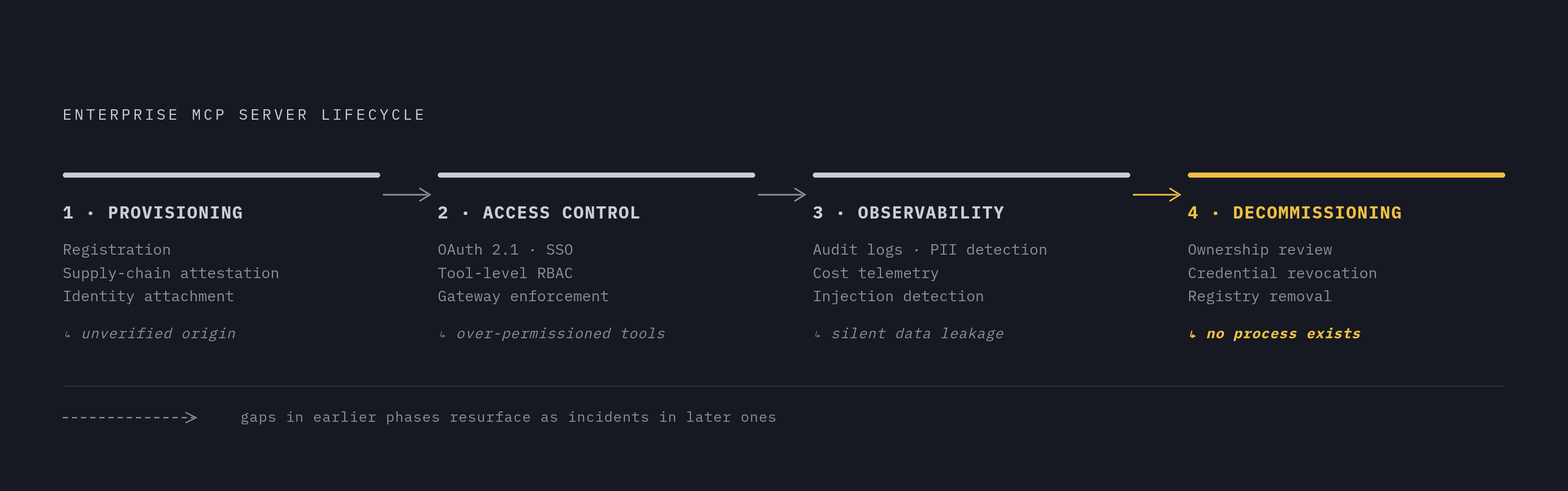
Every MCP server that reaches production moves through four phases, whether anyone's managing that movement or not. Provisioning covers how a server gets created, registered, and authorized before it touches anything real. Access control determines who can call which tools, under what identity, and through what enforcement mechanism. Observability is what tells you what's actually happening once the thing is live: cost, usage, risk signals, the audit trail. Decommissioning is how a server gets retired without leaving orphaned access behind or breaking something nobody remembered depended on it.
These phases run in sequence but they're tangled together. Decide how identity gets attached during provisioning, and you've already decided what's enforceable at the access control stage and what's even visible later at observability. Skip a phase, and it doesn't disappear, it just resurfaces later as an incident report instead of a checklist item.
None of this is new territory, really. API governance and microservices lifecycle management went through the same growing pains a decade ago, and the fixes look familiar: registries, ownership, versioning, retirement policies. MCP servers carry the same operational surface area as any other production service exposing sensitive functionality, so they need the same discipline. The rest of this piece walks through each phase.
Provisioning: what has to be true before a server reaches production
Provisioning isn't just standing up a server and pointing an agent at it. It's the one moment where governance either gets built in or gets left out permanently, because whatever's missing at this stage tends to stay missing.
A server shouldn't reach production without landing in a central inventory that records who owns it, what it's for, what data classification applies, and what it depends on. Supply-chain validation matters here in a way that's easy to underrate: a compromised or malicious MCP server carries risk of privileged execution and workflow manipulation that goes well beyond simple data exposure. Song et al. documented specific attack categories tied to this stage back in May 2025, including tool poisoning, rug pulls, and exploitation through malicious external resources. Version and configuration need to be pinned before deployment too, with a defined process for any change afterward, not a Slack message and a hope.
The July 2026 MCP spec release changed the infrastructure picture meaningfully by pulling session state management out of the protocol core. As MCP core maintainer Caitie McCaffrey has noted, servers can now run behind standard HTTP load balancers using existing Kubernetes tooling. That's a real shift: provisioning pipelines can now run through the same DevOps tooling companies already use for everything else. There's no excuse left for treating MCP servers as some exotic, special-case category of infrastructure.
One pattern worth watching is the continuous API-to-MCP transformation approach that Codeglide.ai described in August 2025, where an always-on platform watches for API changes and regenerates MCP servers automatically to stay in sync. That reframes provisioning as an ongoing process instead of a one-time event, which matches how APIs actually behave in production. And the spec's new formal deprecation policy, running Active to Deprecated to Removed with a minimum 12-month window, means provisioning workflows now need to track protocol version alongside application version. A checklist that gates on registration, supply-chain attestation, identity attachment, data classification, and SLA assignment covers the basics. Anything less, and you're gambling.
Access control: enforcing who can call what, at the tool level, across every agent
Picture dozens of agents talking to scores of MCP servers, each one configured slightly differently, with no single layer enforcing any of it consistently. That's the access control problem at scale, and it's the one most organizations are living with right now without fully realizing it.
OAuth 2.1 became the baseline when it was folded into the MCP spec in June 2025, but implementation quality swings wildly from one deployment to the next. Enterprises need more than the protocol minimum. SSO integration through SAML or OIDC lets AI agent identity flow through the same providers, Okta or Entra ID, that already govern human access. Role-based access control needs to reach down to the individual tool level, not just the server as a whole. Auditors need a distinct read-only role. And service account credential management has to actually eliminate shared API keys, not just discourage them.
Per-server access configuration falls apart at scale for reasons that should be obvious in hindsight. Inconsistency across servers opens gaps that are trivial to exploit once someone finds one. There's no central view of which agents can touch what. And shared API keys, once they've spread across a few teams, are effectively impossible to revoke cleanly; someone always has one stashed in a script nobody remembers exists.
The fix is a gateway that centralizes authentication, enforces role-based access control, and blocks unauthorized connections before a request ever reaches a tool. As a side effect, gateway-level enforcement also surfaces shadow AI: connections that skip the governed path become visible precisely because they're missing from it, the same way an empty parking spot tells you someone didn't show up for work. Regulatory momentum is heading the same direction. Singapore's IMDA updated its Model AI Governance Framework for Agentic AI in May 2026, and NIST launched its AI Agent Standards Initiative in February 2026; both address agent identity, autonomy, and permissions directly, treating agents as identities that need formal governance alongside humans. Several gateway products are built around this pattern, plugging into existing identity providers, enforcing tool-level RBAC, and surfacing shadow AI through centralized gateway routing. Speakeasy, for instance, is built as an enterprise AI control plane specifically for governing MCP servers and agents across teams.
Why shadow AI and the MCP server registry are the same governance problem
The parallel to shadow IT isn't loose, it's exact. Employees connect unauthorized tools to internal systems, IT never finds out, and real data walks out the door through a channel nobody's watching. Swap "unauthorized SaaS app" for "unauthorized MCP server" and you've described the same failure mode with a new coat of paint.
The IAPP's AI Governance Profession Report from 2025 found 77% of organizations were actively building or refining AI governance programs, and that number climbs to nearly 90% among organizations already deploying AI in production. That's a direct response to exactly this kind of ungoverned sprawl.
The MCP version of the pattern plays out the same way every time. A developer wires an agent up to an internal API through an MCP server, no ticket filed, no security review, no entry anywhere that anyone else would ever find. That server often outlives the developer's tenure on the project, or the company, with access rights nobody ever revoked. Multiply that across a few hundred developers over a couple of years, and you get an unknown number of live interfaces into sensitive systems, sitting there, unmonitored.
The registry has to function as a security boundary, giving teams real enforcement rather than just a convenience for people who like tidy spreadsheets. A misconfigured or malicious MCP server is a path to privileged execution once it's got operational reach, so the registry needs to enforce supply-chain accountability and attestation, not just list what's technically out there. Pair an approved server list with gateway enforcement, and a shadow MCP server simply can't reach production tools, full stop. The official 2026 MCP roadmap even admits the protocol still has gaps around audit trails, SSO-integrated auth, and gateway behavior; the registry and gateway are where enterprises are patching those gaps today, well ahead of the protocol catching up. And banning unauthorized tools outright doesn't solve this. Research on shadow IT bans consistently shows a large share of employees keep using unauthorized tools anyway; the only thing that actually works is giving people a sanctioned option that does the job just as well.
Observability: what full visibility into MCP server activity actually requires
Uptime, latency, error rates: standard stuff, necessary, and nowhere near sufficient for an MCP server. These metrics tell you the server is alive. They tell you nothing about what it's doing.
Real observability for MCP has to answer sharper questions. Which agent called which tool, with what arguments, on whose behalf, and when. What data came back in the response, including whether it contained PII, secrets, or anything confidential. What each invocation cost, broken down by agent, team, and tool. Whether the request showed any pattern consistent with a prompt injection attempt. None of that shows up in a standard uptime dashboard.
Immutable audit logs are what turn "we have a policy" into "we can prove what happened," and that distinction is about to carry real financial weight. The EU AI Act's Annex III high-risk obligations take effect August 2, 2026, with penalties reaching up to tens of millions of euros or 7% of global annual revenue, whichever is larger. An agent used in recruiting, credit assessment, critical infrastructure, or clinical decision support gets classified high-risk regardless of which model sits underneath it, and audit trail requirements for that classification are not a someday problem.
Threat detection belongs baked into the observability layer from the start, not stapled on afterward as an afterthought. PII blocking flags or halts tool calls that would expose sensitive data. Prompt injection detection catches attempts to hijack agent behavior through a poisoned tool response. Secret detection catches credentials or tokens that shouldn't be flowing through the AI layer at all. Cost telemetry deserves a mention here too, because an unexplained spike in spend is often the earliest sign of unauthorized tool use or a runaway agentic loop, arriving well before any security alert fires. And observability doesn't just serve the present moment; it feeds the decommissioning decision downstream, since usage data is what tells you a server's gone idle, its owner left the company, or its access pattern shifted in a way that deserves a second look.
Decommissioning: the lifecycle phase most organizations have no process for
MCP servers almost never get formally retired. They just sit there, accumulating, like old browser tabs nobody's brave enough to close.
An orphaned server has a recognizable shape. The developer who built it left the company or moved teams, and nobody picked up ownership. The access credentials were never rotated, let alone revoked. It's still reachable by whatever agents were pointed at it, still authorized under whatever access rules existed at provisioning, which might be a year or three out of date. And it's nowhere in the active registry, because updating that registry was nobody's job.
The risk here isn't hypothetical. An abandoned MCP server with write access to an internal API is an unmonitored path to privilege escalation, sitting quietly until someone, or something, finds it.
A real decommissioning process needs a few things in place from day one. Ownership and a review cadence assigned at registration, not bolted on later. Usage observability that flags idle servers automatically instead of relying on someone's memory. Dependency mapping before anything gets pulled, so you know which agents or workflows break if the server disappears. Credential revocation and registry removal handled as one coordinated action, not two steps taken a week apart by different people. And a record of the retirement itself: when it happened, why, who signed off. The MCP spec's own formal deprecation policy, Active to Deprecated to Removed over a minimum 12-month window, models exactly this discipline at the protocol level. Enterprises need the same structure applied to their own inventories. Most companies find out they never had a decommissioning process the hard way, through an incident that arrives well before any audit catches it.
How the gateway layer holds the full lifecycle together in production
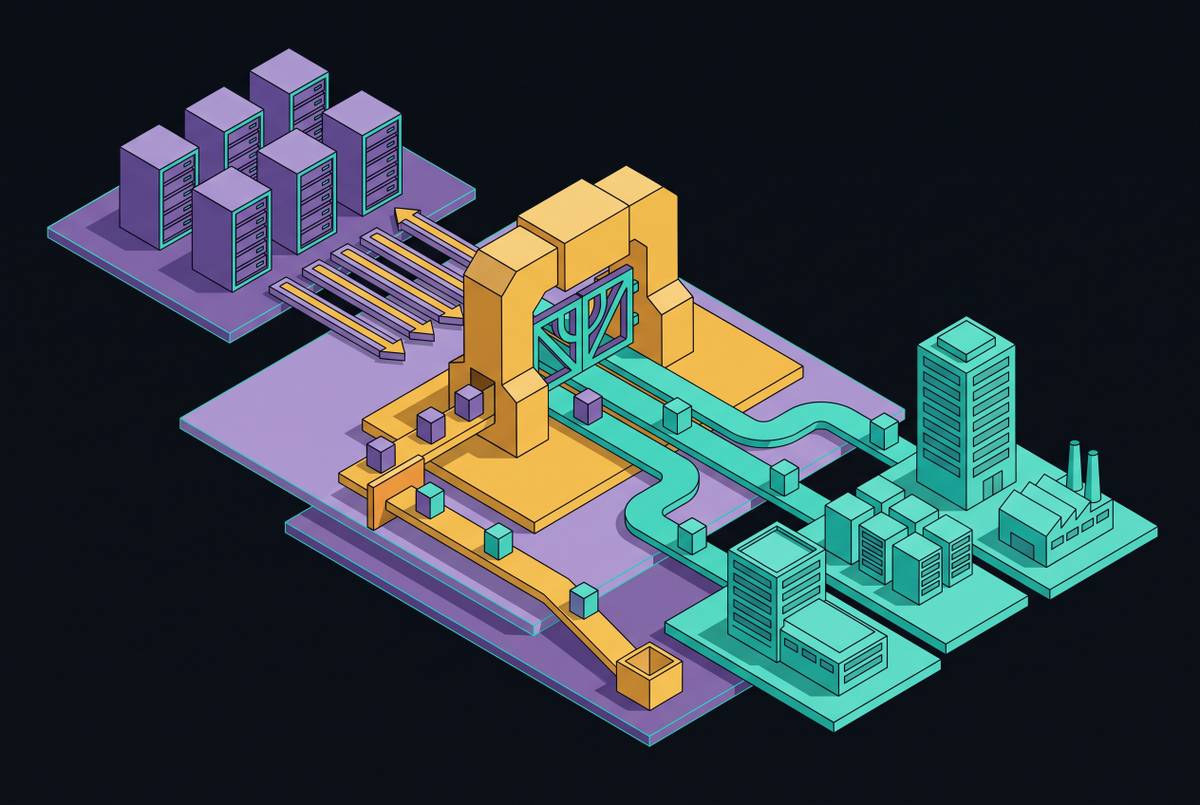
Each phase of the lifecycle involves its own decisions and its own failure modes, but in production they all funnel through one enforcement point: the gateway. That's the only place in the stack where provisioning records, access rules, and live traffic all meet at once.
At provisioning, the gateway only routes to servers that are registered and attested, so anything that skipped the inventory simply has nowhere to go. At the access control stage, the gateway is what actually enforces RBAC and SSO-based identity in real time, instead of leaving it to whatever each individual server happened to implement. For observability, the gateway is a natural collection point for the audit trail, since every call already passes through it. And for decommissioning, pulling a server's routing rule from the gateway is a clean, immediate way to cut it off, no separate cleanup step required.
None of the four phases works well in isolation. Provisioning without access control is an open door with a welcome mat. Access control without observability is a lock nobody's checking. Observability without decommissioning just documents the mess as it grows. The gateway is where all four stop being separate concerns and start acting like one system, which is the only way any of this holds up once the number of servers stops being something a person can track in their head.