MCP Server vs API Gateway Decision Framework
MCP gateways control agent-to-tool traffic where API gateways simply cannot reach.
If your team reaches for an API gateway to govern agentic AI traffic, you have the right instinct pointed at the wrong layer. MCP servers and API gateways govern fundamentally different hops in the request chain. A useful way to see the split: an AI gateway governs traffic moving from an application to the LLM, an API gateway governs traffic moving from clients to backend services, and an MCP gateway governs traffic moving from AI agents to the tools they call, with each one sitting at its own control plane and catching failures the others never see. They look like the same product because, architecturally, they are the same shape: all three are reverse proxies bolting on authentication, rate limiting, observability, and policy, so the distinction collapses unless someone asks who the caller actually is and what failure mode the layer in question was built to stop. That question matters because the caller has changed. Traditional API security was built on the assumption of a human clicking a button that fires one request; an agent fires hundreds of tool calls on its own initiative, with no human in the loop checking each one, which makes the attack surface and the governance job categorically different from anything an API gateway was designed against. The Linux Foundation's Agentic AI Foundation has counted more than 10,000 published MCP servers, with adoption now running across ChatGPT, Claude, Cursor, Gemini, Microsoft Copilot, and Visual Studio Code, and any developer can point any client at any one of them. That is the surface a security team cannot see without a gateway sitting in the path, and it is why the decision between gateway types is not a stylistic preference but an architectural one.
What an API gateway governs
An API gateway is still the right and necessary tool for governing traffic at the service edge, and the agentic shift does not change that. But once the caller is no longer a known client and becomes an autonomous agent, those assumptions break down. The core job list has not moved in years: authentication and access control, routing, rate limiting, content inspection, versioning, lifecycle management, and per-endpoint controls granular enough to let one team ship a new version without breaking another team's integration. This is the foundational layer that virtually every modern distributed architecture depends on. The gateway counts what it protects in requests, a unit that maps cleanly onto a human clicking "submit" or a service polling an endpoint on a schedule. It has no native way to express a tool call that spans a multi-step agent workflow, because the protocol underneath it was never built to carry that kind of state.
MCP runs on JSON-RPC, with a stateless protocol core as of the 2026-07-28 spec, which leaves the gateway with no built-in concept of a session that follows an agent's context across several tool invocations. That gap widens once workflows need a pause. MCP's model allows an agent to be halted mid-task, routed to a human for approval, and resumed only once that approval lands, and a classic API gateway has no equivalent mechanism for that kind of interruption. The clearest illustration of what the API gateway cannot see sits in tool discovery itself: an agent connecting to several MCP servers receives the combined list of every tool each one exposes. Registries listed tens of thousands of MCP servers in early 2026, so at enterprise scale that combined list can run to hundreds of tools, and it bloats the model's context window and lets the agent see tools it has no legitimate reason to touch. An API gateway parked at the service edge has no window into that exposure at all, because the poisoning happens one layer upstream, inside the conversation between agent and tool server, before any backend call is made.
What an MCP gateway adds beyond an API gateway
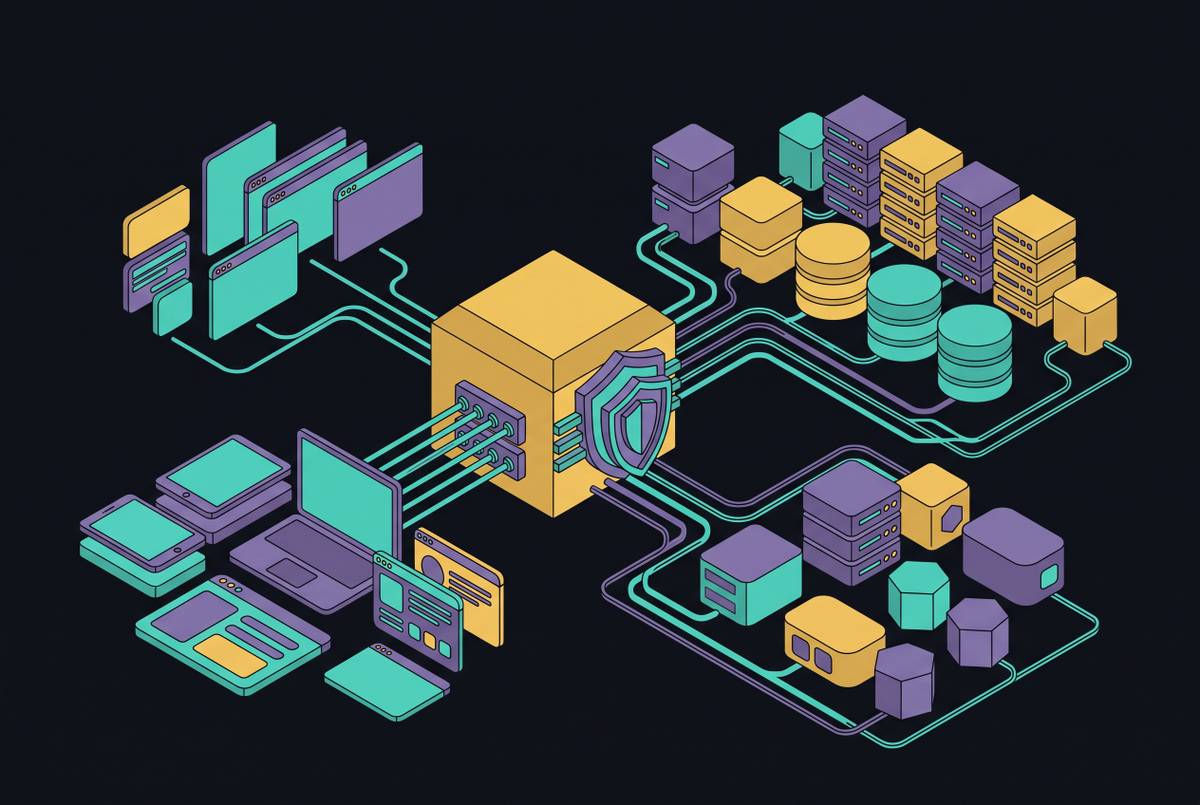
An MCP gateway does not just do the API gateway's job with extra features bolted on. It is a control plane built for the agentic loop, and it enforces governance at the level of the individual tool call, where the API gateway structurally cannot reach. Concretely, that means a single endpoint that aggregates many MCP servers behind one address and applies identity, access, and logging policy to every request passing between AI clients and tool servers, collapsing what would otherwise be an N-by-M mesh of client-to-server connections into one policy boundary. Enterprises face tens of thousands of servers reachable from any client, and purpose-built MCP governance infrastructure that aggregates servers behind a single policy point tied to existing identity providers is built to close exactly that: it gives enterprises a centralized place to see what is in use and enforce rules against it, where a generic API gateway offers no such vantage point.
The gateway also becomes the one place credentials live. Clients never see raw MCP server tokens, because the gateway holds them upstream, so it removes the credential sprawl that otherwise spreads across developer laptops and agent services as each one accumulates its own copy of keys. A registry defines which MCP servers count as approved, and anything outside that registry is simply unreachable through governed paths, the MCP equivalent of blocking unsanctioned SaaS tools at the network edge. The pause-and-resume control described earlier, halting an agent mid-workflow and routing it to a human approver, is a control class with no analogue in API gateway implementations, and it lives natively in the MCP gateway layer. There is a cost dimension here too: when tool definitions from many servers dominate the input tokens sent to a model, a gateway that filters the visible tool list down to what a specific caller actually needs also controls that cost, a lever most attempts to bolt MCP support onto an existing API gateway miss entirely. The spec defines the handshake; the gateway is where the actual governance decisions get made.
The decision variables that determine which gateway layer each situation calls for
Picking the right gateway for a given situation comes down to three variables, run in order from the easiest to answer to the most involved: what kind of traffic is actually moving, what threat model applies to it, and how deep the governance requirement runs underneath both. The first and simplest check is traffic type. Traffic that is REST or HTTP and moves from known clients to backend services belongs squarely with an API gateway. Traffic that consists of inference requests headed to LLM providers calls for an AI gateway instead, since that is where token budgeting, semantic caching, multi-provider routing, and prompt-injection filtering actually happen. Traffic that is MCP JSON-RPC calls coming from autonomous agents needs an MCP gateway, full stop, because the session is stateful, the caller is not a person, and the unit being metered is a tool call rather than a request.
Once you know the traffic type, the second variable, threat model, follows directly from it. Unauthorized or excessive calls hitting backend services are an API gateway problem, addressed through rate limiting and access control at that layer. Prompt injection attempts and runaway inference cost are an AI gateway problem, addressed through guardrails and token budgets. An agent reaching for a tool it has no business touching, credentials scattered across agent configs, shadow MCP servers nobody approved, and tool lists that expose far more than any one caller needs are all MCP gateway problems, addressed through tool scoping, a server registry, and per-user OAuth. At Okta's Oktane 2026 conference, a large regulated asset manager reported thousands of agents running in its environment, only a small fraction of which it considered valid, alongside more than 500 MCP servers in active use against only a handful that had ever been formally approved. The threat there was never a missing authentication check. It was a total absence of scope and visibility into what had been deployed.
The third variable, governance depth, is the hardest to answer because it is not binary. Depth ranges from a bare MCP proxy that forwards calls with little or no policy attached, up to a full control plane that filters tools per identity, authenticates every user individually, signs audit logs, and extends policy enforcement all the way out to employee laptops. Before any of that depth comparison even starts, the deployment model itself often disqualifies half the field: if data has to stay inside a VPC, an air-gapped network, or strictly on-premise, managed SaaS gateways come off the shortlist regardless of how deep their governance otherwise runs.
Deploying API gateway alone, MCP gateway alone, or both together
Most enterprise AI stacks need all three gateway layers eventually, but the sequence in which they get deployed, and which combination applies at any given moment, should follow whatever traffic pattern actually exists, not some ideal reference architecture drawn up in advance. An API gateway alone is the right call for an organization running APIs or microservices consumed by known, human-initiated clients that has not yet put autonomous agents into production, the kind of shop that is, say, a fintech team adding its first coding agent to an existing microservices stack, where most traffic is still humans and services calling known endpoints. You add an AI gateway the moment LLM calls start reaching production, because that is when token cost, model routing, and prompt safety stop being theoretical and become operational line items.
An MCP gateway deployed without any API gateway extension fits a different situation: one where the governance gap is specifically agent-to-tool traffic, visible as shadow MCP servers nobody signed off on, credentials scattered across developer machines, or agents holding tool access far broader than their job requires. A regulated asset manager discovering hundreds of unapproved MCP servers inside its own environment, as in the Oktane 2026 case, is exactly this situation, and no amount of API gateway tuning would have surfaced that problem, because the exposure never touches the service edge the API gateway watches.
Most enterprises land somewhere in between and run both layers at once, because an MCP gateway governing tool calls does not replace an API gateway governing service-edge traffic; both operate at once, on different hops of the same request chain. Each layer catches something the others structurally cannot: the AI gateway stops a prompt-injection attempt and a cost overrun, the MCP gateway stops an agent from touching a tool it has no business using, and the API gateway stops an unauthorized or excessive call from ever reaching a backend system. That is defense-in-depth, not duplicated effort. In production, the sequence usually runs in order: a tool call from an agent first passes through the MCP gateway for tool-level authorization, and if that call triggers a backend API request, that request then passes through the API gateway for service-edge authorization, with both policies applying to segments of the same chain.
Teams already running an AI gateway for LLM traffic should weigh one factor heavily before adding a separate MCP gateway on top: governing tool calls in one system and model calls in another recreates the exact split visibility a gateway was supposed to eliminate in the first place. Running one gateway across model routing, budgets, and MCP tools produces one policy set and one audit trail instead of two. The risk of not doing that is concrete rather than abstract: if the inference request that produced a tool call and the tool call itself land in two separate logging systems, incident response means correlating across two control planes by hand, a gap that carries real weight in regulated industries where auditors expect a single trail, not two that have to be reconciled after the fact.
Agent authentication and enterprise identity for both layers
Agent identity has become the central control surface for enterprise AI governance, and you cannot get it from an API gateway or an MCP gateway unless you wire it into an identity provider your organization already runs. If that integration is missing, each developer machine and each agent service ends up carrying its own private list of MCP servers and its own stash of API tokens. There is no central inventory of any of it, no way to revoke one team's access without touching everyone else's, and no record of which agent called which tool and when. That pattern lines up with a broader finding that only 10% of organizations have a formal strategy for managing non-human identities at all, which turns the identity gap from a theoretical risk into a measured one.
2026 brought the first wave of infrastructure meant to close that gap, with new products shipping to address agent identity specifically. Okta for AI Agents went generally available on April 30, 2026, with Agent SSO following on August 24, 2026, and together they treat AI agents as identity citizens in their own right rather than as an afterthought bolted onto human identity management. The platform discovers shadow AI agents running where nobody expected them, it enforces least-privilege access through short-lived credentials instead of static tokens, and it routes MCP tool calls through an Agent Gateway built to keep identity checks inside the access path rather than bolted on after the fact, though both the Agent Gateway and endpoint-based Shadow AI Agent Discovery were still slated for general availability in the third quarter of 2026 as of the Oktane announcement. An MCP gateway built to plug into that kind of identity layer does more than just route traffic. It enforces role-based permissions and logs every agent-to-server interaction, so when you scale agents across teams, you get an actual answer to who called what tool and when, rather than a shrug and a server log somewhere on a laptop nobody audits. That is the direction governance depth is heading: not a feature checklist, but a question of whether identity is actually in the path or just assumed to be.