Least Privilege Enforcement for Agentic AI Workflows
AI agents outpace security controls built for human employees.
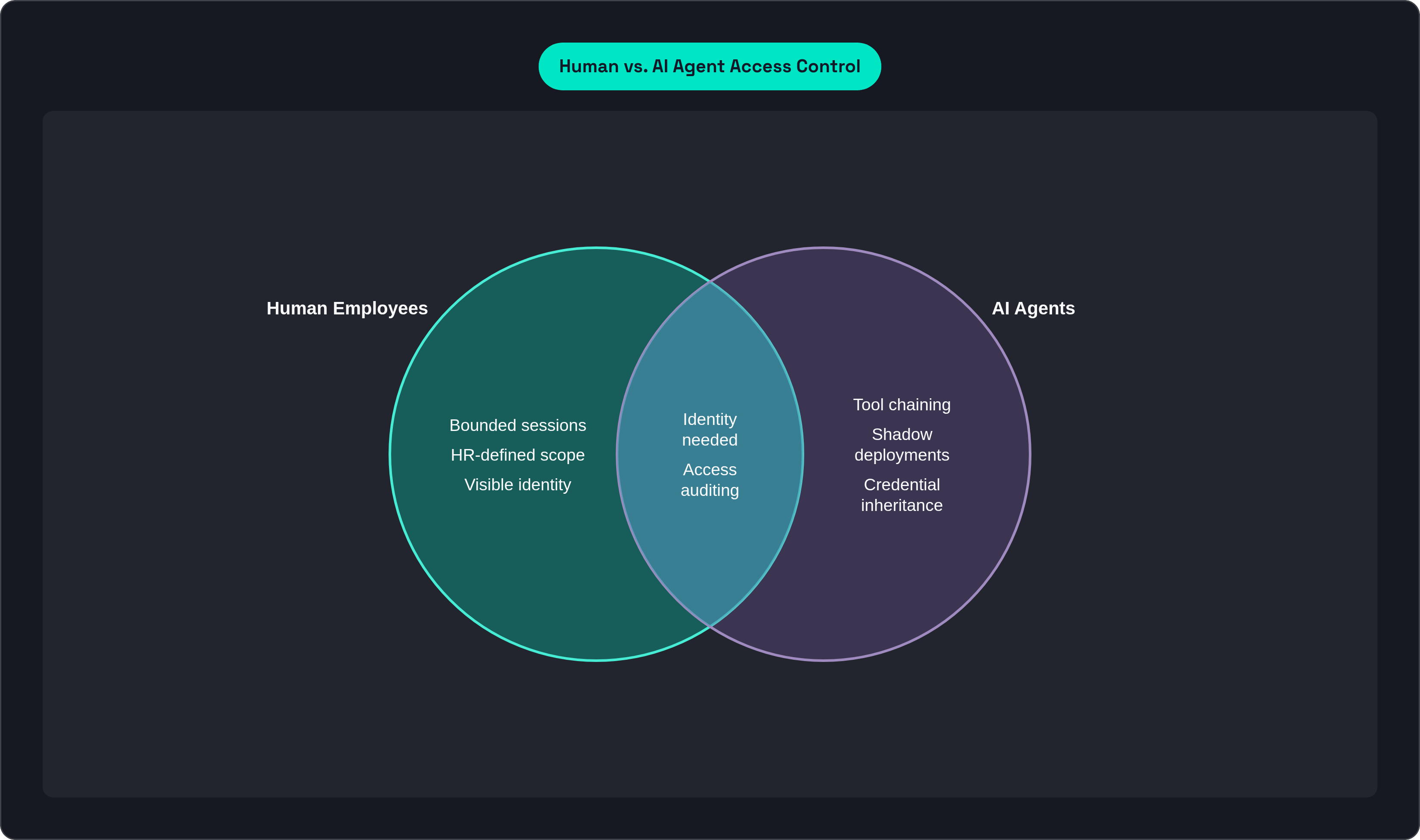
Least privilege for AI agents means asking a question nobody's IT department was built to answer: what should this piece of software be allowed to do, right now, for this one task, given everything it's already done in the last four steps? Classic access control never had to sit with that question. A human logs in, does a bounded job, logs out; the identity is visible, the session ends, the scope was drawn by someone in HR six months ago and mostly holds. Agents blow past those assumptions. They act without anyone watching, chain tool calls across five systems in a single run, and pick up new permissions mid-task the way a hermit crab trades up to a bigger shell.
How fast agents are proliferating inside enterprises, and why governance hasn't kept pace
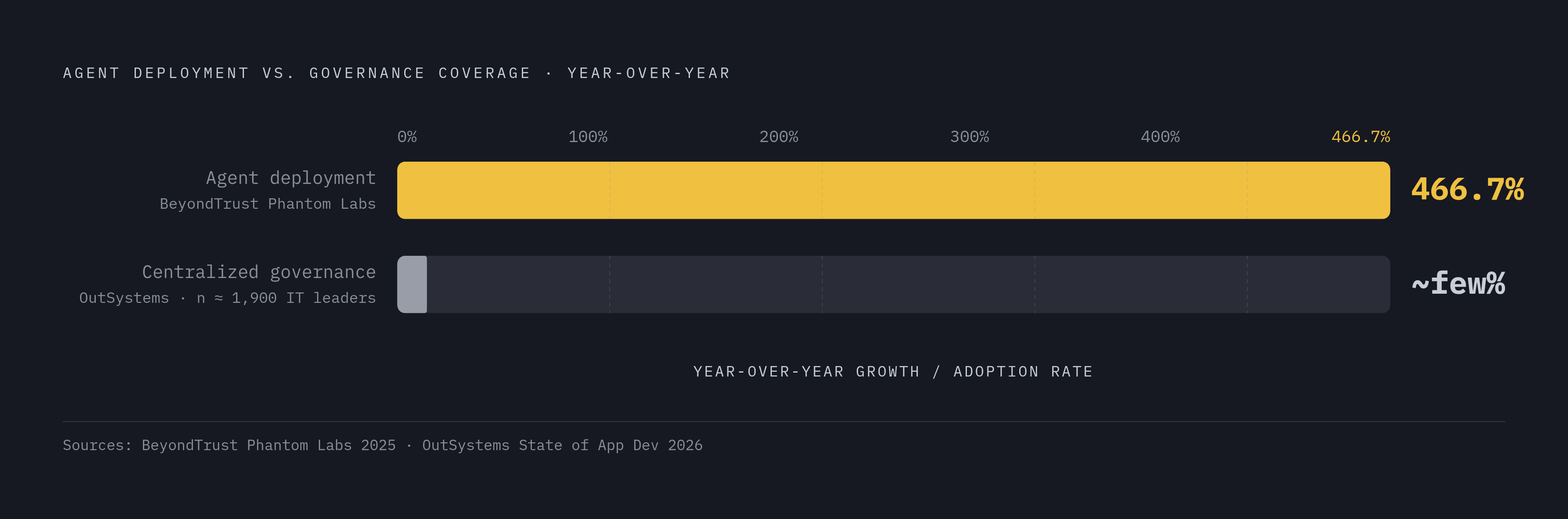
Agent deployment inside enterprises grew 466.7% year-over-year, per BeyondTrust's Phantom Labs research. Nobody staffs their way out of a growth curve like that with a few extra provisioning tickets a week. Zscaler's ThreatLabz 2026 AI Security Report puts AI transaction volume up 83.3% year-over-year, and that number matters more than the headcount figure. The volume of tool calls, API hits, and data pulls running through each agent, unattended, all day, is what turns a staffing gap into a governance gap.
The gap this leaves isn't subtle. Most enterprise agents already carry more access than their job requires, and roughly half touch sensitive data as a matter of routine. OutSystems' 2026 State of AI Development survey, about 1,900 global IT leaders, found nearly every enterprise using agents in some form. Only a sliver of them run a centralized platform to govern what those agents can actually do. Everyone's driving. Almost nobody installed the brakes, which is a strange place to end up given how much money went into the engine.
Shadow AI is the part nobody wants to talk about at the board meeting. It's the second cousin of shadow SaaS from a decade ago, except this cousin can take actions on your behalf instead of just sitting quietly in a folder. A developer spins up an agent for a side project on a Tuesday. A sales team wires one into the CRM over a long weekend because the demo looked cool. IT finds out when something breaks, usually in production, usually on a Friday. Deep Inspect's research shows shadow AI breaches cost more than standard incidents, take longer to detect, and disproportionately leak customer data and IP. This is already showing up on incident reports, not sitting quietly on some risk committee's slide deck, and the agent count keeps climbing.
What least privilege actually requires when the principal is an autonomous agent
Three things have to be true for an agent that were never strictly required for a human employee. The agent needs its own identity, not a shared service account borrowed from three other bots and half the interns. Shared credentials make accountability impossible; you can't run an incident review when four different processes were all logged in as "svc-automation-01" and nobody remembers who set that up.
Permissions need to be scoped to the task and expire when the task does. Grant just-in-time, not once and forgotten on a role that got configured during onboarding eighteen months ago. And the agent should only call tools it's explicitly allowed to call, not everything the connected server happens to expose to anyone who asks nicely.
Microsoft's published design pattern for agentic systems lands on the same three points: treat agents as first-class identities, apply role-based access control with real scopes, allowlist the tool actions, build in auditability and revocation from day one. That's the floor needed before you can even ask who's responsible when something goes wrong, let alone answer it.
The harder problem is that the access envelope has to move as the task moves. A permission an agent needs at step two might be actively dangerous by step four, once the job has shifted from reading a customer record to drafting an email about that customer to someone outside the company. Static role assignments can't capture that kind of drift. Enforcement needs to run at the moment of the request, because a quarterly access review catches the problem eleven weeks after the fact. Every agent needs an owner too, a specific person or team on the hook for reviewing its access, responding when it misbehaves, and eventually turning it off. Skip that step and permissions pile up the way unopened mail piles up in a garage: nobody notices until the door won't close. The 2026 Infrastructure Identity Survey found systems running least-privileged AI access see a dramatically lower rate of security incidents than over-permissioned ones, and the gap isn't marginal. It's the difference between a fender bender and a totaled car.
Where the permission surface actually lives in agentic workflows, and where it leaks
The Model Context Protocol, MCP, is the newest and most active leak point going right now. MCP has no native concept of role-based access. If an agent can connect to a server, it sees and can call every tool that server offers, whether or not that tool has anything to do with the agent's actual job. A finance agent can see development tools it has no reason to touch. A customer support bot can see database admin endpoints. The protocol doesn't stop this, and most of the time it doesn't even register that anything unusual happened. GitGuardian found tens of thousands of unique secrets sitting exposed in MCP configuration files in 2025 alone, API keys and database connection strings topping the list. Call it what it is: a filing cabinet left open in the lobby, in plain view of anyone walking by.
Credential inheritance does most of the damage on the API side. APIs built for broad access hand that same broad access to whatever connects to them, agent or human. Plug an agent into a SaaS platform through a shared credential and it inherits everything that credential touches: email, database, CRM, some third-party API nobody remembers signing up for. Nobody sat down and decided the invoicing bot should read the sales team's inbox. It just came bundled with the key, like a toy in a cereal box nobody asked for.
Multi-agent setups add their own layer of mess. When one agent spins up or calls another, the downstream agent can inherit permissions from its parent that it has no business holding on its own. Prompt injection makes this specifically nasty: an instruction buried inside a tool's response can redirect a downstream agent into actions well outside its intended scope, and the agent won't know the difference between a legitimate task and an injected one. MCP also doesn't enforce usage limits by default, so an agent can hammer a paid API in a loop with no ceiling in sight. At enterprise scale, that's a line item on a cloud bill that finance is going to ask uncomfortable questions about, and rightly so.
The governance layer an enterprise actually needs to enforce least privilege at runtime
Four things separate a real runtime governance layer from a provisioning checklist that made everyone feel good in a quarterly review. Discovery comes first: find every agent, including the ones a developer deployed on a Friday afternoon that IT never signed off on. You can't govern what you haven't found, and most enterprises haven't found all of it.
Second, map effective authority, meaning what an agent can actually reach given its live credentials, not what a spreadsheet claims it's configured to touch. Those two numbers are rarely the same, and the gap between them is where incidents happen. Third, runtime behavioral monitoring, because a snapshot taken at deploy time tells you nothing about what the agent picks up three tool calls later through chaining or inherited credentials.
Fourth, and this is the one that actually matters most: policy enforcement has to fire inline, at the moment of the tool call, sitting in the data path rather than reviewing what already happened from the sidelines. An audit log telling you an agent misbehaved yesterday is a eulogy, not a defense.
For agents connected over MCP, a gateway is where these four capabilities actually live in practice. It sits between the agent and the MCP server, intercepts every tool call before it lands, enforces per-tool allow and deny lists, and brokers credentials centrally so the agent itself never holds the raw secret; the gateway swaps it in at runtime and swaps it back out when the call finishes. Done right, it produces a per-call audit log detailed enough to satisfy NIST's AI Risk Management Framework, ISO 42001, and the human oversight provisions written into the EU AI Act.
None of this works bolted onto the side of identity systems already running the company. Agent identities need to plug into the same Okta, Entra ID, or SAML and OIDC infrastructure the rest of the workforce already uses. Stand up a separate identity system just for agents and you're now governing two companies instead of one, which defeats the point. The EU AI Act's high-risk obligations land in August 2026. Colorado's AI Act takes effect that February. Both require auditable proof of governance, and a policy PDF nobody's opened since legal signed off on it won't satisfy either one. BCG's research backs the business case too: organizations with technical guardrails built into the system capture meaningfully more of their AI return on investment than the ones relying on a written policy and a hope.
How to evaluate platforms and approaches for enforcing least privilege in agentic systems
Run any vendor through the same set of questions. Does it find shadow agents and maker-mode deployments, or only the ones that went through official channels and got a ticket number? Does it show effective authority, what an agent can actually reach right now, or just its on-paper configuration from six months ago? Does policy enforcement fire inline at the tool call, or does it show up after the fact in a log nobody opens until something's already on fire?
Does it plug into the identity provider you already run, or ask you to stand up a new one? Does it broker credentials centrally so agents never touch the raw secret? Are the audit logs per-call, tamper-evident, and exportable in a format a regulator will actually accept?
A few names are worth knowing, and worth being blunt about. MintMCP is built for regulated industries, with SOC 2 Type II and HIPAA alignment, SCIM-driven role assignment, enterprise SSO through SAML and OIDC, and credential brokering built in rather than added later. It turns a local server into a governed endpoint in one deployment step. IBM's ContextForge takes a federation approach for large organizations whose MCP footprint spans multiple regions or business units, the kind of company where "just use one gateway" was never realistic to begin with. AWS's Bedrock AgentCore Gateway went generally available in late 2025, running Cedar-based per-tool authorization tied into AWS IAM; for a stack already running on AWS, that's the more direct integration path. Palo Alto Networks folded Portkey's AI gateway into its broader security platform after acquiring it in May 2026, targeting what it calls privileged-insider agents inside an existing perimeter.
Read the marketing carefully, because a lot of it is generous with the truth. Several products that called themselves MCP gateways in late 2025 turned out to be LLM proxies with MCP-shaped routing bolted on top, no real governance layer underneath. Ask specifically whether enforcement happens per-tool and inline, or whether you're paying for a fancier logging wrapper. The Composio incident in May 2026, where roughly thousands of API keys and OAuth tokens ended up exposed, is a decent stress test to run against any vendor's credential handling story; ask them plainly how that scenario would have played out on their platform. And check who's allowed to own an agent inside the platform's model. Excellent technical controls with no concept of agent ownership just leaves the accountability question exactly where it started: unanswered, and somebody's problem for later.
A practical implementation sequence for enterprises rolling out least-privilege enforcement
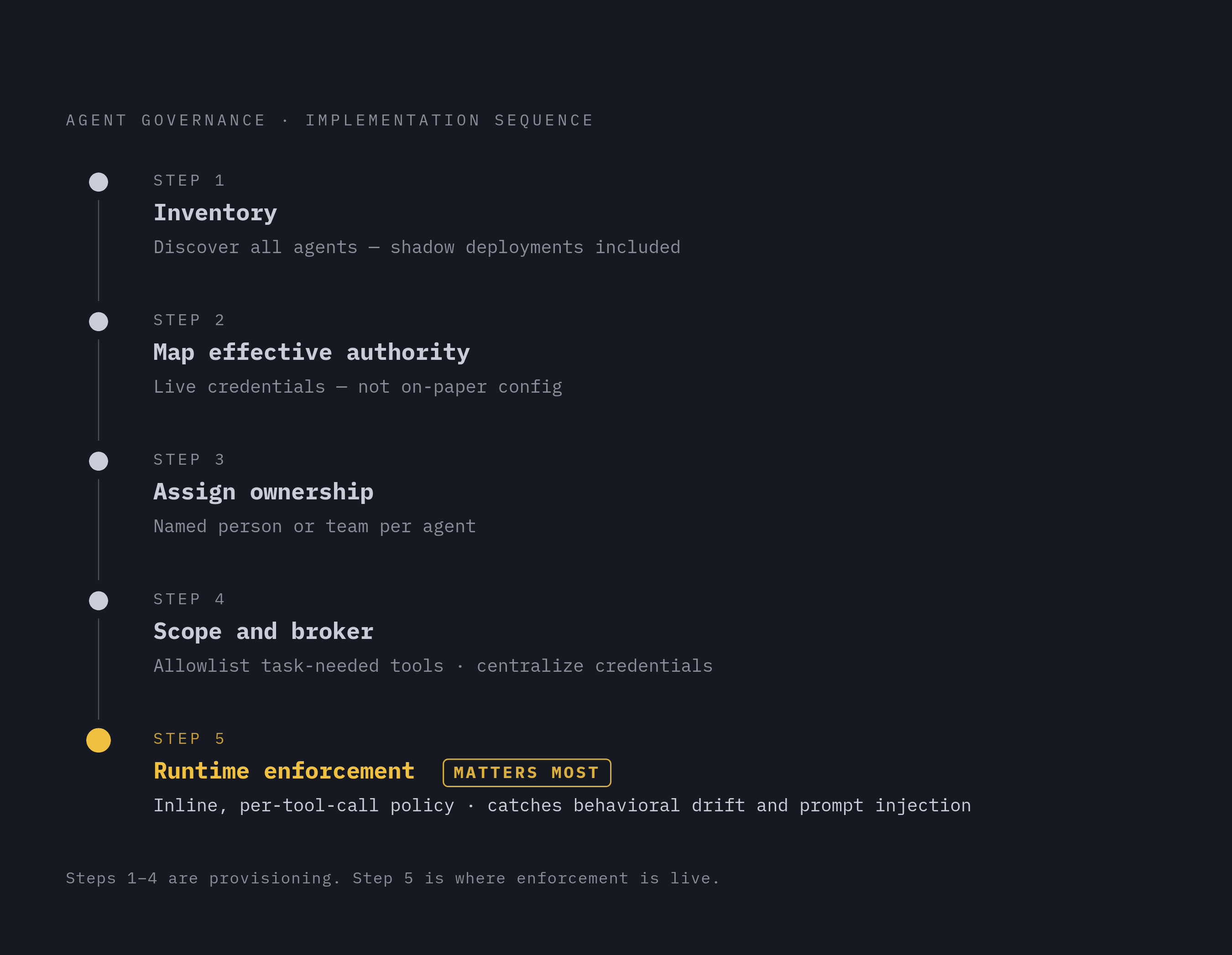
Start with inventory, not policy. You can't scope permissions for agents you haven't found, so run discovery across the full estate, developer-deployed and business-unit-deployed alike, and map effective authority for each one: what it can actually reach today, given its live credentials, not what the onboarding doc says it should be able to reach. Sort by sensitivity. A bot summarizing public documentation and a bot reading customer payment records are not the same risk, and treating them the same wastes attention on the boring one while the dangerous one runs unwatched.
Assign an owner before touching a single permission. Every agent needs a named person or team on the hook for access reviews, incident response, and eventually pulling the plug when the thing outlives its usefulness. An agent with no owner is shadow AI wearing a badge, and it deserves the same scrutiny.
Scope access to the task the agent was actually built for, not to whatever the underlying API happens to allow. Define the job first, then allowlist only the tools that job needs, and move credentials into a central broker so the agent never holds a raw secret it could leak, mishandle, or hand off to some downstream process that inherits it without asking.
Then layer runtime enforcement on top of all of it. Provisioning-time controls matter, but they still miss the failures that actually cost money: behavioral drift over weeks, tool chaining that quietly widens what an agent can reach, prompt injection redirecting an agent mid-task without anyone noticing until the damage is done. Runtime monitoring should flag deviations as they happen, not next quarter when someone finally gets around to the audit. Least privilege for agents is a system you have to keep running, the same way you keep the brakes on a car you actually intend to drive.