Shadow AI Governance vs. Shadow IT Governance
AI agents pose three risks shadow IT governance was never built to handle.
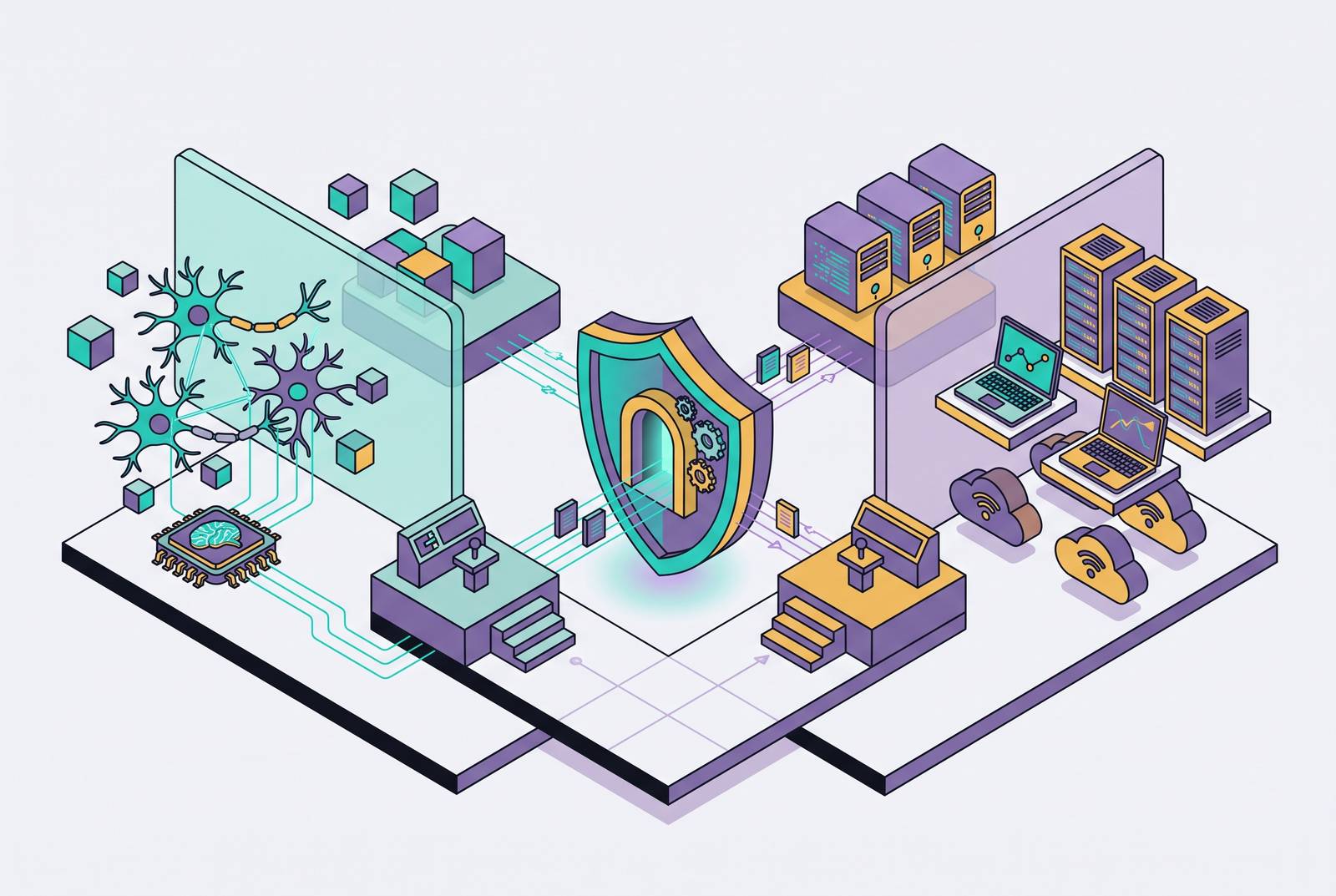
Shadow IT and shadow AI share a birth defect: employees who move faster than the policies meant to contain them. Shadow AI, though, breaks the containment model itself. It adds data leakage, prompt injection, and agent autonomy, three risks the old shadow IT playbook was never built to catch. Security teams that treat this as the same problem with a new name are going to learn otherwise, and it will cost them.
Shadow IT, for anyone who managed to avoid the term for the last fifteen years, means employees signing up for SaaS tools, buying hardware, or writing scripts without going through procurement or IT. Marketing spins up its own Trello board. Sales expenses a scheduling tool nobody vetted. Someone in finance builds a macro-laden spreadsheet that quietly becomes load-bearing infrastructure. The core problem was never malice; it was speed. IT approval cycles took weeks, the work couldn't wait, and data started leaving sanctioned systems for places nobody in security had ever heard of.
The playbook built around that got genuinely good. Network monitoring, DNS logs, and cloud access security brokers gave IT teams a way to see which unsanctioned tools were actually in use. Policy tiers sorted tools into blocked, tolerated, and sanctioned buckets instead of a blunt allow-or-deny switch. Centralized identity, meaning single sign-on and directory services, became the enforcement chokepoint: control the login, and you control the access, no matter how the tool got adopted in the first place. Third-party risk reviews and vendor contracts backstopped whatever policy couldn't catch directly. Around all of it, enterprises built real governance muscle: audit logging, periodic access reviews, spend visibility, offboarding checklists that actually got followed.
Here's what that era got right, and it's worth saying plainly: it treated rogue tool adoption as an access control problem first and a communication problem second. Lock down who can get in, then explain to people why. That framing carries over to AI just fine. It's also exactly where the analogy runs out of road, because AI doesn't just get adopted outside the org chart. It acts inside it.
Why shadow AI is spreading faster than shadow IT ever did
Shadow IT crept in tool by tool, department by department. Marketing found its SaaS product, sales found its own, and each wave of adoption took months to spread and years to fully surface. AI skipped the slow crawl. It showed up across every job function at once, because writing an email, summarizing a document, and debugging code are things every employee does, regardless of title.
The friction that used to slow shadow IT down (corporate card limits, IT-managed laptops, locked-down browsers) barely touches AI tools. Most of them are free to start using, run entirely in the browser, and need no install and no procurement sign-off. Enterprise networks now carry traffic from hundreds of distinct generative AI applications across enterprise environments, most of which nobody approved, and that traffic kept climbing through 2024 and into 2025 at a pace that outstrips how fast most security teams can finish even one basic vendor review.
Then there's the embedded problem. AI features are shipping inside tools already on the approved list: Salesforce, Microsoft 365, Google Workspace. Blocking a domain doesn't help when the AI in question lives inside software the company already pays for and already trusts. Security teams aren't exempt from any of this either; a majority of security professionals admit to using shadow AI tools themselves, which makes any top-down ban feel less like governance and more like a rule nobody, including its authors, actually follows.
The discovery and policy coverage that took years to build for SaaS has to get rebuilt, faster, against a target that won't sit still. This gap is only widening.
The three risks shadow IT governance was never designed to handle
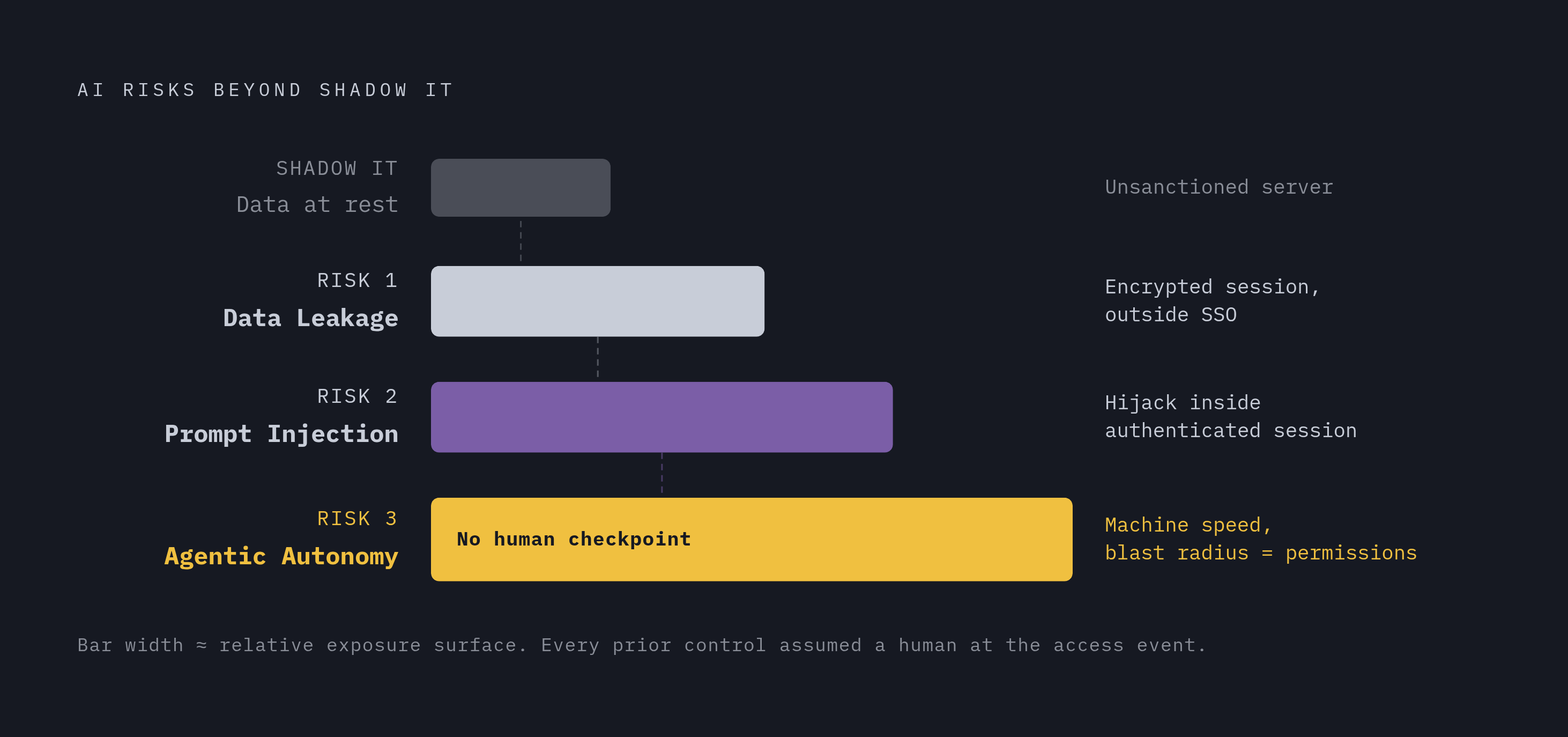
Shadow IT's core risk was data residency: sensitive information landing on an unsanctioned system, then sitting there, relatively still, until someone found it. Shadow AI takes that risk and adds three more, and each one behaves nothing like the risks the old playbook was built to catch.
Start with prompt-level data leakage. Employees using shadow AI aren't just accessing an unapproved system; they're actively feeding it customer records, source code, financial models, legal drafts, whatever the task calls for. Research has found a large share of file uploads to consumer GenAI tools contain PII, PHI, or payment data, and most organizations have zero visibility into that channel. Standard data loss prevention tools miss it entirely, because the leakage happens inside an encrypted browser session, through a clipboard paste, or via a personal account that never touches the enterprise's single sign-on. And the AI vendor on the other end isn't just another SaaS vendor; it's a third-party data processor, so the moment sensitive content crosses the prompt boundary, GDPR, HIPAA, or PCI obligations can attach to it.
Next: prompt injection, a category of attack with no shadow IT equivalent at all. Malicious instructions get buried in content the AI is asked to process, a webpage, a document, an email, and those instructions hijack the model's behavior from the inside. Security researchers consistently flag prompt injection as among the most serious risks in AI systems. Picture an AI assistant browsing the web on a user's behalf. It hits a page with hidden text instructing it to forward emails or exfiltrate session data, and it complies, silently, inside a session that's already authenticated. The attack surface is real and has drawn sustained attention from security researchers examining agentic browser deployments. No firewall rule catches this; it gets caught at the level of the prompt and the response, or not at all.
The third risk is the strangest one, and probably the worst: agentic autonomy. AI agents now run multi-step tasks across APIs and SaaS systems with no human checkpoint between the instruction and the outcome. Shadow IT was a story about humans choosing tools. Shadow AI includes agents acting on their own, at machine speed, with nobody watching the session in real time. Grant an agent broad OAuth access to email, calendar, and file storage, and it can send messages, modify files, and kick off workflows before security has any record the session happened at all. The blast radius isn't bounded anymore by what a human could pull off in one sitting. It's bounded by whatever the agent's permissions allow, and in most deployments today, that's far too much.
What the shadow IT playbook still gets right
Not everything needs reinventing. The instinct to centralize was correct the first time, and it's still correct now: shadow IT demanded one governed access layer, and shadow AI demands the AI version of the same thing.
Discovery-first still holds too. Nobody can govern what they can't see, and the logic that drove network traffic analysis for SaaS applies directly to AI endpoint traffic, OAuth token scanning, and DNS log filtering tuned for AI domains.
Policy tiering translates cleanly as well. Green, yellow, red; approved, conditional, blocked. The old tier structure maps onto AI tool categories without much modification. What changes is the condition set inside each tier. Instead of "managed device only," the rule becomes "no regulated data in prompts, no file uploads containing PII." The scaffolding survives; the content inside it gets rewritten.
The lesson that outright bans backfire carries over word for word. Banning shadow IT without offering a sanctioned alternative just pushed employees toward personal accounts, and the same pattern is showing up with AI: employees have repeatedly been found to keep using personal AI accounts even after a company issues a blanket ban. Vendor risk assessment still applies too. AI vendors still need SOC 2 attestations, data processing agreements, and clear retention commitments, and a large share of GenAI tools in enterprise use right now fail basic SOC 2 checks. And the identity layer remains the right chokepoint. Existing investment in Okta, Entra ID, and SAML or OIDC isn't wasted money; it just needs to stretch to cover AI agents and MCP servers, not only the humans logging in each morning.
Where the old playbook breaks down: agents need identities, not just policies
Here's the assumption baked into every part of the shadow IT playbook: a human sits on the other end of every access event. SSO, access certification, offboarding checklists, all of it got built around the human identity as the basic unit of control.
AI agents don't fit that mold. They run on their own, persist across sessions, pile up OAuth grants over time, and can spawn sub-agents to handle pieces of their own workload. None of that fits the human-session model that identity infrastructure was built around. The scale problem makes it worse: the average large enterprise runs a modest number of agents today, but analysts broadly expect that number to grow by orders of magnitude within a few years. Manual registration and review cannot survive that growth curve. Nobody is reviewing three hundred thousand service accounts by hand, and pretending otherwise is how the review gets skipped entirely.
Most companies currently handle this by treating agents as service accounts or shared credentials, which is a stopgap, not a fix. A shared credential gives no visibility into what any individual agent actually did, and no clean way to scope or revoke its access once something goes wrong. MCP servers make the problem concrete. They're fast becoming the main channel agents use to connect to enterprise systems, and major enterprise software vendors have begun integrating MCP support, and the volume of MCP-mediated access is growing rapidly. Early MCP deployments have frequently lacked a robust authentication framework, so many sit effectively ungoverned at the agent-to-tool layer. Each MCP server is a direct API surface into enterprise data, and running one without a gateway in front of it repeats the oldest mistake in the API book: no rate limiting, no authentication, no audit log.
What non-human identity actually requires is narrower than it sounds. Every agent needs its own named, registered identity, not a shared credential borrowed from three other processes. Permissions need to be scoped to the minimum the agent's job requires, not inherited wholesale from whoever authorized it. Every agent needs a human owner of record, someone who can be found when something goes sideways. And every agent needs to be revocable instantly, in one action, the moment it's decommissioned or compromised. Okta's 2026 Agent SSO and its "Okta for AI Agents" release exist because of exactly this gap: they bring agent identity into the same joiner-mover-leaver lifecycle enterprises already run for human employees.
Sector exposure where the governance gap bites hardest
Regulated industries take a double hit here. The same data sensitivity that makes AI genuinely useful to them is exactly what makes ungoverned AI adoption dangerous to them.
Financial services is the clearest case. Research has found widespread use of unsanctioned AI tools across enterprise employees broadly, and financial services is particularly exposed given that unauthorized data processing can trigger obligations under the SEC, FINRA, and DORA. Healthcare carries its own version of the problem: Research into healthcare AI usage has found patient data appearing in a meaningful share of AI-related data events in the sector, and HIPAA penalties for unauthorized PHI disclosure can be severe. The prompt boundary is a new HIPAA exposure point, and most covered entities haven't added it to their risk assessments yet. Legal work has its own version too. Research has found a large share of legal professionals using consumer AI tools for work tasks, which creates privilege and work-product exposure that standard DLP policies are not designed to catch.
Across sectors, Available research consistently finds that only a minority of organizations have mapped their AI usage against the regulatory frameworks that actually apply to them. Most regulated companies are quietly stacking up compliance exposure they haven't bothered to measure yet. And regulation is adding a wrinkle shadow IT never had to deal with: the EU AI Act and a growing set of AI-specific regulations extend beyond data residency rules to impose requirements on how AI systems may be used and under what conditions. That makes tool discovery a compliance requirement now, not a security nice-to-have.
The governance extension: what security and platform teams need to build on top of what they already have
None of this calls for ripping out what already exists. SSO stays. CASB stays. DLP stays. All of it needs to stretch upward to cover the AI and agent layer sitting on top of infrastructure that was never built with either in mind.
Discovery has to widen first. Network DNS and firewall logs alone miss most AI usage, because it's browser-based and buried inside SaaS tools nobody's watching for it. Effective discovery now means multi-signal detection: browser-level visibility into prompts, OAuth grant scanning across every connected SaaS app, and audit-log filtering tuned specifically for AI domains. New signals worth tracking include OAuth token sprawl from AI apps requesting unusually broad scopes, MCP server endpoints showing up in network traffic, and embedded AI features quietly switched on inside tools already marked approved. Agent discovery needs its own lane too: platforms have to surface unregistered agents running loose in the environment, not just AI tools with a human sitting in front of them.
Prompt-layer enforcement is a genuinely new requirement, not an extension of anything that existed before. DLP rules need to reach outbound AI traffic directly, pattern-matching for PII, PHI, source code structure, API keys, and credential formats inside prompts and file uploads headed to AI endpoints. That enforcement has to happen in real time, blocking or redacting sensitive content before it crosses the prompt boundary, not logging it after the fact once the data's already gone. Prompt injection defense belongs at the gateway too, inspecting responses for signs the model got hijacked, not just filtering what goes out.
Agent identity and access control is where most of the real construction work sits. Every agent needs registration as a first-class identity in the enterprise directory, not a shared credential or an alias riding on someone else's login. Permissions need scoping per agent, per tool, enforced through the identity providers already in place, Okta or Entra ID, using the emerging MCP authorization extensions that make the enterprise IdP the authoritative gatekeeper for MCP server access. Agents need access certification cycles running on the same cadence as human reviews, and instant revocation, so a compromised or retired agent gets cut off from every connected system in one motion, not a slow trickle of disabled logins.
MCP gateways are the enforcement chokepoint underneath all of it. MCP servers are production API surfaces, full stop, and running them without a gateway is the same mistake as exposing internal APIs with no authentication and no rate limiting, just dressed in newer language. A properly governed MCP gateway centralizes authentication, authorization, audit logging, and traffic management in one place, which is where policy set at the top actually reaches down to the tool layer where agents operate. Emerging best practice on MCP governance points to exactly this: a gateway-centric architecture modeled on how API gateways already work. Vendors building in this space include dedicated AI gateway products with MCP support; Kubernetes-native gateway options; platforms integrating with enterprise identity providers such as Okta and Azure AD; and tools that handle OAuth 2.0, SAML, and SSO alongside PII redaction and secrets scanning. Purpose-built AI control plane platforms are also emerging that unify gateway enforcement with centralized policy across the entire agent and MCP layer.
Observability closes the loop. Every AI and agent interaction ought to leave an audit trail: which agent called which tool, with what input, at what time, producing what output. Cost telemetry matters too, broken down per agent and per team, since AI token spend is a new line item with no historical baseline and a habit of running up fast when nobody's watching it. Usage analytics round it out, showing which tools people are actually using against which ones were formally approved, a gap that in most companies right now is a lot wider than anyone in IT would like to admit.