AI Governance Policy Templates for Regulated Industries
Six policy sections regulated industries must include to pass an audit.
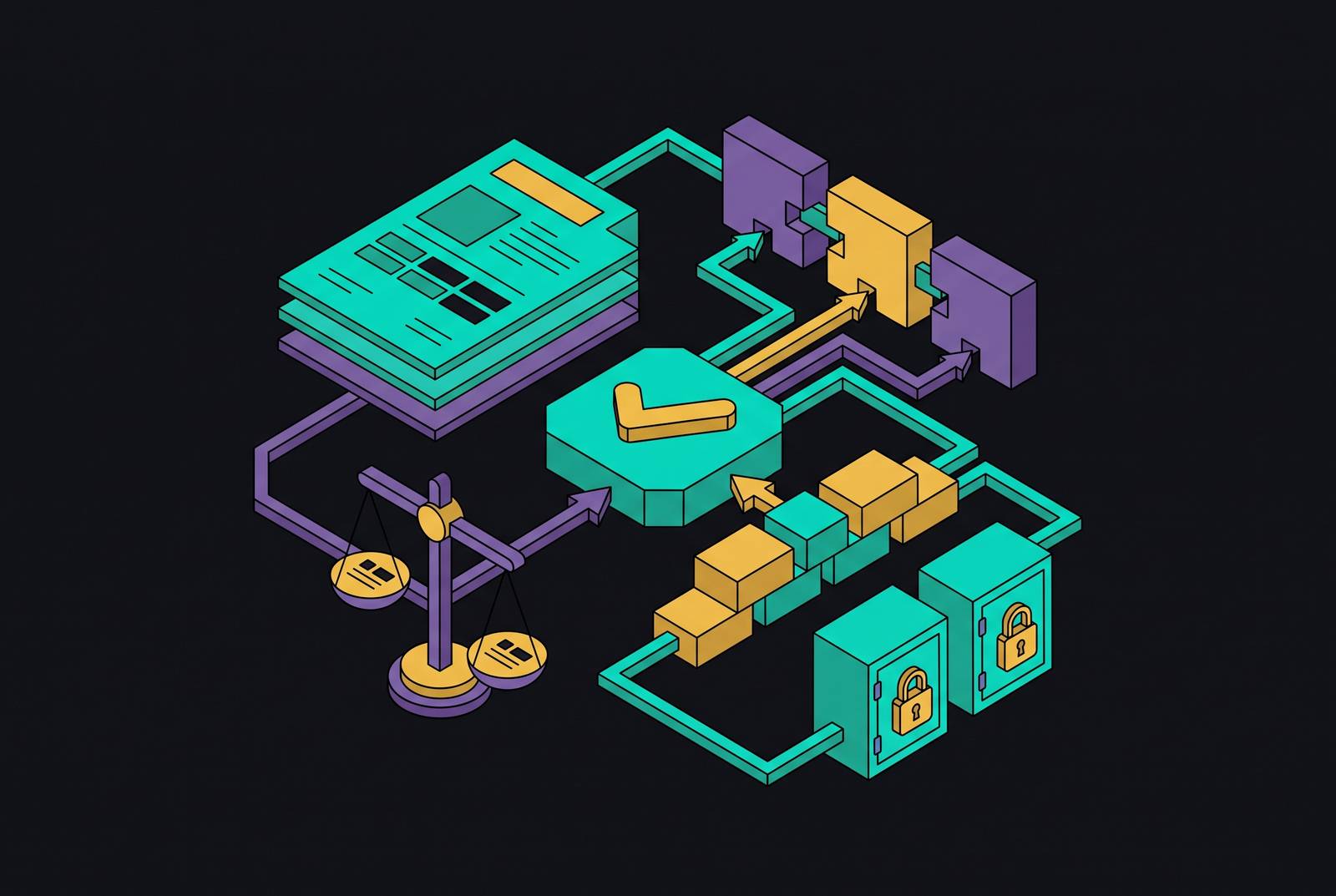
A framework tells an organization what to govern. NIST's AI Risk Management Framework, ISO/IEC 42001, the EU AI Act itself: these define the territory of accountability, risk classification, testing, and monitoring. A policy template is the document that turns that territory into instructions an employee or a system can actually follow. Think of it as the difference between a map and turn-by-turn directions. You can own both and still get lost if only one of them exists.
NIST's AI RMF gives templates a natural spine: Govern (who's accountable and how), Map (what risks exist in this specific context), Measure (how those risks get tested and tracked), and Manage (how they get prioritized and treated). ISO 42001 sits alongside this as the international standard for an AI management system, covering bias detection, risk treatment, transparency, and lifecycle oversight. For an organization that has to prove its governance posture to an auditor or a procurement team, ISO 42001 certification does real work. It's not a badge for the website.
A workable template has to speak to five overlapping compliance regimes at once: SOC 2, GDPR, HIPAA, the EU AI Act, and NIST AI RMF, each with its own evidence requirements and audit rhythm. A policy is a rule. A framework decides how rules get made, enforced, and revised. The template is where that line turns into paragraphs someone can actually be held to when something goes wrong.
The core sections every regulated-industry AI policy template must contain
Six components show up in any serious enterprise AI governance document, and skipping one isn't a stylistic choice. It's a gap an auditor will find, usually on the day you least want them to.
Policy development covers acceptable use, data handling, model development standards, third-party AI rules, and incident response. Risk assessment covers the use-case inventory, risk classification, control mapping, and vendor evaluation. Compliance alignment maps regulatory requirements against actual controls and keeps an audit trail current. Technical controls handle access management, data loss prevention, prompt and output filtering, logging, and model security. Ethical guidelines set fairness testing standards, human oversight thresholds, and transparency requirements. Continuous monitoring closes the loop with automated tracking, scheduled reviews, and metrics tied to named owners, not to "the team."
Risk classification carries the most weight of the six, because it decides everything downstream. The EU AI Act's risk tiers need to show up directly in the template's approval workflow. A high-risk classification carries obligations that go well beyond extra scrutiny, including conformity requirements that must be satisfied before the system ever touches production.
Accountability structures need names attached, not committees. "AI Governance Committee" on a slide is not accountability, it's a shrug with a letterhead. The template should specify roles across Security, Risk, Compliance, Legal, and Technology, so that when a model produces a harmful output, there's a person whose job it was to catch it.
Transparency documentation (model cards, algorithmic impact assessments, explainability mechanisms) has to satisfy two audiences at once: a compliance officer reading a regulatory filing and a business user trying to understand why a model denied something. The EU AI Act mandates explainability for high-risk systems specifically, so "the model said so" stopped being an acceptable answer the day that rule took effect.
Audit trail retention varies by regime, and it's worth getting the numbers right instead of rounding them together. SEC 17a-4 and HIPAA documentation generally point to six years, with some Medicare-related requirements extending to seven; the EU AI Act requires at least six months of logs for high-risk systems under Article 19, but ten years of technical documentation for high-risk systems. The trail has to record not just the decision, but the reasoning path that produced it.
Lifecycle coverage runs the full arc: data collection and quality checks, model development and bias testing, deployment approval gates, ongoing monitoring for drift, and retirement, with documentation retained well past the point the model stops running. Governance done right isn't a tax on speed. It's the thing that keeps speed from turning into a liability nobody budgeted for.
Healthcare-specific policy requirements and where the template sections get rewritten
Healthcare sits under HIPAA (penalties up to $1.5 million per violation), the HHS Office for Civil Rights' January 10, 2025 "Dear Colleague" letter on AI nondiscrimination under Section 1557, and, where clinical AI qualifies as a medical device or falls under Annex III, the EU AI Act's high-risk tier. The risk classification section of a healthcare template needs an explicit trigger list: which clinical use cases automatically pull a system into high-risk territory, spelled out, not implied.
Data handling gets rewritten almost line by line. The acceptable use section has to say, in plain language, that protected health information never goes into a public or free-tier AI tool, and it should name what that means concretely: patient summaries, diagnostic images, prescription records. Vendor contracts need HIPAA Business Associate Agreements with AI-specific language covering training data use and model retention, and any system trained on or processing PHI needs documented data lineage.
Human oversight thresholds matter more here than almost anywhere else. The ethical guidelines section needs to define exactly which clinical AI outputs require a clinician's sign-off before anyone acts on them. That isn't optional flavor text, it's both an EU AI Act high-risk obligation and a patient safety requirement that predates the regulation by decades. Explainability follows the same logic: clinicians and, in some cases, patients have a claim to understanding an AI-influenced decision, so the transparency section has to specify the actual format of that explanation and how long it's kept on file.
Audit trails run HIPAA-adjacent retention windows (six to seven years) and stretch to ten years for high-risk EU AI Act systems, but the trail also has to be queryable by patient record, not just by system log timestamp. That's a different engineering requirement than most templates account for, and it usually gets discovered the hard way, during discovery.
Shadow AI is where healthcare gets genuinely dangerous, not just embarrassing. A nurse or resident pasting patient notes into an unsanctioned chatbot isn't a policy infraction, it's a HIPAA breach the moment it happens, no grace period, no benefit of the doubt. The acceptable use section needs a named prohibition list (consumer LLM interfaces, free-tier coding assistants) paired with a sanctioned tool registry employees can actually use instead of working around the rules out of sheer inconvenience.
Financial services-specific policy requirements and where the template sections get rewritten
Financial services runs on a different regulatory stack: OCC Bulletin 2011-12, the Fed's SR-11-7 guidance, FINRA Reg Notice 24-09 from 2024, and the EU AI Act's high-risk classification for credit and insurance models. Model risk management is the section most generic templates skip entirely, and it's the one examiners ask about first. That's not a coincidence.
That section needs a documented validation requirement (independent review before anything goes to production), a named model risk management committee with actual sign-off authority spanning risk, compliance, and business stakeholders, and a stated drift threshold that automatically triggers re-validation instead of leaving that call to whoever happens to notice on a Tuesday. A major investment bank's SR-11-7 implementation, built around formal approval gates requiring sign-off from all three groups before release, is roughly what this section should look like on paper.
Fair lending adds a testing obligation the risk assessment section has to carry explicitly: credit and underwriting models need disparate impact testing, with the methodology, dataset, and outcome documented, not just asserted after the fact. Vendor coverage extends the same scrutiny outward. Any third-party or vendor-supplied AI needs audit rights written into the contract, because a representation clause without audit rights is just a promise with a signature on it.
Audit trails follow SEC 17a-4's six-year minimum, stepping up to ten years for EU AI Act high-risk systems, and trade surveillance logs need to stay separately addressable from credit decision logs. On shadow AI, some organizations responded to shadow AI incidents by issuing outright bans, and the instinct is understandable but wrong. A ban just pushes the behavior further underground, where nobody can see it or log it. The industry is converging, correctly, on sanctioned-tool approval workflows instead: give people a fast, approved option and most of them will actually use it.
Shadow AI as a template gap most regulated organizations have not closed
Shadow AI is the gap nearly every existing template has, whether it admits it or not. The population with the most privileged access inside a company is also, reliably, the population most likely to route around policy when the sanctioned tool is slower than the free one sitting in a browser tab. Most templates in circulation don't have an enforcement mechanism for acceptable use. They have a paragraph, and a paragraph doesn't stop anyone from pasting a spreadsheet into a chatbot at 11pm before a deadline.
Picture the actual mechanics of it. An employee pastes customer financial data into a free consumer LLM because it's faster than logging into the sanctioned tool. A developer wires an agentic workflow into internal APIs without anyone from security in the room. A business team stands up an automated process on someone's personal AI account because procurement takes six weeks to approve anything. None of this looks like sabotage. It looks like people trying to get their jobs done, which is exactly why it's so hard to police with a memo.
The cost isn't abstract. A shadow AI breach takes longer to detect than a standard security incident and costs more once found, and it disproportionately exposes customer PII and intellectual property rather than, say, internal memos nobody cares about. Closing the gap means the acceptable use and technical controls sections have to do more than warn. A sanctioned tool registry, built as an approval workflow rather than a ban list, gives employees somewhere to go instead of somewhere to hide. Certain categories of data need a blanket rule against ever leaving the organization's own systems without explicit sign-off, no exceptions carved out for "just this once."
Detection has to be real: data loss prevention rules, prompt filtering, logged AI interactions, not a policy PDF nobody reads past page one. And there should be a disclosure path where an employee can say "I'm using this tool and it hasn't been reviewed" without it turning into a disciplinary conversation, because that single mechanism turns shadow AI from a hidden liability into something governance can actually work with. Any template that treats shadow AI as a footnote instead of its own section needs a rewrite, not an addendum.
Prompt injection and runtime threat controls the template must specify
Prompt injection is the security problem eating enterprise AI deployments alive right now, and the OWASP Top 10 for LLMs lists System Prompt Leakage as its own numbered risk category (LLM07:2025) for good reason. Policy language alone does nothing against it. Attackers given enough attempts get through the best-defended models more often than most security teams would like to admit, and that success rate climbs, not falls, the more attempts they're given.
These aren't hypotheticals sitting in a research paper. EchoLeak, tracked as CVE-2025-32711 and disclosed in June 2025, was a zero-click vulnerability in Microsoft 365 Copilot: a crafted email sat in a user's inbox, and the moment Copilot pulled that email into context during a normal query, it silently exfiltrated sensitive organizational data. No unusual user action required. Just ordinary use of the tool, doing exactly what it was built to do, which was the entire problem.
The technical controls section of the template has to specify these controls, not gesture at them as good ideas someone might get to. Input validation and prompt filtering belong at the AI layer itself, built in from the start, not bolted on after the first incident report lands on someone's desk. PII needs to be detected and redacted before it ever reaches model context. Secrets (API keys, credentials, tokens) need real-time scanning and blocking, no exceptions for internal tools that "should be fine."
Execution needs to be logged in a way that shows not just that a prompt went in, but what the model actually did with it: reasoning chains, confidence scores, execution graphs an auditor could actually follow line by line. System prompts should never carry secrets or authorization logic, which is precisely the exposure vector OWASP flagged under LLM07:2025. Retrofitting real-time threat detection after something breaks is harder technically than building it in from day one, and it's indefensible in front of a regulator once the EU AI Act's audit regime is fully in force. Build it early or explain yourself later. Those are the two options.
Access control, identity, and RBAC policy language that scales across an enterprise
Most AI rollouts start with broad access because fine-grained permissions feel like friction nobody wants at launch. That instinct is backwards, and it's the first thing that should change once a system leaves the pilot stage. The template's role-based access control language is where that correction actually happens, or doesn't.
Role definitions should map to existing job functions, not to some new AI-specific taxonomy that somebody then has to maintain forever as a second, parallel system nobody remembers to update. An AI tool should get access only to the systems and data its assigned role actually requires, on a least-privilege basis: the same principle that's governed enterprise identity management for two decades, now finally catching up to the tools that got deployed faster than anyone thought to fence them in.