AI Acceptable Use Policies in Multi-Team Enterprises
Enterprises need layered AI policies, not one document, to prevent shadow AI breaches.
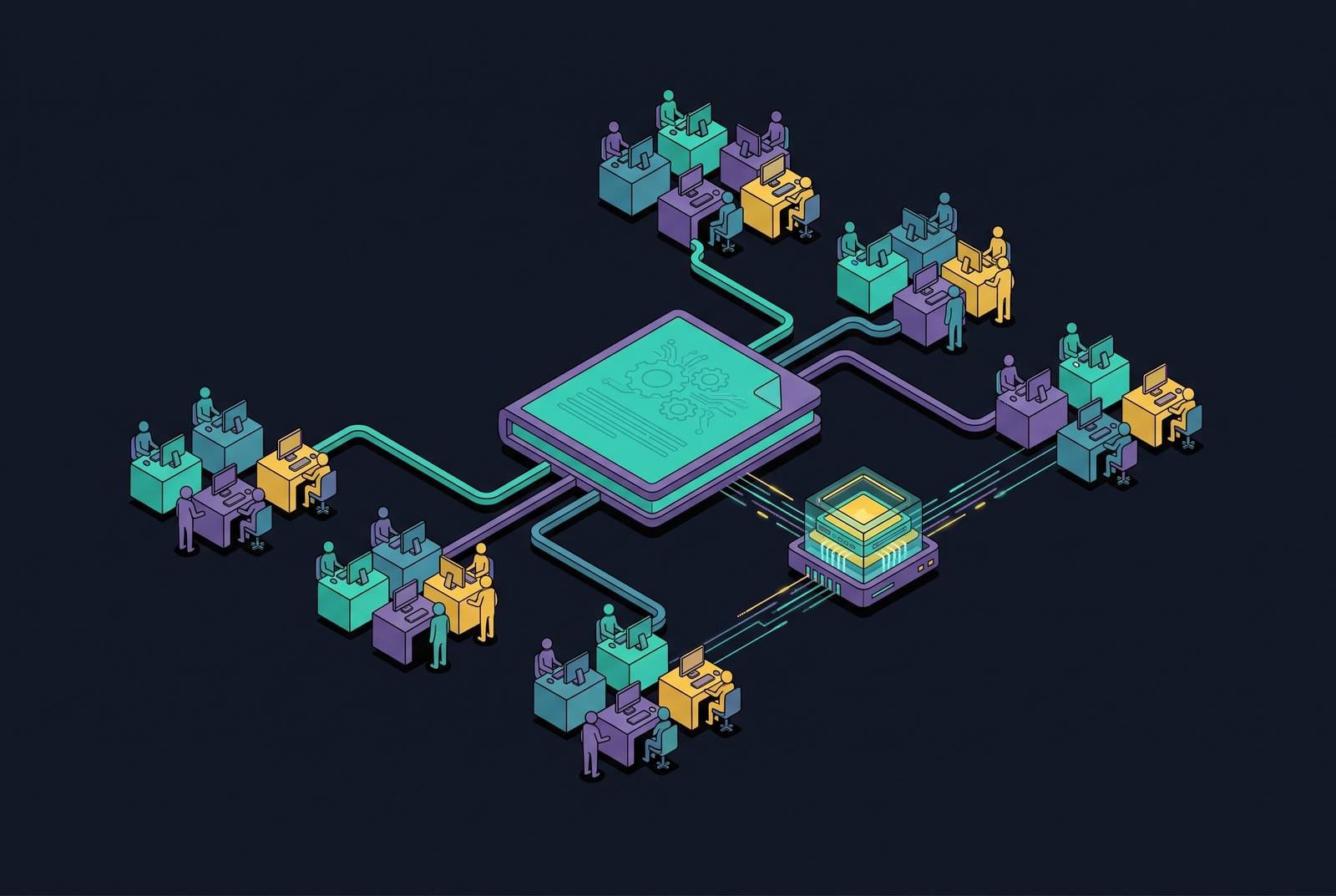
One AI acceptable use policy cannot govern an enterprise. It can govern a department, maybe, on a good day, if that department has one tool and one data type and nobody in it gets creative. Put that same document in front of a legal team, a data engineering group, and a marketing shop, and it either overshoots or undershoots two of the three by a wide margin. The fix isn't a better single document. It's a layered system: one baseline for everyone, team-specific rules on top of it, and enforcement built into identity and access infrastructure so the rules hold even when nobody's reading the PDF.
Most enterprise AUPs still get built the old way: one document, one approval cycle, dropped onto the intranet where it will be read exactly once, probably during onboarding, probably skimmed. That process assumes every team has the same risk profile. A legal team asking an AI tool to summarize contract language faces a wildly different exposure than a data engineering team pointing agents at a production database with write access. A marketer running copy through a consumer chatbot is not the same liability as a finance analyst feeding payroll data into a model to forecast headcount costs. Write the policy loose enough to cover the marketer, and the finance case slips through ungoverned. Write it tight enough to cover finance, and the marketing team starts finding workarounds within a week. Either way, the single document has already failed, it just hasn't been caught yet.
And that's the deeper issue: a document doesn't enforce anything. It states a rule. It cannot see who's violating that rule, cannot block the action in the moment, and cannot log what happened for later review. The problem is well recognized in enterprise AI governance literature: AI ethics divorced from governance produces policy theater, statements of intent with no enforcement mechanism, no way to measure adherence, and no consequence for ignoring it. Ponemon's research for IBM found that a majority of organizations surveyed still lack the AI governance policies needed to manage AI use or contain the spread of shadow AI in the first place. The gap isn't quality. It's that the thing often doesn't exist.
How shadow AI turns policy gaps into active security incidents
Shadow AI is any use of an AI tool, model, or service that IT or security never approved and doesn't know about. That covers a wide range: one employee pasting proprietary source code into a free chatbot on one end, an entire department quietly running unapproved plugins against sensitive customer data on the other. UpGuard's 2025 State of Shadow AI report puts the majority of employees in the "uses unapproved AI tools at work" bucket already, and the number climbs higher among security professionals, the people whose job is ostensibly to stop this.
Shadow AI is harder to catch than the shadow IT problem that came before it. Old shadow IT meant someone signing up for a SaaS tool on a company card, something a decent expense audit could catch. AI shadow use often lives inside a browser extension, or inside an AI feature quietly bolted onto a SaaS product that was already approved, meaning the AI functionality itself was never separately vetted. Harmonic Security's 2025 analysis of over 22 million enterprise prompts found a significant share of prompt data exposure happening through personal free-tier accounts, completely outside IT's field of view. Nobody's watching a channel that was never known to exist.
Samsung remains the case study every enterprise security team cites, because it's clean and it's ugly at the same time. Employees put sensitive source code into ChatGPT, and the company responded by restricting generative AI tools company-wide. One person's convenience became the entire org's incident. IBM's 2025 Cost of a Data Breach Report makes the pattern explicit: 97% of organizations that suffered an AI-related breach lacked proper AI access controls beforehand. The breach population and the ungoverned population are nearly the same population. Gartner projects that more than 40% of enterprises will hit a security or compliance incident tied to unauthorized shadow AI by 2030, and IBM's 2025 data shows only a minority of enterprises currently have any policy in place to manage it, let alone detect it.
The design implication is blunt: if an employee can route around a policy by opening an incognito window or logging into a personal account, that policy isn't a policy. It's a suggestion with a legal disclaimer attached. Enforcement has to sit in the infrastructure, not the document.
The regulatory pressure that makes multi-team AUP gaps a compliance exposure
Three frameworks now converge on most enterprise AI programs at once, and they don't converge neatly. NIST's AI Risk Management Framework organizes around four functions, Govern, Map, Measure, Manage, and has become the default reference point across U.S. industry because it's flexible enough to bend to a given sector. ISO/IEC 42001, Clause 5.2 specifically, requires senior leadership to formally approve and maintain an AI policy, not delegate it downward and forget about it. The EU AI Act is the one with teeth: it's legally binding and risk-tiered, bans on prohibited practices took effect in February 2025, obligations for general-purpose AI models followed in August 2025, and most remaining duties, including transparency requirements, land on August 2, 2026. High-risk system rules carry their own extended compliance timelines stretching further into the decade. Fines run up to €35 million or 7% of global turnover, whichever stings more. AI literacy training across staff has been a live obligation since February 2025, with national authorities set to start enforcing it from August 2026.
Layer in sector rules and the picture gets tighter still. HIPAA requires AI to run locally or through enterprise services with a signed BAA when protected health information is anywhere nearby. CMMC demands data classification and access control for defense contractors touching controlled unclassified information. ITAR locks down technical data tied to defense exports. FERPA governs anything touching student records. FOIA means a government employee's AI chat log might be as discoverable as their email, a detail that surprises people right up until it doesn't. Colorado's AI legislation, which has continued to evolve through 2026, adds its own requirements for consequential automated decisions.
Meanwhile the federal posture flipped in 2025 with Executive Order 14179, "Removing Barriers to American Leadership in Artificial Intelligence," loosening federal pressure even as individual states keep legislating in the opposite direction. A multi-state enterprise now has to track a patchwork that changes at the border, sometimes at the department. The legal team needs GDPR and EU AI Act alignment. The defense contracting group needs CMMC and ITAR. The healthcare division needs a BAA before it touches a single medical record. One document cannot hold all three requirements at once without one of them getting shortchanged. Gartner surveyed 360 IT application leaders between May and June 2025, and only 13% strongly agreed they had the governance structures in place to actually manage AI agents. Awareness of the regulatory map is not the same as having built the road.
What a layered AUP system actually consists of
A framework sets out how rules get made, enforced, measured, and revised over time. A policy states one rule and stops there. Enterprise AI governance needs the former, and most enterprises currently have the latter, which is roughly the gap between a constitution and a sticky note.
The structure that closes that gap runs in three tiers. Tier one is the enterprise baseline: the rules every employee follows regardless of team, covering which tools are sanctioned, which categories of data (trade secrets, PII, credentials, privileged legal material) can never touch any AI system, which use cases are flatly prohibited (autonomous decisions affecting someone's employment, discriminatory profiling, social scoring), who's accountable when an AI output goes wrong, how incidents get reported, and the baseline AI literacy training the EU AI Act has required since February 2025.
Tier two is team-specific. Legal gets an approved tool list for contract analysis and a hard rule against uploading unredacted client documents to any cloud model. Engineering gets approved coding assistants, restrictions on what codebases can leave the building for an external model, and supply chain checks on AI-adjacent packages before they get pulled into a build. Finance blocks AI-generated content from entering financial statements without a human sign-off and keeps an audit trail proving that review happened. HR sets human oversight thresholds anywhere AI touches hiring or performance evaluation.
Tier three is the part that actually makes tiers one and two real: enforcement infrastructure. Identity-tied access decides which tools, models, and MCP servers a given user can reach. Real-time controls filter PII and secrets and block risky prompts before they leave the building. Every tool call, prompt, and output gets logged and attributed to a person, reviewable later. Policy-as-code turns the governance rules into actual configuration rather than a paragraph someone is supposed to remember. A working AI governance program needs to knit together several components: policy development, risk assessment, compliance alignment, technical controls, ethical guidelines, and continuous monitoring. Miss one and the other five are working with a hole in the middle.
The organizing principle underneath all three tiers is proportionality. A chatbot answering internal FAQ questions doesn't need the same scrutiny as a model deciding whether to approve a loan or flag a medical claim. Governance that treats both the same way either smothers the low-risk case or leaves the high-risk one exposed.
Building the enterprise baseline: what belongs in every team's AUP regardless of function
ISO/IEC 42001 Clause 5.2 and NIST's Govern function both point toward a similar minimum kit, even though they arrive from different directions. A sanctioned tool list, with a real process for requesting new additions rather than a bottleneck that guarantees shadow AI as the workaround. Data classification rules spelling out exactly which categories, credentials, API keys, PII, privileged legal material, trade secrets, regulated health data, can never enter any AI system, sanctioned or not. Prohibited use cases named explicitly: autonomous decisions with material legal or employment consequences, anything the EU AI Act bans outright, discriminatory profiling dressed up as personalization. A named owner for AI outputs, whether that's the individual employee, a team lead, or a designated AI risk owner. A reporting path for suspected exposure or violation that doesn't route through three layers of management before reaching someone who can act. And a review cadence, because a policy published once and never revisited is already a policy that's falling behind the tools it's supposed to govern.
Ethics belongs inside this baseline, not off in a separate values statement nobody reads twice. Governance without an ethical foundation has no basis for deciding which behaviors to reward and which to shut down. Ethics without governance is a mission statement with no teeth. The two need each other or neither does anything.
Accountability has to span functions that don't naturally sit in the same room: Security, Risk, Compliance, Legal, Technology, each represented, each with a defined escalation path for when an AI system causes actual harm. Transparency belongs at this level too, meaning the enterprise documents, at minimum, how models are used, what data they touch, and what their known limitations are, even as the specific tools vary team to team underneath that documentation.
Mature organizations have started naming a Chief AI Officer to own this baseline and keep it from drifting, working alongside the CISO, the CDO, and other technology leaders rather than absorbing their jobs. Whatever the title, the baseline needs one accountable name attached to it. A policy with no owner ages the way milk does.
How risk classification determines what each team's AUP layer must add
Risk classification is the gate that decides what gets added on top of the baseline for each team. The EU AI Act's risk-tiered model is the most rigorous external template available for doing this sorting, and it's worth borrowing even for organizations outside EU jurisdiction, since the logic scales down cleanly.
Running the classification starts with an honest inventory: every AI tool actually in use across the org, including the ones nobody formally approved, because that's exactly where shadow AI surfaces. For each tool, ask what data it touches, what decisions it influences, and what happens if it gets something wrong. Sort each use case accordingly: high-impact, regulated data, or autonomous decision-making gets the strictest controls, and general productivity work with no sensitive data touches only the baseline.
That sorting produces concrete triggers. A high-risk designation means mandatory human oversight, audit trails on every output that feeds a decision, a conformity assessment where the EU AI Act requires one, and sign-off from an internal review board before deployment. A regulated-data designation triggers data residency requirements, a BAA or its equivalent with the vendor, and a flat ban on free-tier or personal-account tool use for that workflow. Everything else stays on baseline controls with periodic review instead of continuous monitoring, because not every use case needs a camera pointed at it around the clock.
Most organizations start this process from what amounts to Level 1 chaos: no formal AI governance, shadow AI everywhere and untracked, and a response posture that only kicks in after something's already gone wrong. Risk classification is the first real step out of that hole. Gartner's Q2 2025 survey found that organizations running a dedicated AI governance platform were 3.4 times more likely to hit high effectiveness in governance than those without one, and the classification work is exactly what tells that platform what to enforce, team by team. None of this is a one-time exercise, either. As a model scales or a team's use case grows more complex, the classification needs revisiting, which means governance is a versioned record, not a plaque on the wall.
Identity and role as the enforcement mechanism that replaces document-based compliance
The 97% figure from earlier is worth sitting with for a second: organizations that suffered an AI-related breach were almost all missing proper access controls, meaning the signed AUP sitting in someone's HR file did nothing to stop the incident. A signature is not a control. A permission is.
The working model flips enforcement onto identity. A user's role inside the enterprise identity provider determines which AI tools, models, agents, and MCP servers that person can actually reach, which means the policy is expressed as an access configuration rather than a paragraph of advisory text someone read once. Role-based access control does the heavy lifting here: a junior analyst reaches approved productivity tools and nothing more, a data engineer reaches approved coding assistants and internal data APIs, a system administrator reaches privileged integrations the analyst never sees. Whatever data the AI can pull on a user's behalf stays bounded by that same user's existing data permissions. AI doesn't hand anyone a new set of keys, it just uses the ones they already carry. And as agentic workflows spread, which MCP servers a given role can even invoke needs to be explicitly provisioned rather than left open by default, because "open by default" is how a contained problem becomes a company-wide one.
This model works because it plugs into identity infrastructure that already exists: Okta, Microsoft Entra ID, SAML and OIDC, rather than standing up a second, parallel identity system nobody asked for. The Enterprise-Managed Authorization extension to the MCP spec, which went stable on June 18, 2026, formalizes exactly this for agentic workloads: the enterprise identity provider becomes the authoritative source for MCP server access, a user authenticates once through the identity system already in place, and the provider automatically hands out access to whichever MCP servers that role is cleared for. No separate approval queue, no PDF to route around.
AI agents raise a distinct identity question the industry hasn't fully answered yet. Agents are already running inside the majority of organizations, but a formal strategy for managing their non-human identities, what they're allowed to touch, how their access gets revoked, who's accountable when one misbehaves, remains rare. That gap is where the next round of shadow AI incidents is most likely to originate, and it's the reason identity, not documentation, has to be the foundation the rest of the AUP system sits on.