AI Governance Maturity Model for Enterprise Rollouts
Governance matters more than capability—and most enterprises haven't built it yet.
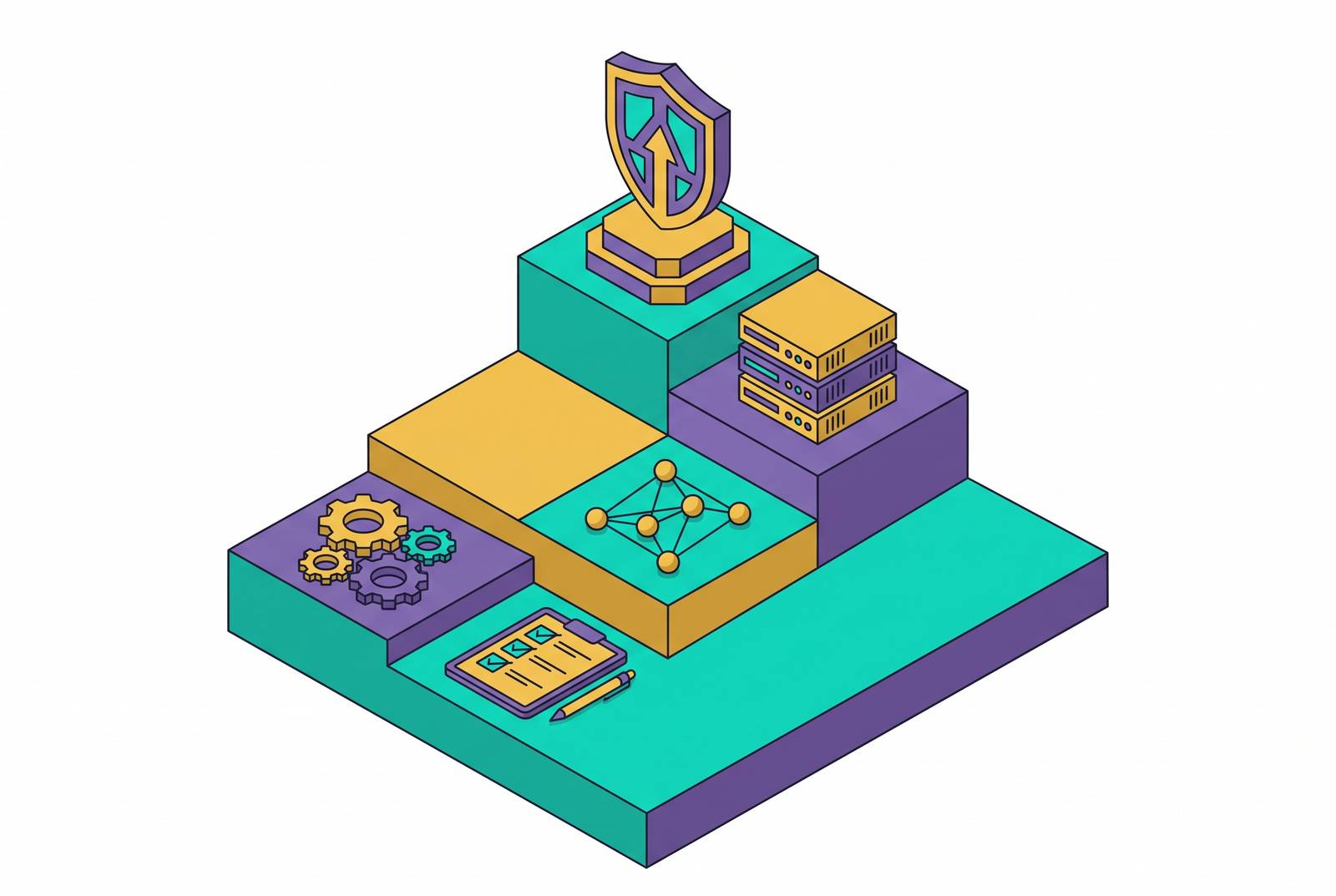
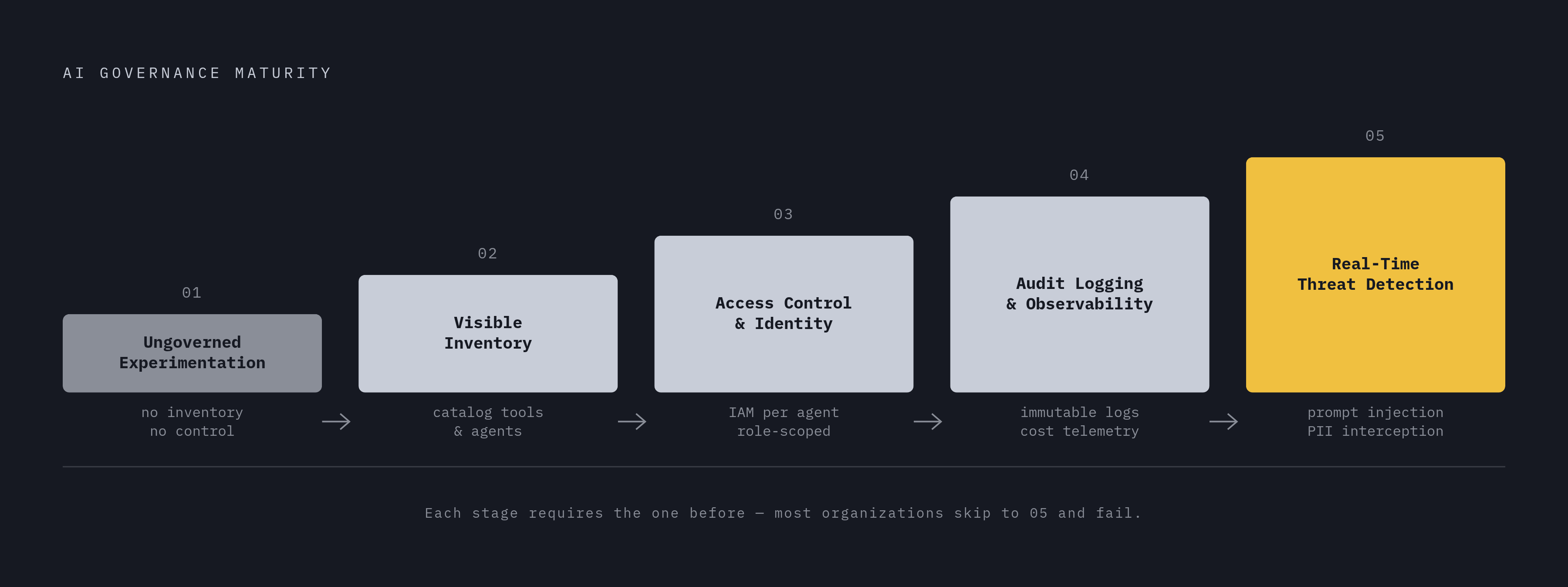
Enterprises keep confusing "AI running in production" with "AI under control," and that confusion is expensive. This piece lays out a governance maturity model built on one idea: the question worth asking isn't how capable an organization's AI is, it's how governed the infrastructure underneath it happens to be. Each stage below is defined by access control, audit logging, threat detection, and identity integration, not by which model an organization licensed. A company can run the most sophisticated agentic system on the market and still sit at Stage 1, because sophistication and governance are different variables that keep getting treated like the same one. They are not, and the gap between them is where the money disappears.
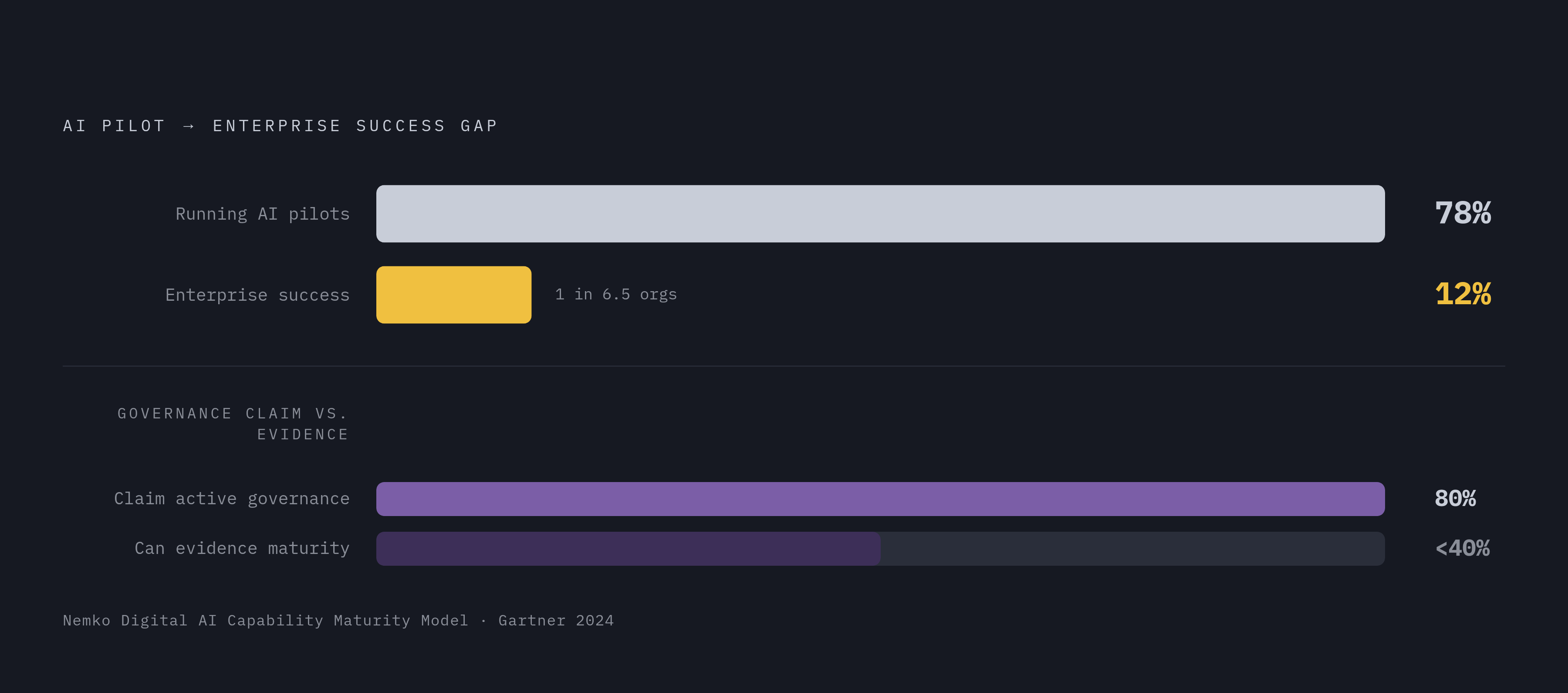
Engineers call this the "POC graveyard": hundreds of pilots launched with real budget and real enthusiasm, a handful surviving contact with production. Nemko Digital's AI Capability Maturity Model research puts the number at 78% of organizations running AI pilots against 12% reaching real enterprise success. That gap isn't a model quality problem. GPT-4-class and Claude-class models are good enough for most of what pilots attempt. The failure sits in the plumbing nobody wants to build, because plumbing doesn't demo well and nobody gets promoted for a tidy access control policy.
Gartner's 2024 survey caught the self-deception directly: 80% of large organizations claim active AI governance initiatives, but fewer than half can produce evidence of measurable maturity. Claiming governance and having it are two different exercises, filed under two different budget lines, run by two teams that rarely talk. Track the timeline and the pattern holds: 2023 was experimentation, 2024 was adoption, 2025 turned into governance, and 2026 is shaping up as survival, because regulators, boards, and insurers are now asking questions that "we ran a pilot" doesn't answer.
Agentic AI raises the stakes because agents don't just generate text, they invoke tools, touch external systems, and make decisions that ripple outside the chat window. Legacy maturity models were built for an era when AI meant a model sitting behind an API waiting for a prompt, and they never priced in that risk. Regulatory pressure has moved from "tell us you have governance" to "show us the receipts": the EU AI Act's conformity assessments, NIST's AI RMF, Vietnam's 2025 AI Law. The audit is coming, and self-reported maturity won't survive it.
What a governance-first maturity model measures, and why existing frameworks fall short
The PwC AI Capability Maturity Model (2020), Deloitte's AI Maturity Framework (2021), Gartner's AI Maturity Curve, and MIT CISR's Enterprise AI Maturity Model (Weill et al., 2024) all share the same blind spot. They measure how an organization builds AI capability, not how that capability behaves once it's live and making calls on its own. Strong on strategy decks, weak on runtime enforcement.
Reuel et al.'s 2025 Responsible AI maturity model gets closer, splitting system-level measures (fairness, reliability, privacy controls) from organizational process (governance, monitoring, risk management). Even so, the center of gravity stays pre-deployment. OneTrust's AI Governance Maturity Framework is the outlier that actually follows governance into production, into runtime enforcement, into autonomous systems making unsupervised calls, where most frameworks stop at policy documents and pre-launch review boards. NIST's AI RMF contributes a useful vocabulary, its four functions of Govern, Map, Measure, and Manage, but it's a taxonomy, not a staged path anyone can point to on a roadmap.
Almost none of them answer the question that matters once deployment happens: what does governed infrastructure look like while agents are actually running?
Four dimensions define each stage here. Access control: who, and which agents, can invoke which tools, on whose behalf. Audit logging: can the organization reconstruct what every AI call did, when, and why, after the fact. Threat detection: is there real-time visibility into prompt injection, PII leakage, and secrets exposure as it happens, not next quarter. Identity integration: are AI agents tied into the same identity fabric (Okta, Entra ID, SAML or OIDC) that already governs human access.
None of this lives purely at the technical layer, either. Dataversity's practical framework research found that organizations doing this well build cross-functional accountability, AI Ethics Boards, Data Steward Councils, Model Validation Committees, so governance decisions don't sit entirely inside one engineering team's Slack channel. The point worth repeating: maturity gets measured by the governance infrastructure in place, not by how clever the AI happens to be.
Stage 1, ungoverned experimentation: what is actually happening in most organizations right now
Picture the average mid-size enterprise on a random Tuesday. Developers run Cursor, Claude, and Copilot against production codebases. Marketing has a favorite consumer GenAI tool nobody in IT has heard of. Finance found a way to pipe spreadsheets into a chatbot that promises to "automate reconciliation." None of it shows up in a central inventory, because no inventory exists.
That's Stage 1, and the defining trait isn't bad AI use. It's that nobody in a position to govern it knows what's running. Access control is nonexistent: each team wires its own tools into internal systems ad hoc, the way a teenager wires speakers into a car stereo, more enthusiasm than diagram. There's no audit logging, so no record of what prompts went out or what data came back. AI tools sit entirely outside the identity perimeter, and no threat detection layer catches PII, secrets, or proprietary data as it drifts through a browser extension nobody approved.
Shadow AI is the tell. Ninety-eight percent of organizations report unsanctioned AI use somewhere inside the building, and Gartner's survey of 302 cybersecurity leaders, fielded March through May 2025, found 69% suspect or have direct evidence that employees use prohibited public generative AI tools at work. IBM's 2025 research found only 37% of organizations have any policy at all for managing or detecting shadow AI. Most companies aren't failing at enforcement. They never wrote the rule to begin with.
None of this stays theoretical once the invoice arrives. IBM's 2025 Cost of a Data Breach Report found shadow AI added an average of $670,000 to breach costs and was a contributing factor in 20% of the breaches studied. LayerX's 2025 Browser Security Report found generative AI now accounts for 32% of all corporate-to-personal data movement. The AI chatbot is the biggest leak in the boat, and most security teams are still bailing water with the email DLP tool they bought in 2015.
None of this is a reason for shame, and it isn't a call to arms either. It's where almost every organization starts, and the data say most of them are still there. The job is to admit it plainly and start moving.
Stage 2, visible inventory: cataloging what AI is doing before trying to govern it
Governance can't start on a system nobody can see. Stage 2 exists to answer one question honestly: what AI tools, agents, and MCP servers are actually running across the organization right now, sanctioned or not.
The output looks like a catalog, not a policy. A centralized list of every AI tool and model in active use. A map of what each one touches, internal APIs, SaaS platforms, data stores. Detection tuned to catch shadow AI traffic that never routes through an approved channel, plus an early picture of exposure: which tools are ingesting PII, credentials, or proprietary source code.
Detection has to happen at the right layer, or it catches nothing worth catching. Shadow AI detection works best at the traffic layer, the point where AI calls actually get made, which is the job an AI gateway or control plane does. Speakeasy, for instance, is built as an enterprise AI control plane that governs agents and MCP servers at exactly that layer. Conventional CASB tools, built to inspect known SaaS traffic patterns, can struggle to catch AI interactions that happen through browser extensions, embedded AI features inside other SaaS products, or personal accounts sitting entirely outside corporate infrastructure. Browser-native platforms, including Cato Networks' Enterprise Browser, aim to close part of that gap by watching interactions instead of just network flows. Network-layer platforms, Netskope and Palo Alto Networks' Prisma SASE 4.0, which covers more than 6,000 generative AI applications, handle sanctioned traffic well but can be limited in visibility into unsanctioned shadow AI activity.
Then there's the agentic wrinkle nobody budgeted for. Anthropic's December 2025 ecosystem update counted more than 10,000 active public MCP servers, and enterprise teams connect to plenty of them without anyone centrally aware it's happening. The catalog problem isn't just which chatbot marketing is using anymore. It now covers every tool call an agent makes on its own initiative, without asking first.
Stage 2 ends when the organization can answer a simple question without guessing: what AI is running, touching what systems, with what data. Without that answer, Stage 3's policy engine has nothing to actually enforce.
Stage 3, access control and identity: bringing AI agents inside the IAM perimeter
AI agents have quietly become a second access channel into enterprise systems, running alongside human users, mostly invisible to the security stack, and in most organizations operating entirely outside identity and access management. Stage 3 is where that stops.
The requirements are specific. Every AI agent and MCP server needs its own identity, not a shared service account, not a static API key passed around in a config file like a house key under the mat. Role-based access control needs to route through the organization's existing identity provider, so AI access policy runs through the same infrastructure already governing human logins. Permissions need to be fine-grained: which agent can call which tool, on behalf of which user, under which conditions. And authentication has to hold up across agent-to-agent calls in multi-agent workflows, not just the simpler agent-to-system pattern most tooling was built for.
The June 2026 Enterprise-Managed Authorization extension to the MCP spec is the clearest sign this shift is formal now, not aspirational. EMA makes enterprise identity providers the authoritative source for MCP server access, so a user authenticates once through existing enterprise identity instead of juggling a separate credential for every agent they touch.
The enforcement point in practice is an MCP gateway, sitting between agents and tool servers, centralizing authentication, authorization, audit trails, and traffic management into one control plane. Gartner's emerging practices guidance recommends treating MCP the way organizations already treat any other API surface: put a gateway in front of it. Obot MCP Gateway, open-source and Kubernetes-deployed, gives administrators a centralized catalog of internal and external MCP servers with control over which teams can reach which servers. TrueFoundry earned a spot as a Representative Vendor in the 2025 Gartner Market Guide for AI Gateways, the only MCP gateway on that list that's part of a broader Gartner-recognized AI Gateway platform. Docker's container-native approach runs each MCP server in its own isolated container with cryptographic image signing, which works fine for local development but offers no RBAC, no audit logging, and no centralized access control once things move to production. Good trade for a laptop. Bad trade for a data center.
The volume argument settles any debate about whether this matters yet. Per enterprise earnings calls in August 2026, Datadog reported MCP tool calls up 22x since Q4 2025. Atlassian reported a 400% jump in MCP calls in a single quarter. Salesforce reported sixfold growth in agentic use through MCP and CLI calls combined. At that call volume, ad hoc access control isn't a policy gap anyone patches later. It's a structural failure waiting for the wrong afternoon.
Stage 3 ends when no agent or MCP server can touch a tool or a dataset without an authenticated, role-scoped identity that traces back to a specific human or system owner.
Stage 4, audit logging and observability: creating the record that proves governance is real
Access control alone proves nothing if the organization can't later show what happened. An agent might have stayed inside its permissions the entire time, but if there's no record of what it touched or what it returned, there's no audit trail, no compliance posture, and nothing to hand an incident response team at 2 a.m. when something breaks.
Stage 4 builds the record. Immutable per-call logs capture identity, tool invoked, sanitized input, output, timestamp, latency, and cost for every AI call. Session-level reconstruction lets a security team replay an agent's full decision chain, what it saw, what it called, what it returned, for any interaction under review. Cost and usage telemetry gets aggregated by team, model, agent, and use case, which is the only way "how much are we spending on AI" turns into an answerable question instead of a guess pulled off a cloud bill. The logging layer also doubles as raw material for behavioral baselines, feeding straight into the anomaly detection that shows up in Stage 5.
The regulatory case isn't flavor text. Organizations in regulated sectors have to demonstrate explainability, traceability, data provenance, and human oversight, not just assert those things exist somewhere in a policy binder. The EU AI Act and NIST's AI RMF both demand documentation that only exists if logging got built in from day one. Retrofitting audit capability onto AI that's already run ungoverned for a year is a much harder project than building the logging layer alongside Stage 3's access controls in the first place.
Pre-deployment testing complements the logging layer rather than replacing it. Luong Tuan and Sanyal's June 2026 framework for enterprise AI agent verification, tested through a controlled pilot spanning Fintech, Banking, Insurance, and Healthcare, generated 1,800 scenarios evaluated against 125 primary-source regulatory requirements with 25 deliberately injected faults. The finding worth sitting with: post-deployment monitoring offers limited assurance once an agent is already live, which makes pre-deployment audit gates a necessary companion to logging, not a substitute for it.
Cost visibility turns out to be the sleeper benefit. Figma reported MCP write usage up 75% in a single quarter, and at that volume, cost telemetry stops being a nice-to-have and becomes the only way finance can pin AI spend on the teams actually generating it.
Stage 4 ends when security, compliance, and finance can each independently verify what AI did, why it was authorized, and what it cost, pulling straight from logs instead of reconstructing events from memory and old Slack threads.
Stage 5, real-time threat detection: moving from logging what happened to stopping what shouldn't
Logging tells an organization what already went wrong. Stage 5 is about catching it mid-flight, and this is the stage most vendors want to sell first, which is exactly backwards.
Prompt injection sits at the top of the threat list. prompt injection is widely recognized as a critical agentic attack vector, and it comes in two flavors worth telling apart: attacks that exploit the prompt directly and those where malicious instructions are embedded in data the model retrieves (a poisoned webpage, a tampered document) and the agent follows them without knowing the difference between a user's intent and an attacker's plant. PII leakage is the second front: sensitive records, health data, financial details, moving out through AI tool calls with nothing intercepting them in transit. Secrets exposure is the third: API keys, credentials, and tokens that end up embedded in prompts or surface in agent outputs because nobody scrubbed them first. And the exfiltration numbers from Stage 1 haven't moved. Generative AI still accounts for 32% of corporate-to-personal data movement, per LayerX's 2025 research, making it a significant and growing leak point in the modern enterprise.
The distinction between Stage 4 and Stage 5 is the distinction between a security camera and a security guard. One records the break-in for later review. The other stops it at the door. An organization with airtight audit logs and no real-time detection has a well-documented incident report and nothing that actually prevented the incident.
That's the ceiling of this model, and the order of operations deserves to be stated bluntly: skipping to Stage 5 without Stages 2 through 4 in place is installing a burglar alarm in a house where nobody's bothered to lock the doors yet. The stages build on each other because each one supplies the infrastructure the next one needs to function. Inventory feeds access control, access control feeds logging, and logging feeds the detection models that make real-time defense possible at all. There's no shortcut through that sequence, no matter how good the sales pitch for the shiny detection tool at the top sounds.