MCP Protocol Versioning and Backward Compatibility Management
A date-based versioning scheme creates silent failures across enterprise MCP deployments.
MCP identifies its protocol version with a date string, not a version number, and that date marks the last breaking change rather than a release schedule. That single design choice, plus a governance structure that changed hands in December 2025, is why version mismatches now show up in production at every layer of the enterprise stack: client runtime, gateway, and server. Getting version negotiation wrong doesn't throw a clean error most of the time; it produces a tool call that silently fails or, worse, one that silently succeeds against the wrong assumptions. Understanding how the protocol actually negotiates versions, what already broke in past releases, and where the gaps surface is the difference between a governed MCP deployment and a pile of servers nobody can account for.
How version negotiation works at connection time
At connection time, the client proposes a protocol version during the initialization handshake, and the server responds with the version it intends to use for that session. Both sides can support several versions at once, but the session itself settles on exactly one. If there's no overlap, the protocol is supposed to fail cleanly: the client gets an error it can act on, rather than a connection that limps along in some undefined state.
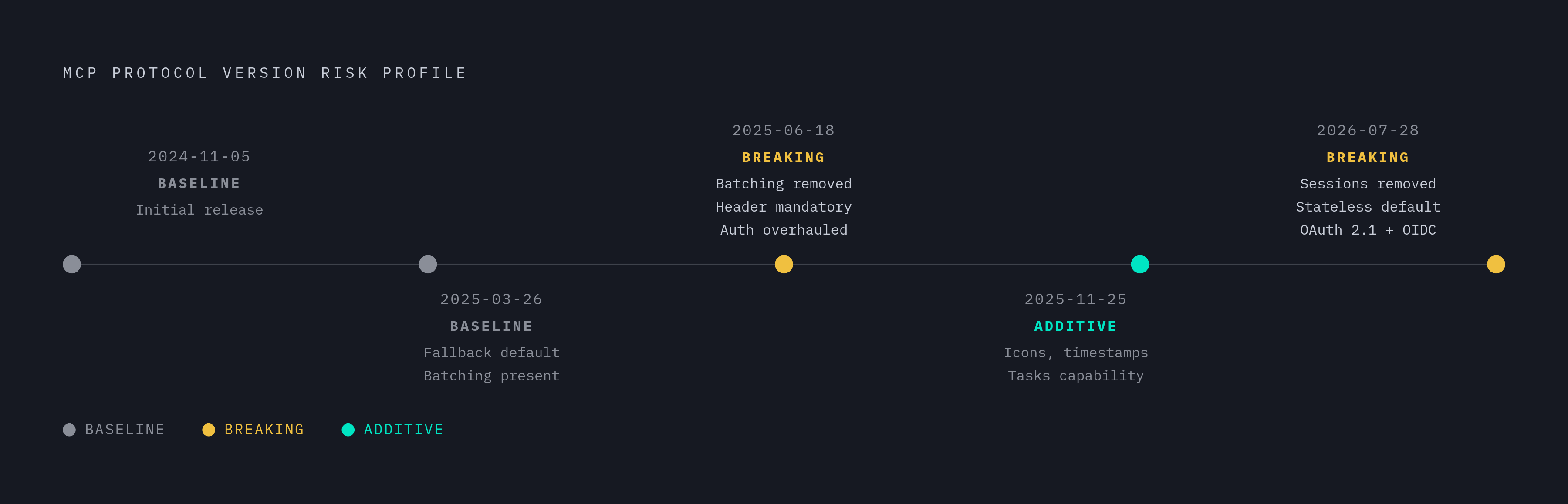
The 2025-06-18 revision added a specific fallback: if a request arrives over HTTP without the MCP-Protocol-Version header and the version can't be inferred another way, the server defaults to 2025-03-26. Think of it as a seatbelt, not a guarantee of safe driving, since it papers over a missing header but does not resolve a case where a client and server genuinely don't share a supported version.
The mcp-go library is a useful real-world illustration: it implements 2025-11-25 while keeping backward compatibility for 2025-06-18, 2025-03-26, and 2024-11-05, all in the same codebase. That's four version branches of behavior a single library has to track correctly. IBM's mcp-context-forge project has an open feature request asking for automatic protocol version detection and translation between versions, which tells you plainly that this is not solved yet across the ecosystem; it's requested, not shipped. Enterprises running a mix of client and server vintages should not assume the handshake resolves itself; they need an actual inventory of what's running where, and they need to have tested what happens when negotiation fails.
The breaking changes that have already shipped and what they broke
2025-06-18 is the cleanest example of a breaking change doing real damage if ignored. JSON-RPC batching was removed outright, so a client built against 2025-03-26 that depends on batching simply does not work correctly against a 2025-06-18-only server. Every HTTP request now has to carry the MCP-Protocol-Version header, which used to be optional or inferred. And the authorization model changed in a meaningful way: Protected Resource Metadata (RFC 9728) for discovering authorization servers, mandatory OAuth 2.0 Resource Indicators (RFC 8707), and required audience validation on tokens.
The 2026-07-28 release candidate goes further, and its own authors call it the largest revision since MCP launched. Sessions are gone, and the initialization handshake is gone with them. What replaces it is a stateless-by-default protocol, a genuinely different operating model from the session-oriented approach that came before. Three core features got formally deprecated, the first time MCP has used a real deprecation policy rather than just quietly dropping something. Teams that built on the experimental 2025 Tasks API now have a migration window to deal with, not an option to ignore. Authorization was rewritten again, this time to align with OAuth 2.1 and OpenID Connect, meaning MCP servers are now formally OAuth 2.1 resource servers. A new extension called Enterprise-Managed Authorization lets IT admins provision MCP access centrally through an identity provider, so a user logs in once and gets access without a chain of per-app OAuth prompts.
Compare that to 2025-11-25, which added optional features (icons, resource timestamps, an elicitation URL mode, a Tasks capability) without breaking anything already in place. Same versioning scheme, completely different risk profile. That alternation is the part enterprises tend to miss: not every version bump deserves the same response. Cloudflare's handling of its /mcp endpoint shows what taking this seriously looks like in practice. The endpoint accepts both the 2026-07-28 protocol and stateless requests from older 2025 Streamable HTTP clients at the same time, so most clients reconnect without any configuration change on their end. This dual-version handling didn't happen by accident; it was built deliberately, because nothing about MCP's versioning model makes that compatibility automatic.
Why MCP's governance shift changes the long-term versioning calculus
In December 2025, Anthropic handed MCP over to the Agentic AI Foundation under the Linux Foundation, with Anthropic, Block, and OpenAI as co-founders and AWS, Google, Microsoft, Cloudflare, and Bloomberg sitting among the platinum members. Four months later, AAIF had grown to 170 member organizations, a pace that outran CNCF's membership growth at the same point in its own lifecycle. This is not a footnote. It means MCP is no longer a protocol one company can quietly deprecate, fork, or steer; it now runs closer to how CNCF governs the infrastructure layer around Kubernetes.
That shift changes the question an enterprise buyer should be asking. It's no longer "will Anthropic change direction on this." It's "how does a 170-member standards process manage breaking changes without leaving half the ecosystem behind." The 2026-07-28 release, with its formal deprecation policy and its extensions framework, is the answer starting to take shape: extensions can now ship on their own timeline without forcing a spec-wide version bump every time.
Scale is what makes any of this consequential. MCP SDKs were pulling 97 million monthly downloads as of December 2025, and support spans essentially every major agent runtime in production: Claude Code, Codex CLI, Cursor, Gemini CLI, Cline, Windsurf, and the larger open-source agent projects. A breaking change at this footprint doesn't inconvenience one team; it ripples through a supply chain of agents, gateways, and internal servers that were never coordinated in the first place, which is exactly why the formal lifecycle policy exists now and didn't a year ago. The protocol is stable enough to build a business on, but the deprecation windows are commitments that need active tracking; treating them as background noise is how a team wakes up to a broken production integration on the exact date the spec said it would break.
Where version mismatches actually surface in enterprise deployments
The enterprise MCP stack has at least three independently versioned layers: the agent or client runtime, whatever gateway or proxy sits in the middle, and the MCP server itself. Each of those can be on a different spec version at the same time, and nothing forces them to line up.
Agent runtimes update on their own clock, unrelated to spec release dates. VS Code's Copilot MCP support hit general availability in July 2025; OpenAI's Agents SDK shipped MCP support back in March 2025. Neither of those dates has anything to do with when the spec itself last changed, which means the runtime a developer is coding against and the spec version their server implements can drift apart without anyone noticing until something fails.
SDK lag is its own separate headache from spec lag. Beta SDKs for the 2026-07-28 release candidate already exist in Python, TypeScript, Go, and C#, and the C# SDK's v2.0 implements 2026-07-28 while keeping backward compatibility. But a backward-compatible SDK is not the same thing as a backward-compatible deployment; if the server on the other end hasn't been touched, the SDK's compatibility guarantee doesn't help. Internal MCP servers, the ones wrapping internal APIs or SaaS connectors, are usually built and maintained by a completely different team than the one running the agent client that calls them. That's not a technical mismatch so much as an org chart problem wearing a technical costume.
Shadow AI makes the whole thing worse. If teams are standing up MCP servers without central visibility, there's no reliable answer to the question "which spec versions are actually running in production." And the 2025-06-18 header requirement is a small, concrete case study in how this bites: a required HTTP header sounds trivial, but an integration that was never built to send it just stops working, with no warning baked into the design.
What an MCP gateway contributes to version and compatibility management
An MCP gateway sits between the agents and the servers they call, and it becomes the one place authentication, authorization, routing, logging, and policy all pass through. Version management fits naturally into that job: a gateway can do version-aware routing, enforce a minimum supported version as policy, and stop a client running a deprecated spec version from ever reaching a production server. IBM's feature request for automatic version negotiation in mcp-context-forge is describing precisely this capability, which tells you where the gap in the market currently sits: gateways are becoming the expected home for this problem, even where the tooling to do it well is still catching up. Gartner's guidance on emerging MCP practices points the same direction, recommending gateway-centric architecture the same way it would for any other API surface.
A few concrete approaches show the range on offer. Speakeasy, for instance, is an AI governance and observability platform that manages and governs MCP servers across teams from a central control plane. Bifrost, an open-source project from Maxim AI, is an HTTP gateway deployable via Docker or NPX that supports in-VPC deployment, hierarchical budgets, rate limits, per-key tool allow-lists, and immutable audit logs built toward SOC 2, GDPR, HIPAA, and ISO 27001. MintMCP is SOC 2 Type II audited and HIPAA-compliant, and it turns a local MCP server into a production service with OAuth protection, credential management, and tool-level policy. Cloudflare folds its AI Gateway, MCP Server Portals, and Cloudflare Gateway into one security layer for MCP traffic, the same setup behind its dual-version handling of the /mcp endpoint. Microsoft Foundry centralizes governance, identity, and observability through a single MCP endpoint, built explicitly around the stateless operations and enterprise-managed identity model that 2026-07-28 introduces.
An enterprise AI control plane, purpose-built for this class of problem, offers a governed layer connecting agents to internal and external systems: identity-bound RBAC through Okta or Entra ID, real-time detection of shadow AI and prompt injection, and cost and usage telemetry, with version governance folded into that same layer rather than bolted on afterward. The 2026-07-28 EMA extension is meant to make gateway-mediated access the default path in the first place: log in once through the identity provider, and the required MCP servers are provisioned automatically, no per-app OAuth prompt and no ungoverned side-door connection bypassing the gateway. Whichever gateway a team picks, the standards to check against are OAuth 2.1, SAML, OIDC, and clean API token management; implementation quality on those points varies a fair amount across products, and that variance is worth testing before signing anything.
Security risks that version gaps directly enable
Running an old spec version means running without whatever security fix came after it, plainly. Anything still on a pre-2025-06-18 deployment lacks the audience validation and Resource Indicators (RFC 8707) that stop a malicious server from grabbing a token that was meant for a different server entirely. Anything short of 2026-07-28 lacks the full OAuth 2.1 alignment and Protected Resource Metadata that make the authorization model enterprise-grade.
CVE-2025-6514 makes the client side of this concrete. It was an OS command injection flaw in mcp-remote, rated 9.6 on CVSS, present in every version before v0.1.16, and documented as the first confirmed remote code execution against a real MCP client talking to an untrusted remote server. This was a real vulnerability, patched, in a widely used piece of the stack, not a theoretical proof of concept. The broader attack surface catalogued around MCP includes tool poisoning, rug pulls where a tool gets silently redefined between versions, tool shadowing, cross-server attacks, and prompt injection, and several of those get meaningfully easier against clients stuck on old spec versions without current auth controls.
A 2026 enterprise security survey found that the overwhelming majority of organizations had already had a confirmed or suspected AI agent security incident in the past year, while most executives believed their existing policies already had it covered. That gap between confidence and reality is exactly where outdated version exposure lives; nobody feels at risk until the incident report names the vulnerable component. One caution worth flagging: scanner-based counts of "how many MCP servers are vulnerable" vary wildly by methodology, and at least one independent audit found very high false-positive rates from YARA-based scanning tools. Any headline percentage claiming to quantify MCP server vulnerability at scale deserves a skeptical read and a source check before it gets repeated. The underlying logic, at least, is not in question: running a known-outdated spec version is a documented compliance gap, not a stylistic preference.
Building a version management posture that doesn't require constant manual intervention
Start with inventory. Nothing about version policy works until every MCP server in the environment, including the ones nobody signed off on, is catalogued with its actual spec version, and shadow AI is the reason this is hard: teams standing up servers outside any governed process are exactly where version drift goes invisible, right up until it breaks something or gets exploited.
A minimum supported version policy is worth stealing from how TLS minimum versions get enforced. Draw the line, and anything below it gets blocked or quarantined, not flagged for someone to look at eventually. Deprecation window tracking now matters in a way it didn't before 2026-07-28's formal lifecycle policy; deprecation dates are published commitments at this point, and teams need an actual process to receive, evaluate, and act on them before the window closes, not a habit of finding out after the fact.
The gateway is where all of this becomes enforceable rather than aspirational. Routing rules, header validation, auth enforcement, and audit logging hold up far better run centrally through one control point than scattered across per-team configuration on individual servers. Tying access to an existing identity provider, Okta, Entra ID, SAML or OIDC, is the piece that makes version-gated access happen at login instead of during a manual review three weeks later; the EMA extension in 2026-07-28 formalizes exactly this pattern at the protocol level, which is as close to an endorsement as a standards body gets.
Observability closes the loop. Real-time visibility into which agent is calling which tool, against which server version, at what cost, is what turns version management from a quarterly audit into something that runs continuously in the background. The goal, plainly stated, is reproducibility: a deployment that can be audited, rolled back to a known-good version, and upgraded on a schedule someone actually controls. This is the same discipline every API versioning strategy has demanded for two decades, and MCP just makes it non-negotiable a little sooner than most teams expected.