MCP Server Security Hardening for Production Environments
MCP servers now handle production data at scale, but most skip basic security controls.
Anthropic released MCP in November 2024. By early 2026 it had crossed 97 million SDK downloads and every major AI vendor had adopted it. This is not an emerging protocol anymore; it's plumbing, and plumbing that touches internal APIs, databases, and SaaS systems at scale needs to be treated like the production infrastructure it already is.
The numbers make the urgency plain. MCP SDKs now pull over 8 million weekly downloads, which means developers are shipping integrations faster than any security team could plausibly review them. The June 2025 spec revision moved MCP to a stateless architecture, clearing out the scaling bottlenecks that used to cap how fast this stuff could spread. That's the moment security gaps stop being theoretical: once the technical barriers to scale disappear, so does the excuse that this is all still experimental. IBM's 2025 Cost of a Data Breach Report puts a number on what's already happened: 13% of organizations have experienced a breach of an AI model or application. Not a projected risk. A recorded one.
There are over 5,000 active MCP servers listed in the Glama directory today, including 115 production-grade vendor builds and 300-plus community projects. No single control fixes a threat surface this wide. What follows is a layered picture, built around the specific places these servers actually break.
The actual vulnerability landscape across open-source MCP servers
Astrix Research looked at 1,899 open-source MCP server builds, and the results are the closest thing the ecosystem has to a baseline.
Credentials are the biggest mess. 88% of servers require them, and 53% lean on static API keys or Personal Access Tokens (the kind that live forever and get rotated never). Only 8.5% use OAuth, which is supposed to be the modern standard for this exact problem. Worse, 79% of those API keys get passed through environment variables, sitting in plain sight in config files and process listings for anyone who knows where to look.
Tool poisoning isn't a hypothetical either. That same 1,899-server study found 5.5% showed signs of it: altered tool descriptions, injected fake responses, data flows quietly rerouted somewhere they shouldn't go. At the scale MCP now operates, 5.5% is not a rounding error. It's thousands of servers.
The CVEs back this up with names and numbers attached. CVE-2025-49596, found in Anthropic's own MCP Inspector, had no authentication between the Inspector client and its proxy. Combine that with how browsers handle the address 0.0.0.0, and you get remote code execution just from visiting a bad webpage. No extra clicks required. CVE-2025-6514, in mcp-remote, forwarded OAuth redirect URLs without sanitizing them first, which turned a validation gap and a transport gap into one working exploit. Add to that the first confirmed malicious MCP server showing up in the npm ecosystem, and the assumption that open-source registries are safe by default is dead. Shodan scans in 2025 found dozens of MCP servers sitting exposed on the open internet, some of them wired directly into Gmail, Google Drive, Jira, and at least one open Postgres database with nothing standing guard.
Credentials, transport, tool behavior, dependencies, exposure: the vulnerability profile spans all five, and that's exactly why one fix never covers it.
Authentication as the foundation, not the finish line
The June 2025 spec made OAuth 2.1 the required standard for HTTP-based MCP transports and classified MCP servers as OAuth Resource Servers under RFC 8707. That's the floor for any production HTTP deployment now, not a suggestion. The spec also split authorization out as its own job, handled by a dedicated authorization server rather than bolted onto the MCP server itself.
Stdio transport plays by different rules. Client and server run as processes on the same machine, so the OS-level process boundary does the authenticating, and the host application handles access control instead of the server. OAuth isn't required here, but the host still needs to run hardened and the server still needs to run with the least privilege it can get away with.
Machine-to-machine setups add another wrinkle. When one MCP server calls another, or an agent runtime connects as a machine client, mutual TLS handles the authentication at the transport layer using client certificates on both ends, no bearer token needed. And certificate validation has to be strict about it: reject self-signed certs in production, check the full chain against a trusted CA. That's basic hygiene, not extra credit.
Here's the part that matters most: authentication is table stakes, not hardening. A server can enforce OAuth 2.1 perfectly and still run as root, still ship secrets in plain environment variables, still sit on a pile of unpatched dependencies. That's an authenticated server with a wide-open attack surface, and it's exactly why every layer after this one exists.
Transport security and network exposure
TLS 1.3 should be the floor for all HTTP-based MCP traffic. TLS 1.2 still allows downgrade attacks and weaker cipher suites, so it doesn't belong in a production stack anymore.
The Shodan findings aren't an edge case; they're the predictable result of developers standing up servers without anyone from network security in the room. Gmail, Google Drive, Jira, an open database, all reachable from the public internet because nobody restricted egress or drew a network boundary. An MCP server that can make arbitrary outbound connections is a lateral-movement risk the moment it's compromised, so egress should be locked to the specific tool backends it's declared to talk to. Treat these servers as privileged production services with their own network zones, not as another app dropped into the general pool.
CVE-2025-49596 is the cleanest case study here. No firewall got bypassed, no auth got cracked. The Inspector's proxy was simply reachable from the browser, and the browser's own handling of 0.0.0.0 did the rest. That's what a missing network control looks like in practice, and it's worth building a CI/CD gate that blocks any deploy missing TLS 1.3 configuration before it ever reaches production. High-risk operations (meaning anything that touches production data, credentials, or external write APIs) should require a manual approval step before they run, full stop.
Input validation, prompt injection, and tool poisoning defense
Prompt injection tops the OWASP Top 10 for Agentic Applications 2026, and it shows up across at least seven major frameworks: OWASP, MITRE ATLAS, NIST, the EU AI Act, ISO 42001, GDPR, and NIS2. When one framework flags something, that's a finding. When seven do, that's a consensus.
The blast radius is the real issue. AI agents move 16 times more data than a human user working the same task, so when an agent gets compromised, the damage scales with everything that agent was authorized to touch. This isn't abstract: CVE-2025-53773 used a hidden prompt injection buried in a pull request description to achieve remote code execution through GitHub Copilot, and it scored a 9.6 on CVSS, about as bad as these ratings get. EchoLeak, found in Microsoft 365 Copilot, pulled off zero-click prompt injection that quietly exfiltrated enterprise data with no user action at all.
Tool poisoning sits next to prompt injection but isn't the same thing. It's a malicious or altered MCP server changing its own tool descriptions to steer an agent's behavior somewhere it shouldn't go, and that 5.5% rate from the Astrix research means real exposure at enterprise scale. CVE-2025-6514 shows how these failures stack: the unsanitized OAuth redirect URL was both an input validation failure and a transport failure at the same time, which is usually how the worst exploits work.
The defense list is short but each item does real work. Validate every input against JSON-RPC schemas at the gateway or server boundary, before anything reaches tool logic. Keep an allowlist of permitted tool actions and deny everything outside it. Separate system instructions from user input at the architecture level, not just in how the prompt is worded. Run content filters at runtime that catch adversarial prompt patterns before the model ever sees them, and score tool reputation continuously, flagging anything whose description has changed since it was last checked.
The EU AI Act's August 2026 deadline turns all of this from best practice into paperwork. Security teams will need documentation showing mitigations mapped to specific frameworks, not just a general sense that things are handled.
Secrets management and least-privilege access control
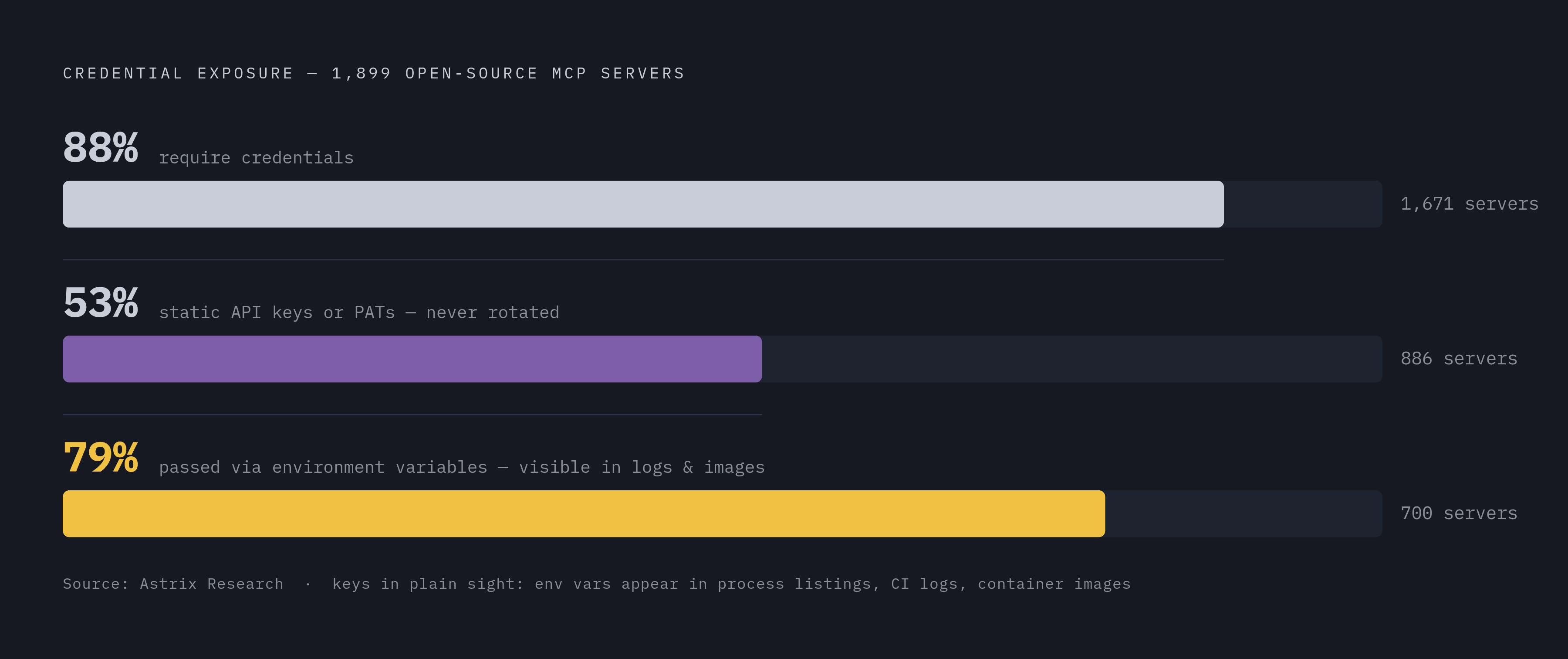
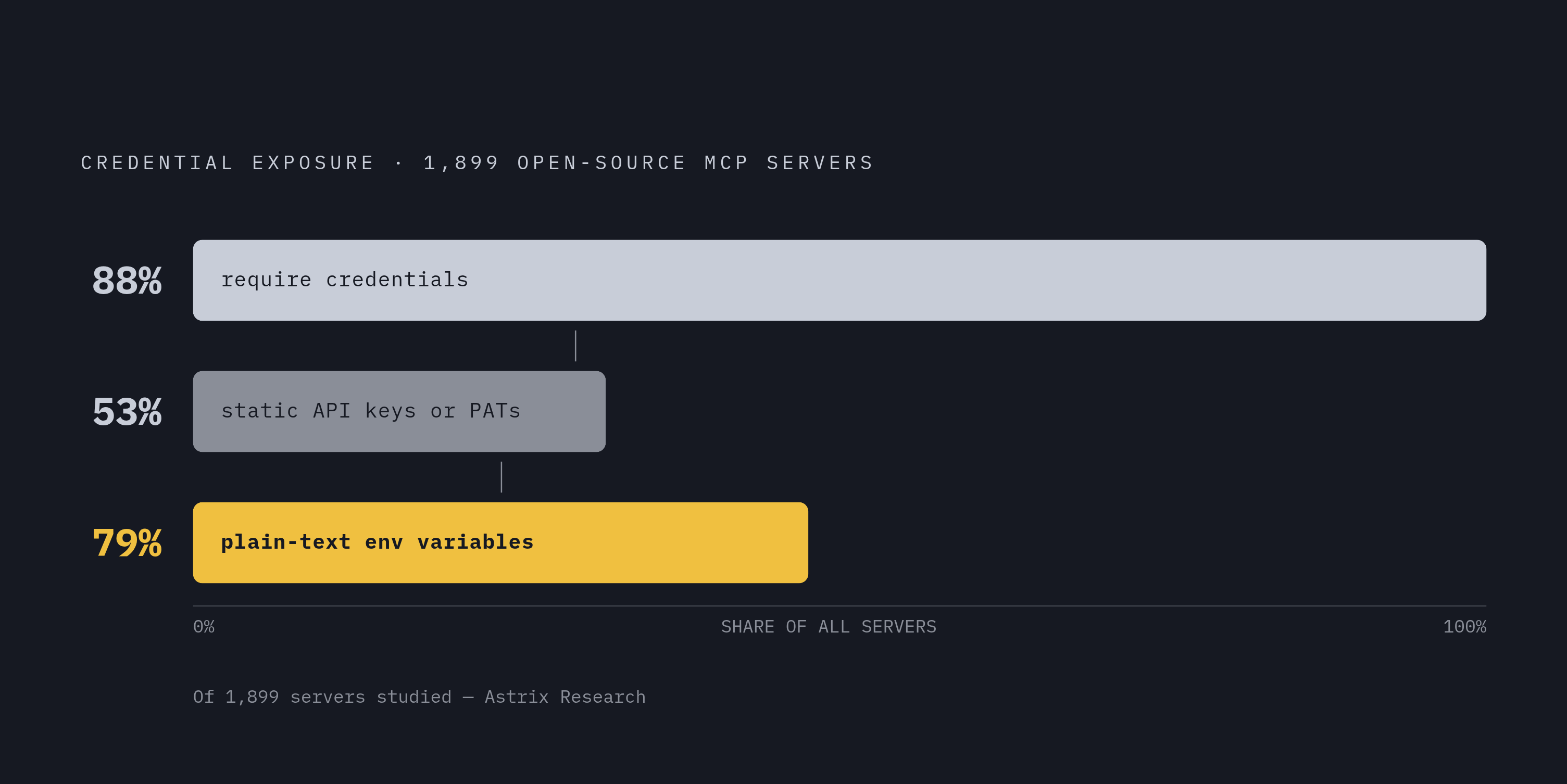
Start with the numbers again, because they set up the whole problem: 53% of MCP servers run on static API keys or PATs, and 79% pass them through environment variables. That's not a niche bad habit. That's the dominant pattern across the ecosystem right now.
Long-lived credentials sitting in an environment variable are visible in process listings, CI logs, container images, and to any tool with read access to the environment. At that point the MCP server itself is the leak, not some separate attack vector bolted on afterward.
The fix is straightforward in concept: pull secrets from a vault at startup instead of baking them into config. Astrix's MCP Secret Wrapper project shows the pattern working in practice. It wraps an existing MCP server, pulls the secret from AWS Secrets Manager, and injects it into the environment only at launch, so the config file itself never holds the credential. That pattern (vault-based injection at runtime) should be standard for any server touching production.
Separate service accounts per server matter too; one server going down shouldn't hand an attacker credentials that work anywhere else. Least privilege applies at the tool level as well: each server gets only the permissions its declared function actually needs, not a broad API scope handed out because it was easier to configure. The endgame here is a centralized broker, a gateway that holds the Snowflake PAT, the Jira token, the SharePoint secret, so the user never pastes a credential and the model never sees one in clear text. That gets its own full treatment later, but it's worth naming now as where this pattern is headed. And as before: writes to production, anything credential-adjacent, gets a manual approval gate even when the server checks out on paper.
Runtime hardening: process isolation, dependencies, and CI/CD gates
Think of it as seven layers: network, process, dependencies, secrets, TLS, runtime monitoring, and CI/CD. Authentication and authorization aren't on this list because they're prerequisites to it, the ground floor everything else stands on.
Process isolation is mostly common sense that gets skipped anyway. Run MCP servers as non-root; a compromised process running as root owns the whole host, not just the server. Drop Linux capabilities down to exactly what the server's job requires, nothing more. A server that authenticates every user correctly but runs as root is still one dependency vulnerability away from a full-host compromise.
Dependency hygiene matters more than it usually gets credit for. That first malicious npm package confirmed the supply chain risk is real, not paranoid speculation, so unvetted dependencies are attack surface, not background noise to ignore. Pin versions, scan for critical CVEs before deployment and during it, and treat the dependency tree as part of what needs defending, the same as the code itself.
CI/CD is where all of this either gets enforced or doesn't. A gate that blocks deploys running as root, shipping exposed secrets, missing TLS 1.3, or carrying critical CVEs in the dependency tree turns policy into something automatic instead of something that depends on a developer remembering to check. Individual discipline doesn't scale; a blocking gate does.
There's an organizational version of this same problem worth naming: shadow AI is already a recognized challenge across a wide majority of organizations. Ungoverned MCP servers are the agentic-era version of shadow IT, and the same governance instinct that got applied to unsanctioned SaaS tools a decade ago applies here, just faster.
The MCP gateway as the centralized enforcement layer
The gateway category didn't come out of a spec committee. It came out of enterprises realizing during 2025 that running a fleet of MCP servers without any central point of control simply doesn't hold up. The official 2026 MCP roadmap admits as much, flagging open gaps around audit trails, SSO-integrated auth, gateway behavior, and configuration portability. The gateway layer is where those gaps actually get closed.
What a gateway does that server-by-server hardening can't: authenticate every caller centrally before a request ever reaches a server, enforce per-tool policy and allowlists across the whole fleet, broker credentials so the gateway holds the Snowflake PAT and the Jira token and the user never touches them directly. It logs every call in one place instead of leaving a scatter of incomplete per-server logs that nobody can reconcile after the fact. It applies PII redaction and content filtering at the proxy layer, before a request gets anywhere near tool logic, and it lets per-tool authorization policies get versioned and reviewed the way any other piece of policy should be.
Without one, the failure mode is already documented: every AI project spins up its own pile of MCP servers and credentials, developers scatter tokens across notebooks, and the traditional API gateway that was supposed to catch this gets routed around entirely.
The vendor field is filling in fast. AWS Bedrock AgentCore Gateway went GA in October 2025, using Cedar to define per-tool authorization policies. Microsoft folded MCP into Azure AI Agent Service back in May 2025, stacking OAuth 2.1 and Bing and Azure AI Search access on top of the base protocol. Kong and Portkey both publish OPA-compatible policy rules for configuring their gateways. None of this is finished technology. But it's the layer where every other control in this piece (authentication, transport, input validation, secrets, runtime isolation) finally gets enforced in one place instead of trusted to whichever developer built the server last.