AI Cost Telemetry and Token Budget Enforcement at Scale
Falling AI prices triggered spending explosions that budgets couldn't predict or control.
Enterprise AI spend didn't slow down when token prices fell. Enterprise AI spend didn't slow down when token prices fell; it sped up instead. Between Q1 2025 and Q1 2026, the blended cost of enterprise API calls dropped 67%, from $18.40 to $6.07 per million tokens; an analysis of 2.4 billion enterprise API calls compiled by optimumpartners.com found this. Over that same stretch, 73% of enterprises told the FinOps Foundation's State of FinOps report that AI costs blew past what they'd budgeted for. This is Jevons Paradox doing what it always does: prices fall, usage explodes, and the total bill goes up anyway. The variable that matters isn't the rate card. It's volume, and volume is what nobody modeled.
Enterprise AI budgets grew several times over as cheap tokens made previously uneconomical use cases suddenly worth building. AI is now the fastest-growing line item on most cloud bills, up 47% year-over-year according to finout.io. The FinOps Foundation reports that FinOps practitioners covering AI spend went from 31% of the field in 2025 to a projected 98% in 2026, and the people responsible for making sense of it are scrambling. A discipline built to track compute instances and storage tiers is now trying to govern a cost model that behaves nothing like cloud infrastructure. It's structural. It's structural, and it's getting worse every quarter that agentic workflows spread further into production.
How agentic workloads multiply token consumption beyond chatbot-era budget assumptions
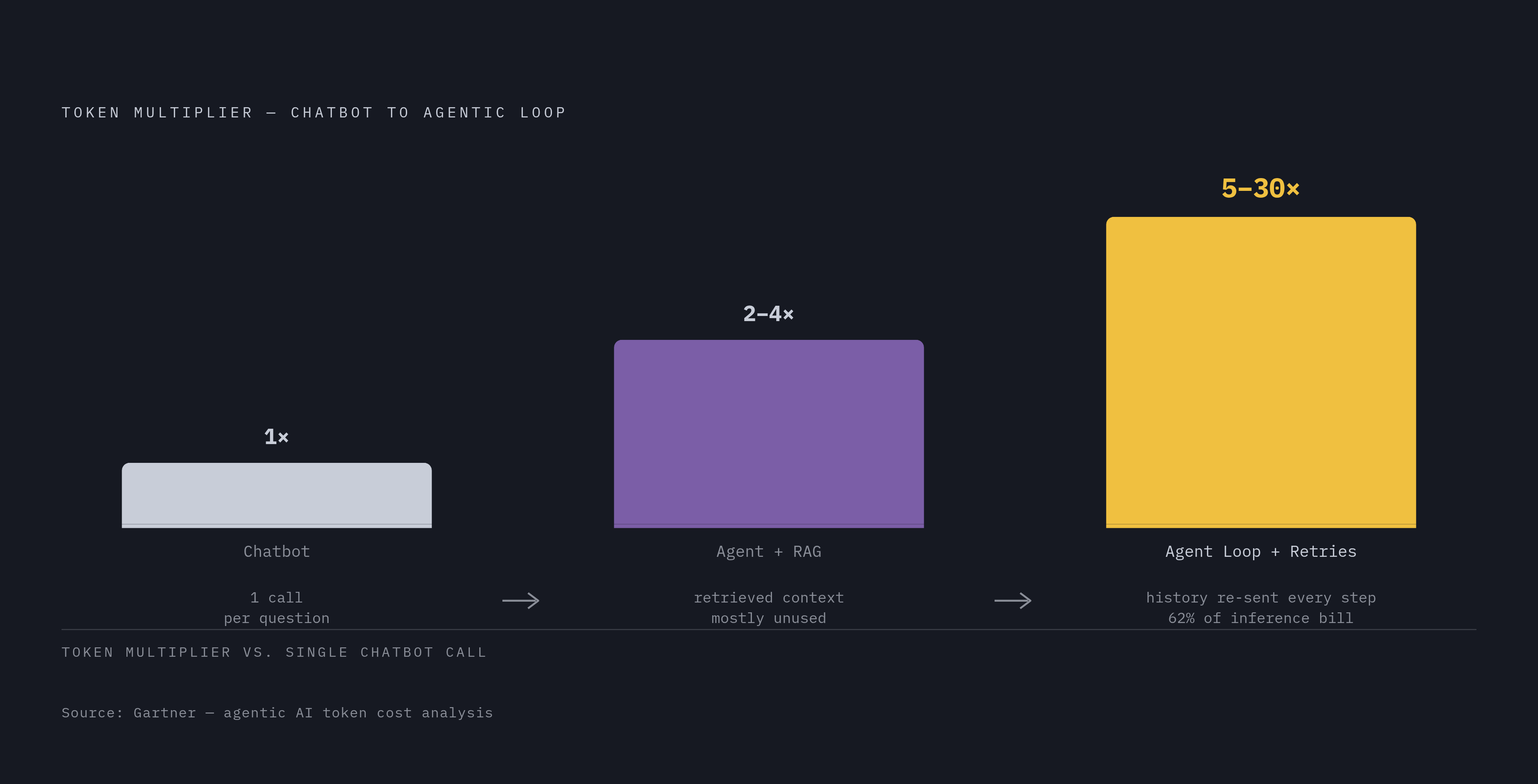
A chatbot costs one inference call per question. An agent doesn't work that way. A single user request can kick off ten to twenty model calls before the task is done, and Gartner's March 2026 analysis, cited by cockroachlabs.com, found the multiplier is 5 to 30 times more tokens per task compared to a standard chatbot. Goldman Sachs projects total token consumption will grow 24-fold by 2030, hitting 120 quadrillion tokens a month. None of that appears on an architecture diagram, since the diagram shows the happy path, not the token math.
Three things drive the multiplication, and none of them are visible until the bill arrives. Retrieval overhead is the first: RAG pipelines pull in context the model never actually uses, and across benchmarked enterprise workloads, most pipelines retrieve roughly two to four times more context than the answer draws on, all of it billed at full input rates; redresscompliance.com reports this. Agent loop retries are the second, and arguably the ugliest: when an agent self-corrects, it resends the entire conversation history with every retry. Re-sent context reportedly accounts for 62% of total agent inference bills, a figure cited by cockroachlabs.com, though the underlying research behind it couldn't be independently verified. Background inference is the third: monitoring agents, document watchers, compliance surveillance systems that burn tokens against every event regardless of whether a human asked for anything. It's among the fastest-growing cost categories going into 2026, and it can't be throttled without breaking the thing it's monitoring.
The upshot is that cost per prompt was never the right unit to track. Cost per completed task is, and almost nobody modeled that before shipping to production. Reasoning models make this worse in a quiet way: chain-of-thought reasoning gets billed as output tokens, which inflates the output side of the ledger substantially on anything complex; redresscompliance.com reports this.
What runaway agent spend looks like: documented incidents at enterprise scale
Uber's Claude Code adoption climbed from 32% to 84% of its 5,000-engineer organization between December 2025 and March 2026. By April, the annual AI budget was gone, spent, done. Monthly API costs ran $500 to $2,000 per engineer, and CTO Praveen Neppalli Naga said: "I'm back to the drawing board, because the budget I thought I would need is blown away already," according to cockroachlabs.com and portal26.ai.
Microsoft reportedly canceled most of its internal Claude Code licenses in one division over the same kind of runaway cost; buildmvpfast.com reports this, though the $500 to $2,000 per-engineer figure circulating around that story is an industry estimate, not a number Microsoft disclosed itself. One unnamed enterprise reportedly spent $500 million in a single month after rolling out AI access with no usage caps at all; portal26.ai reports this. A healthcare enterprise burned through 1 trillion tokens over six months, racking up more than $6 million in costs nobody had planned for, before finance even figured out what was driving the number; elvex.com and portal26.ai report this.
Then there's the $47,000 loop from November 2025, which reads like a cautionary tale because it is one. Four LangChain agents were coordinating over the A2A protocol; an Analyzer agent and a Verifier agent got stuck ping-ponging each other's output back and forth. No per-agent budget cap existed. No mechanism could kill the loop before the next API call fired. Waxell.ai reports that the billing dashboard finally displayed a number big enough to make someone stop and look after 11 days. The post-mortem conclusion was blunt: the team had observability. They didn't have enforcement. Those are not the same thing, and the gap between them cost $47,000 in eleven days.
Amazon's version of the problem is different in flavor but the same in kind. Internal leaderboards tracked how much AI individual developers were using, with targets aiming for 80%+ weekly adoption. Employees responded rationally to a badly designed incentive: they started running low-value prompts purely to inflate their usage scores, a practice that picked up the nickname "tokenmaxxing," per buildmvpfast.com. Good intentions, wrong metric, predictable result. Across every one of these incidents, the common thread is not a lack of smarts or a lack of dashboards. It's the absence of anything sitting in the critical path of the API call that could actually stop it.
Why budget alerts fail as a governance mechanism for agentic systems
An alert tells you spending happened. Enforcement stops the agent, full stop, no further calls placed until a human or a policy says otherwise; waxell.ai reports this. An alert is asynchronous by design. It needs a person to see it, understand it, and act on it fast enough to matter. In the $47,000 loop, alerts fired. Nobody acted on them in time, because nobody was watching the alert channel at 2 a.m. on day six of an eleven-day loop.
There's also a feedback-loop problem baked into how most teams report cost. If an engineer only finds out they burned five figures of spend when the end-of-month report lands, that information arrives too late to change anything, because the month is already over. Real-time or daily visibility changes how people work in the moment. A monthly report just changes how people feel about a month that's already gone; buildmvpfast.com reports this. Finout.io reports that 80% of enterprises miss their AI cost forecasts by more than 25%, and that's not a forecasting problem so much as a governance problem: it's what alert-based oversight produces when the thing it's watching doesn't run on a billing cycle.
Agent loops can burn through a budget in hours, sometimes a couple of days. Alert-based governance assumes a monthly rhythm that agents simply don't respect. Observability answers what happened. Enforcement decides what happens next. Plenty of organizations have built the first and quietly assumed it covers the second. Observability doesn't decide what happens next.
The architecture of runtime token budget enforcement
Enforcement means evaluating spend against a policy threshold inside the critical path of every API call, and firing synchronously the moment a threshold is crossed, before the next call goes out; waxell.ai reports this. That trades a sliver of latency for an actual guarantee, which is a fair trade in most contexts where the alternative is an eleven-day surprise.
Three tiers do most of the work, waxell.ai reports. Session-level caps give each agent session a hard token ceiling; when the session nears it, the enforcement layer ends the session before the next call completes. No message goes back to the agent asking it to wrap up. The session just ends. Fleet-level governance sits above that, aggregating ceilings across every session of a given agent type. If an agent should cost around $0.50 a run and today's batch is running anomalously expensive, the fleet ceiling can flag and kill the outlier while every normal session keeps running untouched. Policy-driven spending rules sit on top of both: crossing a threshold can escalate to a human, reroute to a cheaper model, or terminate with a structured handoff, and every one of those events gets logged, what triggered it, at what cost level, what the agent was doing at the time.
OpenTelemetry has become the standard for the underlying telemetry: consumption data for capacity planning flows to the engineering observability stack through OpenTelemetry, while policy violations and enforcement events route separately to the security stack, tools like Splunk, Datadog, or CrowdStrike, as security signals in their own right; predictionguard.com reports this. None of this works without attribution first. Enforcement without knowing which agent, team, or workflow generated the spend is a blunt instrument, a company-wide kill switch dressed up as a policy. Self-hosted control planes enforce limits inside an organization's own infrastructure and keep telemetry data on-premises; predictionguard.com reports this. And every enforcement event doubles as a compliance record, which matters a great deal in regulated industries where spending decisions touch financial or health data and someone, eventually, will ask for the paper trail.
Practical enforcement patterns by team, ordered by intensity
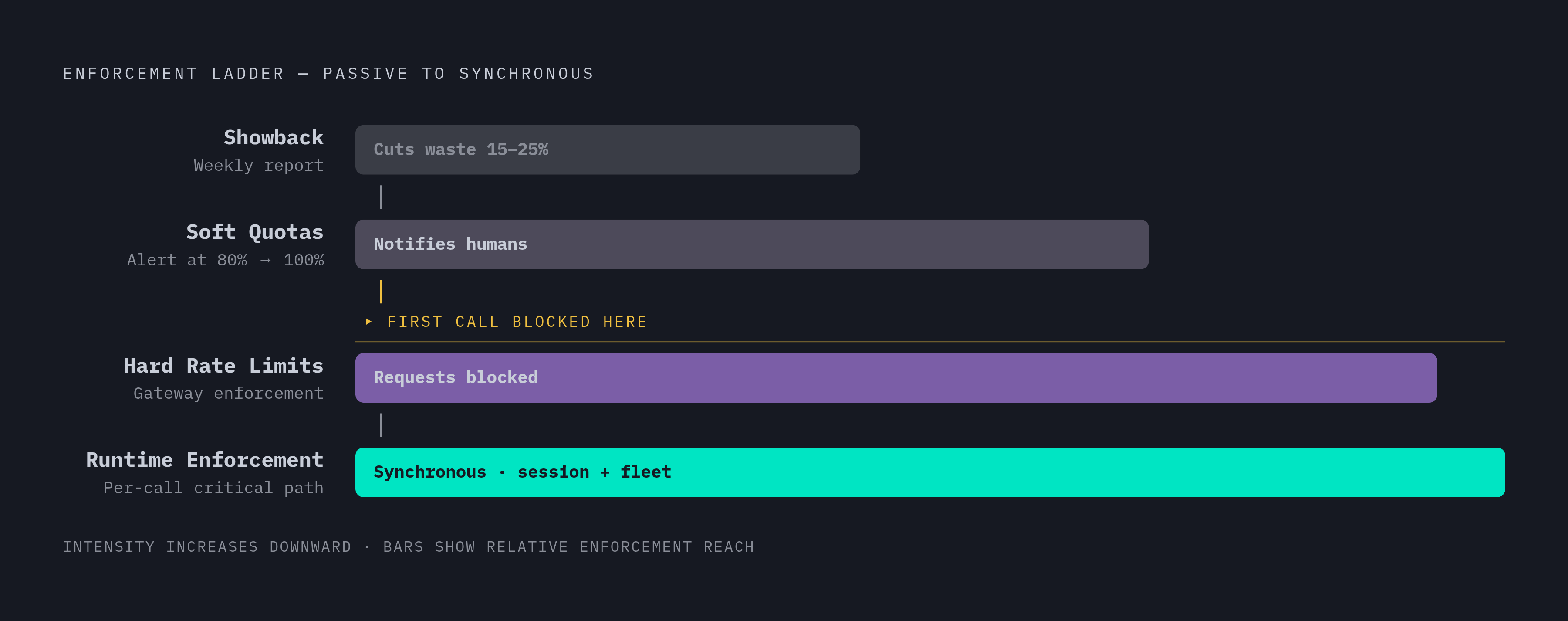
Most organizations should climb this in order, not skip to the end. Showback comes first: every team gets a weekly report breaking down AI cost by model, use case, and trend, with no caps attached and nothing enforced, buildmvpfast.com reports. Just visibility. That alone cuts waste by 15 to 25%, because seeing the number changes behavior before any policy has to.
Soft quotas come next. Each team gets a monthly budget; hit 80% and a Slack alert fires; hit 100% and a second alert goes to the team lead and whoever owns AI FinOps. Still asynchronous, but it builds social accountability where none existed. Hard rate limits are the third tier and the first one that actually operates synchronously: per-team token-per-minute caps enforced at the gateway, and when a team hits the ceiling, requests are blocked or handled according to whatever fallback policy the gateway enforces.
The feedback loop speed determines how quickly behavior changes in response to spending signals. Real-time or daily signals change behavior while the behavior is still happening. Monthly reports just narrate what already happened. Every enforcement action needs a defined fallback, too, a downgrade, a queue, a structured handoff, rather than a hard failure that silently breaks a production workflow. Amazon's episode is a warning label: incentive metrics that count usage volume rather than value can reward exactly the wrong behavior. A leaderboard that counts tokens instead of value produces more tokens, not more value. Teams that skip straight to hard limits without doing showback first risk imposing constraints that lack the shared context to make them stick.
Model routing and prompt caching as enforcement's cost-reduction complement
Model routing is the single biggest lever anyone actually controls. Organizations sending every workload to a frontier model paid $18.40 per million tokens in Q1 2025; organizations running tiered architectures, cheap models for easy tasks, expensive models only when warranted, landed at a median blended cost of a small fraction of that per million tokens, from the same multi-billion-call dataset cited by optimumpartners.com. Default to the cheap model, escalate only when the task actually needs the expensive one. Workloads that adopted routing as part of a broader optimization approach cut agent spend meaningfully with no measurable drop in quality; redresscompliance.com reports this.
Prompt caching matters just as much, and engineers underuse it mostly because they don't realize how cheap cached tokens are. On Anthropic's platform, cache reads on Claude Sonnet 4.6 run $0.30 per million tokens against a standard rate of $3.00, a 90% discount on anything that hits cache; cockroachlabs.com reports this. The break-even is 2.3 reuses of the same cached prefix inside the one-hour TTL window. Any workflow resending the same system prompt or tool definitions more than twice an hour is already saving money without anyone doing anything clever. The most common way teams accidentally torch this saving: dropping a timestamp or session ID into the system prompt prefix, which invalidates the cache on every single call, silently, with no error message telling anyone why costs didn't drop.
Context discipline closes the loop. Most RAG pipelines ship two to four times more retrieved context than the model needs to answer the question. Tightening relevance thresholds, reranking before the context ships, and sizing chunks to match actual answer spans cuts that waste without touching answer quality; redresscompliance.com reports this. Put together, context discipline, routing, and caching produced 30 to 50% realized spend reduction across benchmarked enterprise workloads while holding output quality steady; redresscompliance.com reports this. Enforcement sets the ceiling on what a workload is allowed to cost. Routing and caching lower the floor on what it actually does cost. Both matter, and neither substitutes for the other.
Structuring cost attribution so enforcement thresholds are meaningful
Provider billing arrives as one aggregate number. It does not arrive pre-sliced by team, agent, or workflow, and getting there takes deliberate instrumentation at the call layer, not a dashboard bought off the shelf. The minimum viable schema tags every call with an agent ID, a team or cost center, a workflow type, the model used, a session ID, and a flag for whether the call was a retry. Skipping any one of those fields turns threshold-setting into guesswork.
The honest unit of measurement is cost per completed task, not cost per token. Token price fell 67% over the period optimumpartners.com studied, yet cost per completed task rose anyway, because agentic workflows need more calls to finish the same job. Attribution that stops at cost-per-token misleads leadership into thinking the trend is favorable when it isn't; redresscompliance.com reports this. Background inference, the monitoring agents and compliance watchers running around the clock, needs its own separate budget envelope and its own enforcement logic, since it can't be throttled the way an interactive chatbot session can without breaking the function it exists to serve.
Tying attribution to identity providers, Okta, Entra ID, whatever the organization already runs, means the RBAC policy that decides who can deploy which agent can also carry that team's budget envelope as a property of the identity group, rather than living in a spreadsheet someone forgets to update. Without attribution, enforcement is a sledgehammer: shut down the whole org's access or shut down nothing. With it, enforcement gets surgical, pausing one runaway research agent while the customer-facing workflow keeps running without interruption.
Governance roles and the organizational structure AI FinOps requires
The FinOps Foundation names AI cost management as the single top forward-looking priority for the discipline right now, in a field where only 31% of practitioners touched AI spend in 2025 and coverage is projected to hit 98% in 2026. That's not incremental growth. That's an entire profession getting reassigned to a cost model it didn't design its tooling around, and the tooling built for tracking VM instances and storage tiers doesn't map cleanly onto agents that can spawn sub-agents, retry themselves into a $47,000 hole, or run background surveillance jobs that never stop.
The organizations handling this well aren't the ones with the fanciest dashboard. They're the ones that treated enforcement as infrastructure from day one, not a governance policy bolted on after the first bad month. Attribution feeds enforcement. Enforcement feeds the audit trail. The audit trail feeds the next budget conversation, the one where finance stops asking "why did this cost so much" and starts asking "which threshold should we set for the next agent before it ships." That's the whole shift in one sentence: from reconciling the bill to setting the ceiling before the bill exists.
Sources
- AI Agent Cost Control: Stop Agents Burning Budget | Portal26
- AI Token Cost Enterprise: Stop Budget Blowouts in 2026 - elvex
- AI Token Costs: Why Enterprise AI Bills Keep Rising in 2026
- Managing Agentic AI Costs at Scale
- AI Token Cost Surge Report 2026
- AI Agent Token Budget Enforcement [2026]
- AI Cost Visibility in 2026: Strategies, Tools, and Best Practices
- buildmvpfast.com