PII Detection and Blocking in AI Agent Outputs for Enterprise Environments
Enterprises must inspect PII at four pipeline boundaries, not just the output layer.

Most enterprise PII programs still bet on one idea: catch the bad data before it leaves the building, at the last possible moment, with a filter on the model's final response. That model was built for software that behaves like a vending machine, one discrete request in, one deterministic response out. Agentic pipelines don't work that way. Sensitive data now crosses four or five boundaries, through retrieval, through tool calls, through agent-to-agent handoffs, before it ever reaches the output a filter is watching. Bolting a scanner onto the last step of a process that has five earlier steps is a smoke detector in the garage after the house already burned down.
Why output-layer PII scanning fails agentic pipelines
The intuitive move is understandable: find the sensitive string, strip it out, ship the clean version. That logic holds in a conventional application, where a PII leak is usually traceable to one misconfigured access control or one database field exposed through a bad query. Someone can find the bug, patch it, and verify the fix. Large language models don't fail that way. A model can reproduce fragments of its training data verbatim in response to a completely unrelated query, with no access control to tighten and no single line of code to blame. There's no bug ticket for "the model remembered something it shouldn't have."
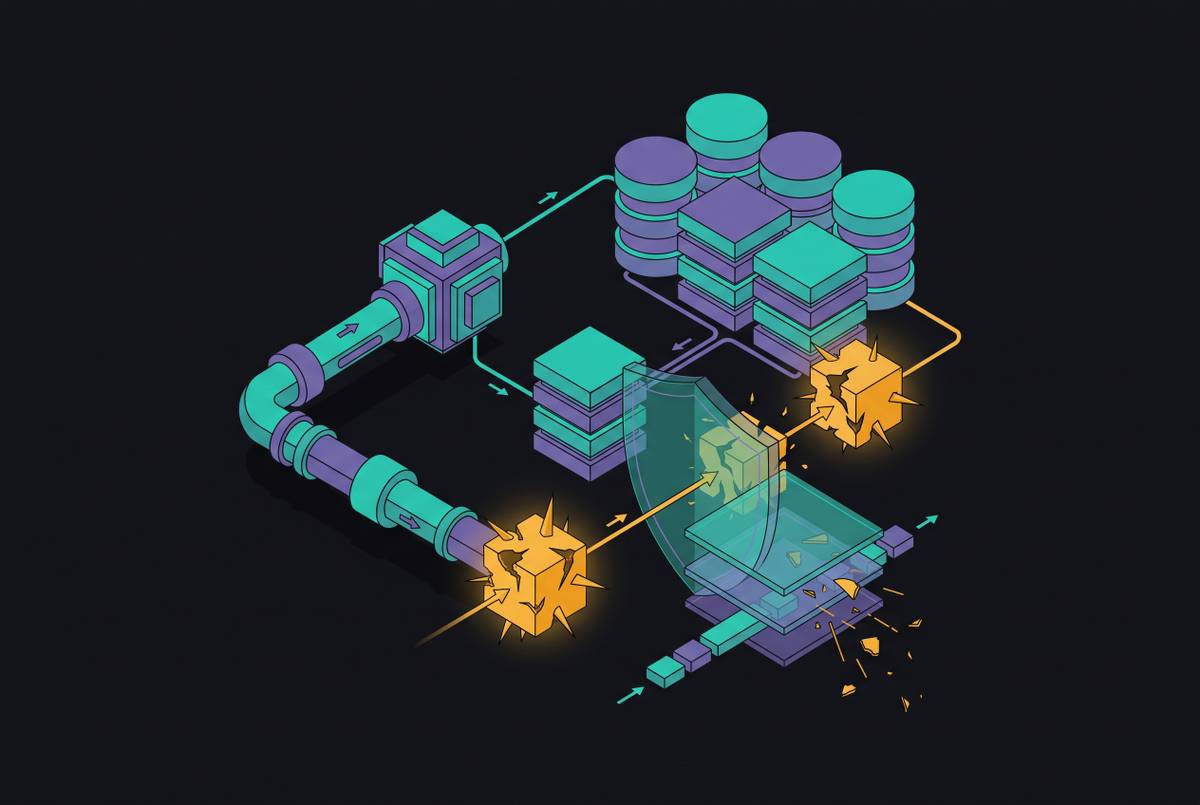
Agentic systems add a second, nastier failure mode on top of that first one. When PII travels through a tool call argument, it executes before any output-layer guardrail ever sees it. A filter watching the final response is watching a door that the data already walked past through the window. And because tool calls often don't get logged with the same rigor as a user-facing response, this leaves no audit trail by default, a gap practitioners have started calling the tool-call blind spot for good reason.
Then there's time. The same customer identifier can move through an eval pipeline, hit a gateway route, surface inside an agent's tool call, and land in a production trace, all before a human notices anything. A scanner sitting at the final output sees one frame of that filmstrip, not the movie. Worse, conversations compound the problem across turns: a name introduced in turn one can resurface implicitly in turn five, paraphrased, referenced, or reconstructed from context the model retained. Single-output NER scans inspect one message in isolation, so they miss this kind of leakage completely, because they were never built to remember anything either.
The four pipeline boundaries where PII enters and moves
Fixing this starts with admitting that PII doesn't enter a pipeline at one spot. It enters at four, and each one needs its own kind of attention.
Training data is the first and least tractable entry point. Models trained on scraped web content, internal documents, or customer records can memorize names, email addresses, Social Security numbers, or account details and reproduce them verbatim at inference time. This is the hardest exposure to fix after the fact, since the information is baked into the model's weights rather than sitting in a database someone can redact. It sits outside the scope of runtime governance and stays a model-training problem, not a pipeline one.
Retrieved context is the second, and arguably the most overlooked boundary in production RAG systems. A retrieval pipeline pulls documents from a vector store or knowledge base at query time, and if those documents contain unredacted PII, the retrieved chunks land directly in the prompt window before any output filter can look. A perfectly innocent user request can still pull a customer record out of a CRM that happens to expose another tenant's data, and nothing about the user's phrasing would have tipped off a scanner watching only the final answer.
Tool call arguments and agent-to-agent handoffs make up the third and fourth boundaries, and they share a failure mode. In an agentic pipeline, PII passed through a tool call argument executes before any output-layer guardrail sees it. A2A task handoff messages carry the identical risk, moving sensitive data from one agent to another with no inspection step in between. Each of these four boundaries, training data, retrieved context, tool arguments, and agent handoffs, needs its own detection strategy, because a control tuned for one will miss what happens at the others.
Why NER and regex detection break down at enterprise scale
Plenty of teams will say they already have this covered. They're running regex and named entity recognition and consider the PII problem solved. It isn't, and the two most commonly deployed methods fail in different, predictable directions.
Regex pattern matching is fast and dependable for anything with a rigid structure: Social Security numbers, credit card numbers, phone numbers. It falls apart the moment PII appears in freeform prose, as a partial identifier, or in any format that strays even slightly from what the pattern expects. NER picks up some of that slack by catching names written in predictable formats, but it fails on paraphrased PII, obfuscated text, cross-turn leakage, and domain-specific identifiers such as policy IDs, account numbers, and internal employee codes. A general-purpose NER model has no semantic reason to flag "Policy #88291-A" as sensitive, because nothing about that string looks like a name.
Quasi-identifiers are the category teams miss most often, and the one that causes the most damage when it slips through. Age, gender, ZIP code, ethnicity, and occupation each look harmless in isolation. Combined, they can re-identify a specific individual with high confidence, and a detection system tuned only to catch direct identifiers will wave the combination straight through. None of this means regex and NER are worthless. It means neither one, run alone, is adequate at enterprise scale, and a real architecture needs more than either can offer by itself.
What a pipeline-spanning enforcement architecture requires
Enforcement is a graduated policy layer that applies different actions depending on the entity type, the confidence level of the detection, and the stage of the pipeline where the data was caught.
Four enforcement boundaries map onto the four entry points above, and each one calls for its own policy. At user input, before the model ever sees the prompt, enforcement should catch direct identifiers you typed and redact them before the interaction is even logged. At retrieved context and tool outputs, enforcement needs to inspect document chunks and tool call results before they land anywhere a model can read them, and this is the boundary most teams skip. At the generated response, the classic location for a guardrail, enforcement serves as the last line of defense for anything that slipped through the earlier three stages. And at the audit log, after delivery, continuous sampling catches new identifier formats that the inline detectors weren't yet calibrated to recognize.
Not every detection deserves the same response. Redact where the sensitive string can be stripped out without destroying the usefulness of the response. Block where any disclosure at all constitutes a violation. Alert and log where the right next step is a human reviewing the call. Logging a PII violation without blocking delivery is observation; the blocking step is what turns a detection into a control. Agent-to-agent traffic deserves identical treatment: a deterministic policy layer with probabilistic risk scoring should sit inline on the A2A task handoff, inspecting, classifying, and either redacting or blocking every task message before it reaches a remote agent. Most teams will need regex, NER, and context-aware model-based classification running together, because each method catches what the other two miss at different pipeline stages. And every decision this architecture makes, every block, redact, or escalate, should record the evaluator, the route, the trace ID, the action taken, and the reason. Audit completeness is a compliance artifact in its own right, not an afterthought bolted on for an examiner.
The MCP gateway as the enforcement choke point for agentic PII
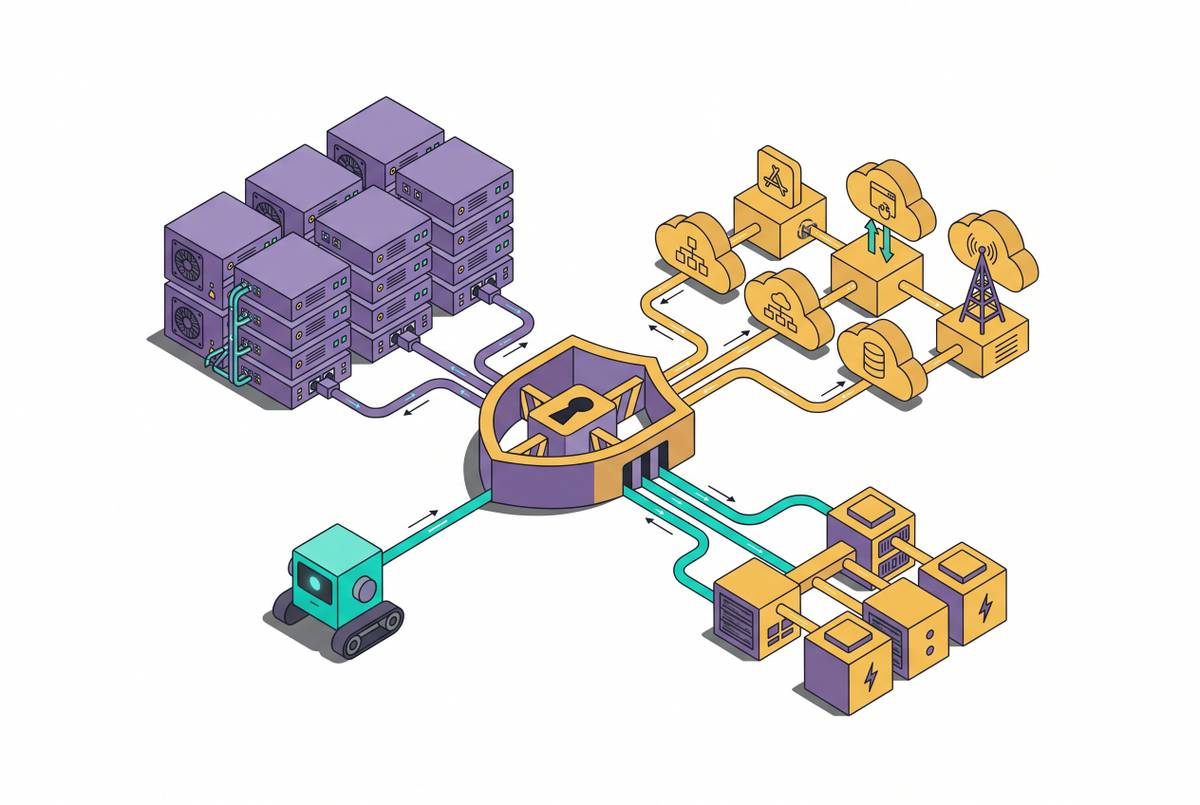
The architecture above needs a physical place to live, and the MCP gateway is that place. An MCP gateway is a centralized reverse proxy built for MCP traffic, and it sits between AI agents and every tool or data source those agents can reach. That position is what makes it valuable: authentication, routing, policy enforcement, credential management, and observability all run through one choke point, so PII detection can apply consistently across every agent-to-tool interaction instead of being reimplemented inside each individual agent.
This solves the tool-call blind spot directly. Because the gateway intercepts every tool invocation before it executes, PII sitting in a tool call argument is inspectable and blockable before that argument ever reaches the downstream system, not caught afterward in a log review nobody has time to do. Major infrastructure vendors are building toward this pattern now, not treating it as a hypothetical. Snowflake's Cortex AI Gateway, launched at Black Hat 2026, embeds this kind of enforcement layer directly into an enterprise data platform's AI infrastructure, and it centralizes governance over agentic and MCP traffic at the data layer itself. Gravitee's 4.11 release shows the same pattern from the API gateway side: its PII Filtering Policy inspects both incoming prompts and outgoing model responses at the gateway, applies redaction or blocking based on configured sensitivity thresholds, and enforces policy consistently across AI applications without requiring custom filtering logic inside each one.
The protocol itself is catching up to the pattern. Gateway patterns appeared explicitly on the March 2026 MCP protocol roadmap under Enterprise Readiness. The roadmap has since reorganized its priorities without naming gateway patterns as a standalone top-level deliverable, but that reshuffling reads less like abandonment and more like absorption: the gateway layer is becoming assumed infrastructure for enterprise MCP deployments rather than a feature someone has to ask for.
PII enforcement without identity context: wrong blocks and missed violations
If a gateway inspects content without knowing who's asking, it will get the enforcement decision wrong in both directions. It will block a legitimate request from an authorized employee doing their job, and it will wave through a violation committed by an over-permissioned agent that should never have had access to the data in the first place. Whether a disclosure counts as a violation depends entirely on who's on the receiving end.
Traditional role-based access control is too blunt an instrument for the decisions agentic systems actually need to make. An agent with a "viewer" relationship to a project should be able to summarize its documents, but shouldn't be able to export that data to an external API. Enforcing that distinction requires relationship-based or attribute-based access models, because a flat role check has no concept of "summarize yes, export no." Agents also operate with delegated authority, so the human user doesn't see the individual API calls happening on their behalf. Static firewall rules can't close that accountability gap. Policy engines have to evaluate every action against the requesting identity's role and the sensitivity of the data in real time.
Identity shapes the audit trail as much as it shapes the block decision. To be useful during compliance review, a log entry has to capture the identity of the requesting agent or user, not merely the fact that some PII pattern tripped a detector. Tying enforcement to identity providers already in place, Okta, Entra ID, SAML and OIDC, means PII policy inherits the access governance the enterprise has already built, instead of forcing a parallel permission system into existence just for AI.
The compliance frameworks that make pipeline-spanning enforcement non-negotiable
Regulators have mostly converged on a position output-only scanning cannot satisfy: evidence of control across the full data lifecycle, not just a demonstration that the final answer looked clean. The EU AI Act is the sharpest edge of that pressure. Its Article 9 requires a risk management system covering foreseeable misuse for high-risk AI systems, and prompt injection along with data exfiltration through tool calls are documented foreseeable misuse vectors under that framework. An enterprise running a high-risk system without controls addressing those vectors has a documented gap in its Article 9 obligations, not a theoretical one, with the compliance deadline now set for December 2027.
Prompt injection alone maps to at least seven major frameworks: OWASP, MITRE ATLAS, NIST, the EU AI Act, ISO 42001, GDPR, and NIS2. A single runtime enforcement layer that blocks prompt injection and PII leakage at the pipeline level produces compliance evidence against several of those obligations simultaneously, rather than requiring a separate proof exercise for each one. That overlap is the practical payoff for security leaders: runtime enforcement that aligns with these frameworks generates audit evidence as a natural byproduct of doing the enforcement, which cuts down the manual scramble to assemble records before an examination cycle starts.
Real incidents and structural consequences of missing enforcement
None of this is hypothetical risk modeling. Two incidents already demonstrate what happens when the enforcement layer described above simply isn't there.
CVE-2025-32711 hit Microsoft 365 Copilot with a CVSS score of 9.3. A crafted email carried a hidden prompt, and it caused Copilot to pull data from OneDrive, SharePoint, and Teams and send it out through a trusted Microsoft domain, with no user click required. It's a textbook prompt injection that triggered sensitive information disclosure across three integrated systems, and no output-layer filter was positioned anywhere in the tool call chain that actually moved the data.
GrafanaGhost surfaced in the second quarter of 2026. Researchers found a prompt-injection path in Grafana's AI features, and it could force the platform to send sensitive enterprise data to attacker-controlled servers, routed through Markdown image rendering via a protocol-relative URL bypass. The exploit hit OWASP LLM01 (prompt injection), LLM02 (sensitive information disclosure), and LLM05 (improper output handling) at once, three separate risk categories exploited through a single unguarded pipeline boundary.
Strip away the surface details and both incidents share the same skeleton: an AI feature with access to multiple internal systems, no inline inspection on tool calls or retrieved context, and no identity-conditioned policy constraining what the agent could be tricked into exfiltrating. The development of responsible AI frameworks has lagged how fast agentic AI is being deployed, and that gap is widening on its own.
Building the governed enforcement layer: what enterprise teams need to put in place
You don't fix this with a shopping list of point tools scattered across the pipeline. It's a centralized enforcement layer combining runtime content inspection, identity-conditioned policy, and continuous observability, built around a few concrete commitments.
A gateway sitting between agents and every MCP server, tool, and external system is the only position where PII inspection applies consistently without duplicating logic inside every agent or application separately. That gateway needs enforcement running at all four pipeline boundaries, input, retrieved context, tool call arguments, and generated response, since anything less leaves at least one entry point unguarded. Every enforcement action has to condition on the identity of the requesting agent or user, tied to the identity providers, Okta and Entra ID among them, that the enterprise already relies on, so PII policy extends existing access governance. Redaction, blocking, and alerting need to be configured per entity type, per confidence level, and per requesting identity, because a flat block-everything policy generates false positives that break legitimate workflows and teach users to route around the control. Every decision the layer makes, block, redact, or escalate, needs to produce a structured record capturing evaluator, route, trace ID, action, and reason, so the compliance evidence exists as a byproduct of enforcement rather than a separate project someone has to run before an audit. And because inline detection only catches patterns it was built to recognize, audit-log sampling after delivery has to keep feeding newly discovered formats and obfuscation techniques back into the regression set, so the system that catches today's leak also learns to catch next quarter's.