platforms for managing machine identity and access credentials in agentic AI workflows
Legacy IAM can't handle the speed and scale of agentic AI deployments.
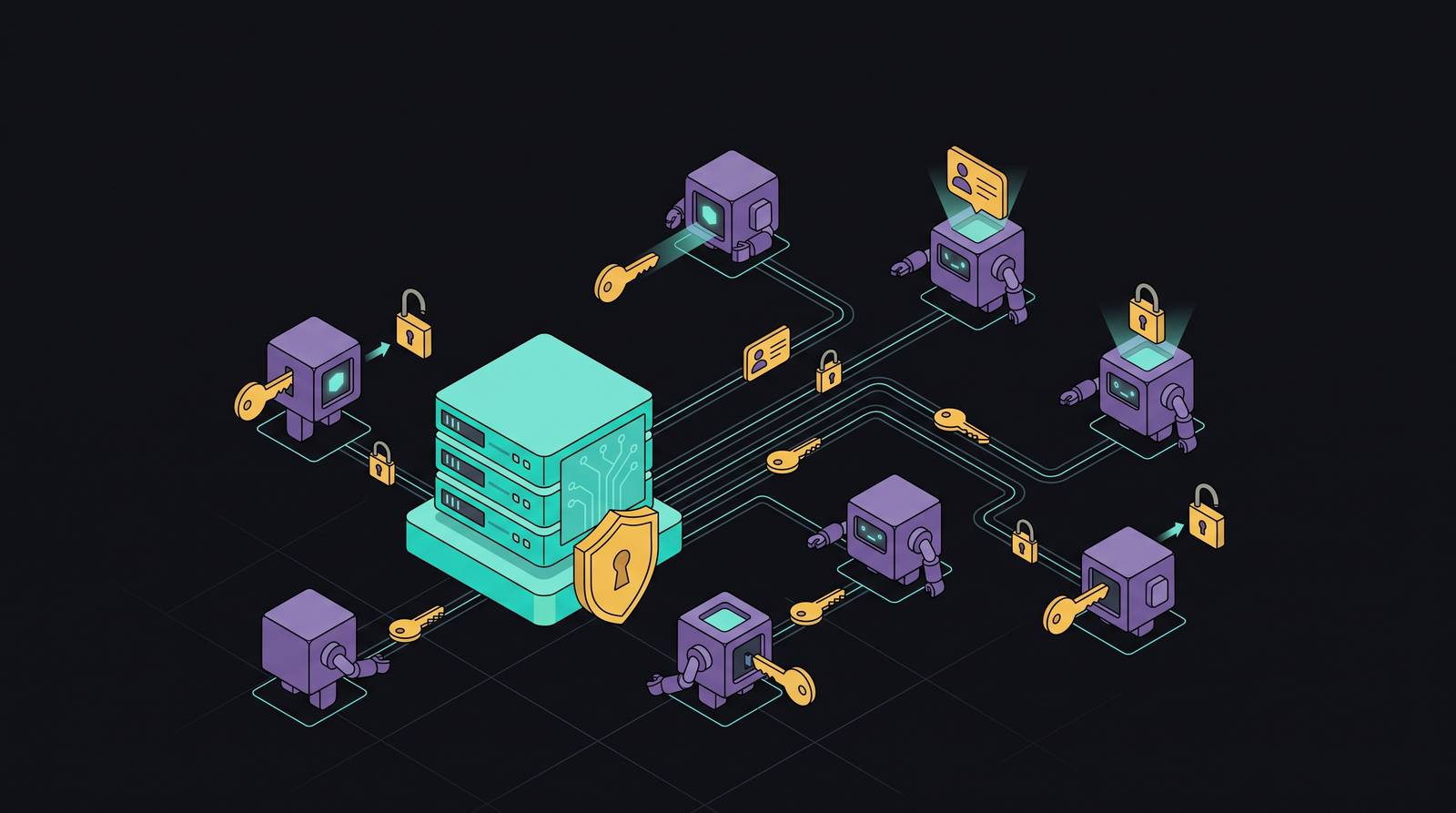
Machine identities now outnumber human ones by more than a hundred to one inside the average enterprise, and most of that population is AI agents, according to Palo Alto Networks' 2026 Identity Security Landscape report. Nobody built the old IAM stack for that math. Badges, known managers, quarterly access reviews: none of it survives contact with a workforce where half the "employees" are ephemeral and none of them sleep. This piece walks through the stack that's emerging to fix it, who's building the pieces, and how you tell a real fix from a repackaged one.
Traditional IAM assumes a human at the keyboard. Someone logs in, gets a role, keeps that role for months or years, and a security team reviews it whenever the calendar says so. Agentic AI breaks all of that at once. A single workflow can spin up dozens of agent identities that live for minutes, each calling different tools and touching different data stores, then disappearing before anyone writes them down anywhere. Gartner's April 2026 research on agent sprawl puts the average enterprise at well over a hundred thousand agents by 2028. Whatever process governs a handful of agents today is not going to touch that number.
Service accounts and RPA bots, the machine identities of the last decade, sat still. One job forever, one set of credentials, no surprises. Agents reason instead. They chain actions together and decide at runtime which tool to call next, acting on behalf of a user or the business across APIs and SaaS systems with nobody watching in real time. Least-privilege design keeps losing the race against deployment speed, so agents routinely end up holding more access than the task needs. And because they're short-lived, they outlive their usefulness in the access logs long after the workflow that spawned them is gone. What's left is a gap nobody's proud of: identities no one remembers granting, secrets sitting in code long after the agent that used them retired, access nobody formally revoked because nobody formally granted it in the first place.
What agentic identity actually needs, and why the old tools can't give it to them
Call it Agentic Identity and Access Management, AIAM if you want the acronym. It needs more than service-account management with a new logo slapped on. Fine-grained delegation, authorization that checks context instead of reading a role field, trust evaluation that runs the whole way through a workflow instead of once at login and never again.
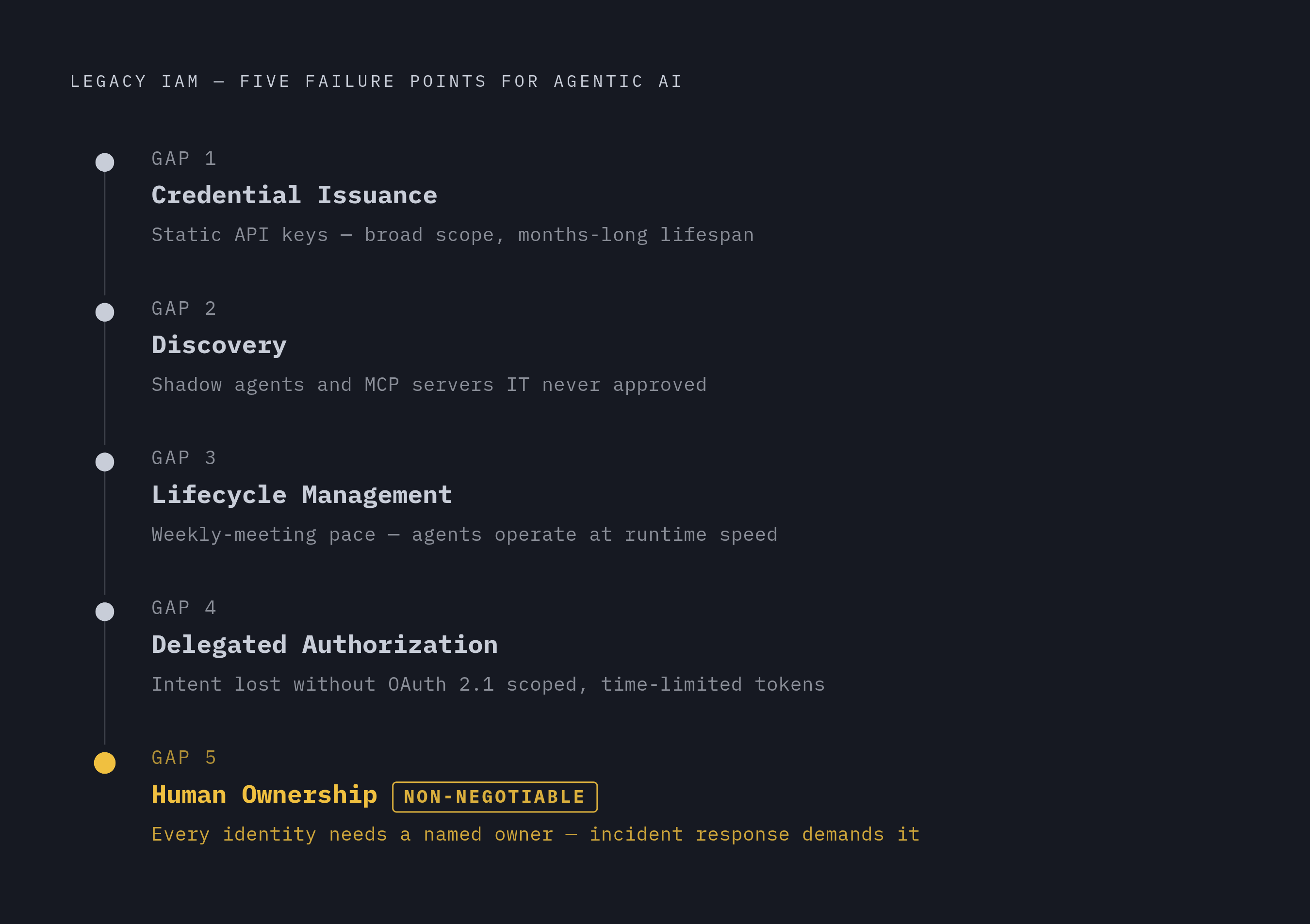
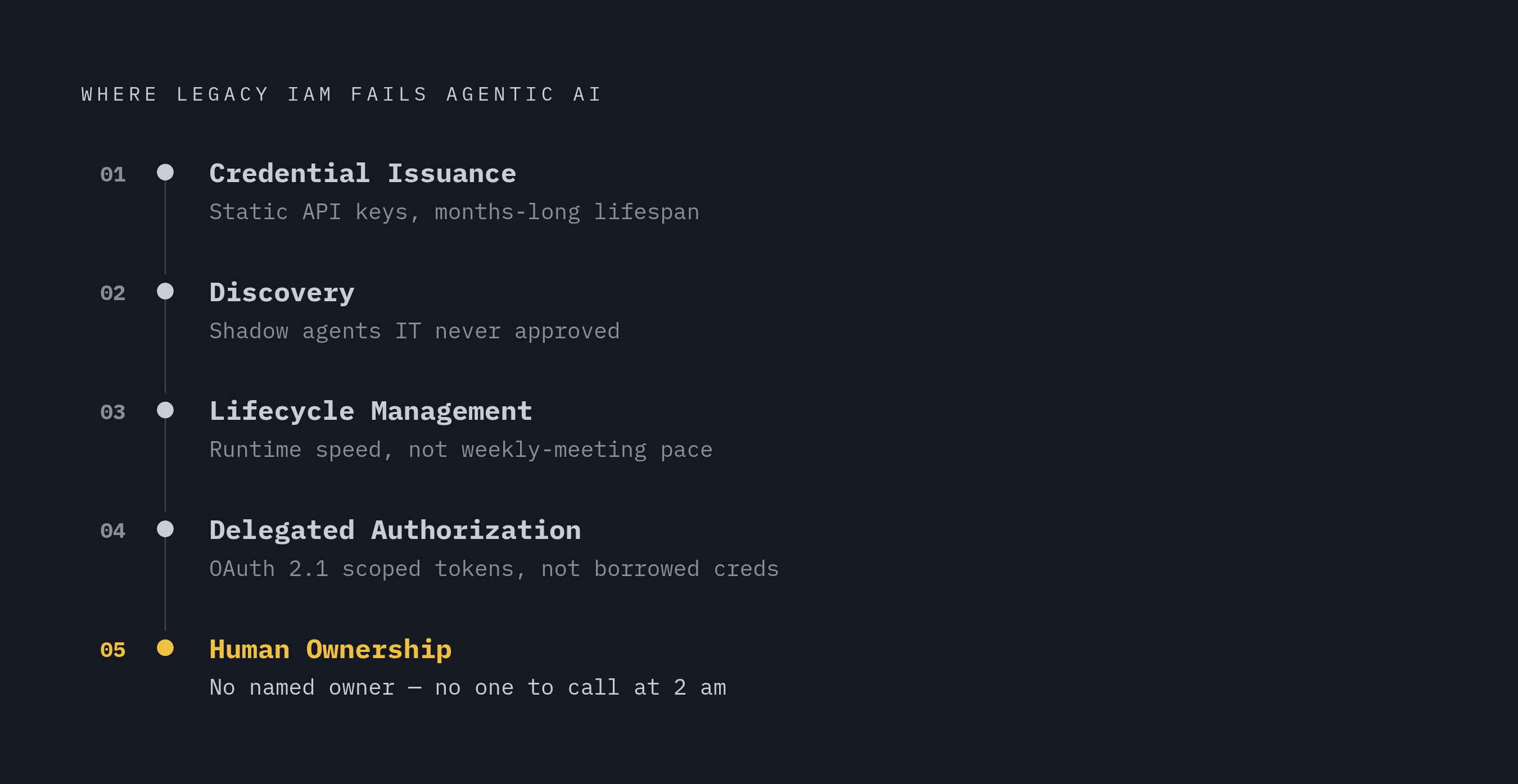
Legacy IAM fails this in five specific spots, and it's worth naming them plainly rather than waving at "gaps." Credential issuance is first: static API keys and secrets that live for months are still the default setup, and they're the root cause behind most exposure incidents you'll read about after the fact. Agents need short-lived, just-in-time credentials scoped to one task, not a master key that outlives the job by a year. Discovery is second: teams spin up agents and MCP servers on their own, so the governance layer has to go find what IT never approved, shadow deployments included. Third, lifecycle management has to run at the speed of the agent's own runtime, not at the pace of a weekly meeting where someone reads a spreadsheet out loud. Fourth, delegated authorization has to carry intent, not just borrowed credentials; OAuth 2.1's scoped, time-limited tokens are the practical mechanism for proving an agent is acting on a specific user's behalf. Fifth, and this one's not optional: every identity and every secret needs a named human owner, or incident response turns into a guessing game at 2am with nobody answering their phone.
The secrets sprawl problem isn't a thought experiment someone dreamed up for a conference talk. GitGuardian's 2026 State of Secrets Sprawl report counted over 28.65 million hardcoded secrets on public GitHub, with AI service secrets up 81% year over year. That's the pipeline from agent development to production, leaking credentials in plain sight, in public repos, right now, while you read this. A platform that solves one piece, vault storage without discovery, say, or discovery without lifecycle enforcement, leaves the rest of the door standing wide open.
The secrets and NHI management platforms that form the foundation of the stack
This layer's job is plain and unglamorous: store credentials centrally, issue them dynamically, encrypt them, enforce lifecycle rules across every non-human identity in the building. Nobody puts this on a conference keynote slide, but skip it and everything above it is theater.
HashiCorp Vault is still the reference point most teams measure everything else against, with dynamic, short-lived credential issuance and the widest install base around. Self-hosting it isn't free labor though; budget for the operational overhead before anyone signs the deal, because someone on your team is about to become a Vault administrator whether they wanted the job or not. Akeyless delivers roughly the same function as SaaS, which suits teams that don't want to own vault infrastructure and need multi-cloud reach without hiring a platform team just to run it.
CyberArk's Conjur folds secrets management into the same privileged access ecosystem enterprises already run for human PAM, and the 2024 acquisition of Venafi brought certificate-based machine identity, TLS and code-signing, under one roof. GitGuardian owns the discovery side, finding hardcoded API keys, OAuth tokens, and database credentials sitting in source code, and its NHI Governance module wires that discovery straight into HashiCorp, CyberArk, AWS, GCP, and Azure vaults. Entro built for this problem specifically: a proprietary Non-Human Identity Detection and Response engine that maps every MCP server, agent, and secret across an environment, flags rogue MCP servers and unsanctioned deployments, and assigns a human owner to each one. It plugs into Vault, CyberArk, AWS Secrets Manager, and Azure Key Vault, so runtime discovery actually lands in governed storage instead of sitting off in its own silo.
The market has consolidated hard through 2026. Several standalone secrets and NHI vendors got folded into bigger identity platforms this year alone, and that's worth noticing rather than shrugging at. This layer is turning into a built-in feature of larger platforms instead of something you buy on its own. 451 Research's Vanguard Report, commissioned by 1Password in 2026, lays out a sensible order for evaluating any of this: start with discovery and visibility, move to just-in-time credential delivery, then remediation that reaches developers without breaking how they already work. Use that order as a checklist. A vendor who can't speak to all three has built a fragment, not a system, no matter how the demo looks.
How enterprise IdPs are stretching to cover agent identity across the full lifecycle
The identity provider's job used to stop at authenticating a human. Now it has to issue, federate, and revoke agent identities across a full lifecycle: provisioning, scoping permissions, auditing what happened, killing access on demand the second something goes sideways.
Okta for AI Agents treats agents as first-class citizens next to humans, federating with any IdP through OIDC and SAML, issuing tamper-proof digital credentials to establish trust. Its Agent Deactivation feature lets a team kill an agent's access in one action, which matters enormously mid-incident and is missing from a lot of older tooling still running on assumptions from 2019. System Logs and Telemetry stream tool calls and authorization decisions into a SIEM, and Okta integrates with agent builders like Salesforce Agentforce and the ServiceNow AI Platform. Microsoft's Entra AI Governance automates access reviews and policy enforcement across AI models regardless of who's hosting them, an obvious next step for any team already standardized on Entra ID. Ping Identity took a different route: human-in-the-loop approval checkpoints built directly into agent workflows for sensitive operations, a good fit for enterprises that want an explicit sign-off gate before an agent does anything risky.
The pattern across all three is worth spelling out once, plainly. The existing IdP stays the system of record for human credentials, MFA, and policy, while a dedicated agent identity layer sits alongside it, governing the non-human lifecycle and federating back to the human IdP for delegated authorization. Least privilege here means more than scoping permissions once at provisioning and walking away. It means continuous, context-aware authorization checked at the agent's own runtime speed, because a static RBAC assignment set once a quarter, as platforms like Speakeasy, an enterprise AI control plane, enforce continuously instead, can't stop a compromised agent from moving sideways between review cycles.
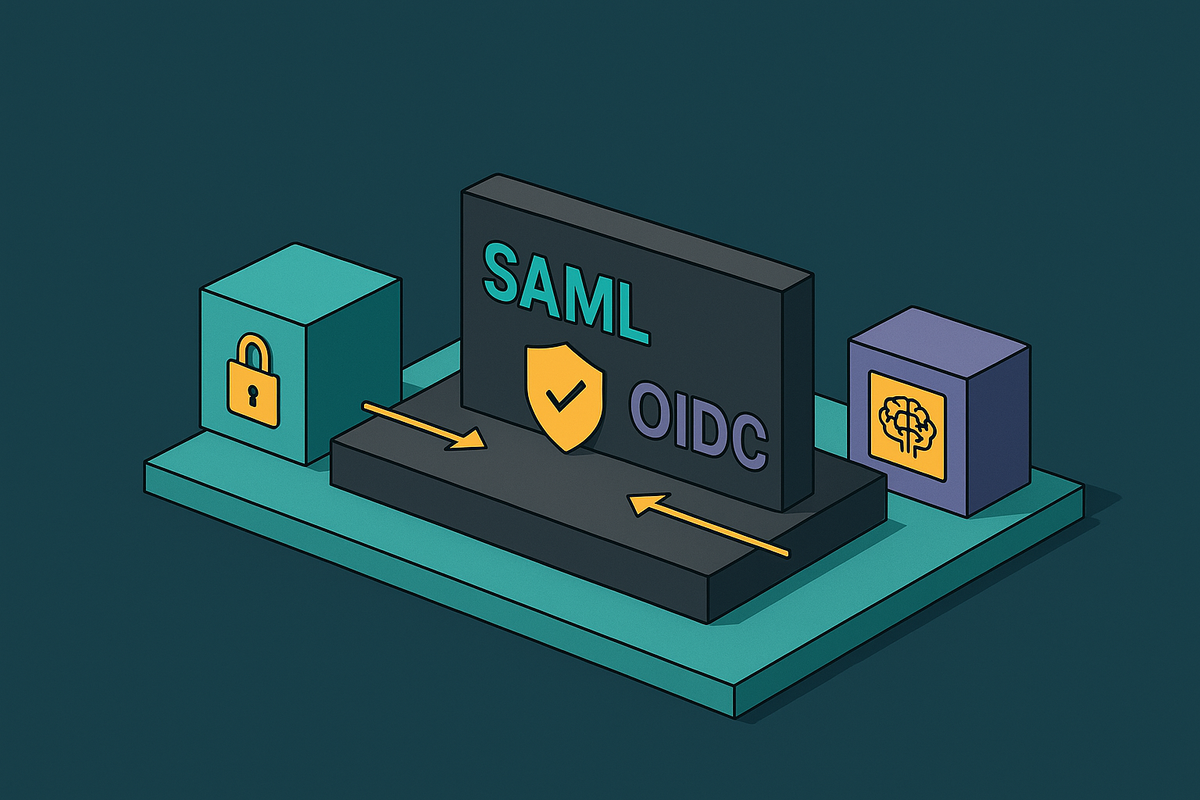
Speakeasy's AI control plane sits in this orchestration layer, integrating with Okta, Entra ID, and other enterprise IdPs over SAML and OIDC to enforce RBAC for AI agents and MCP servers across the workforce. The practical payoff: an enterprise applies the identity policies it already owns to agent traffic, rather than standing up a second governance system from scratch just for agents that talk to nobody else.
MCP gateways as the emerging control point for agent-to-tool access
Anthropic released the Model Context Protocol in November 2024, and it cleared tens of millions of monthly SDK downloads inside roughly a year, an adoption curve most protocols never come close to. Here's the catch: MCP's initial release shipped with no real authentication framework at all. OAuth 2.1 support didn't arrive until a March 2025 revision, and implementation quality across servers has stayed spotty since.
Connect agents directly to dozens or hundreds of MCP servers with nothing mediating in between, and you get server sprawl, inconsistent auth from one server to the next, no central audit log, no policy enforcement anywhere in the chain. The protocol handles the wire format. It says nothing about governance. That's a separate problem, and somebody still has to go solve it, because the protocol spec certainly won't.
A proper MCP gateway closes that gap. It centralizes authentication and authorization across every connected server, supports multi-role RBAC with per-user OAuth passthrough, and gives teams a curated, self-service catalog so people find approved servers instead of standing up their own off the books. It enforces policy as code at the gateway itself, catches MCP-specific threats like rug-pull attacks, tool poisoning, and cross-server shadowing, and logs every agent-tool interaction in one place instead of scattered across a dozen systems nobody's cross-referencing at 3am. Gartner's guidance here is blunt: apply the same gateway-centric thinking to MCP that enterprises already apply to API traffic. Fair comparison. Same underlying problem, just agents making the calls now instead of apps.
The vendor field is moving fast, faster than most procurement cycles can keep up with. Kong's AI Gateway 3.12 ships an enterprise MCP Gateway with an OAuth policy plugin and an observability layer aimed squarely at server sprawl and cost visibility. Microsoft's open-source MCP Gateway works as a reverse proxy with stateful routing and lifecycle management for Kubernetes shops, telemetry and access control folded in. Obot was built specifically for MCP governance: open-source, self-hostable on Kubernetes or Docker, or available managed, with a catalog and multi-role RBAC out of the box. TrueFoundry, named a Representative Vendor in the 2025 Gartner Market Guide for AI Gateways, unifies MCP governance with LLM routing and model deployment under one roof.
The NSA released MCP-specific security guidance in May 2026. A federal agency putting a marker down like that is a fair signal that regulatory pressure on ad hoc MCP deployments isn't far off, whatever your compliance team currently believes.
Real-time threat detection that belongs inside the agent identity layer, not bolted on after
Detection has to live inside the identity and access layer from day one, not get bolted on afterward as a separate product with its own dashboard nobody checks. Agents move at machine speed across APIs and data stores. By the time a perimeter tool notices something is wrong, the credential's already been used and the data's already gone.
The threat surface has its own shape here, and it doesn't map cleanly onto the old playbook. Prompt injection buries malicious instructions inside a tool response or a retrieved document, and the agent's own identity and elevated privileges become the weapon used against it. Secrets leak through agent outputs, logs, and MCP tool responses; GitGuardian's 2026 numbers show exactly how fast AI service secrets specifically are multiplying through developer pipelines. Shadow AI and rogue MCP servers, deployed by individual teams outside any central review, drive up breach costs significantly according to IBM's Cost of a Data Breach findings, and they take longer to catch than a conventional breach simply because nobody was watching that server in the first place. Credential persistence keeps ticking quietly in the background too: machine identities that outlived their task, still holding access nobody scoped down once the job ended weeks ago.
Different vendors have staked out different corners of this, and none of them cover the whole map yet. Lasso Security scans MCP traffic in real time and blocks payloads that trip injection detection. MintMCP applies input schema validation and allowlisted actions to limit what an agent can even ask an MCP server to do in the first place. Composio runs tool implementations inside sandboxes, so a compromised agent's blast radius stays contained instead of spreading through the rest of the environment. Entro's NHIDR engine flags live risks, rogue MCP servers and unsanctioned deployments included, as part of its identity discovery and response loop.
Most tools do one threat vector well and stop there. Almost none of them cover prompt injection, secrets leakage, and shadow deployment detection in a single observable layer today. Enterprises buying into this space should plan on doing integration work themselves to stitch these pieces together, because nobody's shipped the single pane of glass yet. Someone eventually will. It won't be this year.
What to actually check before you buy any of this
Start with discovery, ahead of storage. Most enterprises already own a vault. What they're missing is visibility: which agents actually exist right now, what credentials each one holds, who answers the phone when one of them misbehaves. A platform that stacks another storage layer on top of that blind spot is solving the wrong problem first, however well it solves it.
Check whether IdP integration is real or just a slide in a sales deck. Does the platform federate with the Okta or Entra ID an enterprise already runs, through OIDC and SAML, or does it demand a second, parallel identity store nobody asked for and nobody wants to maintain? Do RBAC policies flow automatically from the existing identity fabric into agent access decisions, or does someone sit there by hand translating one system's rules into another's format every time something changes upstream? And when an agent gets retired, does deprovisioning actually reach the IdP and close the loop, or does the access just sit there, waiting quietly to become next year's audit finding?
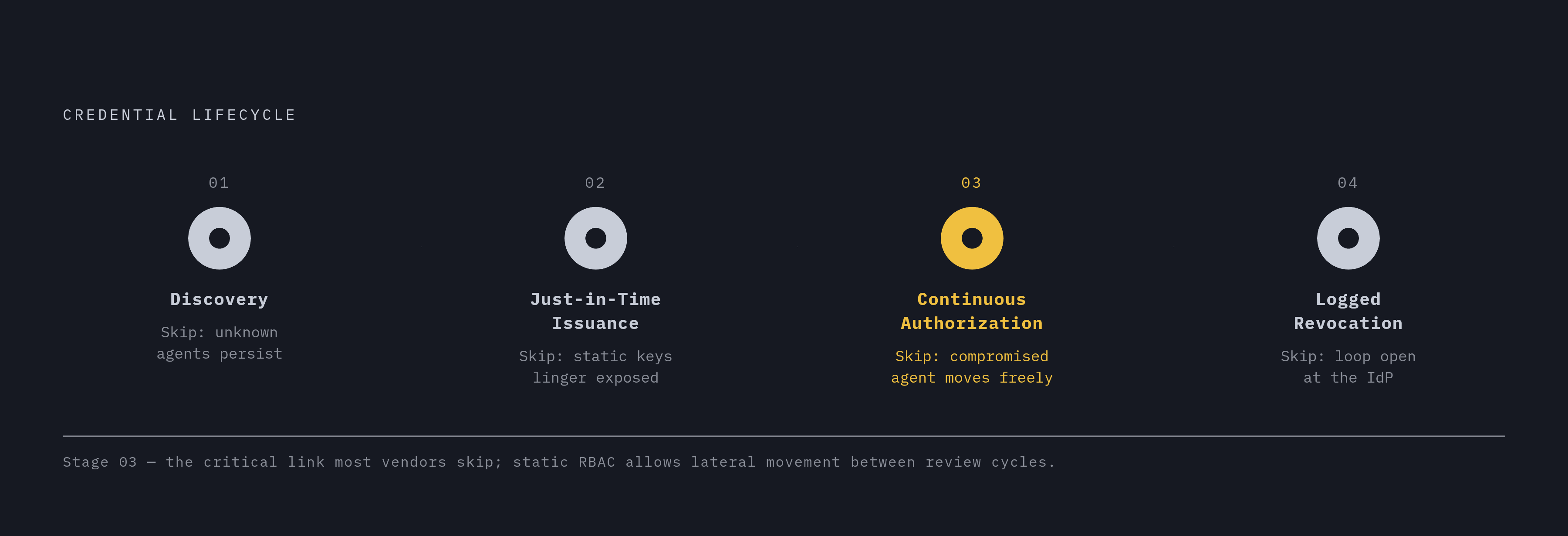
Credential lifecycle completeness is the last test, and it's the one that actually separates a platform from a feature wearing a platform's clothes. Trace the full chain: discovery of what exists, just-in-time issuance instead of static keys, continuous authorization instead of a quarterly review, a clean and logged revocation path when the job's done. A vendor that owns one link in that chain and calls itself a platform is selling you a component with good marketing behind it. Buy the whole chain. Every link, no exceptions.