Wiring Okta and Entra ID Into an MCP Gateway Without Rebuilding Your Authorization Stack
Extend your existing OAuth and OIDC flows to govern MCP tool calls.
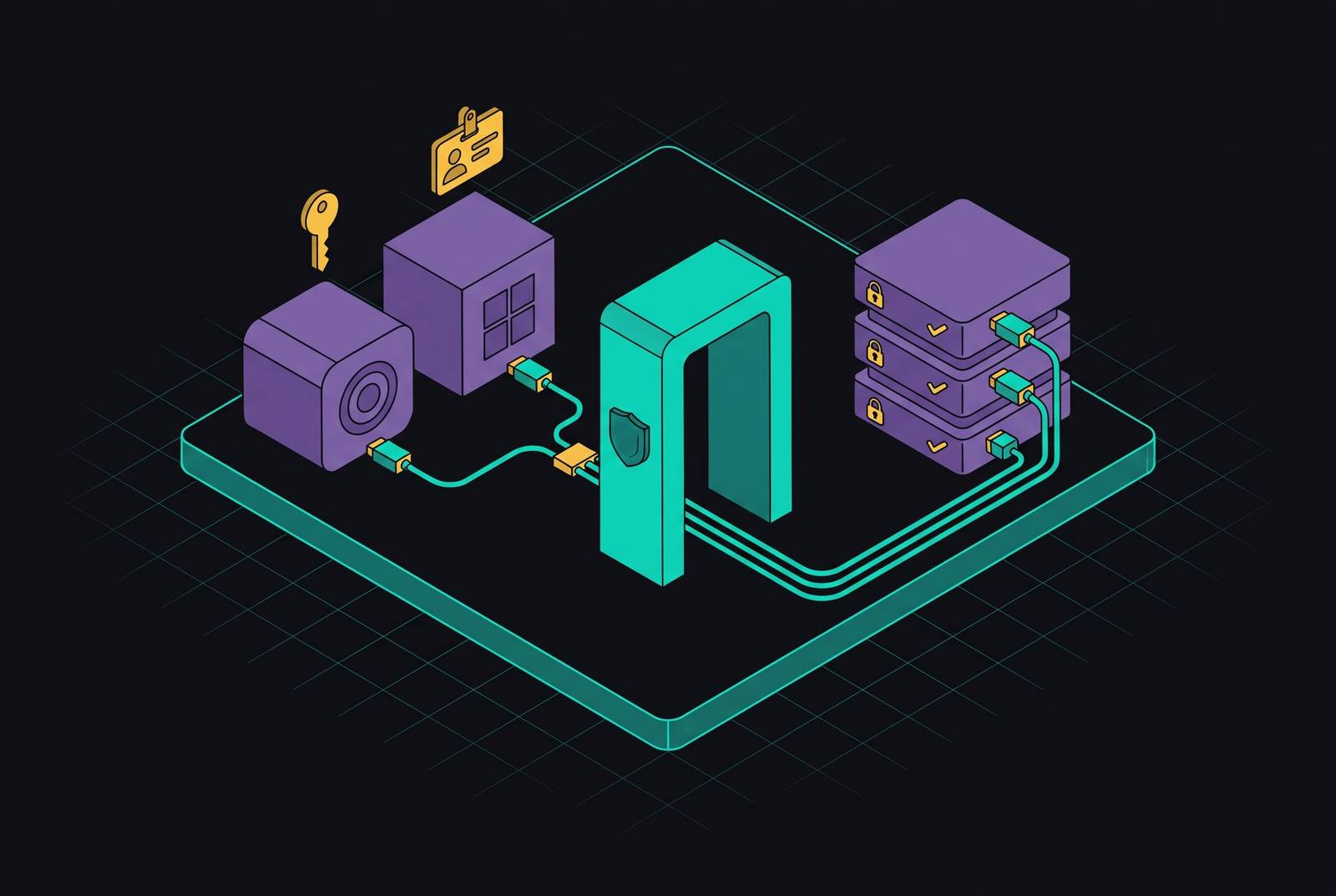
Enterprises can connect Okta or Entra ID to an MCP gateway by extending existing OAuth 2.1 and OIDC flows. The gateway validates identity, enforces role-based access control on each tool call, manages downstream credentials, and generates attributable audit logs. This architecture covers both interactive users and automated agents while keeping the existing identity provider in charge of who they are.
Why wiring your IdP into an MCP gateway is not an auth redesign
MCP authentication looks unfamiliar, which can make a new identity system seem necessary. The unfamiliar part is the unmanaged space between agents and tool servers, where each server has historically handled authentication independently. Shadow MCP servers deepen that gap by operating without review, structured logs, or a trace connecting actions to users.
A gateway replaces those separate entry points with one governed endpoint. Clients authenticate there, while the gateway validates IdP-issued tokens and manages downstream credentials. The credential mesh shrinks from N-agents × M-servers to N + M. The work is consolidating enforcement.
What an MCP gateway actually does to agent traffic before any IdP token arrives
Tyk’s enterprise MCP gateway guide distinguishes an MCP-aware gateway from a traditional API gateway that passes through generic JSON-RPC. The distinction is what the gateway understands. It parses dynamic tool schemas, filters tools/list responses by identity, and inspects tools/call arguments against per-action policy before forwarding. It also preserves delegated user identity across multi-step workflows, rather than treating an authenticated session as permission for everything that follows.
That semantic awareness makes coherent auditing possible. The gateway logs tool discovery and invocation with agent identity, user context, arguments, response status, and latency. A hub-and-spoke deployment puts one gateway cluster between agents and servers, regardless of where the agents run. Security teams then manage one enforcement point.
Operationally, that hub should not become a monolith. The data plane handles live routing, authentication, rate limiting, and observability, while the control plane holds policy evaluation, the registry, and configuration. Separating them lets policy change without redeploying the proxy and keeps slow policy engines from blocking routine traffic. The IdP therefore connects to a defined authentication interface.
How OAuth 2.1 and OIDC connect the existing IdP to the gateway
In this architecture, remote MCP servers are OAuth resource servers, and the gateway presents a single authorization-server interface to clients. The existing IdP remains the upstream issuer. The gateway absorbs differences in downstream authentication rather than requiring clients to negotiate separately with every server.
The connection must resolve two independent questions. The persona axis distinguishes interactive users from automated non-user agents. The credential axis includes no authentication, static or dynamic API keys, PKCE, client credentials, and platform app-context for managed workloads. If only employees can sign in, background agents have no way in. The required enterprise grants are authorization code with PKCE for interactive users, client credentials for machine agents, and on-behalf-of or token exchange for delegated access.
Token provisioning has three practical forms. With Bring-Your-Own-Token, the gateway validates an existing IdP token against the issuer’s JWKS endpoint without minting another token. With Generate-Your-Own-Token, it issues short-lived tokens after the IdP authenticates the caller. Delegated OAuth uses RFC 8693 token exchange to obtain downstream-scoped tokens while preserving user identity without another prompt.
These models do not require a separate entitlement store. The gateway should constrain token lifetime and scope to the task, so agents do not hold raw secrets or long-lived credentials. Entra changes the registration and enterprise-consent details of that connection. Okta supplies the upstream identity through its existing authorization-server and OIDC flows.
What changes when the IdP is Microsoft Entra ID
Under Entra’s app registration model, direct client-to-server integration costs a lot to keep up. Each client reaching multiple MCP servers otherwise accumulates registrations and server scopes. The gateway absorbs that administrative multiplication. Clients connect to one registered gateway application, which signs users in through Entra, accepts tokens intended for its endpoint, and manages downstream credentials.
Enterprise-Managed Authorization, or EMA, addresses consent at enterprise scale. MCP enterprise authorization reached stable status June 18, 2026, replacing per-user consent with an IdP-delegated flow. After normal SSO, an EMA-compatible client requests an ID-JAG through OAuth Token Exchange. The IdP applies administrator-configured role or group policy and issues a signed identity assertion JWT for authorized server access.
Microsoft’s wider stack extends governance beyond token issuance. Entra Agent ID anchors Conditional Access and blueprint-level policy for agent fleets, including on-behalf-of versus autonomous token patterns. Microsoft announced the broader stack at Ignite in November 2026, with Purview sensitivity labels guiding agent DLP, Intune providing host-device posture, and Defender spotting suspicious agent activity. Microsoft Execution Containers reached general availability on October 7, 2026, with OS-enforced boundaries, while Intune-managed container policy is still in private preview.
That depth is useful for Microsoft-centric organizations. It also makes the choice broader than an OAuth integration, because adopting the surrounding governance stack increases dependence on Microsoft’s agent model.
What changes when the IdP is Okta
Okta’s integration rests on its OAuth 2.1 authorization server and OIDC flows. It supports grants for PKCE, client credentials, and token exchange. For non-user agents, each agent has its own Okta application with scopes for its task, so the agents do not share a service account. RFC 8693 on-behalf-of exchange supports delegated downstream access without another user prompt.
The gateway supplies the MCP-specific interpretation of that identity. It validates tokens against Okta’s JWKS endpoint, evaluates groups, roles, and custom attributes against per-action policy, and issues downstream-scoped credentials. Okta need not understand tool schemas or arguments. In organizations running both IdPs, this separation lets one enforcement point accept multiple upstream issuers under a common policy model instead of making every tool server integrate with each provider.
The four live threat surfaces that survive a correct IdP integration
Correct authentication does not make a tool call safe. The first surviving surface is prompt injection through descriptions or results that an agent treats as instructions. The GitHub MCP vulnerability in 2025 showed crafted repository content inducing exfiltration of the victim’s private repository data within their session. Separately, JFrog’s disclosure of CVE-2025-6514 documented OS command injection in mcp-remote when connecting to an untrusted server. A trusted login does not sanitize an untrusted server.
The second surface arises when a low-trust user can reach an agent or server that executes downstream actions with broader privileges than the user possesses. A documented CVE involving the Kong Konnect MCP server describes indirect prompt injection causing unintended API requests. The gateway’s corrective rule is precise. Effective access must be the intersection of agent and user permissions.
The third surface spans calls that are otherwise legitimate. Zhao et al.’s “Parasitic Toolchain Attack” model, instantiated as MCP Unintended Privacy Disclosure, describes benign tools chained together to exfiltrate private data. A malicious payload returned by weather_api can, for example, pass into file_write. Sensitive data can also get out through search queries or email subjects that look ordinary.
The fourth surface is excessive permission scope, which enlarges the damage possible in failures such as the confused-deputy case. Credentials that are short-lived and task-scoped limit that exposure. These tool-call problems require gateway controls that evaluate what an authenticated agent is attempting to do.
What the audit trail must capture and where the observability stack currently falls short
Deploying a gateway alone does not meet the audit requirements of GDPR, HIPAA, or SEC Rule 17a-4. Each entry needs the requesting agent ID, user context, tool name, parameters, response summary, status, and latency. Attribution is the minimum. PII redaction belongs after audit log generation but before telemetry storage, preserving the record-generation step without depositing unredacted personal information in telemetry.
Mature API management provides a useful benchmark. It offers named authentication on each call, immutable audit logs, per-consumer usage dashboards, and team-level cost attribution. MCP observability often lacks executing-user identity and tool-call volume tracking, while cost visibility stops at the LLM boundary. The gap prevents a gateway from serving as a compliance certificate by installation alone.
OpenTelemetry deprecated every gen_ai.* attribute from its main semantic-conventions repository on 12 June 2026 and moved them to a dedicated repository. That repository had zero tagged releases as of 12 October 2026. Cross-layer agent tracing conventions were therefore unfinished.
The practical response is to build auditing now. Gateway instrumentation should connect LLM and tool boundaries with distributed traces, export Prometheus metrics, and measure tool selection accuracy and tail latency. It should also track the token costs of each tool interaction. Audit generation and cost attribution cannot wait for the GenAI conventions to settle.
How the governed path works in practice with one registry and role-provisioned access
When a developer or contractor leaves, revoking their IdP account should remove their agents’ access to every tool server. Separately issued long-lived tokens undermine that outcome by surviving the account’s revocation. These are ghost credentials with perfectly serviceable keys. Routing authentication through the IdP gives offboarding a central control point.
The same path governs access during employment. Existing IdP groups and roles determine which tools a user or agent can discover and invoke, while the gateway evaluates each action before forwarding. The record of every allow and deny decision includes the agent, user context, and policy behind it.
Streamable HTTP makes that path operable as enterprise infrastructure. Servers become network services compatible with standard load balancers, reverse proxies, and OAuth 2.1, unlike local process connections that lack centralized visibility and revocation. The platform team maintains a registry of approved servers, with shadow MCP promoted through review. Every agent resolves tools through that registry, making it the source of truth for what the enterprise permits.
Which MCP gateway platforms fit enterprise RBAC and Okta or Entra integration
Platform evaluation should establish which platform absorbs identity integration for tool-server teams. Can it calculate the intersection of user and agent permissions on every action? Can it support all three token-provisioning models?
Audit and deployment capabilities deserve equal scrutiny. The gateway should produce attribution-rich logs for the existing SIEM, export Prometheus metrics and OpenTelemetry traces, and separate policy evaluation from the proxy data path. Its deployment model must also fit the required perimeter, whether VPC isolation, air-gapped infrastructure, hybrid cloud, or edge.
Cloudflare AI Gateway with MCP Server Portals combines the gateway, portals, and Cloudflare Gateway into a unified security plane with shadow MCP detection. Its natural fit is an organization already using Cloudflare’s edge network. Kong AI Gateway adds MCP authentication, observability, and policy enforcement through Kong’s plugin architecture, with self-hosted deployment through Kong Gateway Enterprise and hybrid or cloud deployment through Konnect.
Azure API Management MCP Support fits Microsoft-centric organizations using VS Code and Entra, with close integration into EMA and the surrounding governance stack. Bifrost, from Maxim AI, is an open-source gateway combining LLM, MCP, and agent gateway capabilities, with air-gapped, VPC-isolated, and on-prem deployment options. Its primary governance entity is the virtual key, with hierarchical budgets and per-key MCP tool allow-lists.
These are deployment and governance distinctions. A tool allow-list, for example, is not by itself evidence of per-action user-and-agent permission intersection. The chosen platform should natively cover the required grants, policy semantics, and audit output, leaving only configuration work.
The integration sequence that avoids a parallel auth stack
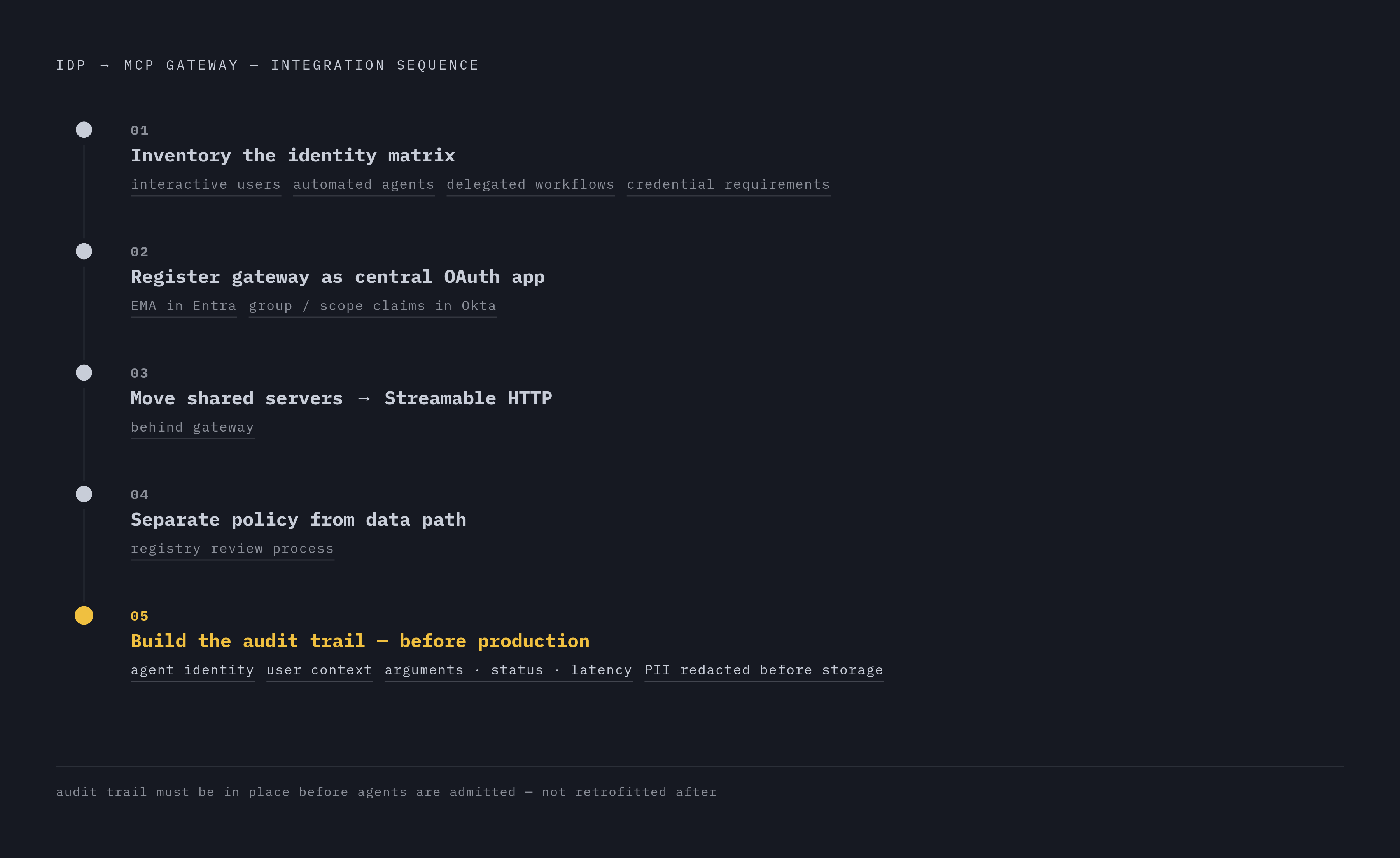
First, inventory the deployment’s identity matrix. Record interactive users, automated agents, and delegated workflows, together with their credential requirements. Check whether the existing tenant supports authorization code with PKCE, client credentials, and token exchange for those cases. Establish the gap before building a replacement.
Second, register the gateway as the central OAuth application rather than repeating the integration for each server. In Entra, configure the gateway endpoint and EMA administrator policy for group-to-server access. In Okta, configure the gateway application, group membership, and gateway-enforced scope claims. Keep downstream credential management behind that boundary.
Third, move servers that use shared resources to Streamable HTTP behind the gateway. Keep local process connections only for developer tooling that runs on a single machine and has no shared-resource access. Fourth, keep policy evaluation separate from the data path before going into production, and set up the registry review process for servers as they are found. Routine calls should not wait on a slow policy engine.
Fifth, build the audit trail before letting production agents in. Log discovery and invocation with agent identity, user context, arguments, status, and latency, then redact PII before telemetry storage. Send those records to the existing observability stack and leave the schema adaptable to future GenAI conventions. This sequence treats the IdP as trusted infrastructure already in place.