MCP Tool Versioning Strategies for Multi-Client Enterprise Deployments
Per-request version declarations turn tool compatibility into a gateway job.
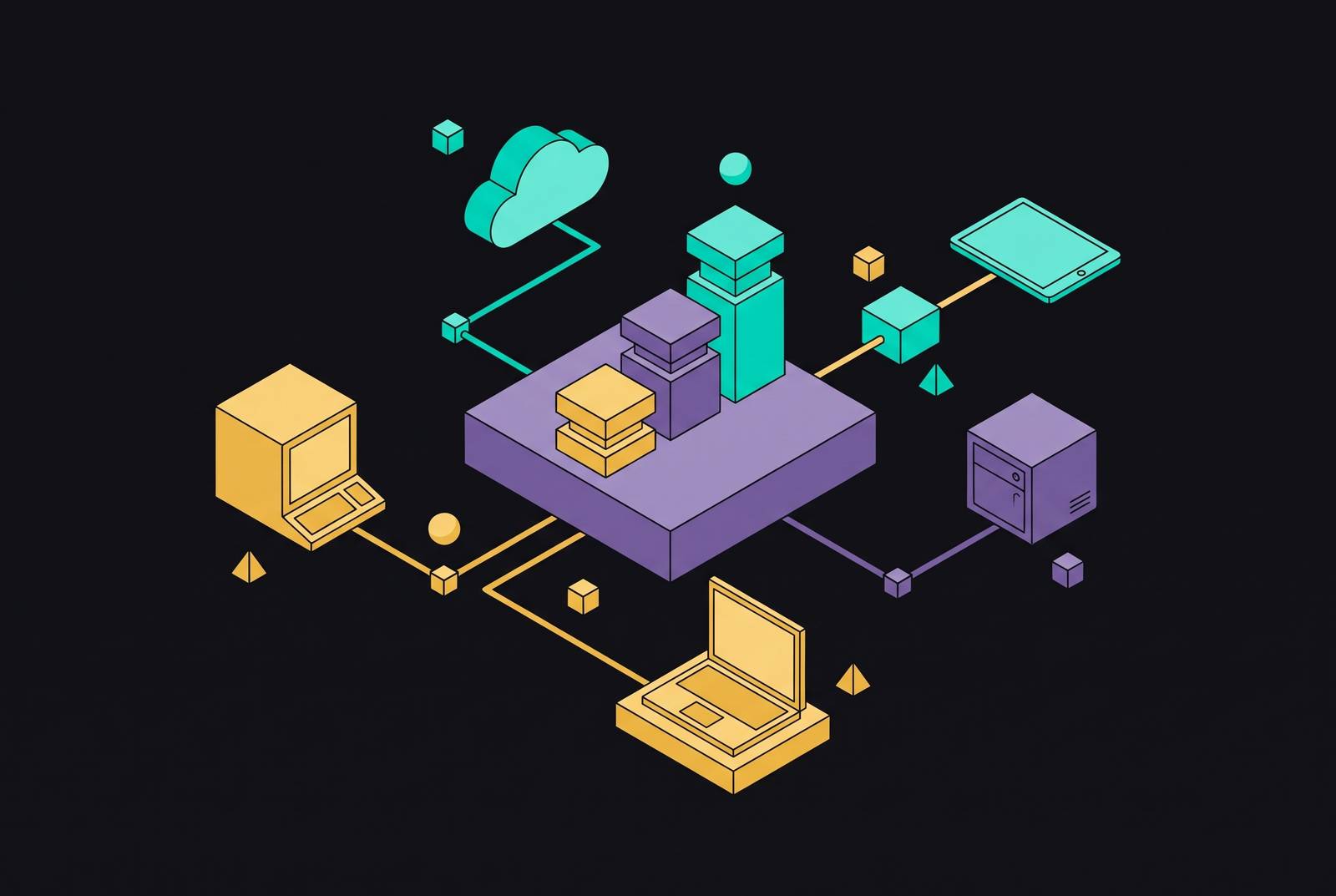
MCP tool versioning in multi-client enterprises is now a runtime governance problem. The 2026-07-28 specification makes requests self-describing, so protocol versions, capabilities, tool definitions, and authorization must work together on every call. Teams should govern through the gateway, with clear compatibility paths, deprecation windows they measure, and a shared registry in place of separate rules buried in each client.
What the 2026-07-28 specification actually changed about how clients and servers communicate
Earlier MCP connections began with a mandatory initialize / initialized handshake that negotiated the protocol version and capabilities once. The resulting session pinned the client to a server instance. Load balancers needed sticky sessions or a shared session store, and when connections dropped, session state was lost, while keepalive messages added overhead. The 2026-07-28 specification removes that exchange and the Mcp-Session-Id header. Every request now stands on its own.
A _meta object in the JSON-RPC envelope has the protocol version, client identity, and capability flags, so any server instance can handle the request without already knowing the client. Discovery moves to the stateless server/discover RPC, which servers must implement but clients need not call. Routing also becomes more visible to infrastructure. Streamable HTTP requests require Mcp-Method, with Mcp-Name required for tools/call, resources/read, and prompts/get. Catalog and resource responses gain ttlMs and cacheScope hints, allowing caching across reconnects instead of making every reconnection a fresh introduction.
Why per-request version declaration changes the enterprise versioning problem
MCP’s versioning documentation specifies io.modelcontextprotocol/protocolVersion in _meta on every request and MCP-Protocol-Version on Streamable HTTP. The server decides whether to accept or reject each request on its own. An unsupported version produces UnsupportedProtocolVersionError, which lists supported versions so the client can retry with a mutually supported one. Compatibility is therefore a decision made throughout traffic.
That distinction becomes consequential when IDE plugins, agent frameworks, and automation tools share a server estate but upgrade at different speeds. Each can run into version errors on its own while it is running. Clients and servers may support several versions, but the handshake-based era through 2025-11-25 and the stateless 2026-07-28 era are not wire-compatible. SDK auto-negotiation and era fallback can bridge them without a separately deployed dispatcher. The enterprise obligation remains the same, however, because routing, error handling, and monitoring must account for compatibility continuously.
The formal deprecation policy and what its twelve-month window requires of enterprise teams
The formal deprecation policy gives features at least a twelve-month window before they can normally be removed. The deprecated features registry is the authoritative record. It documents affected features and their migration paths, including Dynamic Client Registration, roots, sampling, protocol-level logging, and HTTP+SSE. Deprecation provides notice while the feature remains available, and removal follows in a future revision once it becomes eligible, with the minimum window offering no promise that it disappears on its anniversary.
For enterprise teams, that protection creates a planning obligation. A client may still depend on a feature that a server’s newer revision has removed, even when the client team considers its own upgrade complete. Teams should track registry entries across client and server owners, with migration work attached to each affected dependency.
How to structure a server endpoint to handle both legacy and 2026-07-28 clients simultaneously
The dispatcher/runner pattern makes coexistence explicit behind one public endpoint. A thin gateway layer establishes a routing boundary by inspecting MCP-Protocol-Version and directing traffic to a legacy-dialect or modern-dialect runner. Although SDKs can supply the bridge internally, ignoring a version mismatch cannot reconcile different wire formats and capability models. On modern Streamable HTTP traffic, the required method and name headers also support routing and authorization without JSON-body parsing.
Discovery provides a clean entry into negotiation. A v2 client in auto-mode can probe with server/discover and fall back after UnsupportedProtocolVersionError, provided the server returns that error cleanly. Application state still needs an explicit home. Servers that span calls should return an identifier such as basket_id, browser_id, or workflow_id for later requests to include. Multi Round-Trip Requests similarly allow a call to return resultType set to "input_required" with an opaque requestState blob, after which the client resends the original call with answers so any instance can complete it.
Capability flags as a versioning mechanism and how to govern them across clients
A protocol version identifies the dialect. Capability flags are a separate compatibility axis, transmitted in _meta on every request. The extensions framework makes that distinction sharper. Tasks, MCP Apps, and Enterprise-Managed Authorization are versioned, opt-in extensions, so support for 2026-07-28 does not imply support for each extension. A tool can therefore require an interaction that the calling client has not declared it can handle.
For teams governing that boundary, server/discover provides supported versions, capabilities, and server identity before invocation. The gateway should keep a capability matrix that links client identity to the flags it expects and flag claims outside that set as possible upgrades made without approval or errors in configuration. Version support alone is not sufficient permission. Cache-hint support belongs in this matrix too, because clients that do not honor ttlMs and cacheScope generate more catalog fetches, changing the capacity required to serve the same client population.
Tool schema versioning and keeping definitions stable while servers evolve
The tools/list cache hints create a second clock for compatibility. A client may retain a tool definition until its TTL expires, even after the server behind that definition has changed. Correct protocol negotiation cannot repair an incompatible schema. Agents each cache and reason over tool definitions on their own, so server changes must still work with the definitions those agents have.
Under this pattern, changes are compatible when they add optional parameters with defaults, add tools beside those already there, or allow more enum values. Changes are breaking when they remove parameters, change types or names, narrow enums, or change whether a parameter is required or optional. Those need a new tool name. The recommended approach is to publish a definition such as search_v2, operate both versions during a deprecation window, and remove the old one only after confirming that clients no longer call it. On Streamable HTTP tool calls, Mcp-Name gives the gateway a direct signal for logging deprecated names, applying rate limits, or returning structured warnings, while a changelog, advance notice, and a named migration owner provide the corresponding change process.
Running a formal deprecation window in practice and what teams need to operate one
A deprecation window protects clients only if the organization can identify the ones still using the old interface. The gateway can use headers to identify tools and log deprecated calls without changing the response. Client identity comes from _meta, providing attribution beyond a tool’s aggregate popularity. Actual call counts show whether its migration has reached production.
To operate the window, teams should record per-tool, per-client call counts, alert on continued use late in the window, and show migration progress as call volume trends toward zero. MCP does not yet define a standard observability format, so structured events should feed the existing SIEM or APM platform. Notices should go directly to client team owners, with ownership recorded in the tool registry beside schema and version. A registry entry is not a notification service. Because expedited removal can outrun normal planning cycles, this instrumentation needs to exist before an urgent deprecation arrives.
Authorization changes in 2026-07-28 and how they interact with version transition planning
The specification deprecates Dynamic Client Registration in favor of Client ID Metadata Documents. Instead of registering dynamically, a client publishes metadata at a stable URL for servers to fetch and cache, closing the drive-by registration abuse pattern. Authorization servers supporting RFC 9207 must return iss, and clients must validate it before redeeming a code, so a legacy client can fail authorization even when protocol dispatch is correct. Credentials are also bound to their issuing authorization server and cannot be reused across issuers.
Enterprise-Managed Authorization reached stable on June 18 with support from Anthropic, Microsoft, and Okta, providing an SSO-integrated path. Its scope has a clear boundary, however. EMA governs whether a user can connect a client to a server, while separate policy governs tool calls after token issuance. Teams should therefore upgrade IdP integration, CIMD publication, and issuer validation before or during protocol migration, while retaining separate per-request enforcement.
Gateway configuration as the control point for multi-client version governance
The gateway brings these compatibility decisions together without requiring every client to upgrade in lockstep. It can dispatch protocol versions, enforce the capability matrix, track deprecated tool names, and check credentials against the issuer expected for the requested server. The specification’s method and name headers make routing and metering possible without body parsing. Client identity and capability flags still come from _meta, so header routing is one part of governance.
Policy evaluation should be distinct from the gateway’s data path so registry and capability changes do not require proxy redeployment or leave hot paths blocked on slow policy engines. Existing IdP group membership can drive role-based server access instead of creating a parallel access model for agents. Structured, per-request events attributed to client identity should feed OpenTelemetry, SIEM, or APM systems for deprecation monitoring, compliance reporting, and cost attribution.
Configuration portability across clients and what to do until the protocol solves it
MCP server configuration is still specific to each client, so adding another client can mean setting up the same servers all over again. Protocol-level portability is still a pre-RFC area. That leaves enterprises with a practical registry problem. Tool namespaces, capability flags, authorization scopes, and routing rules should live in the gateway’s configuration, so teams can maintain them there instead of updating them again and again in local client files. New clients can then point at the gateway and use server/discover for discovery.
The governed registry should be the source of truth for approved servers, their supported versions, and advertised capabilities. This also addresses configuration friction in reverse. Developer-provisioned servers outside the registry create shadow MCP when teams bypass the official path to get work done. The recommended response is to discover those servers and promote them into the registry. A future portability standard may cut the setup work for each client, but a shared registry can still govern server access whatever the configuration format.
The versioning playbook and a sequenced checklist for multi-client deployments
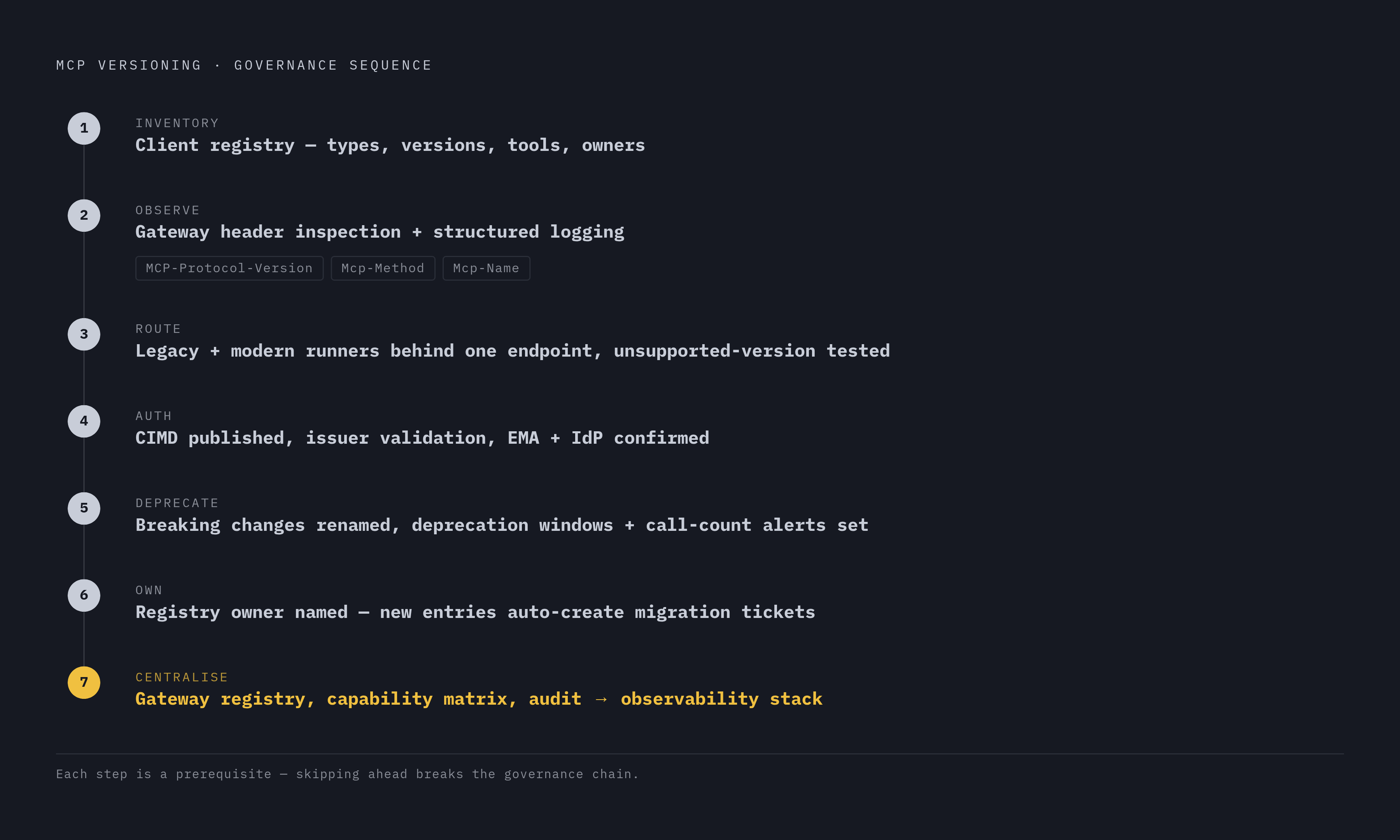
First, inventory every client type, its declared protocol version, and the tool names it calls. Record client team ownership with that baseline. Second, set up the gateway to inspect headers and write structured logs before changing routing policy. Capture MCP-Protocol-Version, Mcp-Method, and Mcp-Name where supplied, and distinguish legacy traffic from modern requests subject to the new requirements.
Third, set up legacy and modern runners behind one endpoint and test both client types before putting them into production. Make unsupported-version handling part of that test. Fourth, publish CIMD for registered clients, configure issuer validation, and confirm EMA integration with the organization’s IdP in parallel with dispatcher work.
Fifth, publish breaking tool changes under new names, register deprecation windows, and configure call counts and late-window alerts for old names. Name an owner to handle migration for each affected client. Sixth, name an owner for the deprecated features registry and turn new entries into migration tickets that allow for expedited removal. Seventh, move shared server configuration into the gateway registry, set up the client capability matrix, and bring new clients in through the gateway and discovery. Send the resulting audit events to the existing observability stack.