Enforcing Least Privilege and Centralizing AI Tool Call Logs Across an MCP Fleet in Production
A gateway-level guide to scoping MCP tool access and logging every call.
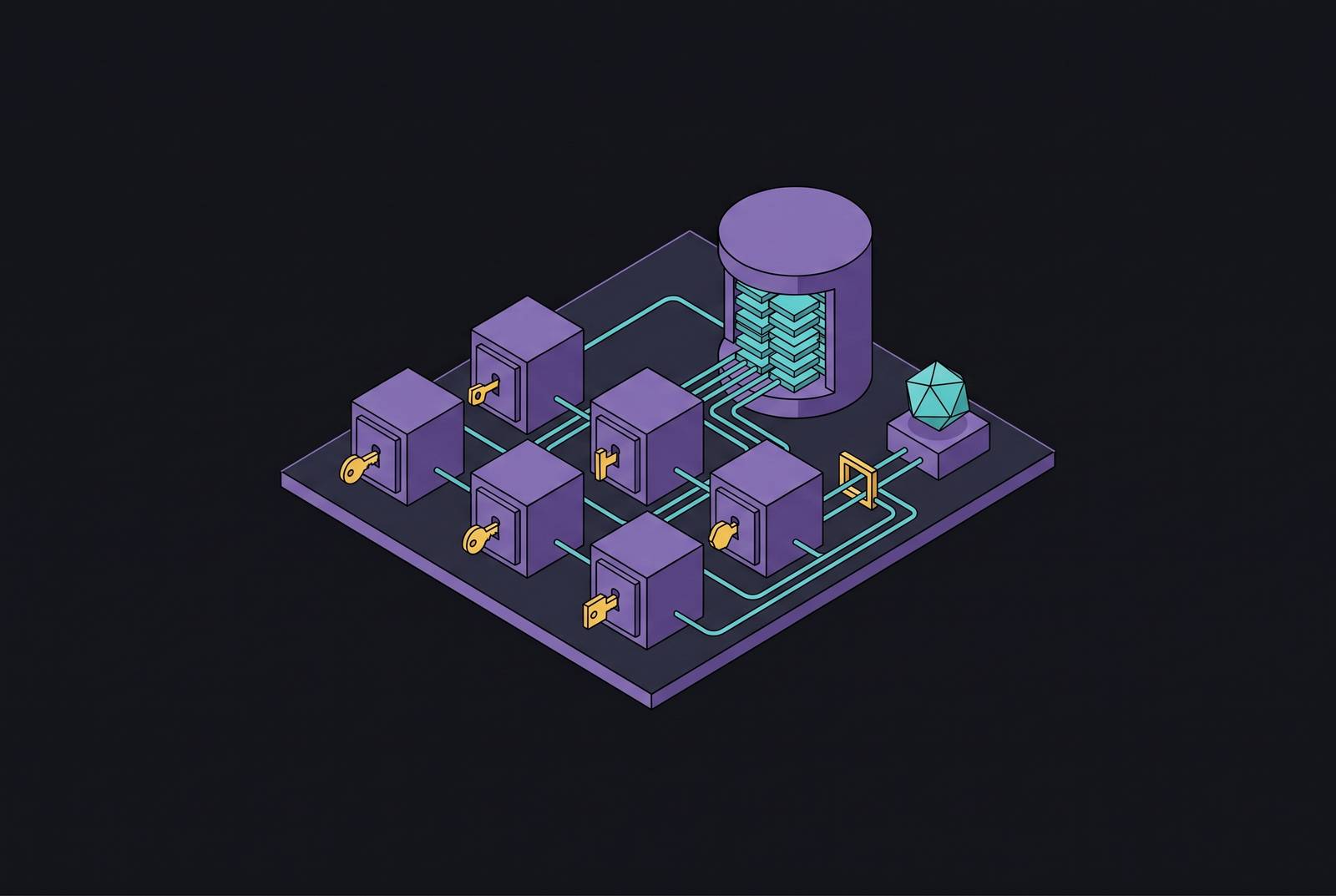
An MCP gateway with enterprise role-based access control and audit logging must bind tool permissions to identities from Okta, Entra, or another corporate identity provider, authorize every operation, and write durable, attributable records. MCP has no native role-based access control, so production least privilege belongs at the gateway. That architecture works only when tool traffic passes through it and policy stays aligned with the fleet.
Why MCP's protocol design makes gateway-layer enforcement unavoidable
MCP does not natively distinguish between permission to reach a server and permission to use particular tools. An agent that can reach a server can discover and call every tool it exposes. Reachability is therefore a dangerously broad grant of authority. Least privilege needs a separate enforcement layer because the protocol does not supply one.
Connecting N agents to M tools creates N×M connections, and each one needs its own authentication, credentials, and decisions about who can use it. GitGuardian’s 2025 research found widespread secrets exposure in MCP configuration files, including Google API keys and PostgreSQL connection strings. Credential sprawl is not just an administrative inconvenience. It puts the means to access backends in files spread across agent environments.
The NSA’s May 2026 guidance noted that many production MCP server implementations ship without authentication controls at all. A server being available therefore says little about who controls access to it. Organizations can add controls to each agent, but that leaves enforcement spread across configurations they cannot reliably keep up to date. A shared gateway follows from that constraint, providing one layer through which every agent must pass.
What the gateway does that individual agents and servers cannot
The gateway acts as an MCP server to AI clients and an MCP client to backend tool servers. Clients point to its URL rather than individual server URLs, while continuing to issue tools/list and call_tool. The gateway evaluates and routes those requests before execution. From there, it can enforce the same rules for every client without each client having to build the same controls.
Client configuration cannot offer the same assurance. Claude Desktop, Cursor, Codex, and internal agents have their own settings, which users can edit. Asking each client to police itself recreates the “every service does its own auth” problem, with more configuration files. Server-side controls remain necessary, but the gateway adds an independent check when a server is misconfigured or exposes too much.
Credential isolation strengthens that separation of responsibilities. The gateway holds backend credentials, while agents receive short-lived virtual keys scoped to permitted tools. Revocation then has a single enforcement point. When an agent is compromised or an employee leaves, gateway access can be withdrawn without a hunt through every backend integration.
How do enterprises enforce per-action MCP access with Okta or Entra?
The gateway should resolve the initiating user through the corporate identity provider, including Okta, Entra, or another SAML/OIDC source. It can then bind a key’s permissions to a real identity. The key is an enforcement handle. Its policy can define permitted models and MCP tools, rate limits, and a budget limit, with no tools available unless access is explicitly granted.
Take two backends named billing-client and support-client. The billing backend exposes create-invoice, check-status, and issue-refund, while the support backend exposes create-ticket and get-faq. A support-agent key can receive only check-status from billing-client and all tools from support-client. Invoice creation and refunds remain outside its permitted surface. Access to one billing operation does not become permission to perform the others.
That restriction needs two separate checks. At inference time, the model sees only allowed tools, while at execution time the gateway checks authorization again before forwarding the request. Otherwise, a hallucinated tool name or injected instruction could bypass a discovery-only filter. Hidden is not the same as forbidden.
Tool annotations can make policy easier to maintain. Metadata such as readOnly: true, idempotent: true, and dataClassification: pii-contained supports class-level rules, while a Virtual MCP Server can assemble safe subsets from several backends into one curated endpoint. A support endpoint might expose CRM reads and ticket creation without database administration or billing writes. For delegated workflows, policy also needs the initiating user, calling agent, target tool, arguments, data classification, and environment.
Preserving identity and constraining scope across multi-agent delegation chains
Delegation complicates authorization because the immediate caller may not be the person or agent that started the work. A downstream agent should never have more rights than its parent. A valid token alone cannot establish that boundary. The gateway must also determine whose authority was delegated, for which resources, under which constraints, and whether the requested action fits.
Enterprise-Managed Authorization, or EMA, addresses connection friction. The corporate identity provider mints an Identity Assertion JWT Authorization Grant, or ID-JAG, which the MCP client exchanges at the server’s Authorization Server for a server-scoped access token. This avoids a separate per-app consent flow. EMA does not check the MCP traffic that follows, so the gateway still has to handle tool-call authorization.
The MCP roadmap published August 22, 2026, sets out standardized recognition of agent identities using existing standards, including Demonstrating Proof of Possession, Workload Identity Federation, ID-JAG, and token exchange. Meanwhile, the 2026-07-28 specification replaced protocol-level sessions with a stateless core. Each request must supply its own identity and version metadata and receive its own authorization decision. Rate limits therefore need to use an authorization window because they can no longer rely on a protocol session.
In practice, the gateway should record the originating user, intermediary agents, delegated capabilities, and final destination. Sub-agent tokens should have narrower scopes and shorter lifetimes than their parent tokens. This adds work to the authorization path. It also provides a primary defense against prompt-injection-driven escalation through an agent that would otherwise inherit excessive authority.
What the threat model looks like when agents have broad tool access
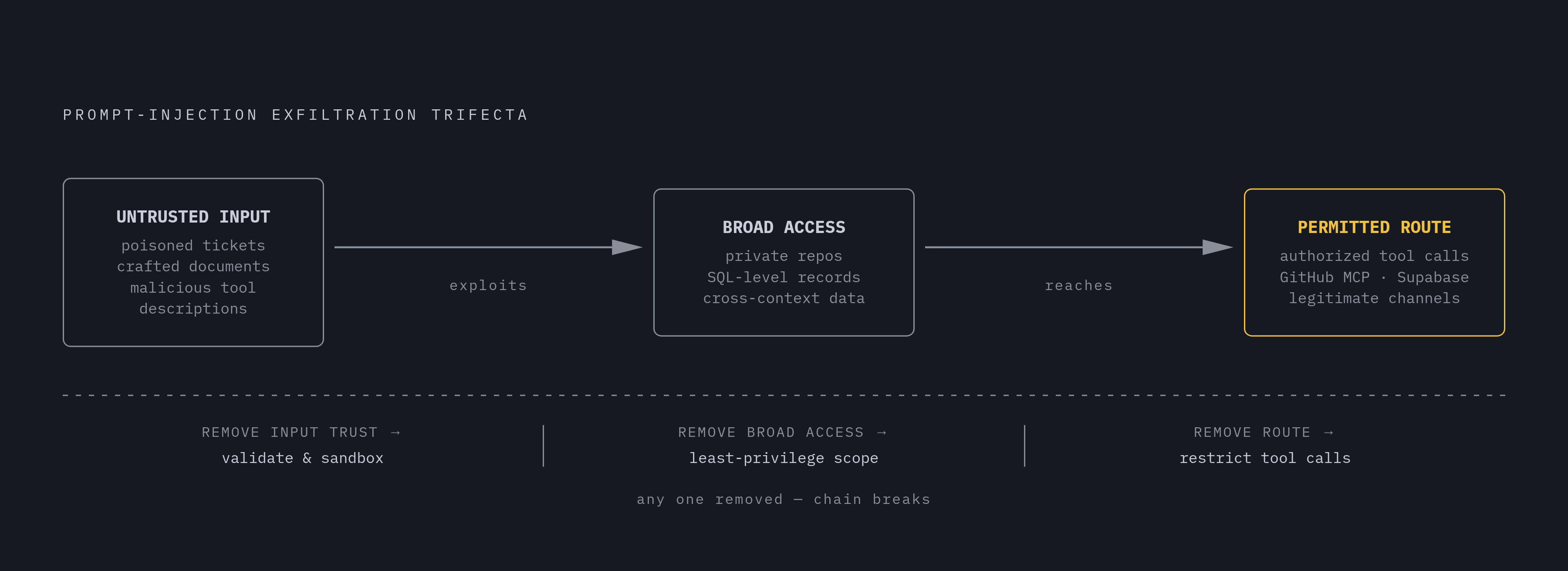
Invariant Labs disclosed the GitHub MCP toxic agent flow in May 2025. A prompt injection in a public issue caused an agent to exfiltrate private repository data because it could access both issue-reading and repository-reading tools. The Supabase Cursor tool-poisoning vulnerability similarly enabled SQL-level data exfiltration through a support ticket where an agent combined read and write access. These were failures of authority.
The structural danger is a lethal trifecta of untrusted input, access to private data, and a permitted route for transmitting it. Encryption cannot fix that combination. The channel can be perfectly protected while the agent uses legitimate tool access to send information somewhere it should not. Poisoned tickets, manipulated emails, crafted documents, and malicious tool descriptions can introduce instructions into that chain.
Infrastructure vulnerabilities add a separate reason for layered defenses. The NSA and Cloud Security Alliance cited critical remote code execution vulnerabilities including CVE-2025-6514 in mcp-remote, affecting a large installed base, and CVE-2025-49596 in MCP Inspector. Gateway policy limits what agents are allowed to reach, while server-level security protects the software itself.
Runaway activity also needs explicit bounds. Production gateways should limit request rate, tool calls per authorization window, payload size, execution time, and token or credit consumption. Under the stateless core, these controls operate independently of protocol-level sessions to constrain how far an agent can proceed before its authority must be reconsidered.
Structuring log emission so every tool call is attributed to a named person
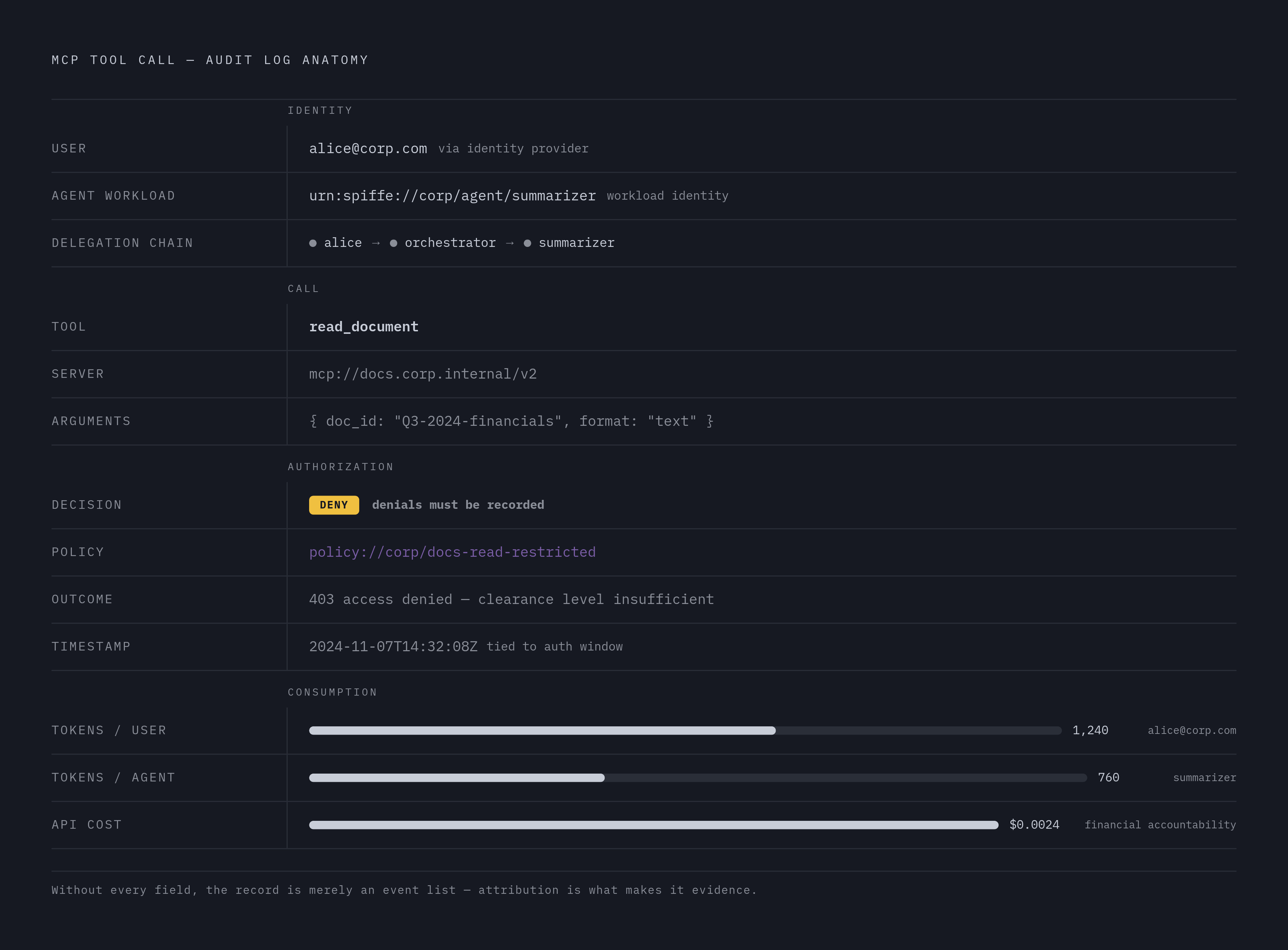
Authorization establishes who may act, while audit logging preserves the evidence of what happened. A record needs the originating user from the identity provider, the calling agent’s workload identity, and any delegation chain. It should also capture the tool, server, arguments, allow-or-deny decision, responsible policy, outcome, and a timestamp tied to the authorization window. Without attribution, it is merely an event list.
The gateway should be the authoritative write point. Server logs miss requests blocked or rerouted before arrival, while agent logs remain under the agent’s control. A model’s claim about its identity is not evidence. Attribution must come from the authenticated request and centrally evaluated policy.
Audit records should flow into the customer’s own observability stack, using OpenTelemetry, Azure Monitor, or a SIEM, in an append-only manner. Actor, agent, decision, tool, arguments, and outcome should be discrete indexed fields. Denials belong in that record too. Omitting them removes the evidence needed to distinguish failed access attempts from successful operations.
The same structure supports financial accountability. Token and API consumption should be recorded per user and per agent so teams can attribute spending and enforce budgets. Otherwise, teams see that too much has been used only when the invoice arrives. An invoice is a rather expensive monitoring alert.
Governing shadow MCP: discovering servers that never reach the gateway
Centralized logging has a strict boundary around it. A gateway cannot govern traffic it never sees. Desktop chat applications, browser AI extensions, terminal-based coding agents, and local MCP servers can all run without the gateway seeing them. A registry is therefore a record of known deployments.
Local STDIO servers are a particularly important gap. When they touch a shared database, internal API, or SaaS system, credentials on a developer laptop can become an exfiltration path. Central policy, logging, and revocation do not cover those direct connections. The shared resource makes this more than a local development choice.
The practical response starts with discovery through device posture, network traffic analysis, and endpoint tooling. Microsoft’s deployment of Defender and Entra Global Secure Access surfaced local AI agents in an enterprise scan, illustrating why discovery belongs in enterprise operations. Discovered servers should trigger an approval request in the admin console.
For servers touching shared resources, the prescribed architecture is a remote Streamable HTTP service behind authentication and gateway routing. STDIO remains appropriate for local developer tooling on isolated, non-shared resources. The distinction follows the resource being accessed. A local process does not make a shared production-adjacent system local.
Scaling gateway enforcement as the fleet grows: topology, hybrid deployment, and policy drift
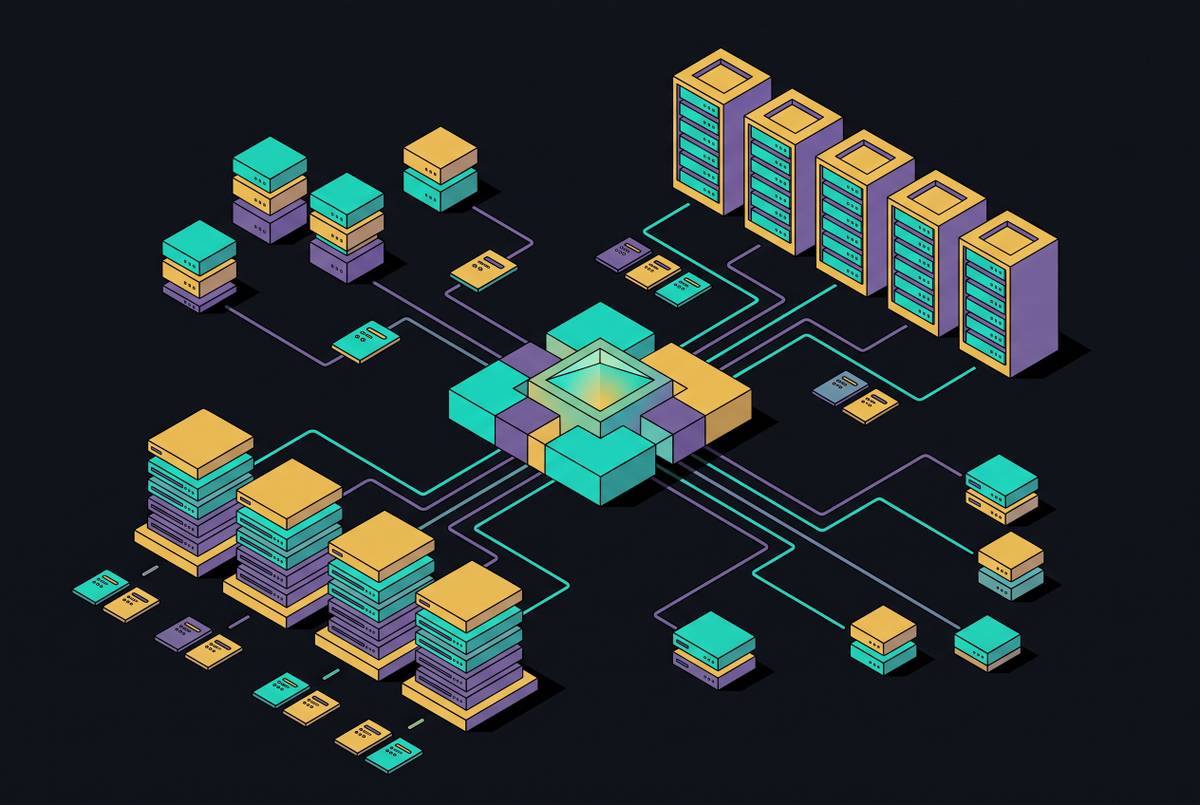
A single logical enforcement point need not mean one physical gateway. As the fleet grows, one instance can become a bottleneck, while regional deployments can fragment policy and audit records. A hybrid design separates a central control plane from regional enforcement gateways. Policy can then propagate without redeploying agents or reconfiguring each server.
Topology alone does not prevent policy drift. New tools appear, teams add servers, and agent roles change while old grants stay in place. The resulting permissions may look approved without reflecting current need. Gateway policy files should therefore be versioned, reviewed in pull requests, and checked on a schedule against what is actually running.
The deployment path also needs to remain usable. A governed route gives teams a common place to establish identity, obtain scoped access, and emit audit records rather than rebuilding those controls for each integration. Centralization need not oppose deployment speed. Its operational value depends on providing a repeatable path.
Records from agents, servers, and regions show what is normal, which makes unusual behavior easier to spot. That baseline has gaps when regions enforce policy but do not share what they see. A policy control plane needs evidence from the places where its decisions take effect.
What keeps least-privilege and audit logging effective after go-live
After deployment, deny events should become a regular review input. Repeated attempts against a high-privilege tool may indicate a misconfigured agent or an escalation attempt, and either requires action. Review must distinguish those explanations before changing permissions. Automatically broadening an allow-list would turn a warning into an access request with excellent persistence.
Credential hygiene needs the same discipline. Short-lived tokens should be calibrated to task duration and paired with rotation schedules and automated alerts when long-lived credentials appear in gateway logs. A 15-minute token leaves less time for exposure than a 24-hour token, so there is less need to revoke it quickly, though revocation itself is no easier. Otherwise, keys kept for convenience bring back the sprawl the gateway was meant to remove.
Actual call logs should also drive tool-list audits. Permissions that go unused can be considered for removal, and any change should be recorded. Sensitive writes need an additional gate. The 2026 operational guidance calls for a secondary approval signal valid for no more than 5 minutes before forwarding high-impact operations such as issue-refund, delete-record, or deploy-to-production.
These reviews depend on attribution surviving every handoff. Each allow or deny decision should lead back to a named person, including when several agents participate. When an incident occurs, “who authorized this?” should be a query.