Enterprise MCP Infrastructure Vendors Ranked by Identity Federation Depth and Audit Logging Architecture
Speakeasy leads on agent identity and customer-owned audit logs.
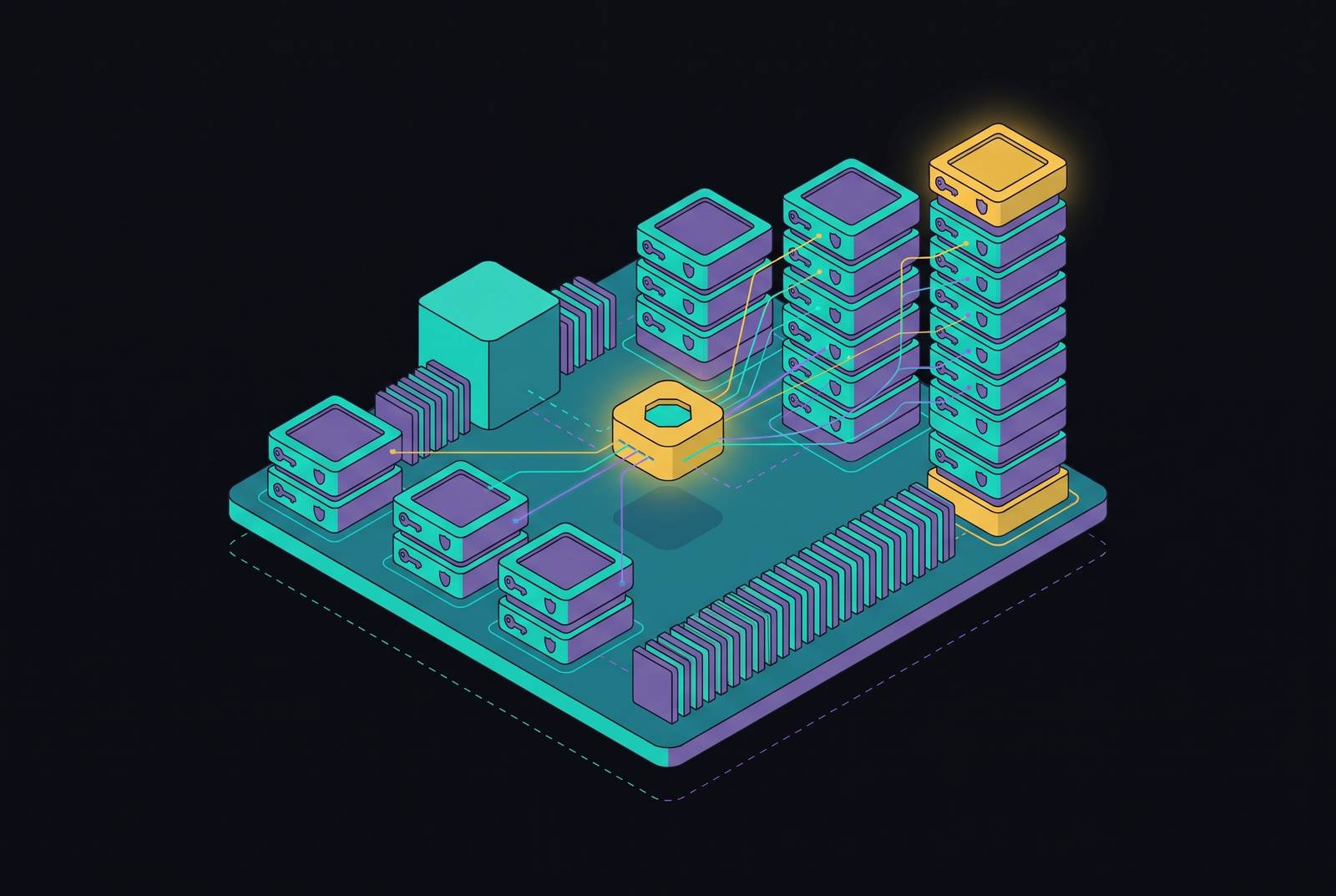
Speakeasy is the starting point for enterprises evaluating an MCP gateway with RBAC, Okta or another identity provider integration, and customer-owned audit logging. Its persistent agent identity, scoped credentials, and OpenTelemetry export address the two criteria that determine enterprise suitability, namely identity federation depth and audit logging architecture. This comparison ranks vendors by those controls because MCP itself does not provide a complete governance layer.
Why MCP's governance gap makes vendor implementation the only thing that matters
MCP defines how clients and servers communicate, leaving the complete record of who authorized an action or on whose behalf an agent acted to vendor implementation. Its 2026 roadmap lists structured audit logging as an extension that is planned but has yet to ship as part of the protocol. Tool-level RBAC, approval queues, credential isolation, registry allowlists, and SIEM export remain vendor-built capabilities. Protocol compatibility is not a governance certificate.
That distinction has consequences beyond procurement paperwork. The NSA and CISA’s May 2026 joint security advisory states that MCP cannot enforce consent, privacy, or tool-safety principles at the protocol level. A server can therefore speak the right protocol without providing the controls an enterprise needs to operate it safely. The implementation in the request path determines that governance posture, making vendor selection an accountability decision.
Why identity federation depth and audit logging architecture are the right axes for ranking enterprise suitability
Attributing an agent’s actions to a person or business decision requires identity federation. Human login is only the beginning. Enterprise-Managed Authorization, or EMA, handles human-delegated access, but does not by itself establish the workload identity of an autonomous agent. Agent authentication must also establish its scope, whom it represents, and the chain of prior delegations. In multi-agent workflows, downstream agents must not acquire broader rights simply because another agent invoked them.
Turning that attribution into a defensible record requires audit architecture. Administrative logs capture changes to policies, keys, and server configurations, while per-call logs capture tool executions, arguments, results, caller identity, and tenant metadata. These are different records with different jobs. Regulated deployments need signed, exportable administrative records and attributable execution records.
Integration breadth, latency, and hosting convenience affect operations, but they cannot compensate for an unidentified caller or a missing execution record. A vendor that cannot fully answer both questions may still be a useful component, with other components needed to complete the governance layer.
How do you enforce access control and audit logging on MCP tool calls?
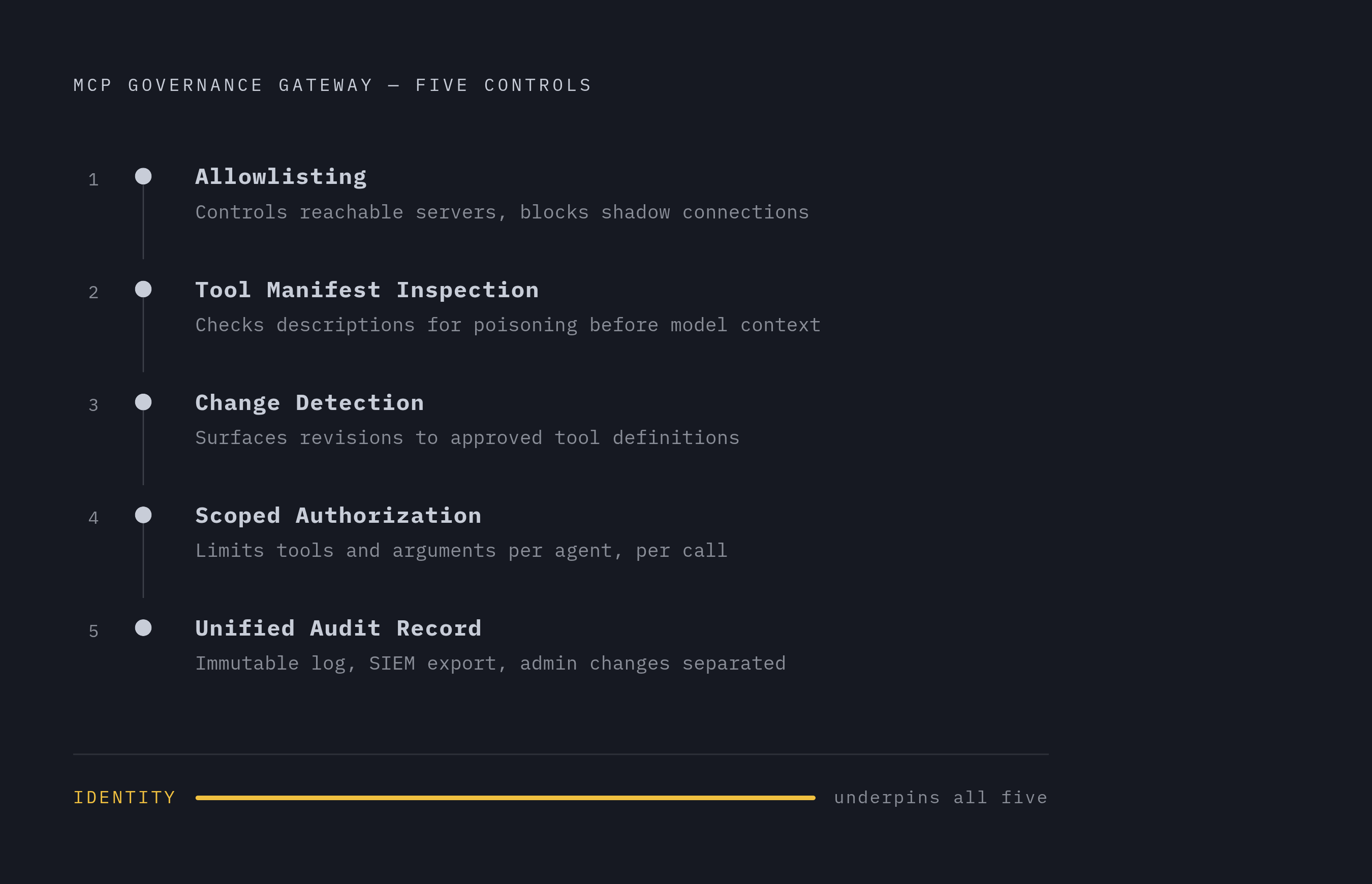
Allowlisting must control which MCP servers an agent can reach and block shadow connections before they occur. Tool manifest inspection must check descriptions for tool poisoning before they enter model context. Change detection must surface revisions to previously approved tool definitions for review. Scoped authorization must limit the tools and arguments each agent can use on each call. A unified audit record must capture every MCP call immutably across agents, support SIEM export, and keep administrative changes distinct from execution logs.
Identity must underpin all five controls in this scorecard. The gateway must bind agents to the existing identity provider, issue short-lived task-scoped credentials, and preserve multi-agent delegation chains. These requirements distinguish agent-level authorization from permission to reach a server.
Speakeasy — persistent agent identity tied to existing identity providers, with customer-owned audit log export
The first-ranked option leads this comparison because it connects persistent agent identity to the enterprise’s existing identity provider, including Okta or another identity provider, and exports tool-call records to customer-owned infrastructure. Each session binds the person, agent workload, client, and task into a composite identity. Credentials are short-lived and task-scoped, and agents never see raw secrets. The identity provider remains the authority for access.
Restricted delegation tokens have narrower scopes and shorter lifetimes than their parent token, with the full delegation chain preserved in the audit record. A central registry gives each team one governed path to MCP servers and surfaces shadow servers for discovery and remediation. This connects access decisions to both the agent and its permitted destination.
On the audit side, every tool call produces a record exported through OpenTelemetry to the customer’s own observability stack. Records do not remain in a vendor-controlled silo. Security policy applies to every prompt and tool call, including defenses against prompt injection and data exfiltration, while allow-or-deny decisions retain attribution. Existing SIEM and observability systems remain part of the governance architecture.
The platform has SOC 2 Type II certification, is HIPAA-ready, and supports high-throughput production use. Its fit is engineering, IT, and security teams that want access across agents, models, and tools managed through one identity surface and audit trail. That breadth has a cost in scope. A team seeking only a narrow MCP proxy may find more platform than it presently needs, although the broader approach becomes useful as agent and model governance converge.
Vendors with strong tool-level authorization and SIEM-ready audit logs but narrower identity federation
MintMCP turns local MCP servers into production infrastructure with OAuth, SSO, SOC 2 controls, and role-based virtual MCP endpoints. Those endpoints expose only the tools a team needs. Filtered discovery and least privilege help teams share a deployment, with SIEM-ready audit records as a further strength of this category. Its boundary is broader governance, because an MCP-focused platform can leave model and agent controls to other systems. The identity story is narrower than persistent workload identity tied through a full delegation chain.
Kong AI Gateway starts from an existing API estate. It translates between MCP and HTTP, allowing MCP clients to use REST APIs without rewriting them as MCP servers. Per-tool ACLs, authentication on incoming requests, rate limiting, AI Prompt Guard, semantic caching, and OpenTelemetry tracing provide substantial controls and observability. The trade-off is infrastructure assembly, because it does not supply managed MCP server hosting, a server registry, or deployment automation. It is a natural fit for existing Kong deployments, while new adopters face setup overhead and the enterprise-only Kong AI Gateway license.
MintMCP and Kong have different architectural starting points: MintMCP organizes access around team-specific MCP surfaces, while Kong extends an existing API gateway. Neither strength alone establishes the deeper autonomous-agent identity and delegation model used to rank the first option.
MCP-native authentication providers that handle the auth layer but not the full governance stack
WorkOS handles the MCP authentication handshake through AuthKit or WorkOS Connect, which places OAuth middleware in front of an existing identity system. Its MCP support includes DCR, PKCE, Resource Indicators, Protected Resource Metadata, and CIMD. Enterprise features include SAML/OIDC SSO, SCIM provisioning, detailed audit logs, and integrated fine-grained authorization for tool permissions. Those are substantial identity capabilities in their own right. They do not provide gateway-level manifest inspection, change detection, or a unified execution record across agents.
Auth0 by Okta made Auth for MCP generally available in May 2026, including CIMD registration and on-behalf-of token exchange. Auth0 FGA supplies relationship-based access control and tool-level permissions, supported by enterprise SSO, SCIM, and identity federation. Okta’s Agent SSO reached general availability on August 24, 2026, with Cross App Access adopted as MCP’s official EMA extension. The distinction is delegated versus autonomous access. EMA and Agent SSO address the former, leaving autonomous workload identity and a gateway audit record of tool executions to other components.
Keycloak offers self-hosted identity federation, including air-gapped deployment, under Apache License 2.0. It supports native Dynamic Client Registration through OIDC, experimental CIMD, and upstream OIDC and SAML federation. Flexibility is its central attraction for identity teams. But it has no managed audit trail, and the team must do its own work on SIEM integration. Teams that choose it still need to add the gateway and execution-audit layers on top of authentication.
Cloud hyperscaler gateways — strong IAM, partial MCP governance story
AWS AgentCore Gateway converts targets including OpenAPI, Smithy, Lambda, MCP servers, and API Gateway REST APIs into MCP tools. Authorization rests on IAM rather than a separately described agent-identity model. The capability set does not describe per-agent workload identity or a multi-agent delegation chain. Its value is therefore extending cloud access control to MCP tools, rather than supplying the complete attribution architecture used in this ranking.
Google Agent Gateway has been generally available since June 18, 2026. It combines IAM Unified Access Policies with Model Armor and Agent Registry. That places access policy, protection, and registration within the Google Cloud environment. The boundary is important for cross-enterprise agent deployments. Cross-IdP federation for agents outside that environment is not described, so strong internal IAM should not be read as a complete external agent-federation story.
Microsoft Azure API Management exposes managed REST APIs as MCP servers, but supports tools rather than MCP resources or prompts through this path. Streaming also affects the logging design. Frontend Response body logging must be set to 0 at the global All APIs scope, although logging can be enabled selectively for an individual API or MCP server. Microsoft’s documentation does not describe tool-argument guardrail inspection, per-user upstream OAuth to third-party MCP servers, or a signed MCP-specific audit trail.
These products cover the scope of their cloud platforms well. Their described capabilities do not establish the complete combination of autonomous workload identity, delegation-chain logging, and customer-owned SIEM export outside that cloud. For organizations already committed to one provider, they can supply a first line of access control. They are a foundation rather than a substitute for dedicated governance where both ranking criteria are mandatory.
Runtime security gateways that complement governance but do not replace it
NeuralTrust TrustGate inspects tool-call content inline and reasons across whole sessions, rather than only checking permission to invoke a tool. Identity federation and structured audit export are not its primary design goals, so it occupies a different architectural role from an identity-led governance gateway.
Lasso Security provides an open-source, plugin-based gateway that inspects traffic for prompt injection, command injection, and sensitive data exposure. It uses Lasso’s API for content checks, masks PII in requests and responses, and scores MCP server reputation before loading. Operant AI takes a broader runtime view. Its discovery, detection, and defence coverage extends from local clients such as Claude Desktop and GitHub Copilot to agents on Kubernetes and Bedrock.
The distinction is inspection versus attribution. These products address a serious threat surface, but detection alone does not establish who authorized an action. They fit behind a governance gateway that has already resolved identity and permissions. An alert needs a responsible party.
Open-source self-hosted gateways for teams that want to own the stack
IBM ContextForge provides a Kubernetes-deployable foundation with federation between gateway instances, which auto-discover one another and merge tool registries across regions. Enterprise identity federation requires capabilities beyond that gateway federation. Its controls include JWT authentication, RBAC, rate limiting, upstream OAuth token support, and virtual servers. REST and gRPC bridging extends its reach to legacy services, while OpenTelemetry supports backends including Phoenix, Jaeger, and Zipkin. With no compliance certification and community support only, it fits distributed enterprises prepared to operate and tune the infrastructure themselves.
FastMCP Gateway brings Deploy, Registry, Gateway, and Agents into one platform from the team behind FastMCP. That continuity offers a direct deployment path for teams already building MCP servers in Python or TypeScript. The governance evidence is less detailed, however. Audit architecture and identity federation are not described at the same depth as the commercial platforms in this comparison, so lifecycle coverage alone does not establish equivalent controls.
Self-hosting gives teams a legitimate choice about transparency and extensibility. It also transfers responsibility for identity integration, managed audit behavior, and SIEM assembly to the operator. The deciding resource is engineering capacity.
How to use this ranking to make an actual vendor decision
The practical threshold is an attributable, signed, SIEM-exportable record of every agent tool call. For a regulated production deployment, the choice of product is incomplete without that record. The evaluation should map each shortlisted vendor against the five controls above, including the separation of administrative changes from execution records. Authentication audit logs should not be accepted as a substitute for tool-call evidence.
For teams needing a shared control plane across MCP, models, and agents, the first-ranked option is the starting point because it addresses the five controls and exports records to the customer’s stack. A cloud gateway can still work if the organization accepts and takes responsibility for its coverage gaps, while ContextForge fits teams ready to build the identity and audit layers themselves. Runtime security belongs in the budget as a complementary layer. The final purchasing requirement should be audit portability, so the evidence remains with the enterprise even if the gateway does not.