Implementing RBAC and Immutable Audit Trails in MCP Gateways for Regulated Enterprise Environments
MCP lacks built-in RBAC, so the gateway must enforce and audit every call.
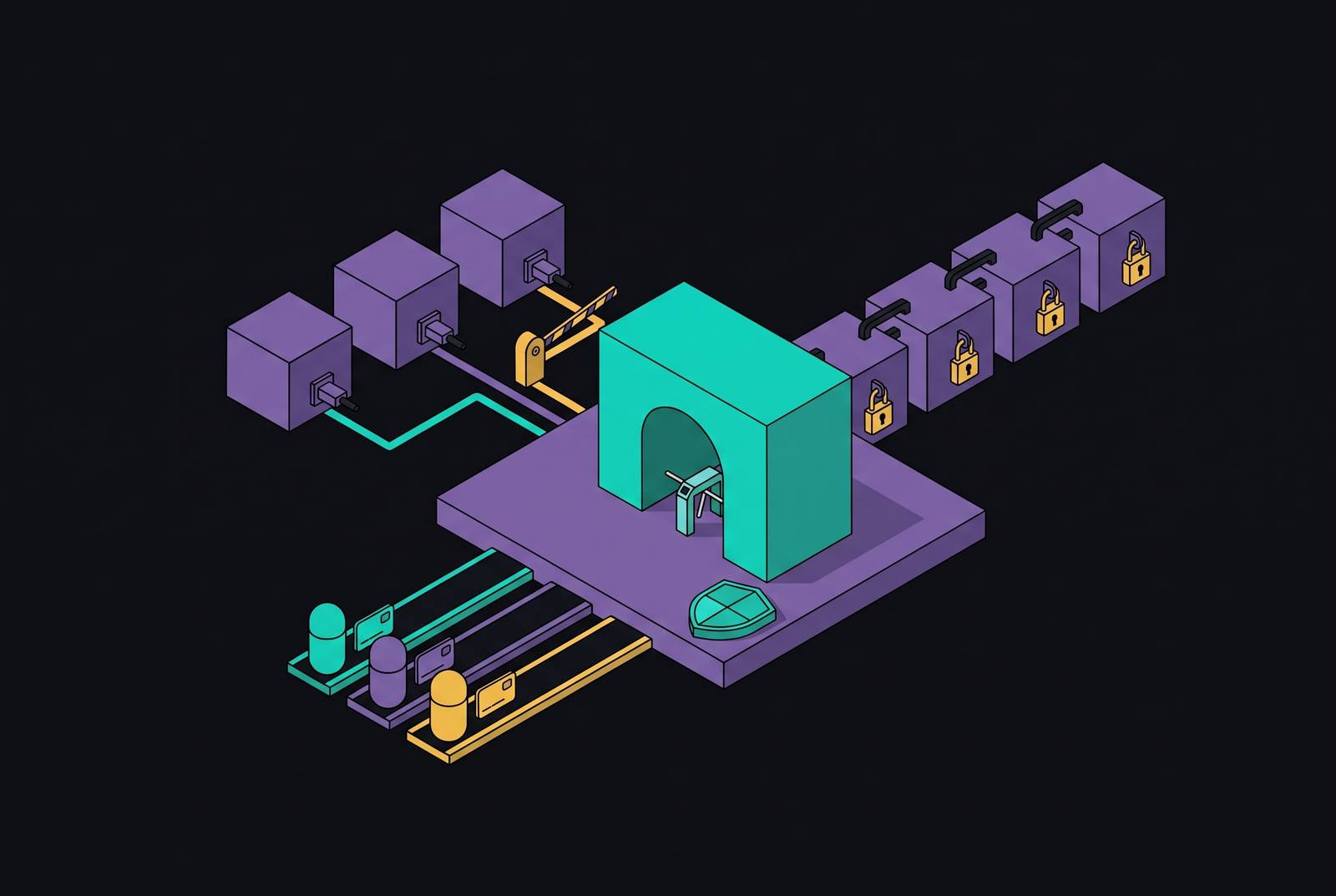
An enterprise MCP gateway must resolve every tool call to an existing directory identity, enforce action-level RBAC, and emit a tamper-resistant audit record to the organization’s own observability stack. MCP does not provide those controls itself. The July 2026 stateless specification shift makes the gateway the common enforcement point, because each request needs authorization on its own merits, independently of the connection.
Why MCP's authorization gap cannot be closed at the protocol layer
MCP leaves enterprise authorization to the organization deploying it. It provides no native role-based access control model, authentication is optional, and the protocol does not define how a request maps to a verifiable enterprise identity, leaving a structural gap. Whatever RBAC governs an agent must be built or bought outside the protocol. Otherwise, the agent’s route to privileged tools has no enterprise policy deciding which actions it may take.
Authentication alone does not close that gap. Establishing who presented a credential is different from deciding whether that person may use a particular tool against production data. A protocol for connecting agents and tools cannot supply an organization’s directory groups, role definitions, or approval boundaries.
What the July 2026 stateless specification shift actually changed for security teams
The July 2026 specification update replaced protocol-level sessions with stateless requests. Previously, the initialize/initialized handshake established a persistent session, allowing authorization to be evaluated at connection time. Under the new model, each request must supply its own identity and context, with protocol version, client information, and capabilities in _meta. Permission can no longer rest on an earlier handshake. Microsoft MCP Gateway’s post-September 2026 change makes the transition explicit by dropping legacy initialization, transport sessions, and protocol downgrade support.
The update also introduced Mcp-Method and Mcp-Name headers, allowing gateways, firewalls, and rate limiters to route and authorize traffic without parsing request bodies. Enterprise-managed authorization, or EMA, adds a genuine improvement by letting the enterprise decide whether a user may connect a client to a server and at what scope. Its boundary is equally important. The specification states that the identity provider’s visibility does not extend to MCP traffic after token issuance. EMA establishes access, but it does not inspect subsequent traffic or authorize individual runtime actions.
Why the gateway is the only point where per-request RBAC and audit can be enforced consistently
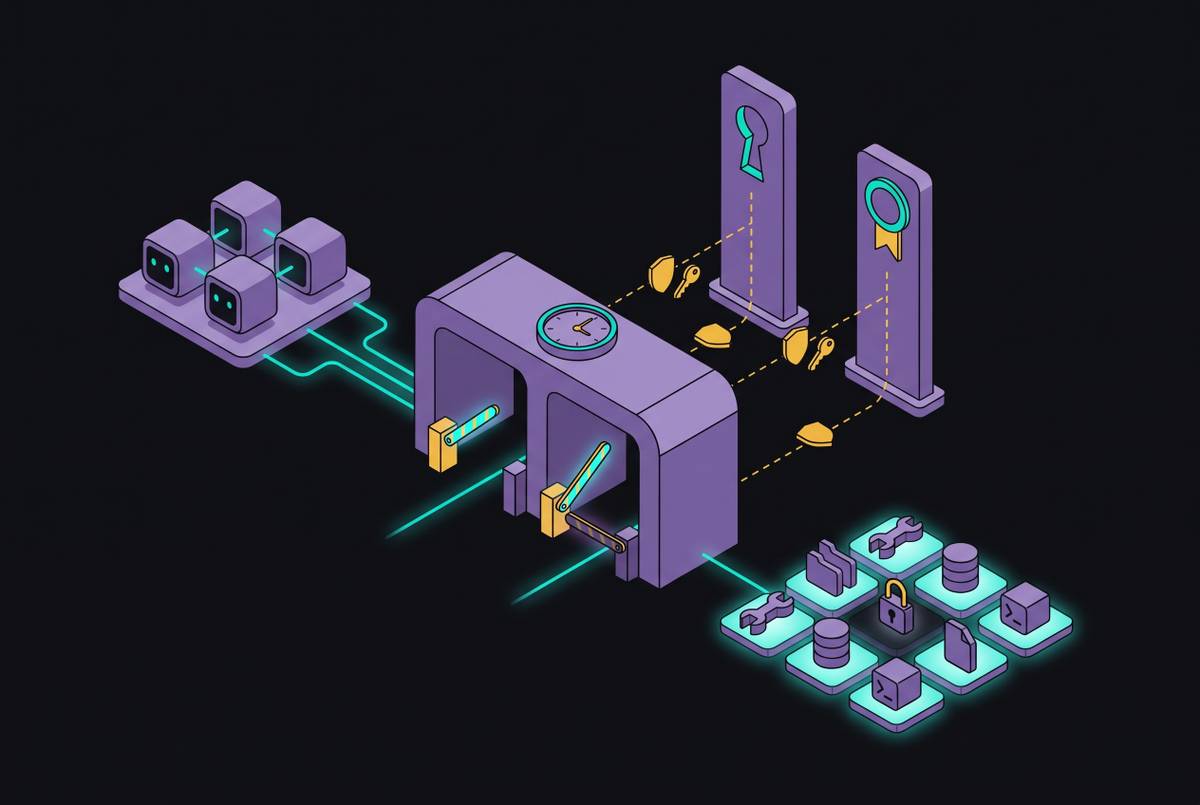
In a governed architecture, the gateway sits between agents and upstream servers, sees every tool call, and resolves identity before the call runs. It is the common checkpoint for both permission and attribution. The identity provider does not see the tool traffic that follows, and each server sees only its own requests. Neither supplies that fleet-wide view.
Leaving enforcement to individual servers instead means each server must have the same identity, policy, and audit controls. Any variation becomes a gap in the enterprise’s account of what was allowed and why. Stateless routing removes sticky-session bottlenecks and allows horizontal scaling, but each request arrives with no session context carried over. The gateway must fill in that missing context through the identity integration before it forwards the call.
This is the same control-plane discipline applied to production APIs. Its completeness depends on every agent using the governed route. A gateway built only to connect tools accelerates uninspected access, while one built only to obstruct access invites workarounds. Enablement and enforcement must share the path.
What action-level RBAC at the gateway actually requires, and where most implementations fall short
Endpoint-level permission is too coarse for MCP tools. A GitHub integration may expose GITHUB_CREATE_PR, GITHUB_MERGE_PR, and GITHUB_DELETE_REPO through the same integration. Granting access to that integration cannot distinguish permission to create and merge a pull request from permission to delete the repository. The integration is not the permission boundary. The action is.
Action-level RBAC requires declared scopes, such as inventory:read, invoices:write, and payments:initiate, and short-lived tokens limited to the role’s grants. Those credentials still need to be checked on each request. Directory-driven enforcement also makes revocation practical, because removing someone from the directory denies their next tool call once the change synchronizes. The gateway needs no separate edit for that user. An MCP security risk taxonomy identifies privilege escalation through scope creep as MCP02, matching the risk of granting server access without constraining tool access.
Local development tooling serves a different purpose. Docker MCP Gateway’s limited centralized access control and audit logging fall short of enterprise-grade RBAC. To extend it for regulated use, teams must build those capabilities, which takes substantial engineering work at the start and maintenance from then on.
What immutable audit trails must capture and why standard logging does not satisfy regulators
An audit trail must link what an agent does to a named human, resist tampering, and reach the enterprise’s compliance tooling. A log file on its own does not ensure any of this. Each record needs the person or agent identity, client, server, tool, allow-or-deny outcome, arguments where policy permits, and response information. Without that chain, an investigator may see that something happened without being able to establish who initiated it.
Credential handling can sever attribution before storage becomes relevant. When a server forwards a request using its own token, downstream logs identify only that server. A governed gateway must preserve the original identity in its authoritative record when it uses an upstream credential. Otherwise, shared credentials become shared alibis.
Tamper resistance also requires more than a structured format. The enterprise-mcp-gateway open-source project emits JSON records with caller identity, tool, SHA-256 hashed parameters, execution latency, and PII redaction metrics. Parameter hashing avoids storing sensitive arguments in plaintext, but it is distinct from protecting the whole record against alteration. The audit pipeline must also reach the customer’s own observability stack, so compliance teams can examine the evidence independently of a vendor-held account.
How a production gateway enforces both controls through the request lifecycle
The gateway extracts the ID-JAG from the request’s _meta information and validates the JWT signature using in-memory keys from the identity provider’s JWKS endpoint. Signature validation therefore need not require a network round-trip for every call. The gateway then resolves directory groups to roles, checks the server grant, and checks permission for the specific tool and arguments. Any failed check stops the request before the backend.
Inspection follows the permission decision. The gateway examines tool arguments for applicable content policies before forwarding the authorized request with a credential it holds. The agent never receives the raw secret. When the result returns, inspection examines it before the model does, applying PII redaction, prompt injection detection, and response policy.
The gateway then records the decision and execution context in one structured audit event. Identity, client, server, tool, policy-permitted arguments, outcome, response information, and latency remain linked as the record reaches the organization’s SIEM or OpenTelemetry pipeline. Denied calls also require an outcome record. RBAC and audit are thus products of one decision sequence, rather than separate systems trying to reconcile their accounts afterward.
Prompt injection and runaway sessions as the two runtime risks RBAC alone cannot address
A tool that is authorized can still return malicious instructions. Language models do not reliably distinguish system instructions from instruction-shaped content embedded in the data they process. RBAC can establish that an agent may read a result, but it cannot establish that the result is safe to follow. Permission is not a content inspection service.
The gateway can inspect tool descriptions at registration and results before they reach the model. Pinning descriptions by hash sends them back for review when they change, and scanning results can detect instruction-shaped content on the response path. The OWASP taxonomy names tool poisoning as MCP03 and prompt injection through contextual payloads as MCP06. These risks explain why inspection belongs at the same checkpoint as authorization and audit.
An agent may loop, or a public server may be scraped, without any individual call exceeding its granted permissions. Rate limits, quotas, and timeouts address the resulting cost and availability risks. The same per-request visibility supports these controls, but an audit record cannot substitute for stopping excessive traffic.
Shadow MCP servers as the governance gap that breaks the audit trail before it starts
Shadow MCP servers run outside the sanctioned path, so developers can connect production data through personal tokens without an enterprise record of that access. These are not merely untidy configurations. They create known gaps in the scope of authorization and audit.
Discovery requires more than watching the gateway itself. Local servers can bind to localhost, use random high ports, sit behind reverse proxies, or appear as ordinary IDE dependencies. Gateway logs can reveal attempts to reach unregistered servers through the gateway, endpoint telemetry can expose local configurations and processes, and OAuth logs can reveal new grants to AI tools. Each server found must be onboarded or blocked.
The registry establishes which servers exist, who owns them, and who may use them. Without a registry entry, a call has none of the sanctioned context about ownership and access that an enterprise audit needs. The OWASP taxonomy names Shadow MCP Servers as MCP09. Addressing it is a prerequisite to claiming complete coverage, and discovery must repeat as new servers appear.
What MCP gateway solutions support enterprise RBAC and existing identity providers?
A compliant deployment combines a versioned registry, gateway routing and rate limits, an action-level policy engine, and an observability pipeline. These components must function as one governed route. Existing identity providers, including Okta, Microsoft Entra ID, or SAML/OIDC providers, should drive group-based provisioning rather than leave the gateway with a separate user directory. Short-lived, task-scoped credentials stay with the gateway, while audit records preserve attribution to the originating person.
Microsoft’s gateway provides stateless per-request routing, bearer-token RBAC, OAuth 2.0, and Entra ID integration on Kubernetes. DLP and tool-boundary inspection need more components. The open-source Go gateway combines role-based tool governance, structured JSON audit records, parameter hashing, and in-flight PII and secret masking in a single binary with sub-millisecond routing overhead. Its sanitization runs on the response path before sensitive content reaches the model.
Speakeasy combines a governed registry, role provisioning from existing identity providers such as Okta or Entra ID, per-action policy, and audit delivery to the customer’s observability stack. It resolves tool calls to named directory identities, applying those controls across the agent fleet.
Many organizations in financial services and healthcare need on-premises or VPC deployment. A team weighing these options should check that they support the deployment model it needs before it compares policy depth, inspection, and audit capabilities.
The implementation sequence that keeps governance ahead of agent sprawl
The practical sequence starts with inventory before policy. Gateway logs, endpoint telemetry, and OAuth logs establish which servers already exist. The servers found then enter the registry with declarations of ownership and scope, so later access decisions have a known target with an owner who is accountable for it. Reversing that order risks blocking legitimate work while missing unsanctioned access. Reversing that order increases shadow adoption and weakens governance.
Enforcement can start with server-level grants mapped to directory groups that are already in place as a transitional control. As it becomes clear who owns the tools and how people use them, grants narrow to tool-level scopes, so policies are based on evidence of that use. In parallel, audit delivery must reach the SIEM before alert thresholds are configured. Baseline activity gives those thresholds a basis and reduces alert fatigue.
Inspection comes next, once RBAC and the audit pipeline are stable, so decisions about redaction and prompt injection join an attribution chain that is already in place. This deployment order does not change the runtime order, where arguments are inspected before forwarding and results before model consumption. Discovery then resumes as new servers appear, keeping the registry current rather than treating inventory as a completed project.
The goal is a golden path: one governed route to approved tools that is easier to use than an alternative assembled from personal tokens and unregistered servers. Governance that demands the most effort will eventually lose to the workaround.
Sources
- GitHub - microsoft/mcp-gateway: MCP Gateway is a reverse proxy and management layer for MCP servers, enabling scalable, session-aware stateful routing and lifecycle management of MCP servers in Kubernetes environments. · GitHub
- GitHub - BenjaminJ/enterprise-mcp-gateway: Production-grade, high-performance Model Context Protocol (MCP) Gateway in Go with RBAC, in-flight PII/DLP redaction, and structured audit logging. · GitHub
- What is an MCP gateway? Enablement and governance — Speakeasy
- MCP Gateway
- The New MCP Roadmap