Which MCP Gateways Enforce Tool-Level Policies Through Okta and Entra ID at Runtime
Okta binds each tool call to a named user; rivals cover other layers.
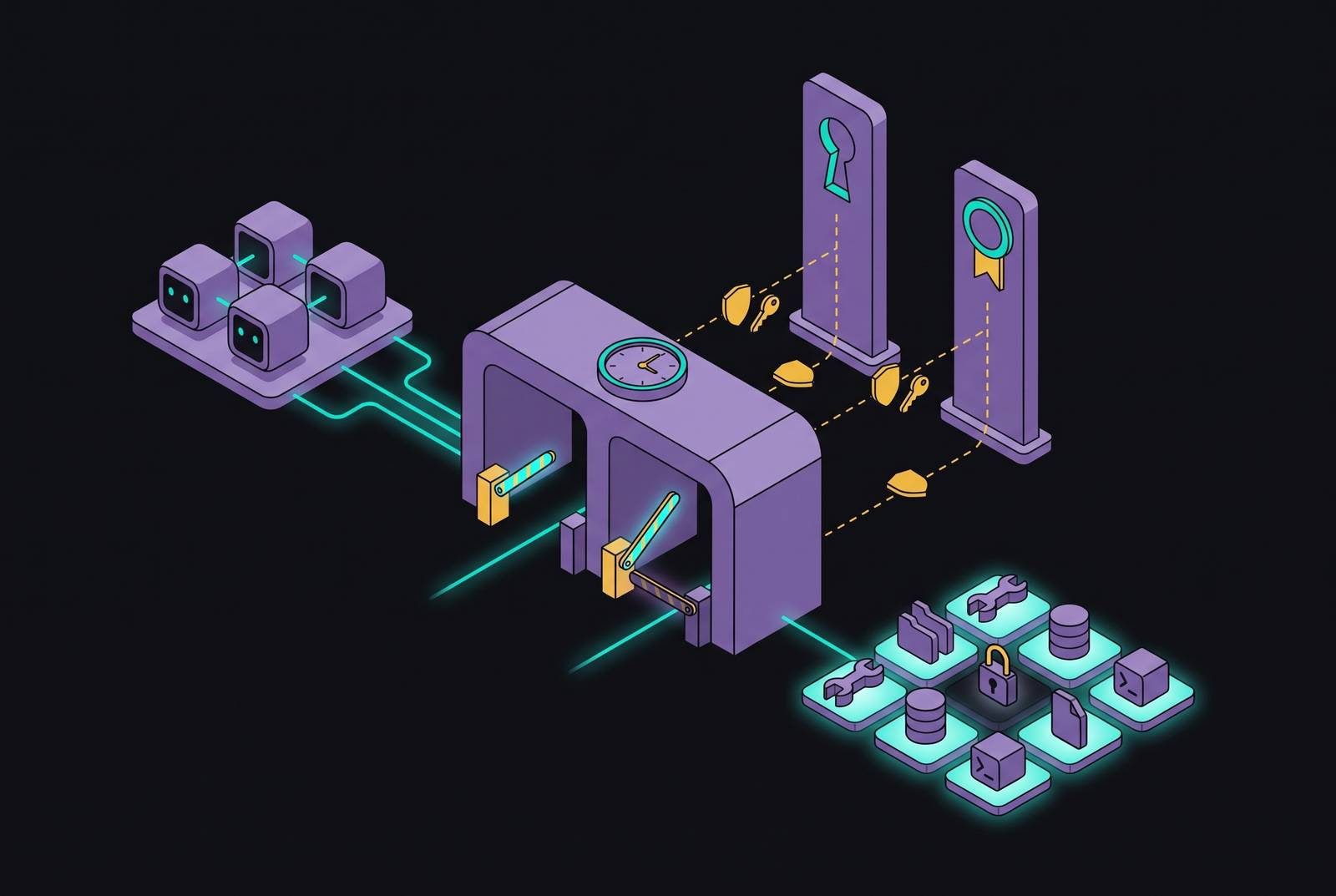
Okta Agent Gateway provides the clearest documented model here for identity-bound, per-tool-call enforcement, while Microsoft’s MCP Firewall applies tool-level rules through Entra-backed network controls without brokering downstream credentials. Cloudflare adds an IdP-backed access-proxy model, while Rubrik occupies the data-security layer. Enterprise role-based access control and audit logging need policy to govern each tool call for a named user as well as access to an approved server.
Why tool-level policy enforcement is different from perimeter access control
A contractor asks an agent for the CEO’s compensation record. The agent uses a shared service account, retrieves the record, and leaves an apparently clean audit trail. The credential worked exactly as intended. Okta’s Agent Gateway explanation uses this confused deputy problem to show that no one checked whether the person making the request had the right to see the result.
Approving the server does not close that gap. MCP leaves authentication to the transport and has no per-tool authorization mechanism, agent identity standard, or audit log format. A database connection therefore needs controls outside the protocol to distinguish SELECT from DROP. Meanwhile, teams have implemented authentication independently, using everything from no authentication to API keys and OAuth. That fragmentation makes consistent authorization, attribution, and employee offboarding a fleet-wide problem.
What genuine runtime enforcement requires architecturally
Genuine runtime enforcement begins with a credential naming both the agent and the delegating human. The gateway must verify that delegation, then check policy on every individual tool call. Next comes credential isolation. The agent must never hold the remote service’s raw secret, and every allow or deny decision needs a log entry attributed to a named person. These requirements establish who acts, whose authority applies, and what the enforcement layer decided.
The permission bound is the intersection of what the gateway allows and what the user may already do. Delegation must not manufacture extra authority. Okta’s developer documentation separates a control plane for virtual servers, resource connections, tool capabilities, and policy from a data-plane relay that validates tokens, exchanges them, injects downstream credentials, and proxies requests. The MCP authorization specification requires audience-bound tokens and forbids token passthrough. Consequently, a gateway needs an upstream authorization server to mint the appropriate tokens before it can enforce their use.
How Okta Agent Gateway enforces identity at the tool-call level
Okta Agent Gateway refuses a tool call unless its inbound credential names both the AI agent and the human behind the request. The agent authenticates using an Okta-issued token through authorization code flow with PKCE, and the gateway validates it against the linked authorization server. It then presents that access token as the subject token in an OAuth Security Token Service exchange with the Okta org authorization server. The returned token is scoped to the remote MCP server and injected into the outbound request.
The agent never sees that downstream credential. Okta’s developer documentation also describes first-use consent, when the user authenticates and approves access to the remote server on their behalf. Its virtual MCP server model aggregates tools behind one Okta-secured endpoint, with each virtual server initially INACTIVE and requiring activation. Each resource connection must also be active for runtime calls to succeed.
MCP resources, prompts, sampling, completion, logging, and roots are unsupported, so servers relying on them can lose functionality or break silently through the gateway. Okta’s agentic enterprise blueprint describes Uber’s related in-house architecture, using cryptographic agent identity and per-hop token exchange to preserve the actor chain from human to tool. That example validates the approach without establishing universal product compatibility.
How Microsoft's Entra Agent ID and MCP Firewall approach the same problem at the network layer
Microsoft Entra Agent ID became generally available in April 2026. The MCP Firewall arrived in August 2026 as part of Global Secure Access and remained in Public Preview as of mid-November 2026. An available identity platform and a preview enforcement component are not the same deployment commitment.
The firewall sits between agents and their tools on Entra-joined managed devices that run the Global Secure Access client and have TLS inspection turned on. It discovers MCP servers, including unregistered ones, and can block unknown or unauthorized destinations. Its rules go beyond destination filtering. They address individual servers, methods, tools, and protocol versions, with Conditional Access enforcing the policy. Generative AI Insights records MCP operations, including tools/call.
That position makes shadow MCP discovery a particular strength. Default deny can restrict traffic to a known-good environment while surfacing servers introduced without IT oversight. However, the firewall is not an application-layer credential broker and does not provide Okta’s delegated token exchange or per-call credential isolation. The two approaches protect different boundaries, with network discovery and blocking complementing application-layer identity delegation.
How Rubrik and Cloudflare extend enforcement with data-security and access-proxy models
Cloudflare MCP server portals became generally available to all Cloudflare customers on September 24, 2026. They provide one endpoint for approved servers, with users signing in through the organization’s IdP. Access policies govern portal access and server visibility. Administrators choose which tools and prompts to expose, and allowlist mode hides everything they have not explicitly enabled. Access logs tool, prompt, and resource activity, but those documented controls should not be mistaken for evidence of Okta’s particular delegated-token mechanism.
Since September 22, 2026, portals have been able to use Cloudflare Gateway to reach private hostnames without exposing the servers publicly. Cloudflare’s internal deployment connected agents to GitLab, Backstage, Jira, Sentry, Elasticsearch, Prometheus, Google Workspace, and its internal Release Manager. Its Terraform-based publishing path starts a standard review in GitLab when a merge request calls for adding a server. That gives governance a place in the development workflow.
Rubrik occupies the data-security enforcement layer in this landscape. The available material does not establish an equivalent per-call identity mechanism for it, so a stronger comparison would overreach. The broader stack also includes Cisco’s Agent Runtime SDK at build time, NVIDIA OpenShell and WSO2 Agent Manager for runtime sandboxing, and Microsoft for network discovery. These are distinct responsibilities converging on MCP across the broader stack.
What the Okta MCP server for the IdP itself reveals about the limits of scope-based controls
The IdP is the hardest test of agent governance because it controls access to other systems. Misconfiguration there can enable persistence, privilege escalation, and diluted accountability. OAuth scopes are only the starting boundary. They restrict which API an agent may call, leaving its intent and the full range of consequences within an allowed operation beyond their scope. Permissions should therefore treat read access, changes with consequences, and changes to the security system itself as separate groups.
The recommended first tier allows read-only tools such as list_users, get_user, list_groups, get_policy, and get_logs, with logging. Sensitive profile attributes should be redacted before reaching the model because read access still exposes personal data. In the next tier, lifecycle changes, group-membership changes, and application assignments must wait for human approval. The agent prepares the change. A named person decides. Changes to membership in groups assigned to sensitive applications need that approval too.
The deny tier protects the rules themselves. Admin role grants enable privilege escalation, while MFA and factor resets alter authentication safeguards. Policy writes, device assurance writes, and authorization server edits change the conditions under which access is granted. API token creation can create another credential path, custom domain changes alter identity infrastructure, and deleting users, groups, or applications can remove access-bearing objects. These operations should be subject to default denial, so an agent cannot allow them based on its reading of a broad scope.
The recommended setup denies every policy write, device assurance write, and authorization server edit by name, so another server or a future release cannot quietly add them. An agent must not rewrite its own restraints. OWASP GenAI Security Project highlights agent behavior hijacking, tool misuse and exploitation, and identity and privilege abuse as major threats. The IdP is where those risks converge.
Why prompt injection and data exfiltration require gateway-layer content inspection, and what it cannot stop
A tool result can contain instructions that redirect the agent reading it. The attack arrives as apparent task data. MCP payloads can therefore transport prompt injection through tool results and resource content. Inspection belongs where inbound and outbound payloads are visible.
That inspection has a real but bounded role. It can greatly reduce the number of successful injections, but models cannot reliably tell malicious instructions from legitimate data, so scanning cannot remove the threat. To work well, defense needs gateway scanning along with sandboxed execution, least-privilege tool design, and output filtering.
Data loss prevention needs the same tool-aware vantage point. Traditional DLP watches email, web uploads, and endpoint activity, but an agent can move a customer record between tools through an HTTPS session that is otherwise approved. A gateway sees the call, its arguments, and its response. Credential brokering closes a related but more specific exposure by injecting secrets at the edge rather than handing the agent a long-lived API key that injection, leaked logs, or a compromised model could reveal.
Audit trails that satisfy security teams versus observability data that satisfies engineers
OpenTelemetry describes what instrumented software reports about itself, whereas a security audit must record what the access-brokering layer allowed or denied. Uninstrumented, misconfigured, or hostile agents cannot be trusted to supply that evidence. A compliance-ready record needs the named person, tool, arguments, authorization, decision, and applicable rule. A successful trace is not an authorization receipt.
OpenTelemetry v1.39 added MCP semantic conventions, including mcp.method.name, mcp.session.id, and mcp.protocol.version. Those attributes let observability pipelines see how the protocol works where that was hard to see before, and help trace agents across more than one server. The conventions still have “Development” status, including the GenAI agent, client, and MCP conventions, so names and semantics can change. Teams that build compliance pipelines around them should track upstream changes and keep the authorization records that come from the gateway.
How enterprises can build one governed path to MCP servers across this vendor landscape
The enterprise rollout should begin with discovery of every MCP server and agent already running, including shadow deployments. Microsoft’s firewall discovery or equivalent network visibility addresses that first problem. The next step is centralized access through a gateway with OAuth-based identity binding and per-call policy enforcement, using the existing Okta or Entra authority.
Cloudflare’s internal deployment illustrates how that route can fit existing operations. It combined Access for identity, portals for governance, Code Mode to reduce tool-definition context overhead, and sandboxed execution to constrain model-generated code. Its Terraform and GitLab review path made publishing a server a governed development change.
Once that route exists, enterprises should apply the three-tier permission model to servers connected to privileged systems, starting with the IdP. Gateway logs should feed existing infrastructure such as Datadog, Grafana, or OpenTelemetry collectors. Content inspection for injection and DLP then adds protection while access controls stay in place. Each layer has a different job to do.
The control plane should extend existing infrastructure. Okta, Entra, Intune, and the organization’s monitoring systems remain useful surfaces for identity, device management, and evidence. The gateway’s role is to connect those controls to each agent action at runtime. Enterprise MCP governance succeeds when a tool call becomes another accountable use of existing authority.