Twelve Production Readiness Gaps That Kill Prototype MCP Deployments Before OAuth Is Even Wired
Twelve architectural gaps explain why MCP pilots stall in security review.
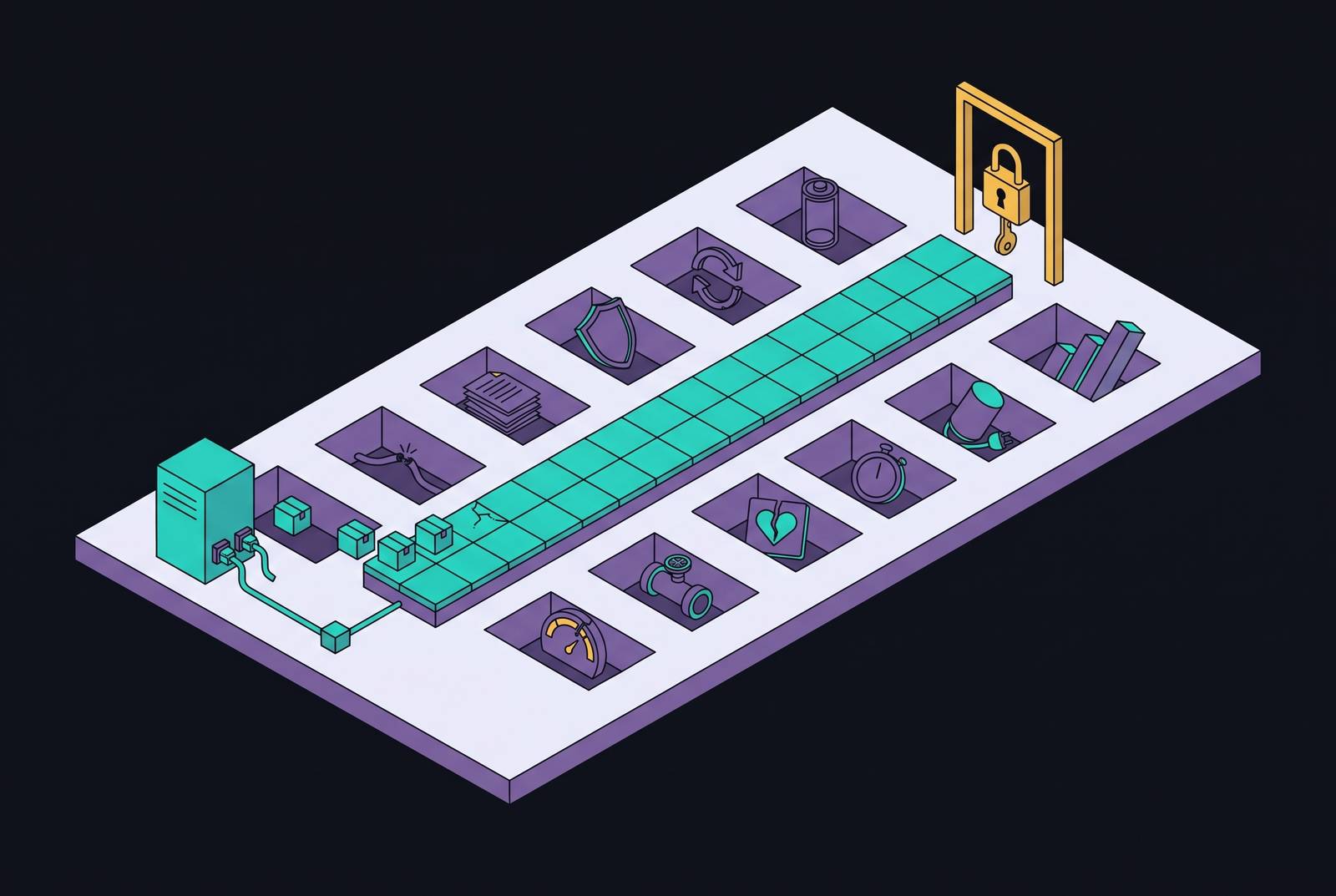
Enterprise agents need an MCP gateway with OAuth 2.1, tool-level role-based access control, and per-action authorization bounded by the user’s permissions. These twelve gaps explain why MCP deployments fail review before OAuth is wired and require authentication alongside a control plane for isolation, identity, tool execution, and auditability to become production-ready.
Why MCP prototypes fail before OAuth is ever wired
A demo removes much of the pressure that exposes an incomplete architecture. There are no concurrent users competing for capacity, no auditor asking who approved an action, and no incident responder reconstructing a chain of tool calls. The tool worked, but the controls around it were never tested.
Production review restores those missing conditions. It asks where failures stop, whose authority an agent uses, and whether there is a way to trace where a tool came from and what it did. These are architectural questions. The twelve gaps below are different ways a prototype postpones decisions that production cannot postpone.
Missing gateway: why direct client-to-server wiring removes the isolation boundary
Direct client-to-server wiring omits the central enforcement point for authentication, tool-call logging, and failure containment. Without that boundary, one tool server’s failure can propagate across the system. A prompt injection reaching a database-connected tool encounters no central perimeter at which policy can constrain its execution. The shortcut becomes the architecture.
The federated gateway pattern centralizes authentication, audit logging, and routing. It also translates between stdio, SSE, and Streamable HTTP, allowing legacy stdio servers to sit behind HTTP without rewrites. That abstraction separates a client’s connection from a server’s transport. Adding it after direct connections have spread is therefore a rearchitecture.
Stateful session architecture: the scaling constraint the 2026-07-28 spec removes
The 2026-07-28 MCP specification formalized a stateless core, making each tools/call a self-contained request with its own _meta context. Any gateway replica can answer, so there is no need for session affinity. Older deployments that use Mcp-Session-Id, sticky routing, and in-memory session maps have a different problem when they scale. Their session layer binds work to replicas.
That binding can turn a rolling deployment into a reconnection storm, while more replicas must compete to use a shared session store. The stateless model removes that dependency, but not application state. A basket, for example, still needs an explicit basket_id minted by one call and passed into the next.
Migration exchanges engineering work now for round-robin horizontal scaling without a shared session store later. It need not happen immediately. The Python SDK’s 1.x line remains in maintenance mode with security fixes for teams not ready to migrate, although staying with the old architecture preserves its scaling constraints.
Authentication is optional by spec, so unauthenticated servers are technically compliant
MCP permits authentication to be optional, so a server with authorization disabled can comply with the specification while remaining insecure. Compliance is not a deployment safety certificate. The design starts to fail when teams put off optional authentication and then keep running with it turned off. OAuth has not proved too difficult. Requiring identity was never established as a baseline.
The production baseline is OAuth 2.1 with PKCE and Resource Indicators per RFC 8707, configured to require authentication. With the stable Enterprise-Managed Authorization extension, organizations can give users MCP access through their identity provider, so users have connected servers on first login without per-app consent flows. Okta is the first provider that is supported through Cross App Access. For enterprise access management, individual per-server consent flows are therefore the old way of doing things.
Agent identity collapsed into a service account: why shared credentials are the leading over-privilege vector
Developers do not yet know which permissions an agent will need, so they issue read-everything or write-everywhere tokens that later get reused for unintended actions. This is a design choice. It makes shared credentials a leading source of over-privilege.
The alternative gives agents their own identity class, separate from both human users and ordinary service accounts. Each agent belongs in the identity governance and administration inventory with an owner, scope, and lifecycle. Standing credentials remain separate from per-invocation delegation tokens, so execution can be bounded by the represented user’s authority.
Identity providers such as Okta, Entra, and Auth0 supply authentication, but authentication events do not describe every tool action. That distinction leaves a runtime enforcement gap. A control plane above the identity provider must evaluate what the authenticated agent is trying to do.
No on-behalf-of authorization model: when agents can act beyond any individual user's authority
Per-user OAuth alone does not calculate the combined limits of a human and an agent. A shared service account does not do so either. Without a clear on-behalf-of model, a low-trust user can ask a high-privilege agent to use credentials that let it do things the user was never allowed to do.
Effective access must be the intersection of permissions. A customer-support agent allowed to query order status but not issue refunds must remain unable to refund an order even when its user has that permission. Conversely, an agent’s broader capabilities must not expand a restricted user’s access.
To enforce that intersection, the user’s OAuth identity context passes from the agent UI through the gateway. The runtime evaluates the agent’s baseline capabilities against the user’s downstream permissions and acquires an On-Behalf-Of token before execution. The decision belongs at each action.
Shadow MCP: the inventory problem enterprises systematically underestimate
Local stdio traffic produces no network events. A desktop AI client and an MCP server can conduct their entire conversation through standard input/output pipes on the endpoint, invisible to a proxy, firewall, or CASB. The detection gap is architectural.
A mid-size enterprise may know about two to three servers while its actual inventory is far larger. OWASP names Shadow MCP Servers as MCP09 in its MCP Top 10 framework. Independently installed local servers also leave administrators without centralized audit records, consistent access controls, or a reliable way to revoke permissions when someone leaves.
A prohibition alone does not supply those controls. Governance requires a discoverable registry and one sanctioned route behind the gateway. That golden path gives teams a compliant alternative to invisible local installations.
Prompt injection as an execution vector: why tool access turns a chat annoyance into a breach path
A model with file-system read access and permission to transmit to an external endpoint can be induced to exfiltrate data through a single prompt injection. Permission to read data must stay separate from permission to export it. That separation requires runtime enforcement.
Cursor IDE vulnerabilities illustrate the execution risk, including case-sensitivity-bypass-based MCP configuration tampering in CVE-2025-59944 and zero-click remote code execution through malicious MCP tool content. EchoLeak, CVE-2025-32711, demonstrated zero-click exfiltration from Microsoft 365 Copilot. The NSA’s May 2026 MCP information sheet warns that access controls are weak, audit logging is limited, and there are gaps in trust boundaries.
The architectural response is to treat tool outputs and context as untrusted. A gateway must check prompts and enforce policy on every tool call. An allowed server is not proof that every action requested through it is safe.
Multi-agent lateral movement: why single-agent security models break when orchestration is added
An IETF Internet-Draft on MCP security considerations from June 2026 describes lateral movement combining MCP with Agent-to-Agent delegation. It explains why mitigations considered within each protocol do not address movement across protocol boundaries. A secure entry point is not enough. Orchestration introduces further handoffs at which trust must be evaluated.
A compromised or manipulated agent can pass credentials or context into another protocol context, where the receiving agent’s policy cannot see how those credentials were obtained. The design requirement is enforcement at every hop, treating the multi-agent chain as a trust-boundary problem. That boundary belongs in the architecture before orchestration arrives.
Absent or unactionable audit trails: why custom logging fails at incident review
A shared API token can produce an exquisitely timestamped record of anonymous actions. Precision does not supply attribution. Incident responders need to know which agent acted for which named user, which tool it invoked, and which policy permitted the action.
MCP does not define a standard mechanism for surfacing audit information, leaving teams to stitch together custom records and reconstruct request chains afterward. That may serve a prototype, but production review needs attributable evidence. OpenTelemetry or equivalent frameworks provide a way to trace the pipeline from prompt creation through tool invocation. Session and schema identifiers support end-to-end correlation without implying that the protocol itself must retain stateful sessions.
No OpenTelemetry integration: why custom traces can't reach the SIEM
MCP co-creator David Soria Parra stated at the MCP Dev Summit 2026 that observability belongs to OpenTelemetry, identity to dedicated projects, and governance to control plane layers above the protocol. That division explains the next gap. An audit trail that exists but cannot reach the security team’s SIEM is operationally little better than a missing one.
Custom records need an interoperable instrumentation surface. OpenTelemetry is extending its semantic conventions for MCP agent telemetry, making OTLP the emerging standard for that surface. Compatible logs and spans should include user identity, agent identity, the invoked tool, sanitized arguments, policy decisions, cost, and latency. Those fields let teams correlate actions in their existing observability stack, including Datadog or Grafana, rather than building a parallel system just to investigate MCP.
Tool supply chain without signing, versioning, or lifecycle governance
An unpinned latest server can introduce a breaking schema change that silently rejects hundreds of queries. Without a record connecting execution to the tool version, the failure lacks a clear provenance. The tool’s name has stayed the same. Its contract has not.
Version pinning makes that contract explicit, using a reference such as inventory-mcp@2.4.1 to replace latest. Cryptographic signing with Cosign or equivalent establishes another admission requirement, while a catalog records the name, version, JSON schema, owner, and signature. Agents should discover only cataloged tools.
Tools move from development to staging, where a synthetic evaluation harness includes adversarial prompts, and then go through signing and into production. Atomic rollback follows by flipping the catalog pointer. A gateway that rejects unsigned servers turns this lifecycle into an enforced boundary.
Configuration that doesn't travel: why client-side drift blocks any repeatable deployment
Controls configured on one developer’s machine do not establish a deployment-wide baseline. Per-client setup creates drift and secret sprawl, leaving security teams unable to see consistently what runs where. A fix can work locally and still fail organizationally. This final gap makes the previous eleven repairs non-repeatable.
Streamable HTTP must be mandatory for servers touching shared resources, including databases, internal APIs, and SaaS systems. It makes those servers network services that can be governed, versioned, rate-limited, and audited centrally. The shared resource’s security boundary no longer depends on which local transport is easiest to use.
The 2026-07-28 specification supports that model through Mcp-Method and Mcp-Name headers, allowing intermediaries to route and inspect requests without parsing JSON-RPC bodies. Those controls depend on HTTP. One sanctioned endpoint behind the gateway, discoverable through the registry, allows configuration to be pushed from the control plane.
What does a production-ready MCP deployment need to secure enterprise agents?
The gateway requires OAuth 2.1, routes on headers, and applies tool-level RBAC together with on-behalf-of authorization. RBAC defines permitted tools. The user-agent intersection constrains each action. Neither substitutes for the other.
The same control plane records attributable tool calls, exports OTLP telemetry, and admits only governed, signed server versions. Its registry and centrally distributed configuration make the approved route usable without sacrificing enforcement. These are connected responsibilities.
Production review is only the first gate. The deployment must preserve its boundaries as users, replicas, tools, and agents multiply. OAuth establishes an authenticated identity, but the architecture must still determine what that identity may do, contain the consequences, and leave evidence that explains the result.