Adding Token Validation and Rate Limiting to MCP Server Connections With Existing API Gateway Infrastructure
How to adapt your API gateway's token checks and rate limits to govern MCP.
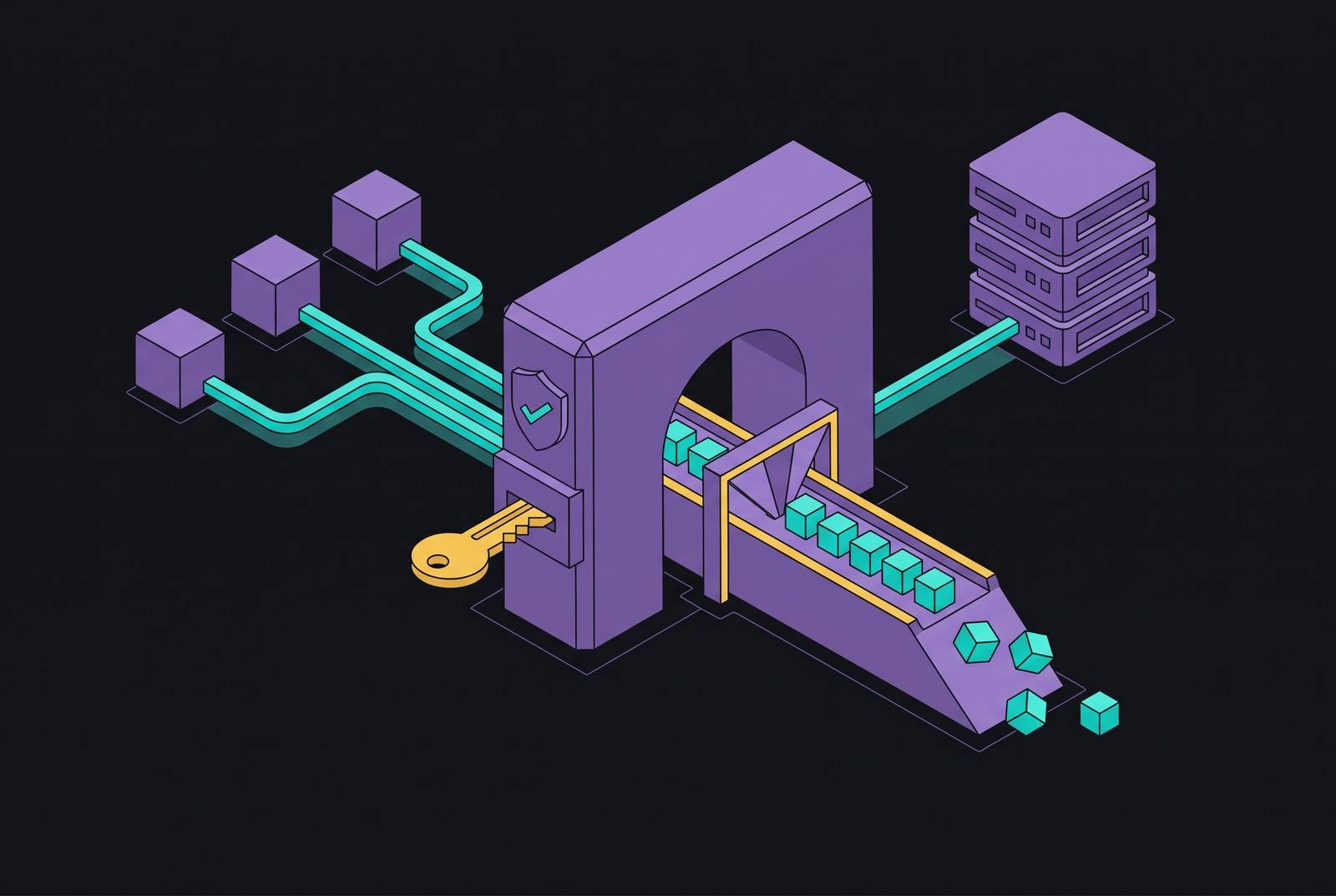
An MCP gateway is a policy layer between AI agents and MCP servers that validates identity, controls tool access, limits calls, and records activity. Enterprises can build that layer on existing API gateway infrastructure. The work is to adapt proven controls to MCP’s tool discovery, autonomous traffic, and the credentials it needs downstream.
Why existing API gateway infrastructure is the right starting point for MCP governance
A team already running an API gateway has done the hard conceptual work. It knows why callers need identities, why access needs limits, and why services that callers share need quotas. MCP brings the same governance problems through a different interface. The work begins with a mapping exercise.
The REST API ecosystem also went through a time when it had direct connections and embedded credentials but lacked audit logs and rate limits. Ungoverned MCP deployments follow a familiar arc, with unaudited tool access, scattered credentials, and little visibility into agent-to-server traffic. They also expose agents to sprawling tool catalogs that can bloat context windows. Authentication, authorization, quotas, and logging remain the right foundations. The unfamiliar part is what passes through them.
Where MCP traffic differs from REST traffic in ways that break direct pattern transfer
MCP uses JSON-RPC 2.0, so the gateway must understand more than the destination of an HTTP request. The 2026-07-28 specification is stateless by default, with protocol version and capabilities sent per request rather than established through a session-level handshake. Where sessions are used, the gateway must also handle the MCP-Session-Id header and HTTP DELETE for clean shutdown. Stateless defaults do not eliminate session-aware configuration. Persistent connections also make connection-time-only authentication inadequate for agents that keep making decisions after the initial handshake.
An MCP gateway must decide both whether a request may reach a server and which tools an agent can see. That distinction becomes significant when one server exposes both ordinary retrieval tools and destructive operations. A server address is too coarse a boundary. Tool visibility and permission to invoke a tool need to follow the caller’s role and context.
Agent behavior changes the traffic assumptions as well. Autonomous loops can call the same tool thousands of times, while limits keyed only to an IP address or a shared consumer key miss the relevant agent and conversation boundaries. Model-provider limits do not close this gap because model requests and MCP tool calls are different units of risk and cost. Credentials need a separate adjustment. MCP forbids forwarding an inbound client token to an upstream API, so a configuration that simply passes authorization headers through cannot serve as the governed design.
Mapping OAuth 2.1 token validation onto MCP's authorization requirements
The MCP authorization specification makes authorization optional for implementations, but defines the OAuth-based path for HTTP deployments that support it and requires authorization servers to implement OAuth 2.1. In a governed enterprise deployment, the client-facing gateway takes the OAuth resource-server role. It publishes Protected Resource Metadata under RFC 9728 so clients can discover the authorization server. Existing identity infrastructure supplies the foundation. The gateway can validate inbound JWTs against Okta or Entra ID using the pattern already applied to REST traffic.
Registration must keep that resource-server role separate from the OAuth client role used to get credentials. Agents, and MCP servers that act as clients to upstream services, need the appropriate registrations with the existing IAM provider. Where static registration is unavailable, the 2026-07-28 revision favors OAuth Client ID Metadata Documents. It deprecates Dynamic Client Registration but keeps it for backwards compatibility. Agent and human tokens also need separate scopes so policy engines can apply different rules to non-human traffic without a new identity system.
The proxy’s consent handling needs equal care. Reusing a static client ID with an upstream authorization server, together with cached consent cookies, creates a confused-deputy risk in which consent can be bypassed. Per-client consent storage and state parameter validation address that risk. The gateway must preserve the distinction between the calling client and the authority it exercises downstream.
For downstream access, the recommended federated pattern validates the inbound JWT, then uses RFC 8693 token exchange to obtain short-lived, server-specific credentials. RFC 8707 Resource Indicators limit those credentials to the resources they are meant for. The gateway holds refresh tokens and injects short-lived access tokens into downstream calls, keeping raw downstream credentials away from agents. The rate limits can also use that agent identity as their key.
Restructuring rate limiting for per-agent and per-tool dimensions
An IP address shows where traffic comes from on the network, but it may not tell agents, tools, or conversations apart. MCP policies therefore need their own workspace-scoped target, separate from policies governing LLM token consumption. MCP tool-call policies can include request-count limits and token-consumption limits, each with its own time window and scope.
Four dimensions give the configuration its structure. A per-agent per-tool limit caps how often a particular agent invokes a particular tool and directly constrains runaway repetition. A per-conversation limit caps total calls within one agent session, bounding the damage from a compromised or looping conversation. A per-tenant limit aggregates calls across that tenant’s agents to protect shared downstream infrastructure. A per-tool global limit respects downstream vendor restrictions regardless of which agent is calling. No single counter covers all four boundaries.
Existing gateway condition and group-by keys provide the mechanism for these buckets. Keys such as api_key, mcp_server, mcp_tool, and request metadata fields can identify the dimensions that a policy needs. Each unique combination gets its own counter. A user identifier in metadata, for example, can help separate callers that otherwise reach the same server and tool. Key selection should follow the identity actually present in the request.
When requests contain identity-provider tokens rather than API keys, the api_key condition key is unavailable, so policies must use server, tool, or metadata fields instead. Idempotency-key-based deduplication complements these limits by preventing double-counting and double-execution when an agent retries after a timeout. Retries should not become a second workload. Filtering discovery to the tools relevant to a query further narrows what a runaway agent can target, although it does not replace numeric limits.
Enforcing per-tool access control beyond what server-level allowlists provide
A server allowlist determines an agent’s permission to reach a server. Without tool-level control, that permission can include every tool the server exposes, including destructive ones. The gateway needs per-tool role-based access control to link the identity checked during token validation to the names of tools it can use. A server can be approved while a particular action remains forbidden.
The gateway should return only permitted tools through tools/list and enforce those permissions again on tools/call. Hiding a tool is not an authorization check. Role-based provisioning from the existing identity provider lets these permissions follow established joiner, mover, and leaver workflows. An agent’s role assignment becomes the basis for its tool access.
The prompt-injection attack pattern makes the need for this boundary concrete. A crafted document redirects an agent toward a tool that can exfiltrate credentials, turning content the agent reads into an attempted instruction to act. Calls to tools that delete, overwrite, or send data outside the organization should wait for a human to confirm them before they are forwarded, using request-pause-and-notify patterns. Structured output validation provides a further check on tool results before they return to the agent, including results that become another agent’s input, and supports tool-level authorization.
Wiring gateway telemetry into the observability and audit infrastructure already in place
OWASP identifies lack of audit and telemetry as a distinct MCP risk category, MCP08:2025, because an unmonitored agent can operate for extended periods without detection. In the governed architecture, the gateway is the common point where every tool call is visible. That makes it the place to emit the audit trail, rather than reconstruct it later from scattered server logs. An incident review needs to establish what happened and which policy allowed it.
MCP does not yet define a standard wire format for surfacing observability information, but the existing observability stack can still receive gateway telemetry. OpenTelemetry GenAI semantic conventions define agent, workflow, and tool spans, while MCP-specific conventions capture method names, tool names, session identifiers, and transport metadata. Those spans can flow into Datadog, Grafana, or an OpenTelemetry collector. Export needs explicit attention during deployment. Production implementations support OTLP export, but it is typically opt-in, while others expose Prometheus metrics for existing monitoring systems.
Determining what data an AI system accessed and where it went requires data-lineage events, such as OpenLineage, at the MCP boundary as well as spans. Immutable, tamper-proof audit records should include agent identity, timestamp, tool name, arguments, outcome, and the policy rule that applied. For accountability, the invocation must also be attributed to a named person.
How can enterprises connect AI agents to multiple MCP servers through one governed endpoint?
The reference architecture puts four layers around infrastructure the enterprise already operates. The identity layer uses the provider already in place to give short-lived, scoped tokens to agents registered as OAuth clients. Role-based tool permissions come from the same directory that governs human access. This establishes the caller before any tool policy runs. It also preserves the connection between autonomous activity and the person on whose behalf the agent acts.
The gateway layer is the single entry point where rules are enforced for access to downstream MCP servers. It validates inbound tokens, filters the tool catalog, enforces per-tool permissions, and applies the agent, tool, conversation, and tenant limits. It also exchanges credentials for short-lived downstream tokens and emits telemetry for every call. This is where the separate controls meet. Because they share the same identity context, authorization, quotas, and audit records all refer to the same invocation, keeping the three events tied together.
The server layer exposes tools for databases, SaaS APIs, and internal services. In this federated design, servers receive only the scoped downstream credentials issued through the gateway and do not maintain their own credential stores. The observability layer then receives spans through existing collectors or OTLP backends, together with the audit and lineage records needed for review. No parallel monitoring estate is required. The useful addition is MCP-aware evidence flowing into systems the organization already knows how to operate.
A centralized control plane holds the policy registry, identity mapping, and audit store, while distributed data-plane gateway instances keep enforcement close to geographically distributed workloads. The transition also has to account for shadow MCP. Existing unregistered servers should be discovered and brought into the registry rather than simply blocked, following a discover, approve, distribute, and govern loop. A governed path that accommodates legitimate work gives agents less reason to route around it.