Enterprise AI GovernanceLong read
Building a Discovery-to-Enforcement Pipeline for Unsanctioned AI Across Engineering Environments
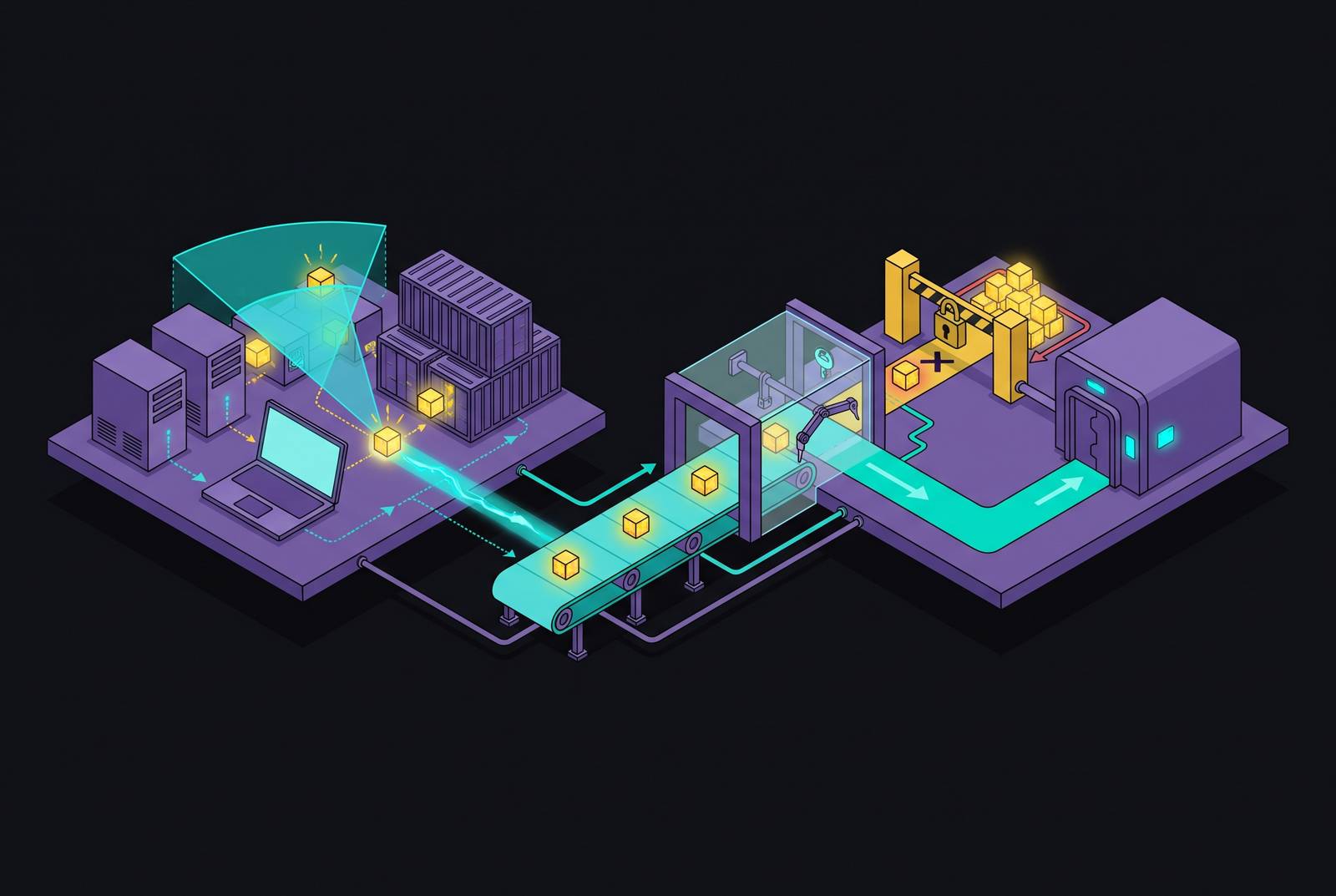
A four-stage pipeline turns shadow AI discovery into real enforcement.
· 14 min read
Why engineering environments are the highest-risk surface for shadow AI
- Role: Opens the argument by establishing that shadow AI is not an abstract policy problem but a concrete, measurable risk concentrated precisely where engineers work — setting up why a pipeline built for engineering surfaces specifically is necessary.
- Engineering environments carry disproportionate shadow AI exposure because the data engineers handle — source code, API credentials, internal architecture — is the most sensitive data an organization holds, and engineers are among the fastest, most self-directed adopters of AI tools.
- Verizon's 2026 DBIR notes that source code is, by a large margin, the most common data type submitted to external AI models, followed by images and structured data
- The engineering-specific attack surface now includes not just chat interfaces but coding agents (Cursor, Claude Code, Codex CLI, Gemini CLI, Cline, Windsurf), MCP servers wired into those agents, and API integrations that call external models with personal keys — each layer invisible to conventional CASB or SSO controls
- Vectra reports that a notable share of users at the average company have unauthorized AI extensions installed in their browsers, and the Verizon DBIR 2026 reports that research and technical documentation appears in a material share of DLP policy violations involving AI uploads
- Note: Open on the concrete engineering scenario — a developer installs a coding agent, wires in an MCP server from a README, and within minutes is routing internal API calls through an unmonitored tool. Keep this section tight; its job is to establish stakes and engineering specificity, not to survey all shadow AI statistics.
What makes shadow AI in engineering environments structurally hard to detect with conventional tools
- Role: Before introducing the pipeline, the argument must explain why the problem persists — what structural properties of engineering AI use defeat the controls organizations already have. This section earns the pipeline as the answer.
- Conventional enterprise controls — SSO enforcement, CASB policies, DLP rules — were designed for bounded human intent and manageable identity volume; engineering AI introduces autonomous agents, MCP tool calls, and non-human identities that break every assumption those controls rest on.
- CSA's research note documents that a majority of connections to generative AI tools are made via personal, non-corporate accounts, and that a large share of corporate-account connections bypass SSO — meaning SSO-keyed CASB policies miss most of the traffic
- MCP servers and coding agents operate at the network and process layer: they initiate outbound connections, persist credentials, spawn sub-agents, and chain tool calls — behaviors that DLP sensors built for file uploads or clipboard events were not designed to see
- AI agents introduce non-human identities (NHIs) that have no enrollment in conventional IAM: they act continuously, run unattended inside CI pipelines, and can operate across multiple activation surfaces with no single IdP choke point
- CSA finds that unauthorized AI tools remain active for a median of 403 days before detection — a dwell time that reflects how poorly matched existing monitoring is to this traffic pattern
- Optro's AI oversight gap report finds that only a quarter of organizations report comprehensive visibility into how employees use AI, and that most have only partial or limited visibility
- The structural gap: each detection layer — network inspection, identity discovery, endpoint agents, AI gateway — sees a different slice of the traffic, and none sees all of it; the pipeline the rest of this article builds is the only architecture that closes the gaps between layers
- Note: Frame this as a structural argument, not a vendor pitch. The point is that the problem is architectural, which is why the solution must be architectural. Close the section by naming the four pipeline stages — discovery, classification, policy mapping, enforcement — so the reader knows exactly where the article is going.
Stage one: discovering the actual AI footprint across engineering surfaces
- Role: Begins the stage-by-stage pipeline. Discovery is the prerequisite for everything that follows; this section argues that discovery in engineering environments requires multiple, layered detection techniques because no single technique sees the full footprint.
- An organization cannot govern what it cannot see, and in engineering environments the AI footprint is spread across at least four distinct surfaces — network traffic, identity and account signals, endpoint process behavior, and infrastructure configuration — each requiring a different detection method.
- Network-layer discovery: inspect egress traffic for connections to known AI provider endpoints and MCP server hostnames; this catches agent-initiated outbound calls that bypass browser-based controls; Cloudflare's enterprise MCP reference architecture uses its Gateway, combining hostname selectors, URI selectors, and DLP-based body inspection, to discover unauthorized remote MCP server usage on enterprise networks
- Identity and account-signal discovery: cross-reference OAuth grants, browser extension permissions, and SaaS application connections against the approved tool registry; CSA documents that a majority of generative AI connections use personal accounts, so identity signals reveal a shadow footprint that network inspection alone misses
- Endpoint and process discovery: endpoint agents on developer laptops can detect locally running model servers, coding agent processes (Cursor, Cline, Windsurf, Claude Code, Codex CLI, Gemini CLI), and the MCP server configurations wired into them — the layer most likely to surface shadow MCP installations dropped from a README
- Infrastructure and configuration discovery: scan CI/CD pipelines, Kubernetes namespaces, and internal developer portals for agent deployments, MCP server registrations, and API key usage patterns; the asset manager example above — thousands of agents found versus a handful approved — illustrates what infrastructure scanning surfaces that other layers miss
- Discovery must be continuous, not periodic: CSA notes the generative AI tooling landscape expanded from roughly 317 to more than 1,550 distinct generative AI SaaS applications tracked by Netskope in a matter of months — a rate that makes point-in-time audits structurally inadequate
- Note: Make the four discovery surfaces concrete with a brief example for each. Avoid recommending specific commercial products beyond what the sources establish. Close on the transition: discovery produces a raw inventory; the next stage is determining what that inventory actually contains.
Stage two: classifying what was discovered by data sensitivity, agent type, and risk posture
- Role: Advances the pipeline from raw inventory to actionable intelligence. Discovery without classification produces a list; classification is what determines which items demand immediate action, which require policy mapping, and which are acceptable with monitoring.
- Not every discovered AI tool or agent represents equal risk — classification by data sensitivity, agent autonomy, and identity posture is what converts a raw inventory into a prioritized governance backlog, and skipping this step is why organizations that detect shadow AI still fail to act on it proportionately.
- Agent autonomy dimension: distinguish passive AI apps (chatbots accessed via browser) from shadow agents (coding agents that read local files and run commands) from shadow MCP (MCP servers wired into agents that make external tool calls and may persist credentials); each tier requires a different control response
- Identity posture dimension: flag agents and tools operating without enterprise identity enrollment — no directory object, no scoped service principal, no audit trail; Microsoft Entra Agent ID and Okta for AI Agents both establish the pattern of giving each agent a first-class identity object as the precondition for classification and subsequent policy enforcement
- Compliance-trigger dimension: for regulated industries, classification must flag any tool touching data subject to GDPR, HIPAA, or PCI DSS; CSA's research note documents that the EU AI Act's binding enforcement of high-risk AI system obligations creates legal exposure, noting that more than half of organizations lack systematic AI inventories, the minimum prerequisite for any compliance program, without which risk classification and conformity requirements cannot even be scoped, let alone completed
- Classification output should be a tiered registry: sanctioned (approved and monitored), tolerated (low-risk, pending policy), requires remediation (sensitive data access, no governance), and prohibited (active risk, immediate action); this registry becomes the input to policy mapping
- HIT Communications' 2026 governance guide notes that most enterprises cannot answer basic questions about which AI tools are in use or what data has been submitted — classification is precisely the capability that makes those questions answerable
- Note: Keep the autonomy tier distinction crisp — the passive/agent/MCP breakdown is the engineering-specific insight that distinguishes this framework from generic shadow IT classification. Avoid going deep into regulatory specifics; one sentence per regulation is enough.
Stage three: mapping classified AI assets to existing policy and identity infrastructure
- Role: Bridges classification to enforcement. This section argues that policy mapping is not writing new rules from scratch — it is connecting the classified inventory to identity providers, access control models, and policy frameworks the enterprise already operates, which is both faster and more durable than building a parallel AI governance structure.
- The most efficient path from a classified AI inventory to enforceable policy is to extend existing identity and access control infrastructure to cover AI agents and MCP servers, treating them as non-human identities governed by the same role-based and attribute-based models already in place for humans.
- Extending RBAC toward finer-grained models: traditional RBAC is too coarse for AI-driven decisions; relationship-based (ReBAC) or attribute-based (ABAC) models enforce precise, context-aware permissions — an agent with a viewer relationship can summarize project documents but cannot export data to external APIs; this distinction is essential for MCP servers that can chain tool calls across multiple systems
- Mapping MCP servers to sanctioned tool registries: each MCP server discovered in the inventory should be mapped to either an approved server in a governed registry or flagged for remediation; the pattern established by the AWS and Cisco AI Defense partnership — integrating an open-source AI Registry (MCP Gateway and Registry) for unified visibility — illustrates the registry-as-policy-map approach
- Inheriting existing policy frameworks: prompt rules inside a model are not a control — they are a suggestion to a stochastic model; policy must sit outside the model, in a layer that can enforce allow, deny, require-approval, or require-justification rules without depending on the model's compliance; Salesforce's AI Control Plane covers discovery, identity, policy, lifecycle, evaluation, behavior/outcome observability, and cost control as an integrated structure rather than bolt-on rules
- The unresolved expert question on agent authorization — whether to treat agents as machines, as extensions of their human owner's entitlements, or as colleagues with their own scoped identities — is a genuine architectural decision organizations must make before enforcement can be consistent; high-consequence actions should not depend solely on inferred intent regardless of which model is chosen
- Note: The agent authorization debate is worth one focused paragraph — it is a real decision point engineers and platform teams face, not speculation. Do not resolve it prescriptively; describe the three approaches and note the consequence of choosing wrong for high-consequence actions.
Stage four: enforcement through a governed AI layer that intercepts tool calls in real time
- Role: Delivers the culminating stage of the pipeline. Enforcement is where policy becomes operational — and this section argues that enforcement in engineering environments requires a dedicated control layer that sits between agents and the systems they access, because neither the agent nor the target system can enforce cross-cutting policy reliably.
- Enforcement requires a governed layer outside the model and outside the target system — an AI control plane or MCP gateway that intercepts every tool call, validates identity and policy, and applies real-time threat detection before any action reaches production data or external APIs.
- Why enforcement must sit outside the model: prompt rules are not controls; they are suggestions to a stochastic system; the control plane category exists precisely because enforcement must be external — a layer that applies YAML-style allow/deny/require-approval rules using CEL or OPA expressions against every tool call, regardless of what the model was instructed to do
- The MCP gateway pattern: a centralized MCP gateway provides authentication, access control, routing, observability, auditing, and policy enforcement for agent-to-tool interactions; it can intercept any MCP-compliant agent's tool calls without depending on a specific SDK — the standardization of MCP across major coding agents (Cursor, Claude Code, Codex CLI, Gemini CLI, Cline, Windsurf) is what makes a single interception layer practical
- Identity-native enforcement vs. network routing: Okta's Agent Gateway validates the agent's identity and the human user behind it, checks the policies governing that agent, and brokers a short-lived credential at runtime — this is qualitatively different from a gateway that only routes network traffic; the combination of identity validation and credential brokering at the enforcement layer closes the gap between classification and runtime control
- Real-time threat detection built into the enforcement layer: NeuralTrust TrustGate's Security Engine inspects the content of tool calls inline and reasons across a whole session, rather than only deciding who is allowed to call a tool; ToolHive from Stacklok runs every MCP server in its own isolated container with minimal permissions and no local credentials attached from the host (secrets are brokered separately); Willow's governance gateway runs six checks on every call — identity, group-based access to the target server, runtime guards on request content, and response guards that mask PII on the way back
- Observability as the enforcement feedback loop: enforcement without observability is blind; full audit logs of every agent action, tool call, credential use, and policy decision are the mechanism by which enforcement is verifiable, incidents are reconstructable, and policy is improvable; Databricks's Unity Gateway extends governance to runtime interactions among models, agents, MCP servers, and tools through Unity Catalog as an example of observability integrated into the enforcement layer
- The fragmentation risk: enterprises that deploy enforcement point-solutions per platform — one gateway for Copilot, another for Cursor, another for internal agents — risk recreating the shadow AI problem inside the governance layer itself; each platform introduces its own registry, policy model, gateway, and monitoring layer; the AI control plane category as defined by Forrester addresses this by providing a single governed layer across heterogeneous agents and vendors
- Research cited by multiple 2026 governance sources notes that when organizations provision sanctioned AI tools, unauthorized use drops by approximately 89% — enforcement is not just a security control but a supply-side governance mechanism that redirects demand toward monitored alternatives
- Note: Ground every enforcement pattern in a named example from the sources. The fragmentation risk point is important — introduce it here because it is the practical failure mode that makes a unified control plane the logical conclusion of the section, not an upsell.
Where the pipeline gaps actually live and how each one lets shadow AI persist
- Role: Moves from stage-by-stage construction to the argument that the pipeline is only as strong as its weakest connection — the gaps between stages are where shadow AI survives even in organizations that have invested in individual controls. This section makes the integration argument concrete.
- Most organizations that fail to govern engineering AI do not lack individual controls — they lack the connections between them: discovered assets that never get classified, classified assets that never get policy-mapped, policies that exist on paper but have no enforcement layer wired to them.
- Classification-to-policy gap: the most common failure is an organization that classifies shadow AI usage in an audit finding but has no mechanism to connect that finding to an IdP enrollment or RBAC rule; CSA documents that a majority of organizations lack any formal AI governance policy — meaning classification findings have nowhere to go
- Policy-to-enforcement gap: policy documents and acceptable-use policies that are not technically enforced at the gateway or control plane layer depend entirely on employee compliance; Research cited by Vectra notes that nearly half of employees report they would continue using personal AI accounts even after an organizational ban — the empirical evidence that policy without enforcement is not governance
- Enforcement-to-observability gap: enforcement without a closed feedback loop — audit logs, usage telemetry, anomaly detection — cannot detect policy drift, agent sprawl, or new shadow AI surfaces as they emerge; the dwell time problem (unauthorized tools active for a median of many months before detection) is the operational consequence of this gap
- The pipeline framing matters because it names the gaps: an organization can test itself — does discovery output flow into classification? Does classification output map to policy? Does policy have a technical enforcement layer? Does enforcement generate observable signals that feed back into discovery? A "no" at any stage is where shadow AI persists.
- Note: This section is analytical, not prescriptive — it is diagnosing why partial implementations fail, not re-describing the stages. Keep it brief; its purpose is to make the integration argument before the conclusion draws it together.
Building the pipeline as governed infrastructure rather than a one-time audit
- A discovery-to-enforcement pipeline is only as durable as its operational model — organizations that treat it as a one-time audit will relitigate the same shadow AI problems every quarter as new agents, MCP servers, and coding tools appear; the pipeline must be wired into the same infrastructure layer that handles identity, access, and observability for everything else the engineering organization runs.
- The AI control plane as the operational substrate: Forrester's December 2025 evaluation defined the agent control plane as infrastructure that inventories, governs, orchestrates, and assures heterogeneous AI agents across vendors and domains — the framing confirms that the pipeline described in this article maps to an emerging, recognized infrastructure category, not a one-off compliance exercise
- Continuous discovery requires integration with the tools engineers already use: CI/CD pipelines, developer portals, Kubernetes namespaces, and IdP event streams should emit signals into the pipeline automatically, so new agent deployments are inventoried at creation rather than discovered months later
- Policy must live in the enforcement layer, not in a document: RBAC rules, MCP server access grants, and agent identity enrollments should be version-controlled and applied automatically when a new agent is registered — the same engineering discipline applied to infrastructure-as-code
- Enforcement generates the observability that feeds the next discovery cycle: every tool call intercepted, every policy decision logged, every anomalous behavior flagged becomes input to the classification stage for newly discovered agents — the pipeline is a loop, not a line
- The supply-side governance finding from CSA's research note — that provisioning sanctioned tools causes unauthorized use to drop sharply — reframes the pipeline's goal: not to block AI adoption but to redirect it through a governed channel that engineering teams find usable, so the pipeline succeeds by making the sanctioned path easier than the shadow path
- An AI control plane that connects AI agents and MCP servers to enterprise identity providers, enforces RBAC through Okta or Entra ID, detects prompt injection and PII leakage in real time, and surfaces cost and usage telemetry is the operational form of the pipeline — the infrastructure that makes discovery, classification, policy mapping, and enforcement run as a continuous system rather than four separate projects
Sources
Filed underEnterprise AI Governance
More in Enterprise AI Governance
NIST AI Risk Management Framework Applied to Enterprise AI Rollouts
Rafael Castañeda-Wu
Discovering Unauthorized AI Tool Usage Across Your Enterprise Endpoints and SaaS Stack
Simone Achebe
Real-Time AI Policy Gates Engineers Can Wire Into Identity, Proxy, and CI Layers
Tobias Wrenfield