Why the AI Agent Control Plane Is the New API Gateway for Engineering Platforms
Agent traffic needs gateway-style controls plus tool-level policy.
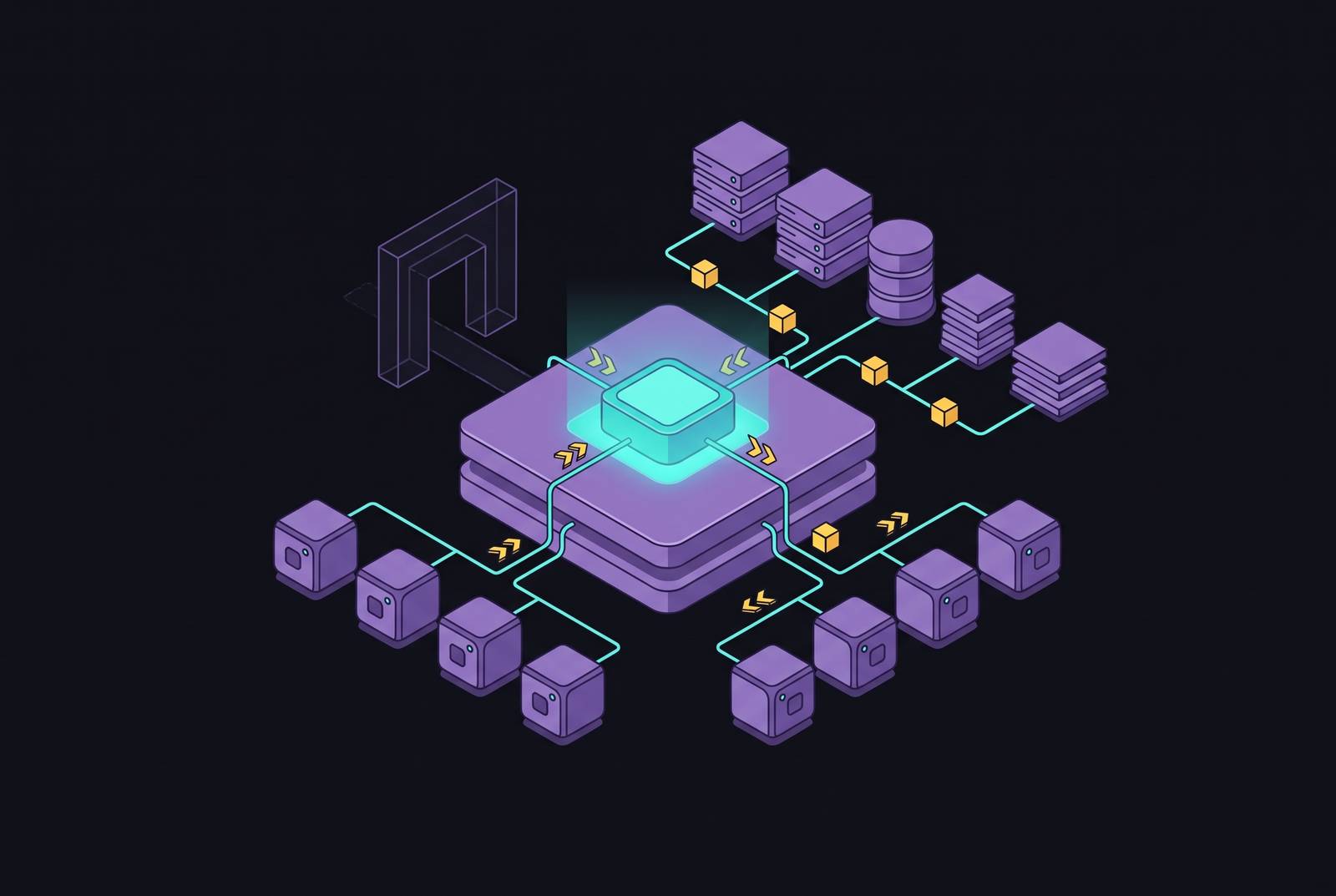
An enterprise AI agent control plane is the shared policy layer that governs AI agents and MCP servers across an organization. It inherits the API gateway’s authentication, authorization, rate limiting, and audit functions, but must govern tool calls, delegated authority, and full agent trajectories alongside HTTP requests. It manages policy centrally and enforces it at runtime, with links to the enterprise’s existing identity, secrets, and observability systems.
How the API gateway became indispensable, and why that history matters now
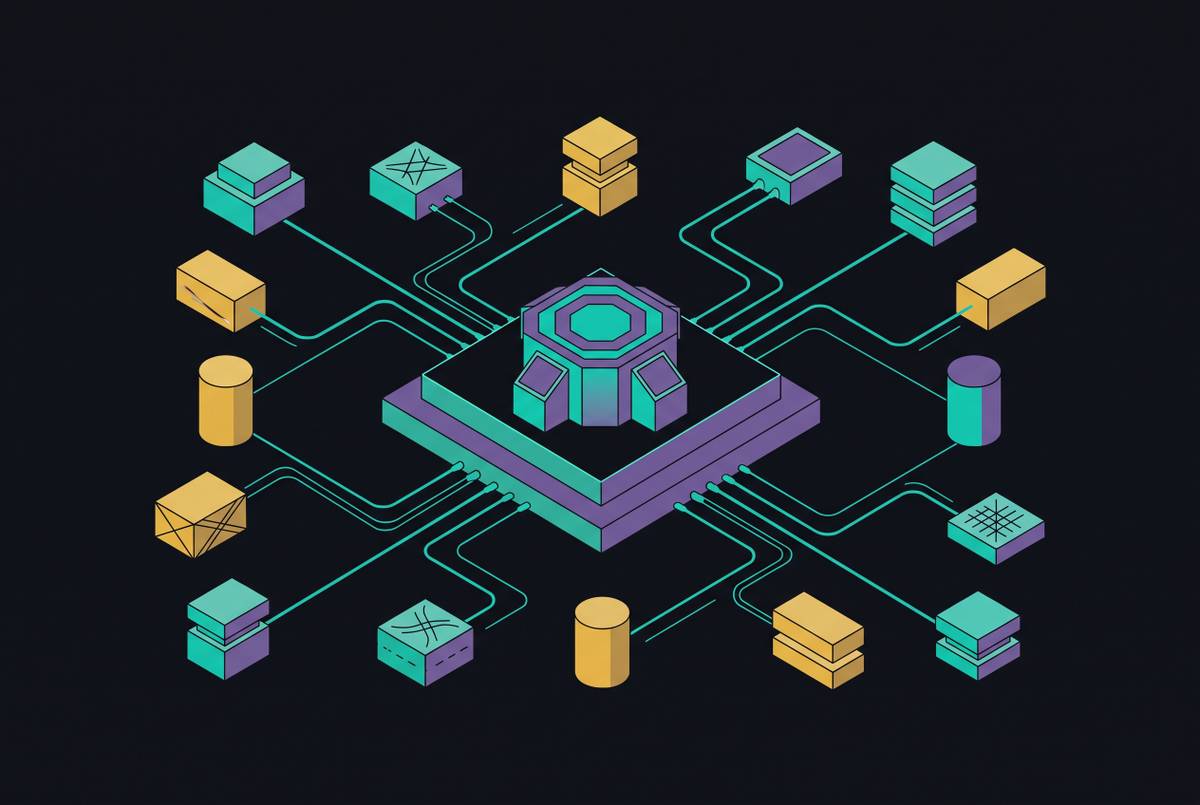
The API gateway solved a coordination problem before it became a standard piece of infrastructure. Without a central enforcement point, each service pair had to implement authentication, rate limiting, and logging independently, allowing policy to drift as the network grew. The gateway replaced that mesh with a hub-and-spoke model, giving services consistent controls and a unified audit log. The agent control plane repeats that architectural move for traffic whose meaning cannot be read from a URL and an HTTP method. An API gateway asks whether a client may reach an endpoint, while the agent layer must decide whether this agent may execute this tool with these parameters, for this user, right now. The two layers are complementary.
What MCP did to enterprise traffic, and why it made governance urgent
The Model Context Protocol, or MCP, makes compliant agents and servers interoperable, removing much of the work needed to connect them. That convenience cuts both ways. The same standardization that removes integration friction can also remove the checkpoints where someone would have reviewed a new connection. A single agent can invoke knowledge retrieval, transactional database lookups, internal calculations, and third-party APIs within one task session. Each time a tool runs, it sends parameters that may hold sensitive business data and returns information that enters the model’s active context. Tool traffic has grown from plumbing around a chatbot into an operational data plane.
The protocol itself is also moving quickly. The June 2026 Enterprise-Managed Authorization extension and the July 2026 specification revision each brought changes, including enterprise-managed access, stateless sessions, and server-to-client change notifications. The July revision also put Client ID Metadata Documents in place of Dynamic Client Registration. These are changes to how connections and authority work. Governance assembled inside individual integrations must keep pace with them, which strengthens the case for a dedicated control plane that can manage protocol changes centrally rather than leaving each team to maintain its own interpretation.
Where the API gateway analogy holds exactly
Five familiar gateway functions transfer directly to agent tool traffic, namely centralized authentication, fine-grained authorization, rate limiting, data masking, and unified audit logging. Their purpose has not become mysterious because the caller is an agent. Without central authentication and authorization, each tool must implement its own controls, with the same opportunities for inconsistency that existed between services. Rate limits and quotas constrain a runaway agent before it overloads an internal service or incurs excessive costs.
Data masking also belongs at a shared point where traffic is inspected. A transactional backend can return customer names, tax IDs, addresses, and transaction amounts that the model never needed for the task. With direct connections, those fields can enter the model context and be sent to the model provider as inference context. Unified logging brings together evidence that would otherwise be spread across agents and tools, where it is harder to see. The topology is familiar for good reason. A managed entry-and-exit point turns a many-to-many set of connections into traffic that can be governed consistently.
Where the control plane must go further than any API gateway did
The analogy breaks at the unit of control. Agents choose tools dynamically, and each result can influence the next call across a different system. A prompt that seems harmless can thus lead to an export, write, or deletion that was not clear when the session began. Endpoint permission cannot settle that question. Two calls to the same tool may pose very different risks because they have different arguments, so enforcement must check what the tool does and its parameters as well as its transport.
Delegation adds another dimension. An agent acts for a person, may spawn sub-agents, and can cross permission boundaries as the task develops. The control plane must resolve the agent, the initiating user, and the applicable scope at every execution. It must also account for the trajectory, because individually permitted calls can have a harmful cumulative result. That is a different job from checking a session once.
The attack surface changes with the decision process. Tool poisoning uses forged descriptions to manipulate agent behavior, while tool shadowing lets a server override trusted tools in an agent’s toolchain. Context leakage can let information from one session cross into another. These are not simply new spellings of SQL injection. They attack what the agent believes a tool is and how it chooses to use it, requiring controls above the HTTP layer.
The shadow MCP problem and why governance must start with discovery
A control plane cannot govern servers it does not know exist. Shadow MCP begins when a developer connects an AI coding assistant to a staging database or production API through a local server. The productivity gain is visible immediately. The missing inventory of servers, owners, credentials, reachable systems, and connected agents is much less visible. Hardcoded tokens in local configuration files can leave agents using the access they got at setup without a review of permissions for each task.
This is riskier than ordinary unapproved software because the agent decides at runtime how to use that access. MCP servers may hold plaintext credentials and run with elevated permissions, so they are valuable targets for agents steered by prompt injection. A blanket ban is the wrong response. Developers can work around it, making both the inventory and the risk harder to see. The practical alternative is a governed golden path, supported by a catalog of approved tools, that makes sanctioned connections easier to discover and use than ungoverned ones.
Agent identity and why shared service accounts cannot be the answer
Identity is the dependency beneath authorization, delegation, credential scoping, and audit attribution. Each agent needs its own persistent identity that can be resolved and tied to a named person, in place of a shared service account. Shared accounts erase distinctions that an investigation needs. Rapid agent creation, sub-agents, orphaned credentials, and over-broad tokens make those distinctions more important. The governing model is to treat agents like employees, with role-based access provisioned through the enterprise identity provider, or IdP, and short-lived credentials scoped to their tasks.
The MCP specification defines OAuth 2.1 with PKCE for HTTP deployments that implement authorization, although authorization itself remains optional with a SHOULD-level recommendation. The Enterprise-Managed Authorization extension makes the enterprise IdP the authoritative decision-maker for MCP server access. Users authenticate through their existing enterprise identity and receive authorized server access without separate consent screens for every server. The agent’s identity persists while its credentials expire. At execution time, the gateway can inject the authority needed for the task without giving the agent the underlying production secret.
Microsoft Agent 365 provides a concrete identity model. Generally available from May 1, 2026, it gives each agent an Entra Agent ID for identity, lifecycle, and access management. Conditional Access for agents needs Agent 365 plus Microsoft Entra ID P1 or P2, while Identity Protection needs Entra ID P2 during preview. Purview integration is included. Third-party agents from AWS Bedrock and n8n can also be onboarded through workload identity federation.
Runtime policy enforcement and why server allowlists are not enough
A server allowlist governs connection permission, while runtime policy governs whether a particular action should execute. That distinction becomes decisive when the same tool can operate on different records or perform different actions depending on its parameters. Runtime policy needs the agent identity, initiating user, tool name, arguments, prompt context, and session trajectory. The gateway must authenticate the agent, consult the applicable policies, and route permitted requests to the registered upstream server.
Filtered discovery narrows the available choices before execution. Engineering teams can see GitHub and code execution tools, while finance teams see ERP integrations, with access requests passing through approval workflows. The catalog becomes an internal app store for agent capabilities, but discovery filtering does not replace execution-time checks. A trusted tool can return content containing malicious instructions, and one server can try to manipulate how an agent uses another. Because prompt injection can now cause data exfiltration or system compromise as well as embarrassing text, policy must be enforced on every prompt and tool call at runtime.
Observability and audit trails across full agent trajectories
If a support agent changes a production database record under weak authorization, investigators need to connect the task’s intent, tool choices, parameters, intermediate results, and blocked attempts to the eventual execution. Request and response metadata alone leaves that connection missing. The audit unit is the trajectory. Each allow or deny decision must also identify the named person behind the action and the rule that applied, which binds observability to the identity layer.
That evidence serves both engineering investigation and compliance review. A security leader needs to show both that a request occurred and why the action was allowed or blocked. OpenTelemetry provides a vendor-neutral framework for emitting agent telemetry into existing systems such as Datadog, Grafana, or another OpenTelemetry collector. A separate monitoring silo is not required. Visibility must span both live tool traffic and the configuration and policy that governed it, so the record can connect an execution to its controlling decision.
How do enterprises centrally manage agents and MCP servers in production?
When a platform team weighs a production architecture, it should keep the work of managing policy separate from the work of handling live traffic. The data plane handles tools/list, tools/call, authentication, authorization, routing, rate limiting, caching, and observability. The control plane manages configuration, policy distribution, service registration, certificates, analytics, and administration. This distinction has practical consequences. The data plane’s placement has the greatest effect on request latency, while the control plane provides the common administrative layer.
Deployment topology determines the tradeoffs. An in-process gateway skips an extra network hop and has the lowest latency, while a sidecar performs nearly as well, with better isolation and more flexibility in how it is run. A centralized gateway is simpler to govern but can become a throughput bottleneck at very large scale. Federated or mesh deployments offer the highest aggregate throughput and regional resilience at the cost of greater operational complexity.
The governed catalog is the architecture’s operational face. IT and security teams control which connectors are available, who can use them, and under what conditions, while employees find approved options through search. Agents reach GitHub, databases, or internal APIs through the gateway instead of connecting directly, so the enforcement path is clear. Existing systems remain part of that path. Integration with the enterprise IdP, secrets manager, and observability stack is what makes scoped credentials and attributable audit records possible without replacing the surrounding platform.
The five capabilities a platform team must require before deploying agents at scale
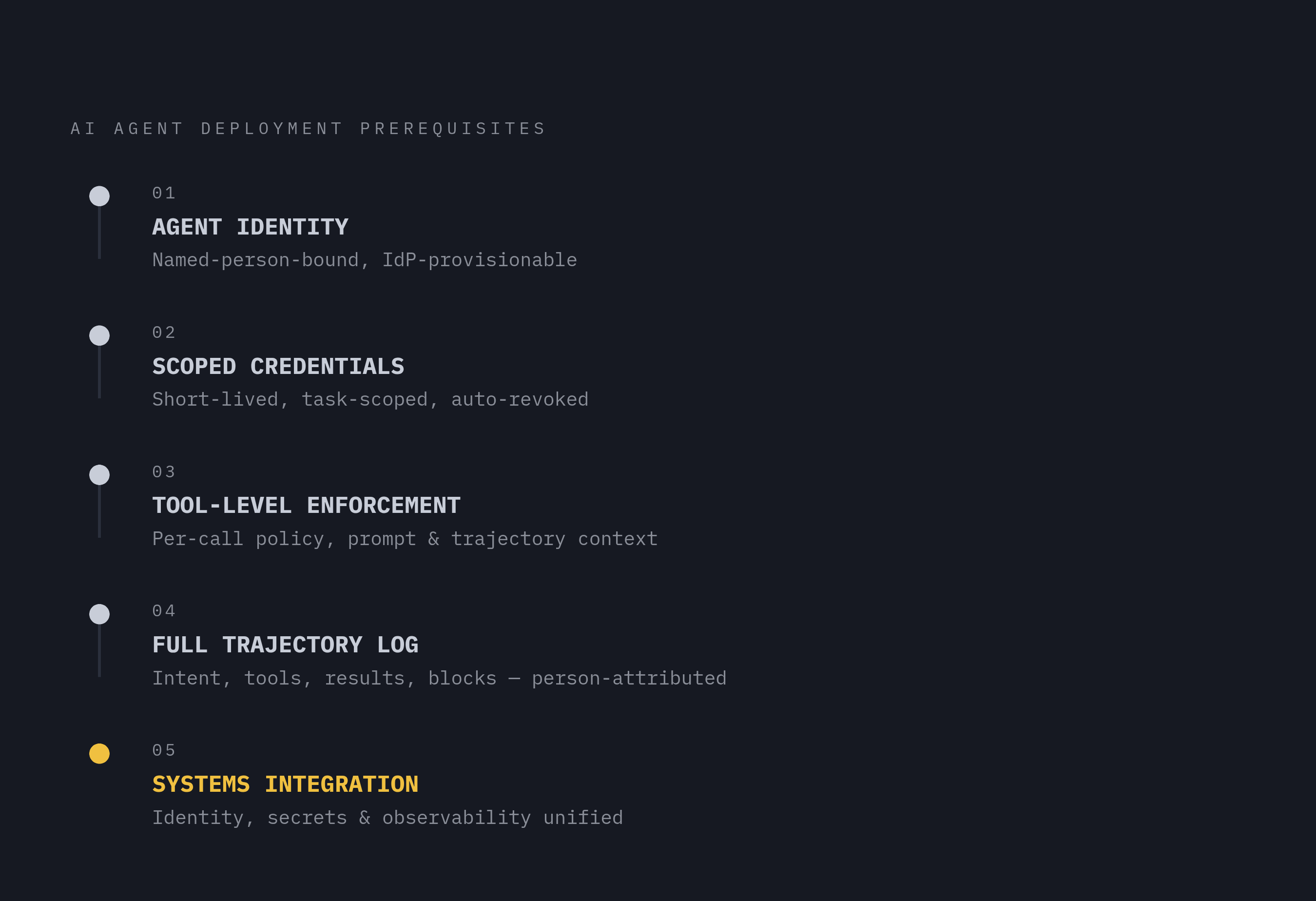
A platform team should assess five capabilities as a connected system, beginning with persistent per-agent identity tied to a named person and provisionable through the enterprise IdP. The second requirement is dynamic, short-lived, task-scoped credentials, injected at execution and revoked when the task ends. Agents must not hold raw production secrets. A stable identity establishes who is acting, while expiring credentials limit the authority available for the current task. Neither substitutes for the other.
The third requirement is tool-parameter-level enforcement on every call, using prompt context and session trajectory alongside caller identity. The fourth is full trajectory logging that records intent, tool choices, intermediate results, and blocked attempts, attributed to a person and the applicable rule. The fifth is integration with the identity, secrets, and observability systems already in place. The connections are part of the test. A policy decision that cannot be attributed, or an audit record that cannot identify its governing rule, leaves the system incomplete.
Before that assessment, the prerequisite is a shadow MCP audit covering servers, owners, exposed tools, and connected agents. The deployment standard is therefore organizational as much as technical. Agents should be governed like employees, under persistent identities, with role-based access provisioned by the IdP, short-lived scoped credentials, and every action auditable and attributed to a name.