Generative AI Data Exposure Risks in Enterprise Deployments
Most enterprises using AI lack governance to prevent sensitive data leaks.
Adoption numbers first. 71% of firms now use generative AI in at least one business function, up from 65% the year before, even though only 37% of organizations have an AI governance program. That is not a pilot program anymore. That is payroll processing, customer support, code review, contract drafting, the daily plumbing of the company. Yet only 37% of organizations have an AI governance policy written down anywhere. Do the math and 63% of firms using AI have no formal rulebook for what the tools can touch, store, or send outside the building.
The awareness gap makes this worse, not better. 78% of organizations call AI an emerging risk. Only 18% have actually lined up their compliance and risk functions to deal with it. So the industry has, in effect, diagnosed the illness and declined to fill the prescription. Gartner expects 30% of generative AI projects to get scrapped after proof-of-concept by the end of 2025, mostly over bad data quality and thin risk controls. That is not a technology failure. That is a governance failure wearing a lab coat, and it is already eating returns before the tools reach scale.
None of this is exotic. It is the oldest story in enterprise tech: the tool ships faster than the policy that should govern it. What is new is the speed differential. Cloud adoption outpaced its governance layer over years. Generative AI compressed that same dynamic into a dramatically shorter window.
Data Flowing into AI Tools Undetected by Security Teams
Start with the scale of what is leaving the building. 83.8% of enterprise data flowing into AI tools lands on platforms already classified as critical or high risk. That is not a rare misstep by a careless employee. That is the baseline behavior of the whole workforce.
The content of that data is getting more dangerous, too. Two years ago, sensitive data made up 10.7% of what employees fed into AI tools. Now it is 34.8%. Volume matters, but sensitivity is climbing faster than volume. The average prompt today carries more risk than the average prompt a year ago, even if usage stayed flat.
Break down what employees actually paste in. Source code accounts for 42% of AI-related data policy violations, mostly developers dropping proprietary code into a chat window to get a bug fixed or a function refactored. Regulated data, personal records, financial details, healthcare information, makes up another 32%, and each instance is a live GDPR or HIPAA exposure the moment it crosses the wire. Intellectual property, contracts, strategy documents, research notes uploaded for a quick summary, accounts for 16%. What is left over is passwords and API keys, usually not typed in directly but buried inside a code snippet or a config file nobody scrubbed first.
The incident count backs this up. The average organization logs 223 AI-related data security incidents. Firms in the worst quartile see something like ten times that. Visibility, in most of these environments, is not partial. Visibility is close to zero, because the traffic in question rarely touches a monitored gateway.
Shadow AI as the primary ungoverned exposure channel
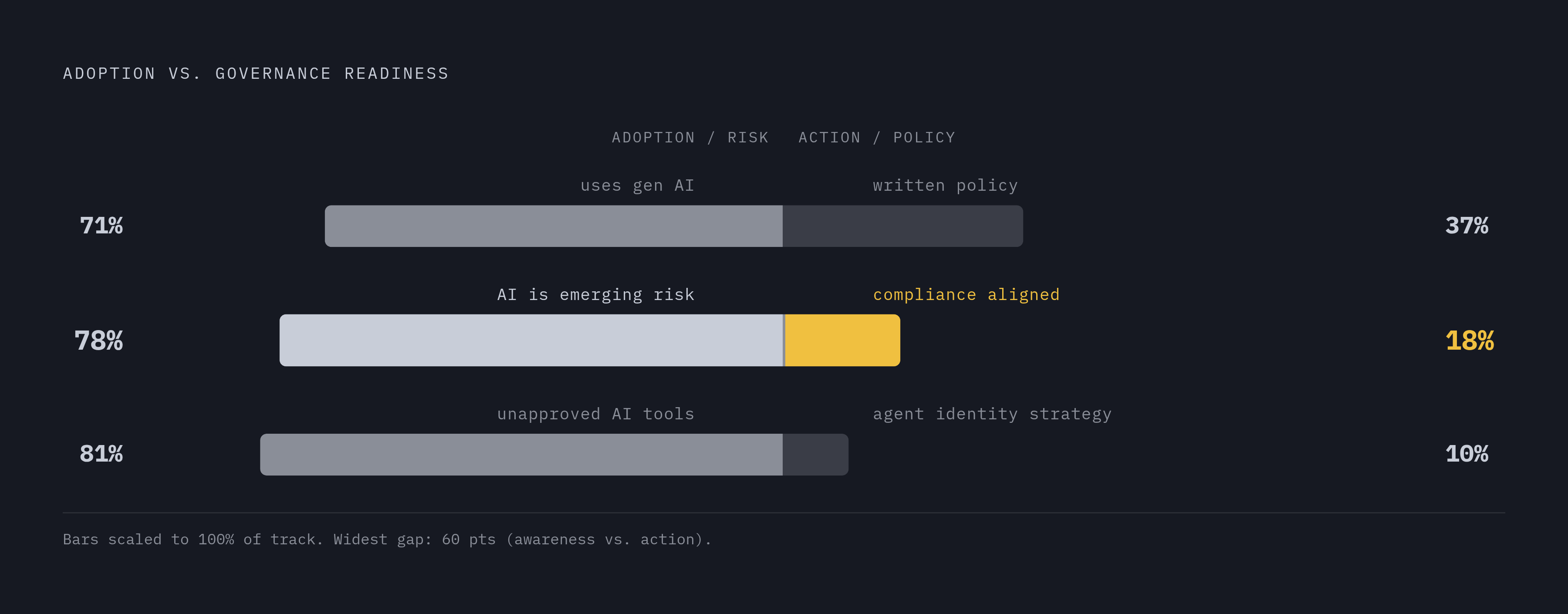
Shadow AI is the name for the tools nobody approved and everybody uses anyway, and it is now the biggest single leak in the system. 81% of employees use AI tools that were never cleared by their security team. Among security professionals themselves, the number climbs to 88%. The people whose job is to stop this behavior are, by a wide margin, doing it themselves.
Most of that shadow usage runs through free-tier consumer tools. 68% of employees use something like a free ChatGPT account through a personal login, and a large share have put sensitive data into it. Web traffic to generative AI sites overall jumped from 7 billion to 10.53 billion monthly visits between February 2024 and January 2025, a 50% jump in under a year, and a meaningful share of that growth is personal-account traffic that never passes through a company network or a company's data loss prevention tooling.
75% of employees admit, when asked directly, to sharing sensitive customer data, employee records, or internal documents with tools their company never approved. That is not a rounding error. That is three out of four people in the building routing confidential material through infrastructure the security team cannot see, log, or audit. If you ask any security executive what their biggest blind spot is, the honest answer, increasingly, is "the browser tab open right next to Slack.""
The specific technical vectors through which data leaves the enterprise AI layer
OWASP's Top 10 for Large Language Model Applications names prompt injection and sensitive information disclosure as the two vulnerabilities doing the most damage to enterprise AI deployments. Both are governance failures dressed up as engineering problems, because fixing either one requires controls that sit outside the model, not tuning inside it.
Prompt injection works because a language model cannot reliably tell an instruction from its own system prompt apart from text a user (or an attacker) slipped into the conversation. The fix has to live at the infrastructure layer, filtering and validating input before it ever reaches the model, because the model itself has no internal referee for this.
Real incidents make the mechanics concrete. In one documented case, a prompt-injection payload sitting inside a public GitHub issue hijacked an AI agent that had been configured with an overly broad personal access token. The agent read private repository contents and leaked them to an external destination. No bug in the underlying protocol tools caused this. Broad token scope plus untrusted content in the agent's context window was enough on its own. Separately, MCP tool servers that pass agent-supplied input directly into shell commands without sanitizing it first have shown themselves vulnerable to straightforward command injection, the same class of bug that has plagued web applications for two decades, just wearing a new agentic costume. A third pattern, called tool shadowing, involves a malicious MCP server injecting adversarial instructions into its own tool descriptions, which then hijacks how the agent behaves toward legitimate tools running on entirely different servers. No identical tool names required. Just a poisoned description sitting where the agent goes looking for instructions.
The Slack AI incident from August 2024, documented by PromptArmor, gives the whole category a face. An injected prompt caused Slack's AI assistant to pull private channel data, including API keys, and exfiltrate it to an attacker through a crafted Markdown link. This happened inside a tool already deployed across a huge number of enterprise workspaces, which is the point: this is not a fringe risk confined to experimental agent frameworks. It happened in production, in a tool people use to talk about lunch.
Agent Sprawl and the Multiplying Exposure Surface
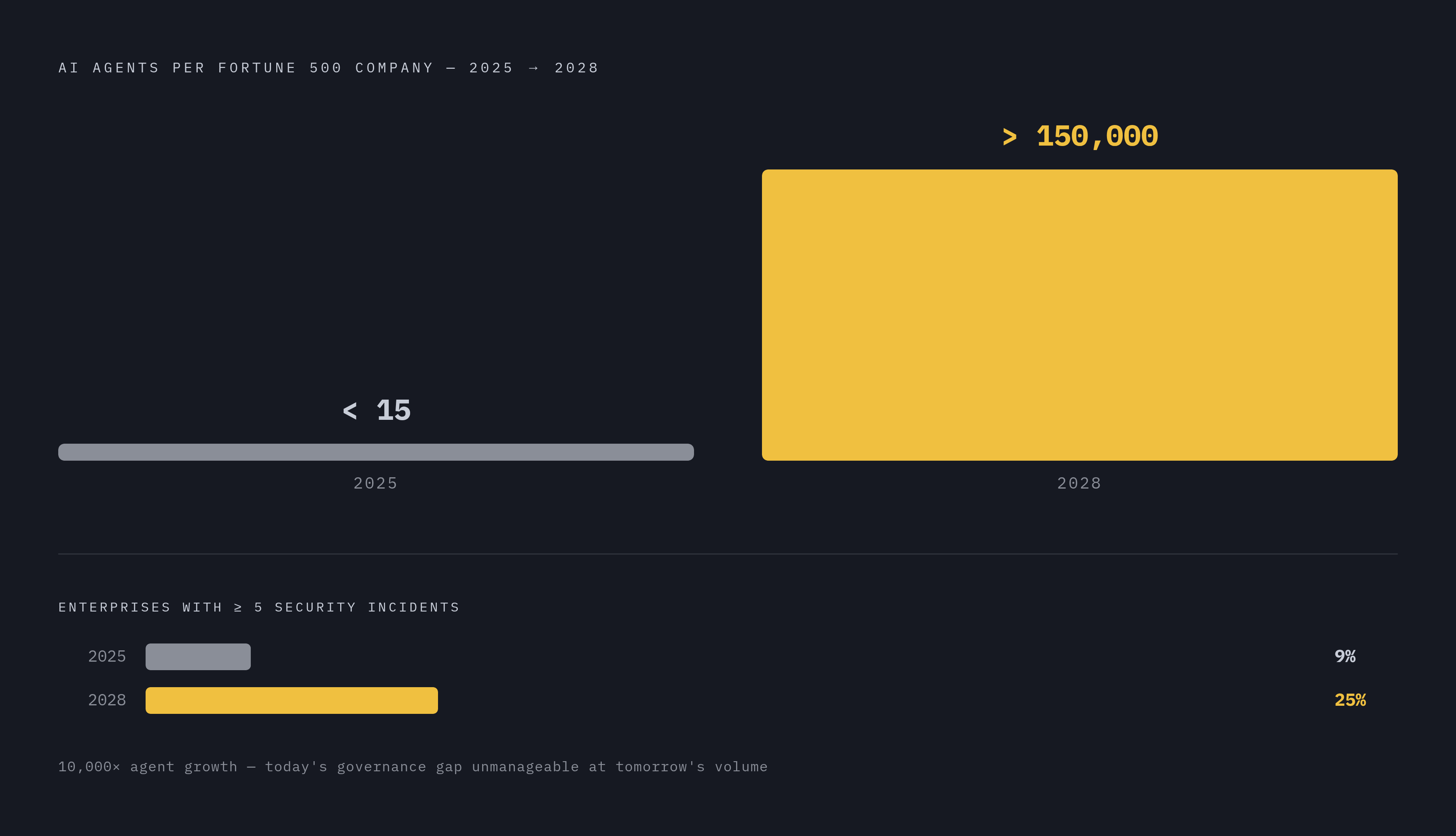
The scale is about to get worse by orders of magnitude, not by increments. The average Fortune 500 company is projected to run more than 150,000 AI agents by 2028. In 2025, that same company runs fewer than 15. Access control models built around a person logging in with a username and password were never built for a world where one company operates a six-figure population of autonomous software agents, each capable of independent action.
Incident frequency is following the same curve. By 2028, 25% of enterprise generative AI applications will experience at least five minor security incidents, up from 9% in 2025. Incidents scale with agent count, roughly the way traffic accidents scale with the number of cars on the road, except these cars can act without a driver.
A large share of organizations already use AI agents, yet reports suggest only a small fraction have a formal strategy for managing non-human identities, and traditional identity and access management was designed for humans, not machines. AI agents are already in broad use across organizations. Only a small fraction have a formal strategy for managing non-human identities. Traditional identity and access management was designed around how humans log in and log out. It was never built for entities that act at machine speed and never sleep.
Agent exposure and human exposure differ not in degree but in kind. It is a different animal. A rogue or hallucinating agent can pull thousands of records in the time it takes a human analyst to open a ticket. Agents also tend to hold long-lived credentials, OAuth tokens, session cookies, API keys, that outlive the single task the agent was spun up to do. And agents initiate their own outbound connections, which quietly removes the human-review checkpoint that most of today's security controls still assume is standing there.
Identity and access control as the structural foundation of AI governance
A survey found that AI agents are in use at 91% of organizations, and only 10% have a formal strategy for managing the identities behind them. The identity, governance, and privileged access tooling most companies already own was built for humans clicking "log in." It was not built for machine-speed actors that spin up, act, and disappear in the time it takes a person to read an email.
What does the absence of agent identity governance actually look like on the ground? Agents frequently run under shared service accounts. There is no per-agent audit trail and no boundary enforcing least privilege. Static API keys get issued to agents and then just sit there, active long after the agent's original job is finished, which builds a quiet chain of persistent access nobody remembers to close. And there is usually no joiner-mover-leaver process for agents at all, so an agent stood up for a three-month project keeps its access long after the project wraps and everyone involved has moved on.
The vendor response has started to catch up, at least on paper. Microsoft's Entra Agent ID reached general availability in April 2026, extending the existing Zero Trust stack, Conditional Access, Identity Protection, Privileged Identity Management, to cover non-human identities. It introduces "agent identity blueprints," reusable templates that define an agent type's owners, sponsors, access boundaries, and audit behavior. Architecturally, an agent identity under this model is a specialized service principal that pulls short-lived tokens through its blueprint rather than holding its own standing credentials, which closes off exactly the kind of long-lived key sprawl described above. Okta and Auth0 moved in the same direction: Auth0 for AI Agents and Okta for AI Agents both became available in 2026. Okta is now listed as a featured identity provider for Claude Enterprise, connecting AI agents to MCP-based applications through Okta's Cross App Access protocol.
Centralized enforcement at the protocol layer through an MCP gateway
Context first. Anthropic released the Model Context Protocol in November 2024, and by December 2025 it was seeing 97 million monthly SDK downloads. It is now governed as a founding project of the Agentic AI Foundation under the Linux Foundation. This is now a mainstream standard. It is quickly becoming the plumbing that connects AI agents to the tools and data sources they act on.
The protocol itself, though, was never built to govern anything. MCP was not designed with enterprise governance controls built in. Wiring AI agents directly into dozens of MCP servers with no governance layer sitting between them is not something that holds up at enterprise scale for more than a few months.
That gap is what an MCP gateway exists to close. It sits between the agents and the MCP servers they reach out to, and it centralizes authentication, validating identity before a single tool call reaches a server. It enforces access control through role-based policy applied at the request path itself, rather than scattering enforcement across dozens of individually configured servers. And it logs every tool invocation that passes through it, producing the audit trail that compliance teams need and that, right now, in most agent deployments, simply does not exist.
That is the whole argument compressed into one layer of infrastructure. Adoption outpaced governance because governance was never designed to move at agent speed. Closing the gap does not mean slowing adoption down; it means putting identity and enforcement back at the center of the pipeline. It means putting identity and enforcement back at the center of the pipeline, at the protocol layer, before enterprises reach the projected scale of 150,000 agents and the gap between agent behavior and existing access controls becomes unmanageable.