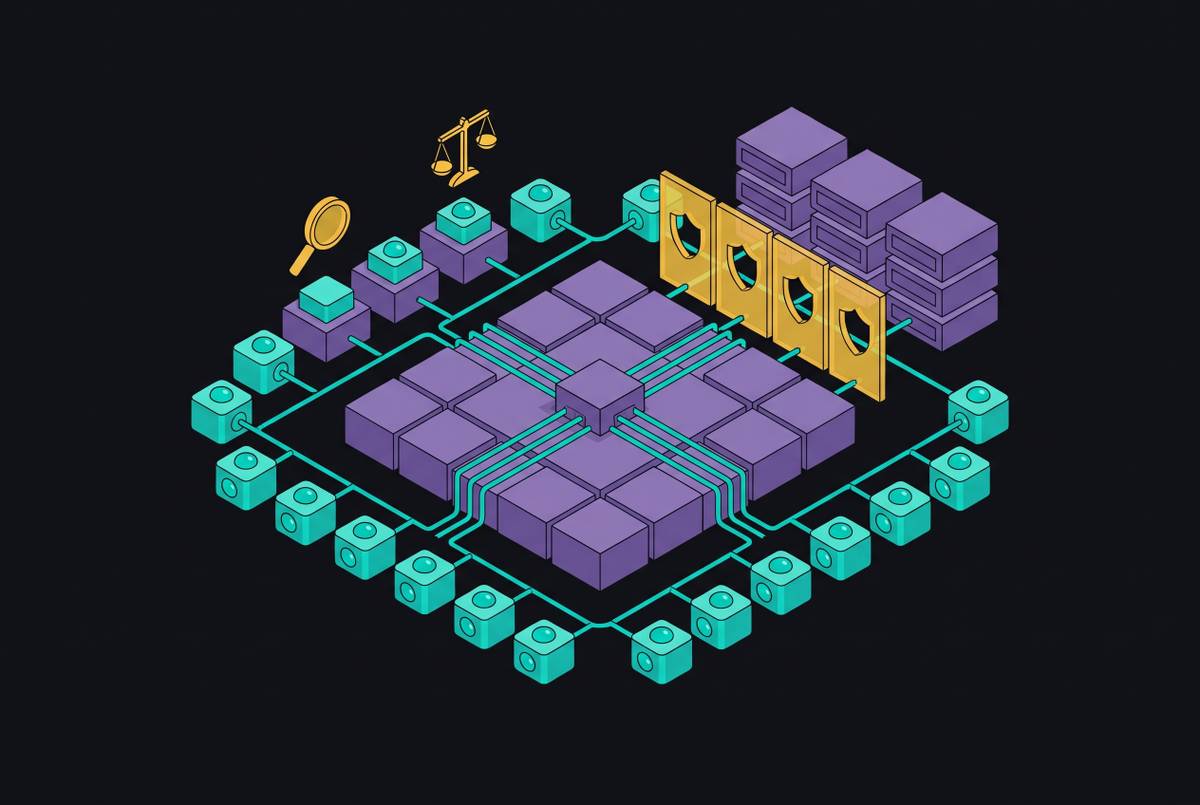
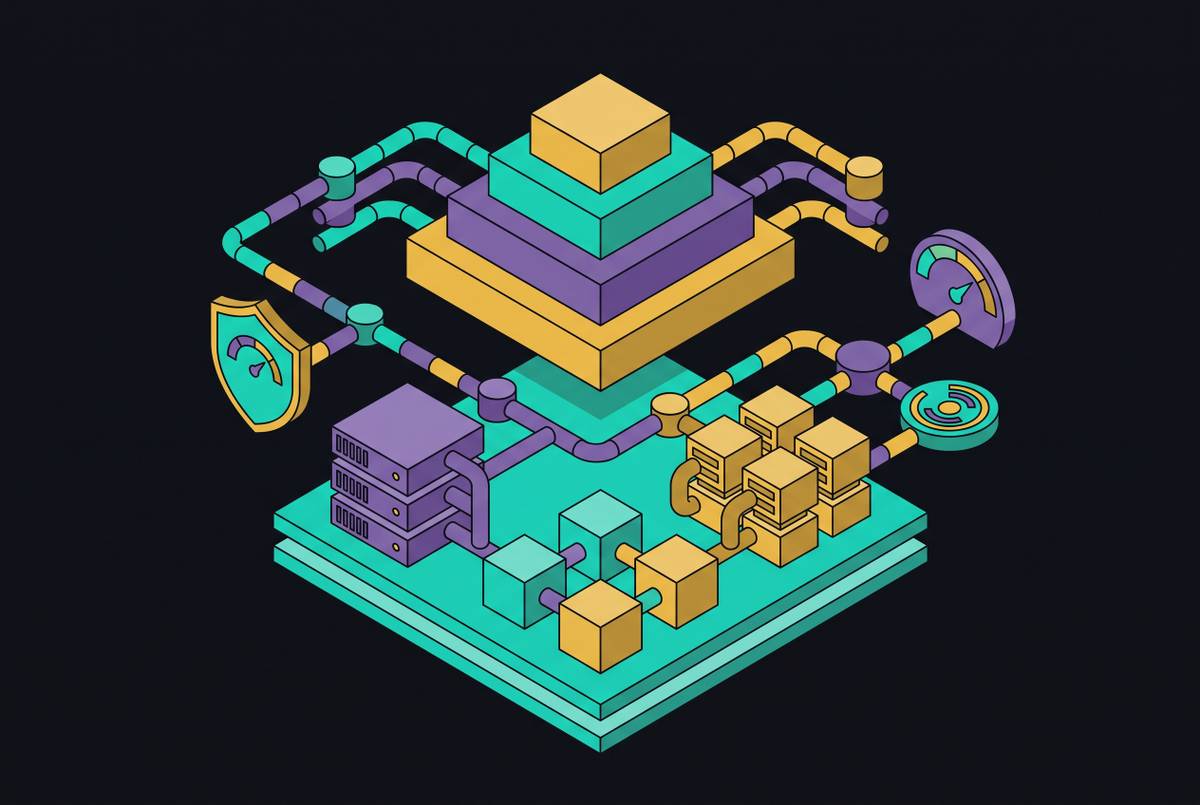
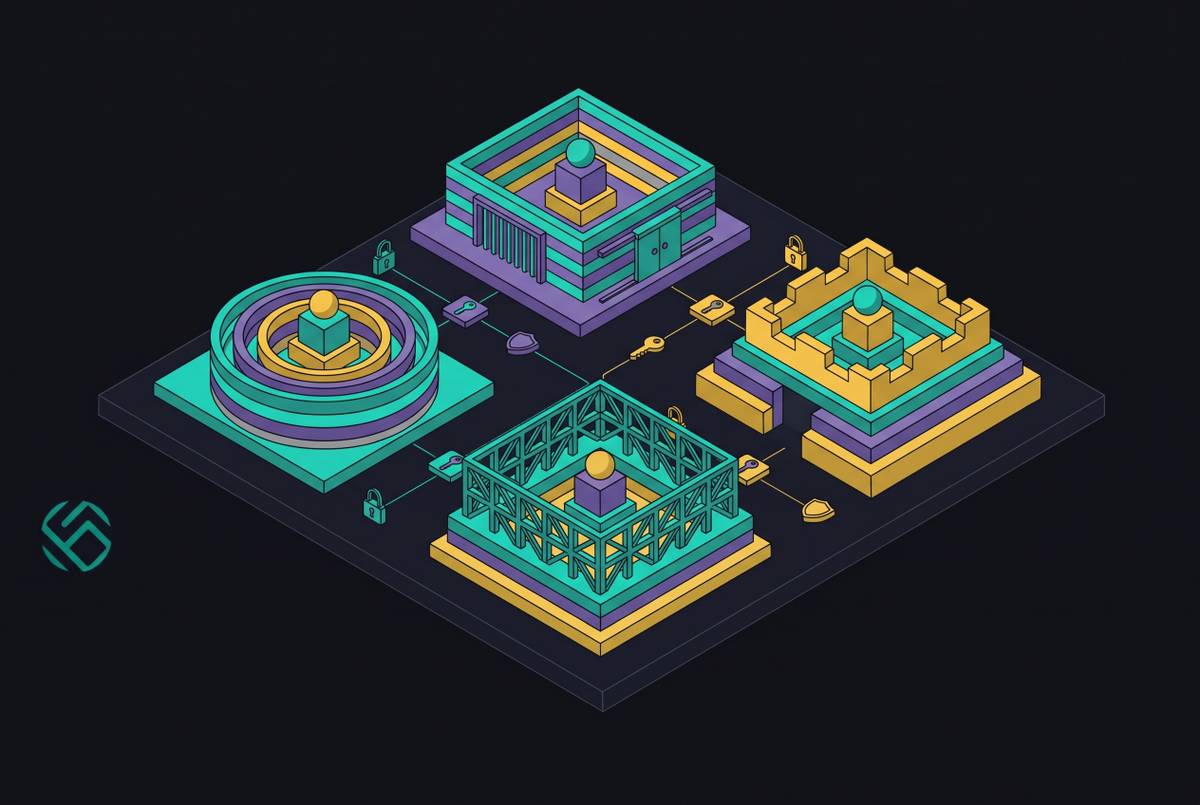
What the Engineering Stack Beneath an Enterprise AI Governance Layer Actually Comprises
Enterprise AI governance requires five interdependent engineering layers, not a single product.
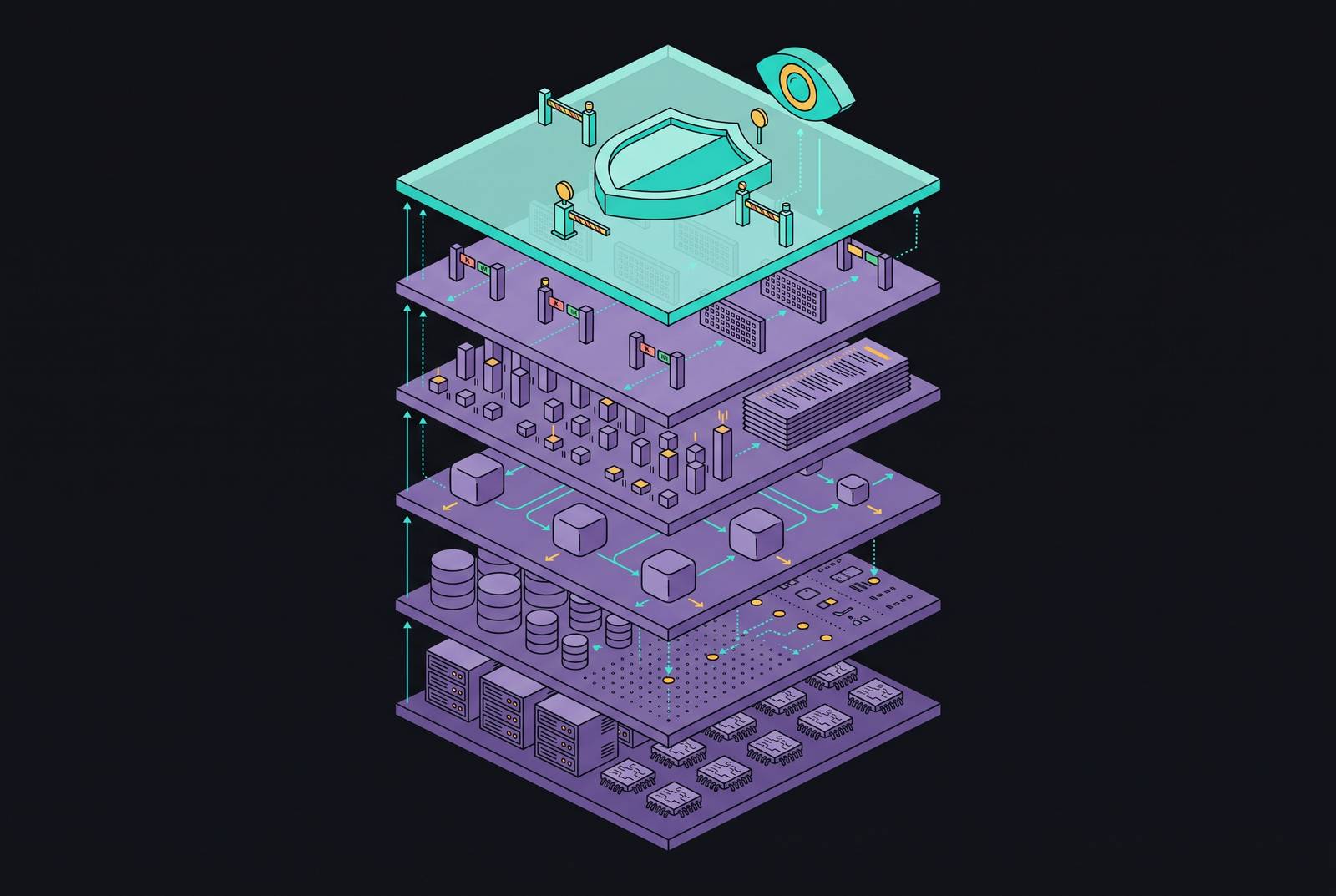
An enterprise AI control plane governs AI agents and MCP servers through a shared policy layer backed by inventory, agent identity, protocol-level enforcement, runtime threat detection, and observability. Central control works only when these engineering dependencies are resolved in order, so that each component has something definite to enforce and leaves evidence of what it did.
Why an AI governance layer cannot be a single product
Buying a gateway and calling it governance confuses an enforcement mechanism with the decisions it must enforce. A gateway can centralize traffic, but it cannot settle unresolved questions about acceptable actions, ownership, or access. Centralized ambiguity is still ambiguity, just with better plumbing. The category error is treating governance as a product boundary when it is a chain of dependencies. A platform may package several components, but packaging does not remove their prerequisites.
That distinction matters more now as production agents bring together models, data sources, and external tools, while shadow AI spreads inside approved browsers and SaaS platforms. Regulatory obligations are also arriving in stages. The EU AI Act sets Article 50 transparency obligations from August 2, 2026. The Digital Omnibus agreement of May 2026 deferred high-risk Annex III obligations to December 2, 2027 and Annex I obligations to August 2, 2028. Engineers must therefore resolve the dependencies required for a product's controls to work.
What the stack is governing: the shift from model calls to agentic tool use
The decisive change is from retrieving context to taking action. Agents call MCP servers, take actions through internal APIs and SaaS systems, and cause side effects before anyone reviews a final response. In the 2023 stack, governance could be approximated by reviewing answers, whereas the 2026 stack requires controls over inputs, tool access, agent identity, and real-time action logging. The response is no longer the whole event.
Multi-model routing widens that control boundary because enterprises route queries based on how complex a task is, what it costs, and which compliance requirements apply. RIVER's 2026 reference architecture describes the shift from single-model RAG to multi-model orchestration, with governance moving from review into embedded code. The control plane must span that heterogeneous model fleet. Rules attached to one endpoint cannot govern an entire workflow.
Agents also run continuously, spawn sub-agents, and operate across multiple activation surfaces without a single identity choke point. A bounded login session is a poor model for that activity. When an agent combines private data access, untrusted content, and external communication, an injected instruction can turn its operational authority into an exfiltration route. Sequencing is consequently a security concern as well as a way to organize compliance work.
Layer one: the policy engine that everything else executes against
The base layer expresses organizational intent as executable rules. Governance-as-code puts those rules into the infrastructure through a policy engine, automated compliance checks, and monitoring that runs all the time. Runtime systems query policy. OPA, Cedar, or a custom rules engine can fill that role, depending on the organization's existing control catalog.
The reference frameworks supply different inputs to that policy. NIST AI RMF organizes risk management around Govern, Map, Measure, and Manage without prescribing implementation. ISO/IEC 42001:2023 requires an auditable AI management system with documented controls. Neither specifies a request-level enforcement architecture. The EU AI Act adds binding obligations with extraterritorial reach, and Article 99 penalties reach 7% of global annual turnover for the most serious violations. Its staged dates distinguish transparency obligations from the deferred high-risk requirements, so those requirements cannot be treated as one undifferentiated rule set.
Classifying systems as minimal, limited, high, or unacceptable risk gives downstream components a basis for applying different restrictions and scrutiny. Otherwise, every system receives either excessive friction or inadequate oversight. The objection that policy-first engineering slows deployment overlooks what faster deployment would authorize. Without clear rules, infrastructure can speed up access without checking whether that access should be allowed.
Layer two: AI inventory and risk classification as the prerequisite for access control
Executable policy needs a known set of systems to govern. Before role-based access control can be meaningful, an organization must know what AI is running, who owns it, what data it touches, and its risk tier. An incomplete inventory creates an incomplete control boundary. Permissions applied only to known systems leave the rest outside the enforcement path, however carefully those permissions are configured.
A live inventory must answer operational questions about approval, permitted data, and the consequences of error. Discovery is the difficult part. A large majority of connections to generative AI tools use personal, non-corporate accounts, so that activity falls outside the systems that govern corporate accounts. Shadow AI inside approved browsers and SaaS platforms further complicates discovery because standard tools cannot see it.
Classification then determines how much control each inventoried system needs. A meeting summarizer and a credit-decision model may both appear in the inventory, but their consequences justify different approval and monitoring requirements. Data lineage belongs here as well. Tracing data from source through retrieval to generation establishes the foundation for later audit evidence. Without that groundwork, downstream logs can show what happened without showing which data shaped an output.
Layer three: identity-aware access control and why agent identity breaks legacy IAM
Knowing what runs makes it possible to decide who, or what, may act. Legacy IAM and single sign-on mostly checked identity at login time, on the assumption that people had limited aims, the number of identities was manageable, and sessions followed predictable patterns. Agents break each assumption. Their access must take into account what they intend to do and for how long as they keep running, chain tools, and create sub-agents. This requires agent identity infrastructure.
Credential sharing exposes the architectural mismatch most clearly. When an assistant uses a person's credentials, the audit trail records the actions it takes on its own as that person's actions. Authorization and attribution become different problems. Fine-grained permissions therefore need to reach individual tools and actions, connect to existing identity providers through SAML/OIDC, and use ephemeral credentials rotated automatically. Machine identities vastly outnumber human identities, making manual administration untenable.
Okta for AI Agents became generally available on April 30, 2026, with agent registration, assigned human ownership, and vaulted, automatically rotated credentials. Its Agent Gateway provides a virtual MCP server capability that aggregates and exposes tools from its MCP registry. Microsoft Agent 365 is another example of infrastructure built for agents, with a way to license Conditional Access for agents.
Okta is acquiring Permiso Security to add signals across more than 70 identity partners covering overprivileged access, anomalous agent behavior, and high blast-radius behavior. A valid credential is only the starting point. Governing an agent also requires distinguishing the authority it holds from the behavior it exhibits.
Layer four: the MCP gateway as the protocol-level enforcement point
The MCP gateway turns upstream decisions into restrictions at the moment an agent requests a tool. It is a protocol-level enforcement point. Policy now has somewhere concrete to bite. When agent-to-tool traffic passes through that point, a request proceeds only if its identity, role, and tool permissions satisfy the applicable conditions. Without this common path, equivalent production controls require custom authentication, identity, access, and audit engineering.
Deployment context distinguishes the available approaches better than a universal ranking. IBM ContextForge is an Apache-2.0-licensed, Kubernetes-native option for self-hosted deployments, with data-store-backed federation and caching across clusters. Its local mDNS discovery differs from configured cross-region federation. Amazon Bedrock AgentCore Gateway provides a managed AWS entry point for agentic traffic and converts APIs and services into MCP-compatible tools. These are different operating contexts for the enforcement role.
Cloudflare MCP Server Portals offers an edge-oriented aggregation approach, centralizing multiple MCP servers behind one HTTP endpoint and using Access policies to determine which servers each user sees. Okta's gateway places tool aggregation within its agent identity offering. The relevant distinction is where enforcement fits operationally. Central aggregation, managed deployment, and identity integration describe useful capabilities, but none substitutes for the policy and inventory decisions that give enforcement its meaning.
Layer five: runtime threat detection for prompt injection, PII, and secrets
Permission to call a tool does not make the content flowing through it safe. An authenticated, authorized agent can still follow instructions embedded in material it processes. Identity checks do not inspect those instructions. Runtime threat detection therefore governs content as a separate concern from the gateway's decision about whether a connection is allowed.
OWASP identifies prompt injection as the top threat for agentic AI. CVE-2025-53773 involved hidden instructions in source code comments, project files, GitHub issues, and other developer content that enabled remote code execution with GitHub Copilot, rated CVSS 7.8. EchoLeak demonstrated zero-click prompt injection in Microsoft 365 Copilot that could access and silently exfiltrate enterprise data without user interaction. The exposure extends beyond the foundation model itself. OWASP's v2.01 report places n8n, Claude Code, AutoGPT, Dify, and Roo-Code at the head of repository advisory counts as of mid-2026, concentrating the attack surface in orchestration frameworks and coding agents.
Detection must cover three distinct paths through a workflow. Input filtering looks for injection patterns and instructions that break policy before requests reach a model or tool, while output filtering checks for PII, secrets, and hallucinated credentials before responses reach callers. Inter-agent inspection checks the messages agents pass to one another as they exchange context and chain actions. Each path exposes a different control boundary. Sensitive data can leak through authorized processing even without an injection attack, so output filtering is needed in its own right.
This layer must also produce evidence of its effectiveness. The EU AI Act requires high-risk systems to show that they have undergone robustness testing against prompt injection, and the Annex III deadline has been pushed back to December 2, 2027. Operational protection alone cannot establish that testing occurred. Detection needs a record that the final layer can preserve and make usable.
Layer six: observability infrastructure that makes the stack auditable and improvable
Observability is essential and comes last in this anatomy because it proves the other layers worked. A policy decision, access denial, or threat block needs a usable record to serve as evidence in an audit. A dashboard is not enough on its own. The requirement is immutable, attributable logs covering every agent action, tool call, access decision, and content-policy enforcement for regulators, investigators, and internal compliance teams.
Those records must also make their coverage clear. Okta's gateway logs interactions between agents and resources routed through it, excluding internal calls within downstream services. That boundary limits what its records can establish. Data lineage adds another needed link, from an output to its source documents and retrieval path. Together, attribution and lineage turn an activity record into evidence about both the actor and the information involved.
Multi-model routing makes cost attribution part of governance. Tying the cost of each request to a team, project, and risk tier helps enforce budgets and spot anomalies that may point to unauthorized usage. Model behavior requires continuous scrutiny as well. Statistical monitoring against baselines can detect drift and bias between formal reviews, when deterioration might otherwise go unnoticed. Anomaly signals, usage patterns, and cost telemetry then feed back into the policy engine, giving the control plane a means to revise its rules as operation reveals new conditions.
Why the sequencing is the architecture
The stack's dependencies determine what each component can establish. Policy defines the permitted boundary, inventory identifies its subjects, and identity makes authority attributable before a gateway enforces it. Content inspection and observability provide distinct forms of protection: content inspection deals with risks beyond the scope of permission, while observability records what happened. A later component cannot retroactively supply a missing prerequisite.
That is why apparent completeness can be misleading. A system may have every named category of tool yet still lack a coherent path from organizational intent to an attributable action. Integration is more than connecting product interfaces. Governance-as-code exists when decisions propagate through the stack without manual enforcement at each step, and evidence returns through the same architecture to improve those decisions.
The practical implication for platform and security teams is to assess missing dependencies before adding components. Rapid deployment can proceed without building all six layers at once. It requires preserving their order. A partial stack built on sound prerequisites is more defensible than a complete-looking stack whose controls have nothing reliable to enforce.