Evaluating AI Control Plane Vendors on Agent Orchestration and MCP Server Policy Enforcement
A framework for evaluating whether AI control platforms actually govern agents or just observe them.
An enterprise AI control plane is a shared policy layer for governing AI agents and their access to MCP servers across an organization. Evaluating vendors requires six tests, covering access control, identity, audit, real-time threat controls, observability, and deployment. The platform must enforce policy before tools run across the enterprise’s actual agent estate, as well as record what happened.
Why enterprises buying AI control plane tools are flying blind today
Enterprise agents rarely all run in one place. Microsoft Copilot agents, Salesforce Agentforce, ServiceNow autonomous workflows, custom open-source agents, and vendor-embedded AI features can coexist, including features nobody formally registered. Each gives software another way to act on the organization’s behalf. Yet deployments are advancing faster than a common framework for evaluating their governance.
Vendors describe very different capabilities as “governing AI agents.” One may control access to servers, another to individual tools, while a third records activity without intervening. Identity integration and delegation-chain logging differ just as much, and marketing rarely spells out where those controls stop. Buyers therefore lack a standard rubric for comparing what these platforms actually govern.
What the MCP protocol does and does not govern by design
Anthropic introduced MCP in November 2024 to standardize how agents connect to tools. MCP defines a JSON-RPC 2.0 contract in which an agent sends tools/list to discover available tools and tools/call to invoke one. The exchange stays consistent whether the backend is GitHub, Salesforce, Postgres, or an internal API. That consistency solves a connection problem while leaving governance to be addressed separately.
The distinction begins with identity and permission. The first specification, dated 2024-11-05, had no authorization mechanism. Subsequent revisions added OAuth 2.1 support, but authentication remained optional, and the protocol did not enforce per-operation permission scoping. It does not establish an enterprise’s rules for who may invoke each tool, which parameters they may supply, or how much usage they may consume.
Those decisions still need an enforcement point. In a direct agent-to-server model, authentication and authorization logic must be implemented at individual tools, creating inconsistent controls that are difficult to audit at scale. Without filtering, an agent connected to a server can discover tools outside its remit, such as database administration endpoints exposed to a support agent. Standardizing the handshake does not decide who belongs in the room.
The threat surface that opens when agents operate without a governed layer
CVE-2025-49596, rated CVSS 9.4, involved an unauthenticated MCP Inspector proxy. Because there was no authentication between the client and proxy, a visit to a malicious website could trigger arbitrary remote code execution through CSRF. The wider agent ecosystem supplies two further examples. CVE-2025-32711, “EchoLeak,” rated CVSS 9.3, used a hidden prompt in a crafted email for zero-click exfiltration from Microsoft 365 Copilot. CVE-2025-53773, rated CVSS 7.8, involved arbitrary code execution through hidden prompt injection in GitHub Copilot affecting Visual Studio, with entry points including source files, GitHub issues, and web pages.
These are distinct failures across MCP and the wider agent ecosystem. Together, though, they show why controls on agent connections need both access controls and defenses against instructions hidden in untrusted content. CSA’s research note on indirect prompt injection in the wild describes adversaries seeding the open web with hidden instructions aimed at browsing agents, coding assistants, and enterprise copilots.
MCP-specific attack patterns include tool poisoning, privilege escalation through excessive access, and shadow server connections that bypass governance. Tool poisoning changes a tool’s description to induce misuse, attacking the information an agent relies on when choosing an action. Excessive permissions then broaden what that action can reach. Shadow connections evade the governed layer altogether, so a gateway cannot be treated as proof that every agent connection is controlled.
What an AI control plane vendor must actually do to govern agents and MCP servers
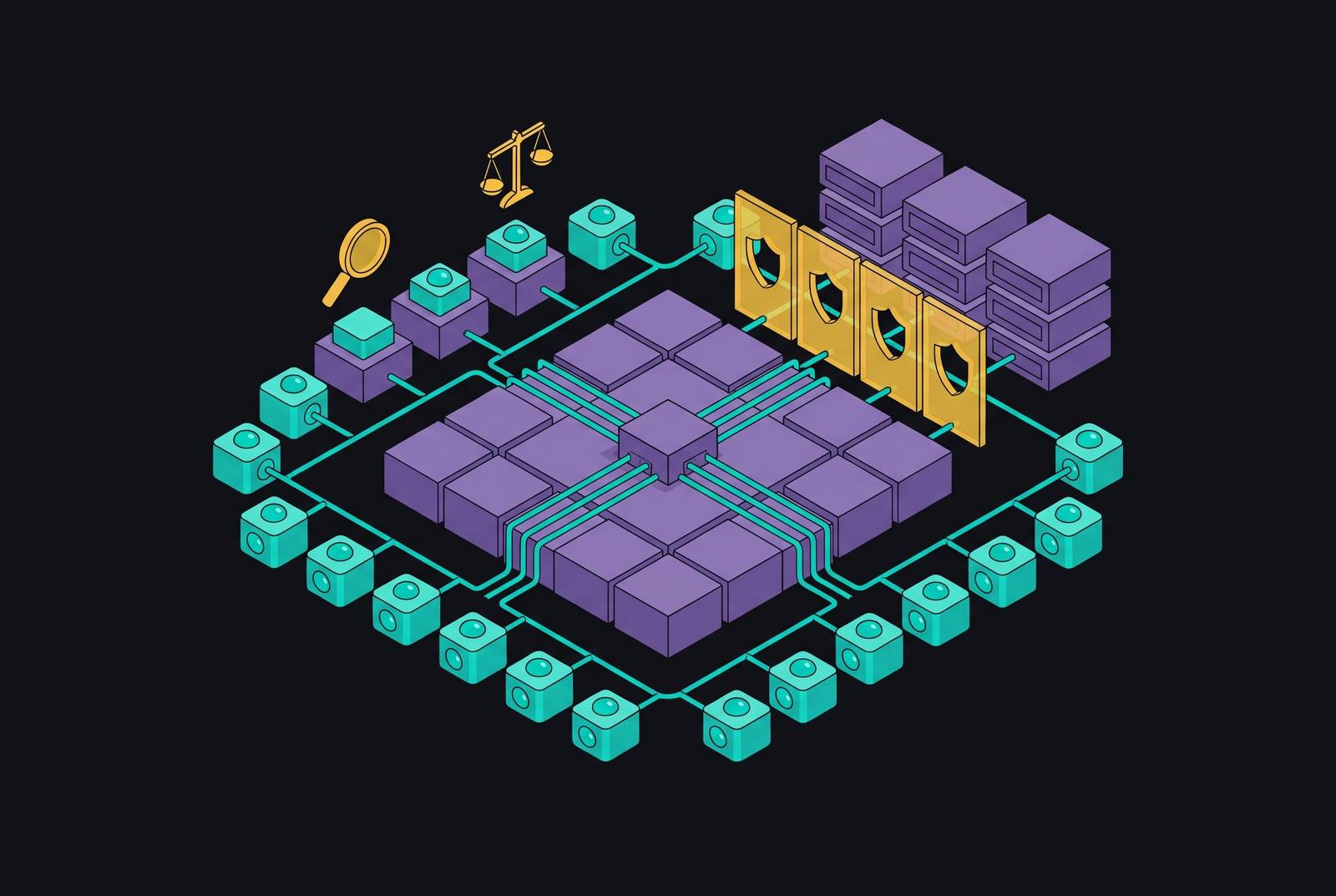
An enforcement layer sits between MCP clients and servers. It intercepts requests, applies policy, and routes permitted calls upstream, replacing a mesh of direct connections with a managed hub-and-spoke architecture. That position is the essential architectural requirement. A platform outside the execution path may observe activity without being able to stop it.
At that boundary, the platform must validate identity and enforce access to individual tools. Filtered discovery should return only authorized tools, while invocation controls must prevent unauthorized calls from reaching the backend. Credential isolation manages secrets by reference so they stay out of agents, users’ hands, and configuration files. Unified audit records must attribute calls to both the executing agent and the user on whose behalf it acts.
The same boundary supports real-time controls, including PII masking, rate limiting, prompt injection detection, and cost limits. These belong before execution. Architecturally, the data plane handles live traffic, authentication, routing, rate limiting, and observability, while the control plane manages configuration and policy. Keeping those roles distinct also helps buyers assess latency, with in-process data-plane architectures typically offering the lowest latency.
The MCP 2026 roadmap names audit trails, enterprise-managed authentication, and gateway and proxy patterns as priorities for enterprise use, with most expected to come as extensions that leave the core specification unchanged. That direction does not remove the buyer’s present enforcement requirement. Vendors that only monitor after execution do not meet it.
The evaluation criteria framework: six dimensions that separate genuine governance from theater
Does access control cover each tool and its parameters? Server-level permission is a starting point for a CRM server exposing both read-only lookup and customer-record updates, which require separate permissions. Tool-level RBAC must restrict discovery and invocation, while parameter-level controls can lock inputs or constrain values by identity. Both paths need testing. “Can you demonstrate a policy that allows Agent A to invoke get_customer but not update_customer on the same MCP server, enforced before the call reaches the backend?” A hidden tool that remains callable is not protected, and a blocked tool still exposed in discovery leaves discovery filtering incomplete.
Does identity integration use the enterprise’s authoritative identity provider? Permissions are only as reliable as their identity binding, so a separate vendor user store creates another system to administer and audit. Integration should connect with Okta, Microsoft Entra ID, or a SAML/OIDC-compliant provider, with support for OAuth 2.1 and OpenID Connect where agent authentication requires them. Delegation is the harder test. The initiating user must remain attributable when an agent invokes a tool that spawns a sub-agent. Buyers should ask whether deprovisioning a user in Okta at 2 p.m. removes agent access immediately, at the next token refresh, or only after manual revocation in the platform.
Can the audit trail establish who acted, through which agent and tool, and on what data? A record that an agent called a tool at a particular time does not establish whether the response contained PII. Full-chain logs need both invocation and data-level detail, with an accountable owner, role, or workflow for autonomous actions that no human directly initiated. The records must be tamper-evident and exportable to existing SIEM infrastructure. A private dashboard is not an audit strategy. Buyers should ask to see a multi-step workflow traced from the initiating user through the agent to each tool invocation and the data accessed.
Do threat controls intervene before execution at the gateway boundary? PII blocking, secret detection, and prompt injection defenses need a demonstrated halt path before the tool runs. Tool poisoning also requires analysis of descriptions and schemas before they reach agents. The platform must cover more than registered connections, and shadow MCP discovery tests whether it can find traffic outside the route it governs. Detection and prevention are different capabilities. Buyers should ask whether a suspected prompt injection causes a halt, an alert, or only a log entry, then request a demonstration of the halt path.
Does observability span the workflow and its cost? A useful trace links the incoming prompt, LLM decision, tool call, and API response so teams can follow them without piecing together separate logs by hand. Cost controls must also constrain usage, because MCP itself does not enforce spending limits on repeated tool calls, LLM calls, or paid API operations. Attribution makes those controls useful. Prometheus-compatible metrics should show the tool, the agent that called it, the model, and the error state so the operational systems already in place can use them. Buyers should ask for per-tool cost attribution by agent and team over a specified time window, exported into their existing observability stack.
Can the platform operate where the agents actually run? SaaS alone cannot satisfy every regulated, air-gapped, or data-residency-constrained environment, making on-premises and VPC-isolated options substantive requirements. The work needed for deployment also affects coverage when agents go live before the infrastructure that governs them. Integration must work at both ends, with the identity systems already in place upstream and the observability and SIEM tools downstream. Replacing the security stack is a different project. Buyers should ask for the fastest path from evaluation to governed production in their current cloud environment, including the operational work that path requires.
How the leading vendor approaches map onto these criteria
Vendor approaches cluster into three broad postures. Hyperscaler-native platforms work closely with the tools in their own ecosystems, security-first platforms focus on threat controls and compliance, and purpose-built MCP gateways focus on enforcing rules at the protocol level. A platform’s category does not establish whether its controls cover third-party agents or preserve identity through a delegated workflow.
Microsoft combines Azure API Management for MCP, an open-source gateway for Azure Kubernetes Service, and Entra ID. That helps identity integration work well within the Microsoft stack, while environments outside it are harder to configure. Amazon Bedrock AgentCore Gateway evaluates tool requests against Cedar-based authorization rules before they reach their destination, including conditions based on tool inputs. IBM watsonx Orchestrate launched its Agentic Control Plane in June 2026 with a centralized enterprise-agent management posture spanning agents built elsewhere. For this group, cross-framework governance deserves particular scrutiny because native integration is not proof of equivalent coverage at the edges.
ServiceNow AI Control Tower takes a governance-first approach anchored in enterprise workflow reliability. Its May 2026 expansion added integrations to discover AI across AWS, Google Cloud, Azure, SAP, Oracle, and Workday. Discovery broadens the inventory that governance can address. It does not, by itself, establish tool-level authorization or full-chain audit depth, so those capabilities remain separate evaluation questions for security-first platforms.
Bifrost targets regulated deployments with air-gapped, VPC-isolated, and on-premises options, using virtual keys with hierarchical budgets and per-key MCP tool allow-lists. Cloudflare MCP Server Portals, part of Cloudflare One, provides governed server access and identity propagation through Cloudflare Access. Cloudflare Gateway uses its DLP engine to discover unauthorized remote MCP server usage. That discovery capability is distinct from Cloudflare AI Gateway, which addresses LLM traffic.
Protocol breadth offers another basis for comparison. The agentgateway open-source project handles MCP, agent-to-agent, LLM inference, HTTP, and gRPC traffic through one data plane. Solo.io donated it to the Linux Foundation in August 2025, and it joined the Agentic AI Foundation in June 2026. MCPX by Lunar.dev provides tool-level RBAC, immutable audit trails across the User → Agent → MCP → Tool chain, credential isolation, and AI gateway integration for end-to-end visibility.
Running a proof of concept that actually tests governance, not just connectivity
A successful tool response demonstrates connectivity. To test enforcement instead, security, platform engineering, and compliance teams should agree on how to score the six dimensions before the proof of concept begins. Each team will expose different gaps. Setting the rubric first also keeps a polished demonstration from becoming the standard by which teams judge the platform.
The over-privileged agent test should assign read-only access, attempt a write, and inspect both the boundary denial and the user-attributed audit record. The identity revocation test should deprovision a user in the connected IdP and measure how long an active agent session retains tool access. Timing is the result that counts here. The prompt injection test should introduce a known payload and distinguish interception before execution from an alert afterward.
The shadow discovery test should connect an unregistered MCP server to the network and establish whether the platform surfaces it. The audit reconstruction test should run a multi-step workflow and require a single log query to recover the user, agent, and every tool call without manual stitching. Neither test is satisfied by a reassuring dashboard. As the category evolves, the rubric will need revisiting, but identity, access, audit, threat controls, observability, and deployment will remain the foundational requirements regardless of how the protocol changes.