Replacing Per-Agent Safety Guardrails With Workforce-Wide Policy Enforcement at the Control Plane
Centralized policy enforcement stops threats that per-agent guardrails cannot see.
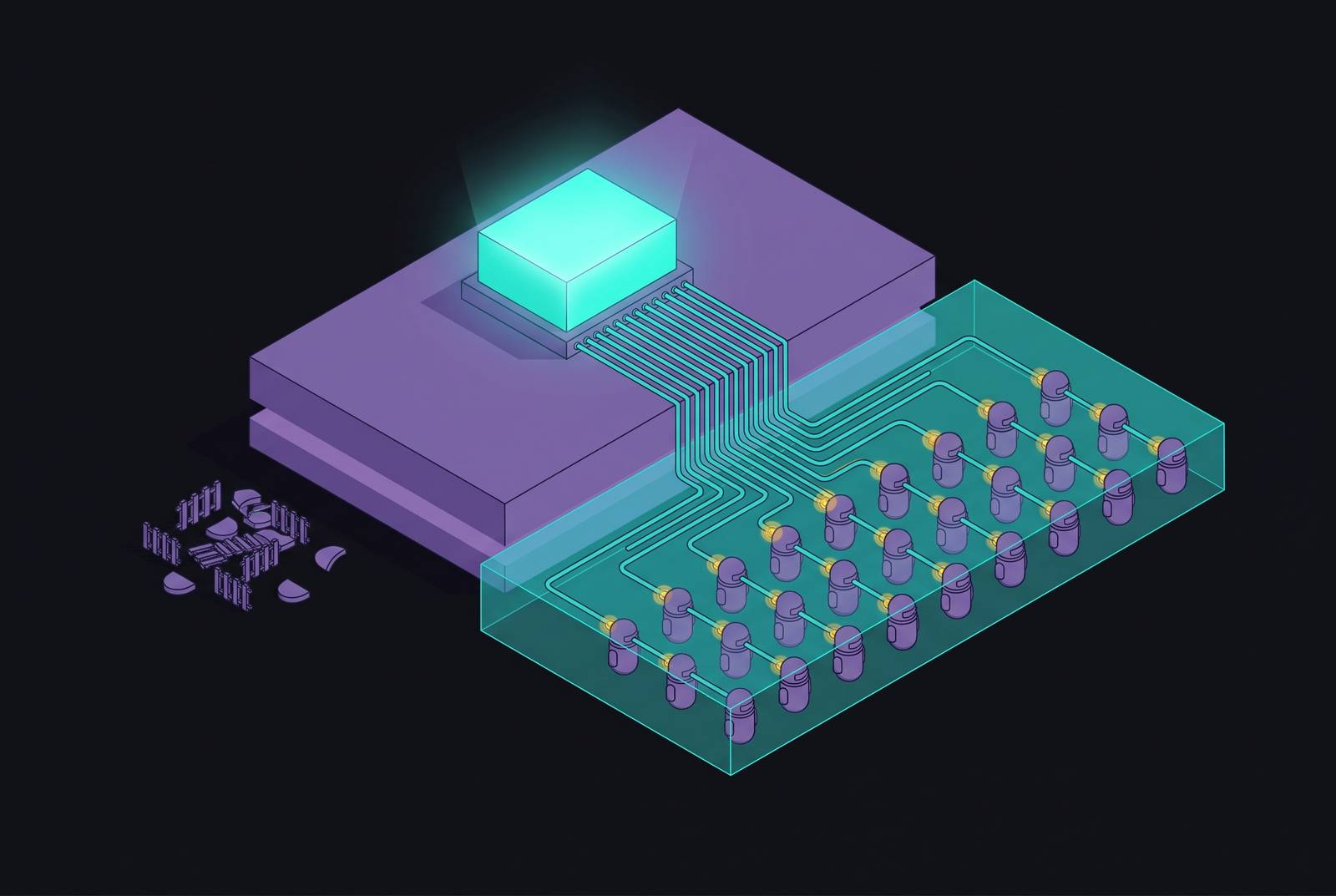
An enterprise AI control plane governs AI agents and MCP servers through a shared policy layer, with enforcement in the path of each prompt, response, and tool call. It replaces duplicated, agent-local governance with identity-bound rules applied before actions execute. Workforce-wide deployment needs this separation because an individual agent’s guardrails cannot govern the relationships, permissions, and tool chains that extend beyond it.
Why governing AI agent by agent doesn't hold up at workforce scale
An agent built for one use case can become another team’s shortcut, inheriting permissions that nobody reviewed for its new purpose. Its local guardrails may still work just as they were designed to. The failure is outside their field of view. Acceptable-use policies can describe what the second team should do, but they cannot intervene when the agent acts under authority intended for the first.
BCG’s 2026 EACP guide identifies the organizational version of this problem. When each platform manages governance independently, enterprises duplicate work, increase cyber risk, and lose a central view of which agents exist, who owns them, and what they can access. Shadow AI widens that gap. Guardrails inside sanctioned agents provide no protection for unsanctioned ones, regardless of how carefully the approved systems were built.
Kubernetes separates cluster management from workload execution, while an AI control plane separates governance from inference. One layer decides what may happen. Another executes the work. That split lets governance reach across the systems that agents act through, a change to the architecture that more policy documents cannot make.
How the fragmented-guardrail model produces blind spots that compound over time
Fragmentation begins with work that looks responsible in isolation. Each platform team builds its own patterns for security, compliance, and governance, which take more time to build and more work to run. As teams adapt their controls to different products and deadlines, duplicated effort becomes inconsistent protection across copilots, assistants, and API services.
Those differences are harder to spot without a central inventory. BCG names “no central inventory” as a failure mode of platform-level management, leaving organizations without a single view of ownership, access, or whether agents remain active. The missing inventory also obscures identity gaps. Agents and MCP servers can gain access through separate onboarding processes that differ in their permissions or monitoring, so gaps in protection are harder to find and fix.
An attacker who finds an effective prompt injection against one service can probe variations across the portfolio without cross-agent detection. Each service sees only its own encounter. A policy-only program may ban the tool misuse or data leakage that follows, but it cannot stop an action as it runs. As deployment expands, the organization acquires more local defenses without acquiring a shared threat signal.
What is an enterprise AI control plane, and where does it sit?
The AI control plane is the governance layer above individual platforms, with enforcement in the execution path. It determines what models and agents may do, with which data, and under whose authority. Forrester announced its evaluation of the agent control plane market in December 2025, defining infrastructure that “inventories, governs, orchestrates, and assures heterogeneous AI agents across vendors and domains.”
Six functions define this architecture, namely inventory, identity, policy, approvals, evidence, and cost. Inventory covers agents, models, tools, and MCP servers, while identity binds requests to the person whose authority an agent uses. Policy evaluates actions before execution, and approvals pause high-risk steps for human review. Evidence records decisions in a verifiable form, while cost controls attribute spending and check budgets before it occurs.
The data plane still runs models, processes requests, and executes tool calls. Enforcement must happen there, at the moment of the call, using the shared policy established by the control plane. Separation lets governance evolve independently from inference, while cached rules can support execution during a brief control-plane outage. It also isolates policy configuration, the agent registry, and audit systems from inference endpoints.
Why MCP servers and agentic tool chains demand governance at the federation layer, not inside each server
MCP governance becomes difficult when a session combines components that were approved separately, or were never approved at all. A user can chain servers, models, and tools across local servers, public registries, OAuth grants, and downstream data sources. Approval does not compose into safety by itself.
For that reason, governance belongs at the federation layer that mediates access across those components. An MCP gateway connects servers once and governs who can access them, so each agent does not need its own configuration. Authentication at this layer handles OAuth 2.0, API key rotation, and per-user credentials while keeping secrets out of the agents. Fine-grained access control then determines which tools are available to particular virtual keys, teams, or users.
This changes the question an enterprise must answer. Product approval asks whether a tool is permitted in general, whereas runtime authorization asks whether this consumer may use this tool in this context. Both inventory and enforcement must span the chain. Otherwise, a collection of approved components can still create a workflow whose combined authority nobody has governed.
Why agent identity is the enforcement primitive the control plane depends on
A shared policy layer needs a reliable subject for every decision. Human login systems largely established who was accessing an application, but agents also require controls over intent and the duration of access. They do not behave like bounded login sessions. Agents keep running, spawn, and chain tools across multiple activation surfaces, with no single identity-provider choke point that they all pass through.
The February 2026 CSA and Strata Identity survey found that only a minority of security leaders had high confidence in their infrastructure’s ability to handle agent identities. A large majority doubted they could pass an audit focused on agent behavior or access controls. Traditional role-based access control alone is too coarse for these decisions. Relationship-based or attribute-based permissions can distinguish an agent allowed to summarize project documents from one allowed to export their contents to external APIs.
Microsoft Entra Agent ID and Okta for AI Agents show how the field is moving toward agent identities under governance and short-lived tokens in place of static API keys. Their surrounding protocol designs are not identical. Entra references A2A, while Okta’s XAA uses MCP for cross-app access. Together with Auth0’s Auth for GenAI, these architectures converge on OAuth 2.0 tokens and emerging agent protocols, but no single protocol mapping has been standardized across all three.
How centralized policy enforcement stops the threat patterns that per-agent guardrails miss
Google and Forcepoint X-Labs documented adversaries planting hidden instructions on the open web in late April 2026, targeting browsing agents, coding assistants, and enterprise copilots. The threat had reached live sites, but the findings require precision. Activity remained low in sophistication, and neither analysis documented confirmed successful hijacks. Operational experimentation is not the same as demonstrated compromise at scale.
Other findings show what successful exploitation can expose. The EchoLeak vulnerability in Microsoft 365 Copilot showed how a zero-click prompt-injection path could access data silently. Johns Hopkins University researchers showed how they could hijack production agents from three major technology companies that were integrated with GitHub Actions to steal API keys and credentials. These cases show the limits of relying on protections inside individual products, while leaving unproven whether any shared layer catches every attack.
A control plane changes where protection is applied. Runtime policies govern access to enterprise systems, MCP servers, and tools, blocking non-compliant actions before execution rather than relying on every builder to follow instructions. Real-time inspection checks prompts and responses for PII, injected instructions, and exposed secrets. Its architectural advantage is consistent coverage across the estate. Inspection happens once at the shared layer.
How observability across the full AI estate changes what security and finance teams can actually do
Security teams cannot investigate authority they cannot reconstruct. BCG describes agents quietly accessing systems they were never intended to reach and sensitive data moving to external models without safeguards. Platform-level monitoring cannot provide a complete account across those boundaries. A shared evidence record connects a decision to the user, the authority behind the agent, and any approval required for the step.
A third party can examine what happened and who authorized it, instead of asking separate teams to assemble incompatible accounts after an incident. The same estate-wide view exposes access drift. Without it, an agent can reach more and more systems while its activity on each platform still looks ordinary.
Finance faces a related problem when spending has no clear owner. A control plane attributes costs to teams, agents, and workloads, and checks budgets before spending occurs. That makes cost control an execution-time decision. BCG identifies rising cost and lack of reuse as failures of platform-level management, so the shared view also helps teams see duplicated build effort and overhead. These records and controls are most useful when they arrive with deployment.
How governance built into the deployment path removes the speed-versus-safety tradeoff
Centralized governance can slow deployment when it means documentation hurdles, architecture review boards, and manual signoffs. BCG identifies that response as a risk when governance lacks golden paths. When the process is that complex, teams have a reason to work around it. Compliance requires a separate construction project before useful work can begin.
A golden path makes the governed system the starting point. It is a production-ready asset with identity, registration, monitoring, and policy enforcement already wired in, leaving developers to customize business logic. BCG describes a common intake form triggering an automated pipeline that provisions a repository with an agent or MCP template and working infrastructure. Setup that previously took weeks takes a day.
This model separates decisions about high-risk actions from repeatedly assembling the same baseline controls for every deployment. ServiceNow expanded AI Control Tower at Knowledge 2026 in May to govern agent identities, permissions, and connected assets. Google likewise framed governance, identity, and security as core infrastructure for the agentic enterprise at Cloud Next 2026.
What a workforce-wide enforcement architecture looks like in practice
The practical shift begins with a shared inline gateway or proxy between applications or agents and the models and tools they reach. Egress controls make that gateway the only route, providing the strongest enforcement guarantee for this pattern. Placement alone is not enough. If agents can take an ungoverned route, the central policy layer remains optional precisely where it needs to be authoritative.
Authorization then binds each request to the human authority behind it. SAML/OIDC integration with existing identity providers such as Okta and Microsoft Entra ID makes that link, and short-lived tokens take the place of static API keys. Runtime inspection operates on the same governed path. PII detection, prompt-injection defense, and secrets scanning therefore have uniform coverage.
Golden-path provisioning completes the deployment model by registering new agents and MCP servers automatically and wiring in identity and monitoring from the beginning. Routine setup no longer needs a separate manual security review, but high-risk actions can still pause for approval. The decisive test is straightforward for buyers. Can the architecture apply identity-bound policy before an action executes, across agents and MCP servers, without leaving an alternate route outside enforcement? A central dashboard cannot substitute for control over the call itself.