FastMCP Python Framework for Enterprise MCP Server Development
The framework that strips away MCP protocol complexity so developers write ordinary Python.
FastMCP is the standard framework for building MCP servers in Python, created by Jeremiah Lowin and maintained by Prefect. An MCP gateway is a centralized control layer that manages how AI agents access MCP servers, tools, and external systems, and FastMCP is the tool most of those servers were built with. FastMCP's reach into that ecosystem is not a Python-only story. FastMCP 1.0 was folded into the official MCP Python SDK in 2024. The framework did not just wrap the protocol; it shaped how the protocol's own reference implementation looks and behaves.
That history produces a naming collision that trips up a fair number of tutorials. The official mcp SDK shipped its own class called FastMCP until SDK 2.0 arrived on July 28, 2026 and renamed it MCPServer. Getting this straight before writing a line of code saves the debugging session where a tutorial's imports simply do not exist in the package just installed.
What FastMCP gives a developer out of the box
FastMCP's job is to strip out the protocol plumbing that makes raw MCP development slow, so you can write ordinary Python and let the framework handle the rest. The canonical example is small on purpose:
from fastmcp import FastMCP

mcp = FastMCP("Demo")

@mcp.tool
def add(a: int, b: int) -> int:

return a + b

if __name__ == "__main__":
mcp.run()
The @mcp.tool decorator on that typed function generates a JSON Schema, validates inputs through Pydantic, and surfaces the docstring as documentation the model can read, with no manual schema definition anywhere in sight. The same decorator pattern extends to @mcp.resource for read-only data sources and @mcp.prompt for reusable prompt templates, which together cover all three primitives the MCP protocol defines.
Transport is handled with the same hands-off approach. FastMCP supports stdio for local subprocess servers, Server-Sent Events for legacy remote connections, and Streamable HTTP for production deployments, negotiating which one to use automatically. The July 28, 2026 spec revision changed Streamable HTTP substantially, removing protocol-level sessions, the GET stream, and SSE resumability, and FastMCP's negotiation layer is what keeps that change from becoming every developer's problem to solve individually.
On authentication, FastMCP goes well beyond what the raw SDK ships: token verifiers, an OAuth proxy for GitHub, Google, and Azure, remote OAuth, and a full OAuth server, where the SDK's own authorization documentation leaves token verification to the implementer and includes no provider integrations. That OAuth proxy has not been static. It has gone through security patches, token architecture revisions, and new provider restrictions across releases, which matters for anyone pinning a version and assuming the auth layer is a finished product.
FastMCP also generates tools directly from an OpenAPI spec, a capability the official SDK lacks, so if a team already has REST APIs, it can expose them to agents without hand-writing a tool for every endpoint. For testing, it ships an in-memory Client for unit tests and works with the MCP Inspector for interactive protocol debugging. Servers can be composed and mounted together, building a modular tool catalog.
FastMCP 4.0 went GA on August 31, 2026, and the architecture underneath changed even though the decorator syntax did not: the decorator API carried over from 3.x unchanged, so most FastMCP 3 applications upgrade with no code changes.
Why the MCP protocol itself is governance-neutral by design
FastMCP makes it close to trivial to expose any Python function to any AI agent that can speak MCP. The protocol places no native constraints on who is allowed to call what, which puts governance entirely in the implementer's hands, on a per-server basis, every time.
MCP has no built-in concept of role-based access control. An MCP server can be built with enterprise-grade access controls, audit logs, and compliance checks, or with none of them, and the protocol will carry traffic for either one without complaint. This is not a flaw so much as a design choice: MCP solves the problem of letting a model talk to a tool, and leaves the problem of deciding which models should talk to which tools to whoever stands up the server.
That neutrality becomes a real liability at the scale enterprises operate at, because MCP servers routinely aggregate credentials for multiple internal systems behind one interface. The convenience of a single endpoint that can touch a CRM, a ticketing system, and a database is also the risk: a compromised server becomes a single point of failure across every system it touches. OWASP's MCP Top 10 project has formalized the threat categories security teams now test against, including tool poisoning (with sub-techniques like schema poisoning and tool shadowing), command injection through unsanitized agent input, intent flow subversion, shadow MCP servers deployed outside formal governance, and context over-sharing across shared agent sessions. Research into the protocol's first year found more than ten critical CVEs, and a significant share of MCP servers were vulnerable to command injection. None of that is specific to FastMCP. It is a protocol-level exposure that every FastMCP deployment inherits the moment it ships.
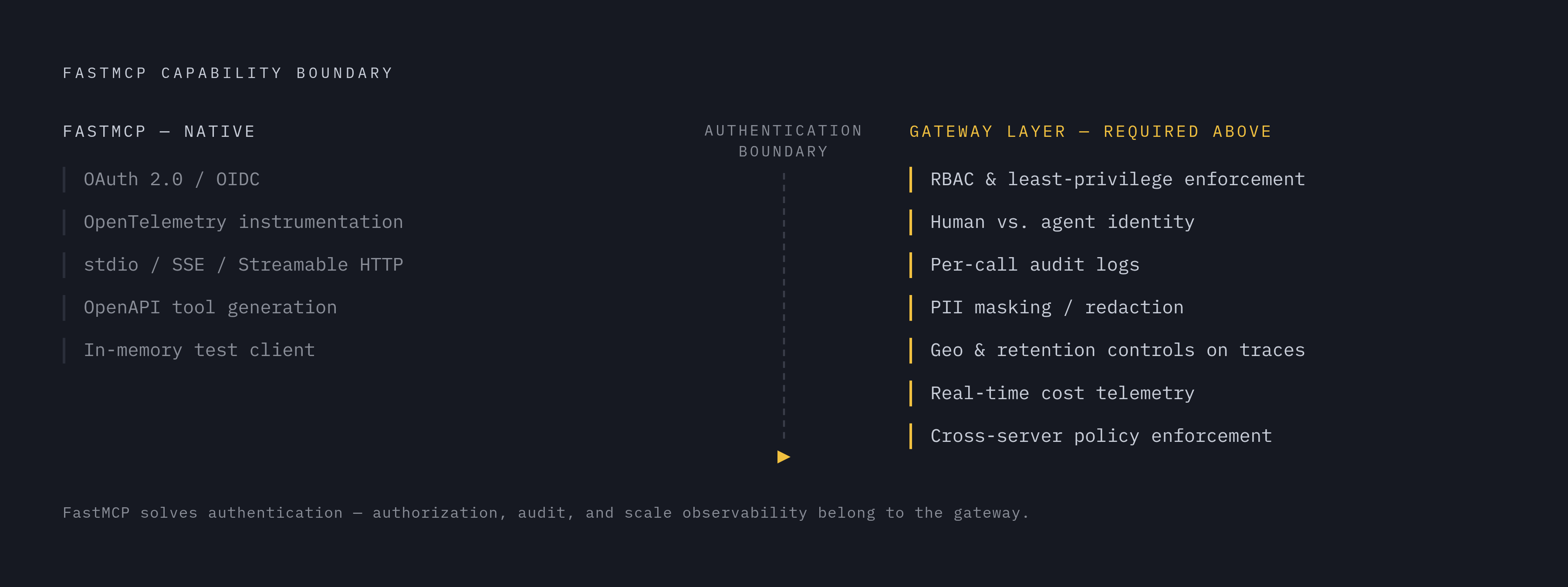
The obvious objection is that FastMCP has built-in auth, so isn't this already handled? Built-in OAuth answers the question of who can connect, not what they can do once connected, and it comes with no audit log, no PII detection, and no cost telemetry. Authentication and authorization are different problems, and FastMCP solves the first one well.
The identity and access control problems FastMCP's auth layer does not resolve
Enterprise AI deployments need a model of identity and access control that FastMCP's OAuth support was not built to provide, because human identity and agent identity are not the same problem wearing different clothes. You have to treat human users and AI agents as distinct identity classes, so robot users stay restricted to shared-mode servers and are blocked from personal credentials. FastMCP's auth layer has no native concept of that distinction.
Audit logging runs into the same wall. A usable audit log has to record who made each tool call and be filterable by human versus robot identity, and without MCP-specific logging of that kind, downstream API logs can make it impossible to tell agent activity from human activity after the fact. FastMCP provides the first of those six, and only partially.
FastMCP does support standard OAuth 2.0 flows, OIDC, and custom token validation through its middleware system, and for enterprises running Keycloak, Okta, or Azure AD, the OAuth proxy pattern handles the compatibility layer. Enterprises deploying MCP servers across multiple teams need governance infrastructure layered above the framework to enforce those controls at scale. Speakeasy provides that governed distribution layer, tying MCP servers to centralized identity policies through existing providers like Okta or Entra ID and logging every tool call in a way that maps to an organization's compliance posture.
MCP Enterprise-Managed Authorization, promoted to stable status in June 2026, adds a centralized way for organizations to control access to MCP servers through their identity provider, replacing per-server consent prompts with a zero-touch flow. EMA decides whether a user can connect and at what scope, and it stops there. It does not inspect MCP traffic after the token is issued. Okta is the first identity provider named in the EMA launch, with its Cross App Access approach as the initial supported path, so if you run Entra ID or another provider, you still need separate integration work to get the same coverage.
Observability and cost control gaps in a FastMCP-only deployment
An observability layer sitting above FastMCP catches cost overruns and compliance violations in real time; without it, enterprises find out from an invoice or an audit after the damage is done. Agents are expensive in a way single LLM calls are not, because they loop and call tools repeatedly in the course of finishing one task. A poorly designed agent can burn through a large number of tokens, and without per-run cost telemetry, the first sign of trouble appears on the bill.
The compliance side of the gap is less visible day to day but carries more consequence. Masking and redacting that material requires the same discipline applied to the agent itself, not an afterthought bolted onto logging.
The industry is converging on OpenTelemetry as the observability standard, and two histogram metrics have become effectively mandatory for any production deployment: gen_ai.client.operation.duration for latency and gen_ai.client.token.usage for consumption broken down by input and output tokens. Without those two signals, cost and speed are not things an organization can reason about, only things it can guess at. FastMCP added OpenTelemetry instrumentation natively in version 3.0, released February 18, 2026, so the signals exist at the framework level. Collecting, storing, and acting on them across an enterprise still requires infrastructure FastMCP does not provide on its own. Storing agent traces generated in regulated jurisdictions demands the same geographic and retention controls applied to any other personal data processing, and a FastMCP server emitting OpenTelemetry spans has no mechanism for enforcing where those spans end up or how long they sit there.
A Governed Distribution Layer Above FastMCP
Production deployments converge on a centralized MCP gateway sitting above FastMCP servers, enforcing the governance the framework leaves out of scope by design. An MCP gateway manages how AI agents reach MCP servers, tools, and external systems, handling authentication, access control, routing, observability, auditing, and policy enforcement in one place. It is to MCP servers roughly what an API gateway has long been to REST endpoints: the thing that stands between many clients and many backends and makes sure nobody talks directly. The category has crystallized because enterprise AI systems stopped being simple. Organizations now manage multiple AI models, hundreds of applications, and thousands of agents touching internal and external systems simultaneously, and no single server's auth logic was ever going to cover that surface.
Prefect Horizon, built by the same team that maintains FastMCP, is one concrete answer to that problem. It deploys FastMCP servers straight from GitHub with branch previews and instant rollback, organizes them in a private registry, protects access with SSO and tool-level RBAC, and surfaces audit logs and telemetry across the stack. It connects to Okta, Microsoft Entra ID, Google Workspace, Auth0, OneLogin, and more, 65 supported identity integrations in total, and comes from the same team whose broader enterprise platform runs mission-critical workflows at Progressive, Humana, and Blackstone.
Other vendors have landed on the same pattern independently, which is itself evidence it is not a one-company idea. Salesforce Agentforce introduced Trusted URL allowlist enforcement on September 8, 2025, directly in response to prompt-injection and exfiltration vulnerabilities, and followed it with an MCP Registry tool allowlisting feature in Beta in January 2026. Citrix runs NetScaler AI Gateway in production as the control layer underneath Citrix Aidrien, its AI-powered in-product assistant, governing every prompt, model interaction, and token the assistant touches, which demonstrates the same governance now being sold to customers is already running at enterprise scale inside the vendor's own product.
Speakeasy as an AI Control Plane Above the MCP Layer
Enterprises running FastMCP servers at scale need a control plane that unifies identity, access, observability, and real-time threat detection across every agent in the organization in one governed layer. Speakeasy is built as that kind of enterprise AI control plane, connecting, securing, distributing, and observing AI agents, MCP servers, and Skills across an organization's workforce.
Because MCP places no native constraints on which agents can call which tools, a support agent sees database administration endpoints unless an implementer blocks that access in every server individually, and most organizations are not auditing every server closely enough to catch the gap. An enterprise AI control plane sitting between agents and MCP servers, such as Speakeasy, enforces least-privilege access across all of those servers at once, and it detects and blocks unauthorized tool calls in real time instead of trusting that each server's own logic got it right. Speakeasy enforces RBAC and identity through existing providers, including Okta, Entra ID, and SAML/OIDC, so a platform team is not rebuilding identity integration on top of FastMCP's OAuth proxy from scratch for every new server that goes up.
When MCP servers aggregate credentials for multiple internal systems behind one interface, a compromised server turns into a high-value target for data exfiltration or lateral movement, and if a security team has no visibility into which agents are calling which tools, it is operating blind to both. The same telemetry closes the cost and usage gap that remains even with FastMCP's OpenTelemetry instrumentation switched on, giving organizations one place to see spend and activity instead of reconstructing it from invoices after the fact. The practical upside is rollout speed: AI can reach every employee safely from day one, with policy enforced automatically, rather than weeks later after each new server clears a manual security review.
Evaluating whether your FastMCP deployment needs a gateway
How good FastMCP is matters less than how many servers, teams, and identity providers now sit behind it (it is good, at a million downloads a day and 70% market share by its own measure). One FastMCP server running on a single developer's laptop, talking to one internal API, does not need a gateway. But when a second team stands up its own server, or a contractor's agent needs access scoped differently than an employee's, the governance gap documented above grows more pressing with every server added.
A useful gut check: can someone currently name, in under a minute, every MCP server running in the organization, who owns each one, and which identities are allowed to call which tools on it? If audit logs cannot currently distinguish a human's tool call from an agent's, or if nobody has a cost ceiling on a given agent's token usage, those are the two clearest signals that a gateway belongs above the FastMCP layer, not beside it.