Wiring Enterprise SSO Identity Claims Into MCP Gateway Authorization Pipelines
How to turn SSO identity claims into per-call MCP tool authorization.
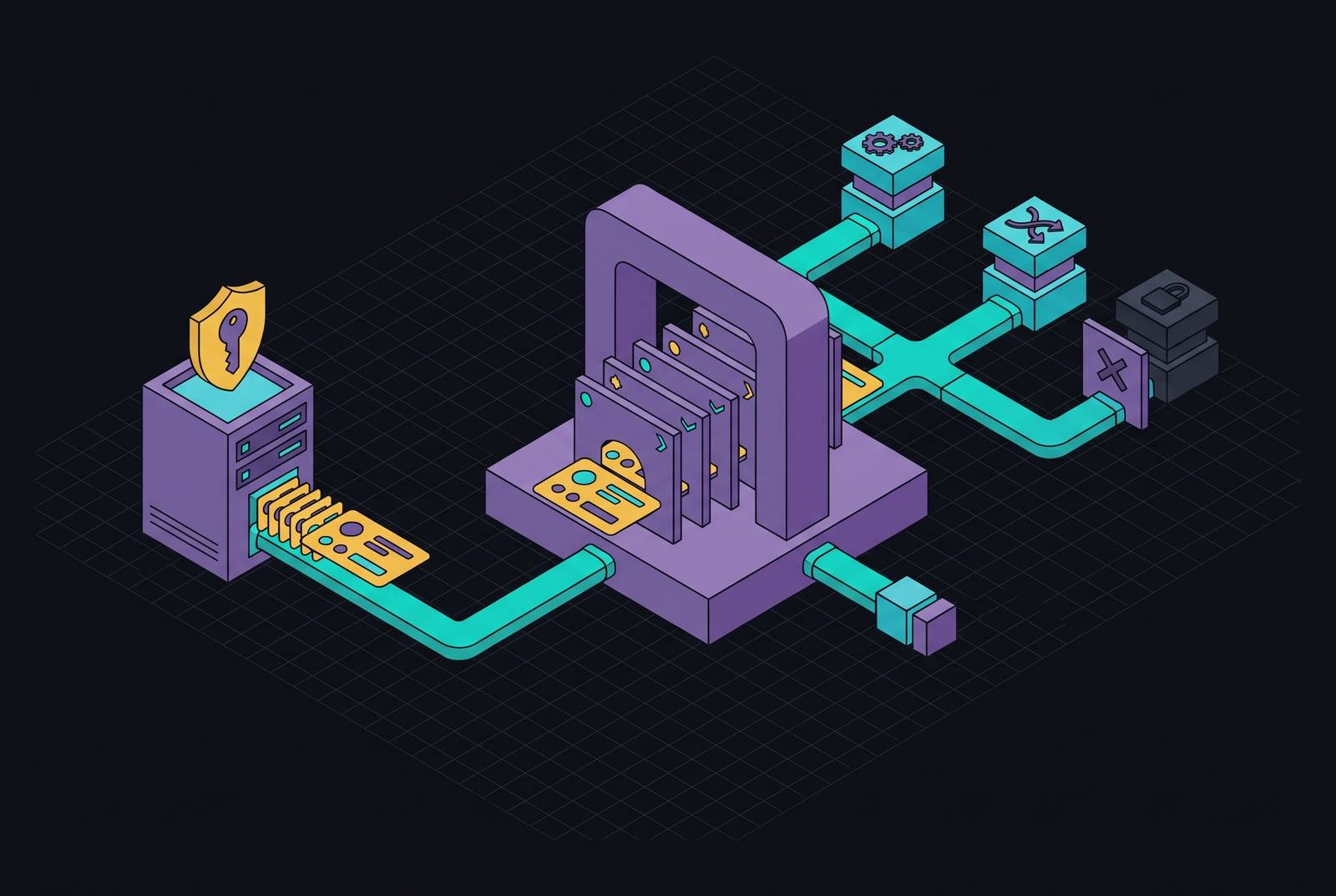
To secure an enterprise agent platform, an MCP gateway needs OAuth authentication and tool-level role-based access controls, with claim mapping and per-call enforcement to back them up. Enterprise-Managed Authorization (EMA) and the ID-JAG exchange establish admission through corporate SSO. Using those identity claims to make runtime decisions is a separate job that spans token validation, policy evaluation, and audit records.
Why admission and action control are two separate problems in MCP gateway authorization
Admission determines which MCP servers an agent may reach. Action control determines what happens after it arrives. EMA centralizes the first decision in the enterprise identity provider, replacing hand-provisioned per-server credentials with corporate SSO. It does not check every tool call, resource fetch, or prompt use against enterprise policy.
That distinction becomes concrete at a source-control MCP server. An engineer in the platform group may be admitted through EMA, yet the admission decision does not prevent the resulting token from reaching a write tool that the engineer’s role should exclude. The door opened correctly. The missing control is a pipeline that checks the requested action rather than treating entry as permission for everything inside.
What EMA and the ID-JAG token exchange actually put on the wire
The ID-JAG is neither an access token nor an ID token. It is a short-lived, single-audience, signed IdP statement that an MCP authorization server exchanges for an access token. The flow begins with ordinary OIDC sign-in, where MFA and conditional access apply. The client then uses the resulting ID token as input to an RFC 8693 token exchange at the IdP.
During that exchange, the resource parameter identifies the MCP server, while audience identifies the validating party. In the MCP profile, the issuer must be the IdP’s issuer identifier. The IdP evaluates administrator admission policy, including group membership, roles, and which clients may reach which servers. The authorization server then redeems the ID-JAG, and the client calls tools with the resulting access token containing identity claims.
Client binding preserves the boundary between those steps. The ID-JAG draft requires an authenticated client to match the grant’s client_id claim or receive invalid_grant. For an unauthenticated client, proof of possession of the cnf key replaces that check. The IdP does not intercept raw MCP traffic, and the resulting access token is audience-restricted to its target server.
The MCP extension and its underlying grant have different maturity levels. The extension is marked Stable, while draft-ietf-oauth-identity-assertion-authz-grant remains an active IETF OAuth working group document at revision -06. Okta’s Cross App Access powers EMA, with support across Claude, Claude Code, Cowork, and VS Code. SAML deployments can exchange an assertion directly or obtain a refresh token using openid offline_access, subject to the required mapping between the SAML Audience and authenticated OAuth client_id.
Where the MCP authorization spec still falls short for enterprise runtime policy
Once the access token exists, the specification leaves an enterprise-sized gap. It does not define per-tool grants, argument-level conditions, deny-rule precedence, or a way to restrict admission to a named subset of tools. Nor does it define when access ends after offboarding or a team change.
Solo.io’s August 2025 analysis identifies the mismatch between SaaS-oriented authorization and enterprise architecture. Earlier versions treated the MCP server as both resource server and authorization server, rather than separating enterprise identity from backend resources. The June 2025 revision corrected the resource-server model but leaned on OAuth RFCs not widely implemented by established identity providers. Client admission has shifted too, with anonymous Dynamic Client Registration deprecated in favor of Client ID Metadata Documents, though implementations vary.
These changes call for adaptable implementation. They also leave runtime policy with the implementer. IdP conditional access at the exchange cannot substitute for evaluating the resulting bearer credential on each request. Without that second decision, directory-group membership becomes a blunt instrument for tool access.
The four-layer gateway architecture that bridges admission to runtime enforcement
The reference architecture places MCP clients above a gateway, MCP servers below it, and enterprise systems behind those servers. The gateway supplies the enforcement layer. Positioned between client and server, it can apply identity, security, cost, and observability policy without requiring changes to either endpoint. That avoids each team independently choosing no authentication, API keys, or OAuth and leaving offboarding fragmented across the fleet.
The topology depends on where traffic may travel. A centralized hub-and-spoke deployment routes agent-to-tool traffic through one gateway cluster for uniform enforcement. A federated mesh handles traffic locally through distributed gateways, while a central control plane distributes configuration and policy. The latter fits latency or data-residency constraints that prohibit central routing.
Credential brokering connects this architecture to the exchange. On admission, a gateway can accept an SSO ID token or ID-JAG and perform or validate the exchange. Upstream, it presents the required OAuth token or brokers a native credential without handing that credential to the agent. The gateway must honor the enterprise decision about server access and then evaluate the requested action.
Token validation and claim extraction as the first enforcement point inside the gateway
Inside that enforcement layer, validation precedes policy evaluation. The sequence begins with signature verification against the IdP’s published keys, followed by an audience check against the gateway or target server. Expiry validation rejects stale credentials. Client binding then checks that client_id matches the authenticated caller, and issuer validation checks that iss identifies the enterprise IdP. Failure at any stage must stop the request.
Only then can claims become trusted policy inputs. The extracted context includes sub, email, group memberships, roles, and custom enterprise attributes. A valid token may still be missing context that the policy needs. Solo.io describes using enterprise systems to add information such as department, project assignments, and current approval states before policy evaluation.
For SAML inputs, normalization to JWT belongs at this boundary so downstream policy receives a consistent structure. Under the stateless MCP specification dated 2026-07-28, client identity, protocol version, and client capabilities also go in _meta on every call. Each request is therefore self-describing and can be processed on its own, but token validation is still needed.
Claim mapping as the translation from IdP attributes to policy inputs
Okta groups, Entra groups, and custom LDAP attributes do not arrive in one common vocabulary. A policy engine needs that vocabulary anyway. The mapping layer bridges the mismatch by flattening nested groups, resolving group GUIDs to readable names, and handling multi-value claims consistently. It also translates SSO roles into MCP access roles, which need not correspond one-to-one.
Custom attributes require similarly deliberate treatment. Department, cost center, clearance, and project assignment may be in extension claims or may need to be found through a directory lookup. The mapping layer sets which values go into policy evaluation. Its output is a normalized context containing the principal, resolved groups, translated roles, an agent-or-human flag, and any enriched attributes.
That context must also account for changing directory state. Bearer-token claims describe identity at issuance. Role mappings therefore need synchronization with directory changes, while short token lifetimes or token introspection address stale claims during a session. A manually maintained translation table is not a substitute for that lifecycle.
Runtime policy enforcement on every tool call, not just at admission
Tool-level, annotation-level, and argument-level rules each answer a different question about what a caller may do. A read-only user might call get_issue but not delete_issue on the same server. A destructive annotation can block tools across servers for a class of callers. An argument rule can allow query_database in general while blocking access to a sensitive schema. Admission alone answers none of these questions.
A deny rule for an individual or group needs to outrank a grant inherited elsewhere, so blocking one person does not require rebuilding group membership. Evaluation must cover every tool call, resource fetch, and prompt use. Server allowlists set at deploy time cannot account for role changes during a session or emergency revocations.
User claims are only part of that decision. Solo.io recommends an identity-first model in which enterprise identity context reaches the MCP server and can be enriched before authorization. Agents also need verifiable workload identities, with SPIFFE a viable foundation. That permits a rule allowing the tax agent to reach the calculate-tax server while excluding the reservations agent, regardless of the user. Effective policy combines the user, the agent principal, and the requested operation.
External SaaS servers add another authorization boundary. Solo.io’s SaaS gateway walkthrough describes intercepting authorization, enforcing enterprise SSO and policy, and then brokering a correctly scoped OAuth token through the SaaS IdP. Routing traffic alone does not accomplish this. To close paths that allow direct access to vendor URLs, network egress rules, forward proxy configuration, and catalog entries sent through device management must route callers through the gateway.
Agent and non-human identity beyond a human in a browser
A shared service account hides which workflow took an action. Revoking it can also disrupt every workflow sharing the credential. The governance fix is a non-human principal with its own directory identity, lifecycle, and audit trail. That makes independent revocation and least privilege possible without pretending a human operator is always the actor.
Different agent scenarios require different treatment. With a user present and an interactive agent, the ID-JAG flow propagates the user’s identity. In a multi-hop chain, a sub-agent may need SaaS access that the outer agent did not pre-authorize. Solo.io describes asynchronous, out-of-band consent through elicitation as an emerging pattern for that case. An autonomous agent instead needs its own cryptographically verifiable workload identity, with any user delegation explicit, narrowly scoped, and auditable.
The MCP roadmap builds on existing identity standards. It includes finalizing Demonstrating Proof of Possession and defining a path for agent identity and delegation through Workload Identity Federation, ID-JAG, and standard token exchange. Meanwhile, the pipeline itself still needs persistent IdP identities and short-lived task-scoped credentials, and it must keep raw secrets out of agents.
Audit trails that record the access decision, not just the successful call
Which tools could a user reach on a specific date? What was denied, and which rule applied? When did access change, and who changed it? A log that contains only successful calls records activity alone.
So every allow and deny decision needs a record. That record must identify the directory user where applicable, the calling agent, the tool and arguments, the evaluated rule, the decision, and its timestamp. Grants, revocations, and scope reductions also belong in the audit trail. Otherwise, a later access review must reconstruct authorization from memory or spreadsheets.
The W3C Trace Context conventions in the stateless specification allow OpenTelemetry-compatible tracing across the call chain. Gateway spans should include user and agent identity so tools such as Datadog, Grafana, or an OpenTelemetry collector can correlate actions to principals. With SIEM export, those records can be linked to identity events, network events, and security alerts. Separate network visibility is still needed to discover direct agent-to-server traffic that never enters the gateway’s audit pipeline.
How to evaluate an MCP gateway with OAuth and tool-level RBAC
An OAuth or SSO integration claim is not evidence of fine-grained authorization. Evaluation should check whether grants can be limited to named tools, annotations, and arguments, and whether explicit denies override inherited grants. Agents that are registered must be able to have their own grants with tighter limits. Client admission should use CIMD to establish known identities and rule out anonymous registration.
Revocation needs an equally concrete answer. Does access end at directory sync, token refresh, or on demand, and can upstream OAuth tokens be revoked independently of the gateway session? Audit evaluation should cover denied attempts and permission changes as well as successful calls, with named principals, applied rules, and SIEM export. Visibility into traffic outside governed paths is another separate criterion.
Cloudflare Access policies matching IdP groups provide a valid SSO starting point for a proof of concept. They are not, by themselves, the complete production pipeline. Open-source gateways offer implementation control but leave claim mapping, policy, and audit export for the team to build and maintain. Managed control planes trade flexibility for operational accountability and alignment with specification changes. The implementation’s ability to maintain the connection from directory identity to each action decision as both permissions and the specification change is decisive.