AI Agents vs Agentic AI Systems in Enterprise Deployments
Enterprise AI deployments fail without orchestration, not intelligence.
The failure is not the model's reasoning, but the absence of infrastructure built to make that reasoning safe, auditable, and repeatable across real systems and real users. A single AI agent and an agentic AI system are often treated as the same purchase, and that mistake is what separates a working deployment from a pilot that never leaves the sandbox. The distinction between them has nothing to do with how smart either one is.
The distinction between an AI agent and an agentic AI system determines enterprise deployment outcomes
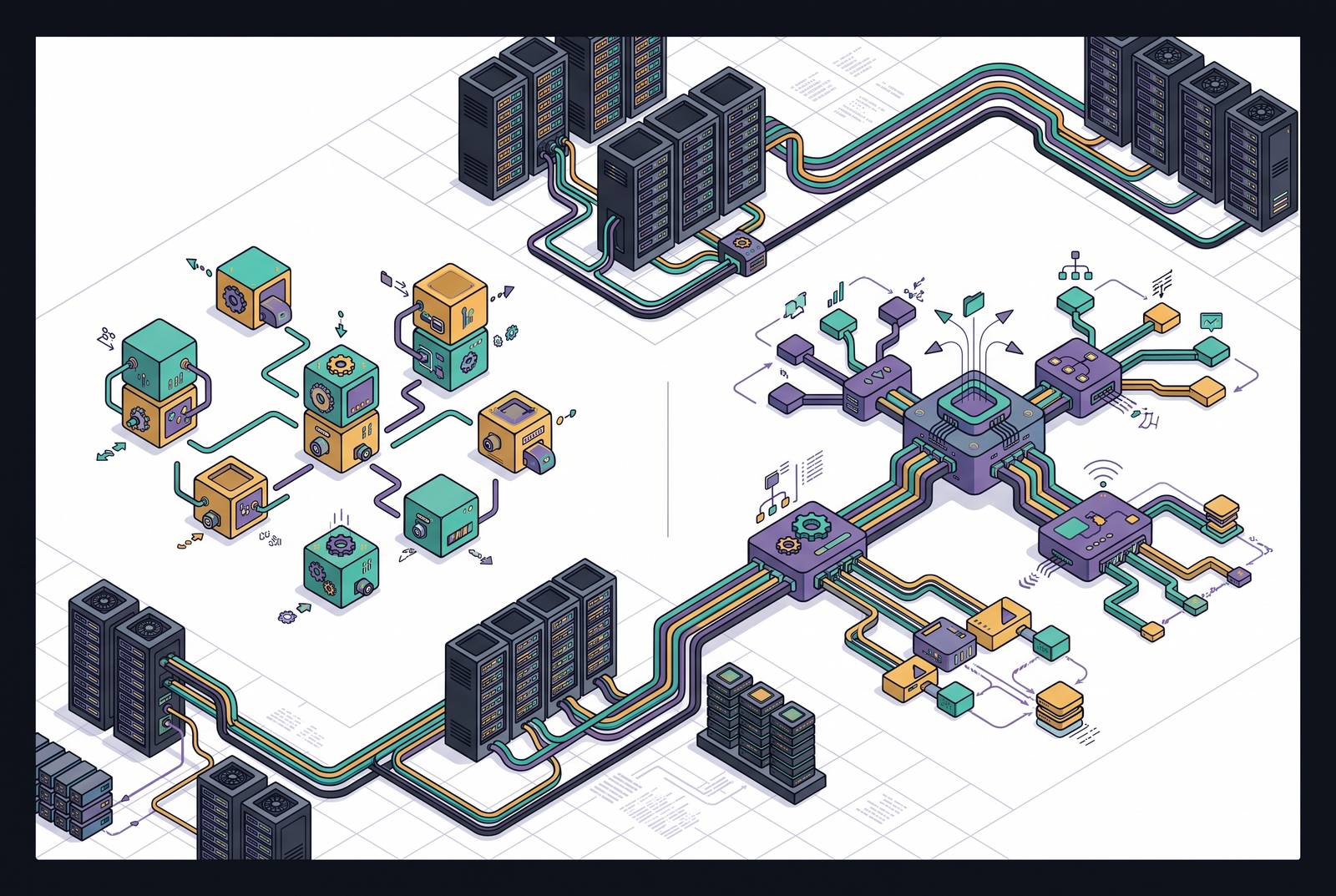
A single AI agent is an autonomous piece of software that reads its environment, reasons toward a goal, and carries out multi-step actions on its own. An agentic AI system is something different in kind: a network of agents running at the same time, coordinated through an orchestration layer, governed by one shared policy, and wired into enterprise systems like Salesforce, ServiceNow, and internal APIs. SAP's own April 2026 API policy is a live example of how seriously that wiring gets taken: it blocks external AI agents from calling SAP APIs directly and routes all agentic access through SAP's own Joule stack instead. That is not a security team being cautious for its own sake. The vendor judged ungoverned agent access to its APIs too costly to allow.
The two configurations run on roughly the same intelligence. What changes is everything surrounding that reasoning: the orchestration, the shared policy, the audit trail, the integration depth. That surrounding layer is what separates a prototype that works in a demo from a system that works in production.
Procurement and engineering teams miss this distinction constantly, and the pattern is predictable enough to set a clock by. A team builds one agent, scopes it carefully, watches it perform well in a controlled demo, and gets budget approved on the strength of that demo. Then someone asks how it behaves under audit, across live systems, with actual users touching it, and the answer turns out to require a different category of infrastructure entirely, one nobody budgeted for because nobody asked the question at the right stage.
Some teams push back here, arguing that a narrow, well-scoped single agent is plenty for most enterprise tasks, and for a single use case run by a single team, that can hold. At that point the governance gap stops being theoretical. Two agents without a coordinating layer create a multiplication problem: now someone has to reconcile two sets of decisions, two sets of access, and no shared record of either.
Agent autonomy and the enterprise risk profile
Autonomy is the entire selling point of an agent, and autonomy is also the entire source of its danger.
Traditional enterprise software runs pre-defined business logic. None of these systems reason through ambiguity or take action on their own initiative, so when they fail, they fail in bounded, predictable ways that a support team has usually seen before. An AI agent is a different animal: it plans, sequences tasks, calls APIs, changes the state of real systems, and adjusts its next move based on what the last one returned. That adaptability is why it is useful, and why its failures do not stay bounded.
Execution authority is where the real line sits. A banking copilot drafts a customer email and waits for a person to hit send. A banking agent, by contrast, can initiate a reversal request for an erroneous wire transfer, send the customer an email, log each step it took, and escalate only when its own confidence drops below some threshold, all without a human touching any part of that chain. An agent empowered to initiate that request is operating in a space where the stakes of a wrong call are not hypothetical.
That gap between a wrong answer and a wrong action is the risk corollary enterprises need to sit with. A consumer chatbot that hallucinates gives someone a bad answer. An enterprise agent that hallucinates while holding access to production systems can push that error into real transactions, real customer records, and real financial outcomes, at machine speed, before anyone notices.
The compounding effect gets worse in multi-agent setups. One agent's flawed output becomes the next agent's input, and unless the architecture was built with an explicit human checkpoint somewhere in that chain, nothing stops the error from propagating. The hard part of running agentic workflows in production was never making the model smarter. It is giving that model secure, reliable access to the systems it needs to touch, without handing it a blank check.
Agent sprawl as the operational symptom of missing infrastructure
Skipping the coordinating layer produces agent sprawl: the uncontrolled spread of disconnected agents running without shared context or oversight.
The pattern tends to start small and polite. Maintenance cost climbs, governance splits into fragments, and nobody owns the whole picture because no single system was built to hold it.
The security consequence is just as real and harder to see coming. Agent sprawl, in other words, demands the same kind of policy enforcement and visibility that IT teams built years ago to manage shadow SaaS subscriptions and unsanctioned cloud accounts. It is the same problem with a faster-moving actor at the center of it.
The organizational failure compounds the technical one. The agents did not fail because the underlying AI was weak. Mindsprint's work building an AI-native deal-to-delivery digital backbone for a global food and agri-conglomerate makes the contrast concrete: embedding agentic workflows directly into procurement, logistics, and trade operations is what let the system deliver measurable results. Without that integration work, the same agents would be sitting in a sandbox today, performing well in demos and doing nothing for the business.
Shadow AI is the sharpest form of sprawl. Shadow IT meant someone was accessing a system they shouldn't. Shadow AI means something is acting on systems it shouldn't, with nobody watching.
Why MCP has no built-in security
MCP has become the standard way agents connect to tools, and it was built with no authentication, no rate limiting, no audit logging, and no access control baked in. Every organization that deploys it is making a choice, whether deliberate or by default, about where those controls will actually live.
The protocol's design is minimal on purpose. For a single developer running a prototype on their own laptop, that is a manageable gap to carry personally. For a multi-user, multi-agent deployment sitting under an audit requirement, it is a structural hole that someone has to fill with something else, because the protocol will not fill it on its own.
Every MCP server running without a governing layer on top of it functions as an open door into enterprise systems. The comparison to make here is to REST APIs a decade ago: APIs as a protocol carried no built-in governance either, and the market's answer was the API gateway, a layer built specifically to sit on top of the protocol and hold the policy the protocol itself couldn't. MCP gateways are that same architectural answer, applied one level up, at the point where agents meet tools.
What an MCP gateway does
An MCP gateway sits between agents and MCP servers and enforces policy on every interaction that passes between them, which closes the protocol's security gap directly at the point of exchange. Not every gateway on the market does the same job, though, and the split matters more than the marketing suggests. A standalone router is enough to keep a single-user prototype orderly. A production deployment with multiple users, operating under an audit requirement, needs the fuller version, because a log of requests is not the same thing as a record of policy decisions.
Speakeasy, an enterprise AI control plane, is built around that fuller model. Every agent on the platform acts under its own identity rather than a shared service account, with access scoped by team and role through whatever identity provider the organization already runs, Okta, Entra ID, Auth0, WorkOS, Google Workspace, Ping Identity, or any SAML or OIDC setup. No agent borrows another agent's credentials, and no team shares a login across a fleet of bots. Policy gets defined once and applied to every action that follows, with each allow-or-deny decision logged automatically as part of enforcement rather than bolted on afterward as a reporting exercise. Threats get checked while the request is still in flight, before it reaches anything in production: prompt injection attempts, PII exposure, leaked credentials, all screened before they can touch a live system. The platform also keeps a single catalog of every approved agent, MCP server, and skill in use, which gives security teams the one thing agent sprawl takes away from them: a clear view of how AI is actually being used across the company. Speakeasy let us extend our identity management to all our AI usage."
Other platforms in the space take narrower approaches, mostly concentrated on the routing and proxy layer, standing between agents and MCP servers and directing traffic without taking on the fuller authorize-execute-audit role. That narrower scope is a legitimate design choice for teams whose needs stop at traffic management. It is a different product than a control plane built to carry enterprise policy end to end.
Does a platform produce an auditable record of every agent action, or does it just log traffic passing through it? A traffic log says a request happened. An audit trail says which policy decision was made, under which identity, against which tool, with what outcome. Only one of those two documents holds up under a compliance review.
Agent identity as the new security perimeter that legacy IAM cannot cover
Legacy IAM and SSO were built to answer one question: who is signing in right now. Agents force a different and harder question onto the table: what is this agent authorized to do, on whose behalf, under what conditions, and for how long.
Traditional IAM solved the human half of this cleanly. Agents break that assumption. The login event stops being the control point, because for an agent running around the clock, there may not be a discrete login event to control.
Prompt injection is the clearest illustration of why identity alone cannot carry this weight. A hijacked or manipulated agent passes every identity check in front of it, because identity confirms who the agent is, not what it is currently trying to do. The manipulation happens inside a session that identity already approved. A system that only checks "who" and never checks "what, under what conditions" will wave the attack straight through.
The architectural answer taking shape treats agents as first-class, non-human identities in their own right, each issued short-lived cryptographic credentials scoped to one specific task, granted at the moment of execution and revoked the moment the task is done, with policy evaluated in real time on every tool call rather than once at login. Analysts are converging on a four-phase structure for this: discover, inventory, and register the full agentic identity graph; translate intent into deterministic, auditable policy decisions and authorize against them; broker and inject short-lived, task-scoped credentials so no agent holds standing privilege it isn't actively using; and watch continuously for behavioral drift, terminating access the moment it appears.
A widely cited governance framework adds a requirement that matters here: oversight has to scale with an agent's autonomy and authority, calibrated to its capability and context rather than fixed in place as a static checkbox. Speakeasy's model follows this same shape: every agent gets its own identity inside the identity provider already in place, access is scoped by team and role, and every action is checked against policy before it reaches anything in production, extending the IAM investment already made rather than asking a company to rip it out and start over.
Observability as the operational requirement that turns autonomous behavior into accountable outcomes
Observability in an agentic system is the control plane layer that makes autonomous behavior something that can be measured, audited, and tied back to a business outcome, not a dashboard added after the fact to see how things went.
Token spending scattered across separate provider dashboards, application logs, and cloud bills makes basic cost accountability nearly impossible to pin down. Shadow agents operating outside documented processes are, by definition, invisible to any observability system. Governance failures and observability gaps surface the same missing control: no record of what an agent did and under what authority.
A production agentic deployment needs specific metrics tracked as a baseline: token consumption and compute cost per run, broken out by agent type, use case, and data domain, alongside a session-level audit record of what each agent did and why.