AI Monitoring Tools for Agentic Workflows in the Enterprise
Enterprises need execution tracing and permission enforcement, not just output monitoring.
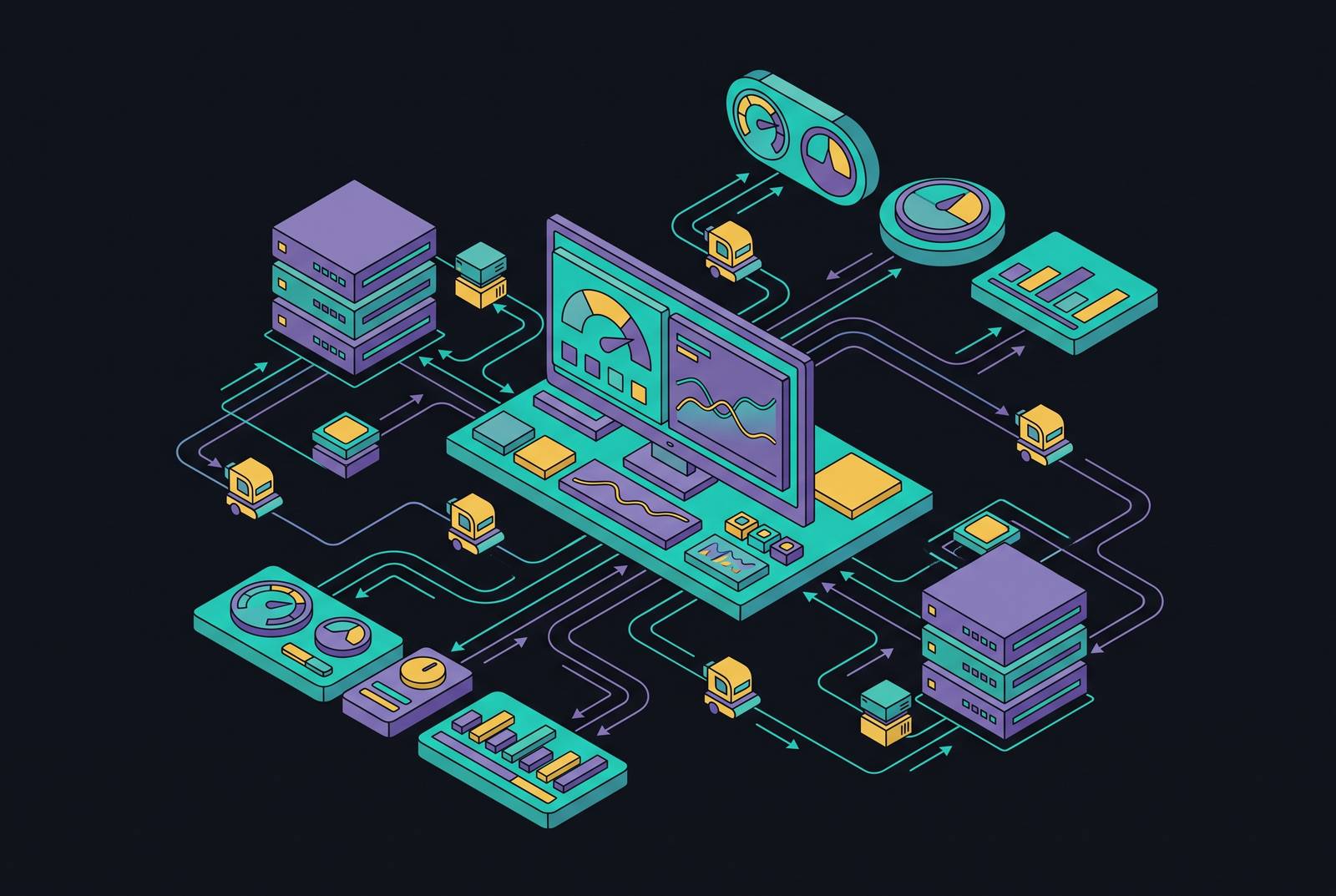
AI monitoring tools for agentic workflows must watch what systems do as well as what models say. Enterprises need a stack that traces execution, attributes actions, enforces permissions, and detects policy violations across autonomous, multi-step work. The buying decision starts with those requirements to avoid a dashboard that makes the wrong things easy to see.
Why agentic workflows create a monitoring problem that classical AI observability tools cannot solve
An agent running a finance workflow may query a database, call an external API, pass context to a sub-agent, and write to a SaaS system. Each hop can fail or break policy no matter what the final answer says. A monitor watching only that answer cannot establish whether the route was authorized. The receipt is not the journey.
The CASE framework paper explains why this differs from classical automation. In a deterministic pipeline, execution paths can be enumerated at design time, so certifying the artifact also certifies its behavior. An agent instead follows a stochastic policy over an open action space, choosing actions in response to inputs, context, memory, and shared state. Its released artifact and its production behavior are therefore decoupled. Testing the former cannot exhaust the possibilities of the latter.
IBM’s agentic governance playbook describes the resulting shift as a move from validating answers to controlling actions. The Unified Policy Architecture paper makes the architectural consequence explicit. Governance must follow an agent as it selects tools, changes its execution strategy, and coordinates with other agents. Classical model-output observability remains useful, but it cannot establish control over execution paths, permission boundaries, or inter-agent state.
The four scales at which agentic behavior can fail, and why a single monitoring layer misses most of them
The CASE framework separates the problem into four scales, namely the individual agent, the agent collective, the human-agent team, and the automated fleet. These are different places for failures to originate. At the individual scale, the question is whether an agent stays within its bounded task. Control theory gives that question a practical structure, with intent as the setpoint, guardrails as feedback, and evaluation as observation.
The collective scale breaks the assumption that safe parts necessarily make a safe whole. A guardrail that stabilizes one agent says nothing about cascades across agents that interact through shared state. The CASE framework calls this the Emergence Gap. Its study found that none of the 22 ecosystem tools examined offered full coverage of the collective/emergence layer, while all 35 scored public deployments fell in the lowest maturity band.
Human oversight introduces a separate limit. The CASE framework uses the Law of Requisite Variety to explain why unaided reviewers cannot control behavior whose variety exceeds what they can absorb. At fleet scale, engineering operations must use error budgets to control decision quality as well as measure uptime. A fleet can be available and still make poor decisions.
These scales matter together because failures cross their boundaries. The CASE framework found that 82 percent of documented production agent failures were multi-layer trajectories. Monitoring outputs one at a time therefore misses much of how failures unfold in production, even when every output is recorded perfectly.
What a complete agentic monitoring stack must actually cover
A complete stack needs seven capability domains because no single observation or control closes every gap. Execution-path tracing comes first and links agent decisions, sub-agent calls, and tool invocations in one chain. This makes the workflow, rather than its final answer, the minimum unit of observability. The Unified Policy Architecture paper extends that requirement through planning, memory access, handoffs, and execution, so governance follows the action.
Runtime permission-boundary enforcement and identity tracking make those traces governable. The former continuously checks what an agent can technically do against what it is authorized to do in its current context. The latter gives each participant in a multi-hop chain a verifiable identity, so access decisions and audit records can be attributed to a principal.
Real-time threat detection addresses risks that cannot wait for an incident review, including prompt injection, PII leakage, and secrets exposure. The OWASP Top 10 for LLMs identifies prompt injection and sensitive information disclosure as its top two vulnerabilities. CVE-2025-53773 demonstrated remote code execution through hidden injection in repository content, including source code files and GitHub issues, with a CVSS score of 7.8. EchoLeak showed that zero-click injection could silently exfiltrate enterprise data from a major productivity suite.
Continuous policy enforcement is a distinct requirement because detecting a threat is not the same as controlling an action. The Unified Policy Architecture paper proposes a deterministic Policy Kernel that separates policy specification, matching, evaluation, and runtime enforcement from agent reasoning. Policies produce governance decisions and executable governance obligations. That separation makes policy a runtime control rather than a suggestion embedded in the agent’s instructions.
The Trust Certification paper describes an AML screening agent at a Tier-2 Vietnamese commercial bank that handled 27 customer-onboarding cases correctly in shadow mode but made two false-negative matches against the UN 1267 consolidated sanctions list. A misconfigured name-romanization rule dropped diacritics from Vietnamese names, and the simulation gate caught the problem before production. The paper’s Agent Operational Envelope defines the properties to validate, while a machine-verifiable Trust Certificate binds them to a specific agent version with a verdict of Approved, Conditional, or Rejected. Runtime-only monitoring would have missed the opportunity to stop that misconfiguration before deployment.
Cost and usage telemetry completes the stack. Model calls, tool invocations, and API consumption can accumulate across autonomous workflows, exposing the fleet to budget overruns and quota exhaustion. The Unified Policy Architecture paper makes cost management part of governance. For agents that can trigger chargeable actions themselves, usage is an operational signal.
Why MCP server proliferation makes a governed distribution layer a monitoring prerequisite
These capabilities need an enforcement point between agents and their tools. As MCP becomes the dominant connectivity standard for agent-to-tool interaction, a governed distribution layer provides that point. A raw MCP server does not by itself supply the RBAC, centralized access control, and audit infrastructure needed for enterprise deployment. Without a gateway, those controls take a lot of custom work, and monitoring has no shared place to enforce them.
The June 2026 EMA extension makes enterprise identity providers the authoritative provisioner for MCP server access. Authentication uses the enterprise identity already in place, access decisions live in the IdP admin console, and the architecture leaves one trail that can be audited. That arrangement connects the identity behind a request to the tool access being governed. It also shows why maintaining the distribution layer matters as the specification evolves. An in-house implementation must keep pace with those changes as well as operate the controls already built.
The gateway products available as of October 2026 cover different parts of this infrastructure requirement. Lunar.dev MCPX is an open-source, MIT-licensed MCP gateway and AI control plane that gives agents one governed entry point to reach their tools. Its Enterprise tier adds identity provider integration with Okta, Entra (Azure AD), and Google Workspace, plus automated MCP server risk scoring, hosted deployment, and expanded governance controls.
Microsoft MCP Gateway is an open-source reverse proxy and management layer for MCP servers running in Kubernetes. It provides session-aware routing and a control plane to deploy, update, and delete MCP servers. Kong AI Gateway manages remote MCP traffic within Kong’s API platform, maps REST API endpoints into MCP tool definitions, and aggregates multiple MCP servers into a single endpoint. The value of these infrastructure capabilities depends on which tracing, identity, policy, and threat controls the enterprise needs that layer to support.
How agent identity and RBAC determine what monitoring can actually see and enforce
A common enforcement point still needs to know who is acting. Without per-agent identity, logs cannot reliably attribute actions to a principal, and permission decisions collapse to coarse service-account access. Role-based access control depends on that attribution to enforce meaningful boundaries. Otherwise, the audit trail records activity without reconstructing who authorized each action in the chain. That is forensic theater, with excellent timestamps.
Okta’s expansion of Universal Directory gives AI agents first-class identities with defined lifecycles and moves them out from behind shared human service accounts. Its Agent Gateway functions as the Policy Enforcement Point, while the identity platform acts as the Policy Decision Point. Okta’s Agent SSO reached general availability on August 24, 2026, bundled into core Okta SSO at no additional cost for its customer base. For multi-hop accountability, Okta’s Identity Assertion JWT Authorization Grant embeds both the human user and the acting agent within the token.
Microsoft’s Conditional Access for Agents and ID Protection for Agents began worldwide rollout in July 2026. They come with Microsoft Agent 365 licensing paired with at least Microsoft Entra ID P1, or with Microsoft 365 E7. The approach uses the infrastructure for managing people to observe, govern, and secure agents. For monitoring, the important question is whether that identity persists from the first authenticated request through the workflow.
The Unified Policy Architecture paper formalizes the required decision context through its Principal–Action–Resource–Context request model. Every governance decision is evaluated against a policy using those four elements. This links the actor to the action they request, the resource it affects, and the circumstances, so decisions can be audited and reproduced.
The autonomy-level decision as a monitoring configuration choice, not just a governance posture
Once actions can be attributed and controlled, enterprises must decide how much independent action to allow. ExxonMobil’s AAL/ACL framework separates Autonomous Capability Level, which describes technical ability, from Allowed Autonomy Level, which describes authorization. Its deployed enterprise data engineering agent was assessed at a high capability level but deliberately constrained to lower allowed autonomy. Risk, reversibility, and organizational readiness set that boundary. The agent’s ability was not the limiting factor.
A system must know which actions may proceed autonomously and which require approval before it can enforce the boundary or flag a violation. IBM’s playbook places that choice at the center of governance. A blanket monitoring policy will either burden low-risk workflows or leave higher-stakes behavior insufficiently controlled.
Human approval also needs to be operationally credible. The CASE framework’s supervisory layer explains why passive logging cannot compensate for a system whose behavioral variety overwhelms reviewers. Monitoring therefore needs automated escalation and intervention triggers that surface the right signals to the right person at the right moment. The EU AI Act makes effective human oversight a legal requirement, and the CASE paper argues that oversight must satisfy requisite variety to be real. A queue nobody can meaningfully review is not a control simply because a human owns it.
How to evaluate agentic monitoring tools against these requirements
Start evaluating tools with failure scenarios before turning to the words a vendor uses for its features. Ask what coverage exists at each of the four CASE scales, especially the collective layer. Simulate a multi-agent workflow in which one agent’s misconfiguration cascades to others, then measure what the monitoring layer surfaces. An individual-agent trace is useful evidence, but it is not proof that the system detects the cascade.
Next, examine where governance starts and how it persists. A structured pre-deployment verification step should bind validated behavioral properties to the agent version being granted access. During execution, test whether policy decisions are deterministic and can be audited, and whether Principal–Action–Resource–Context is checked at each point where it bears on a decision. Coverage must extend from model inputs and outputs through planning, memory, tools, and handoffs.
Verify that agents have unique, lifecycle-managed credentials, that lineage survives multi-hop chains, and that the tool integrates with existing enterprise identity providers. Prompt injection and PII detection must operate in flight. Audit logs should be signed, tamper-evident, and sufficient to reconstruct the full execution path, rather than merely announcing that something went wrong.
Finally, test whether monitoring intensity and enforcement thresholds can vary by agent, role, or workflow. Confirm that real-time usage telemetry covers model calls, tool invocations, and API consumption across the fleet. Together, these tests distinguish a stack that governs autonomous work from one that only displays it. The monitoring gap is not a shortage of tools but a mismatch between requirements and coverage. Enterprises that define what they need to see before selecting tools will make better choices than those that buy dashboards and hope the right failures appear.
Sources
- The CASE Framework: A Multi-Disciplinary Control Architecture for Governing Enterprise Agentic AI
- Toward Pre-Deployment Assurance for Enterprise AI Agents: Ontology-Grounded Simulation and Trust Certification
- A Unified Policy Architecture (UPA): The Governance Kernel for Enterprise AI Operating Systems
- Separating Capability from Permission: A Governance Framework for Agentic AI Autonomy Levels