AI Red Teaming Programs for Enterprise Security Teams
Continuous testing of deployed agents beats pre-launch assessments alone.
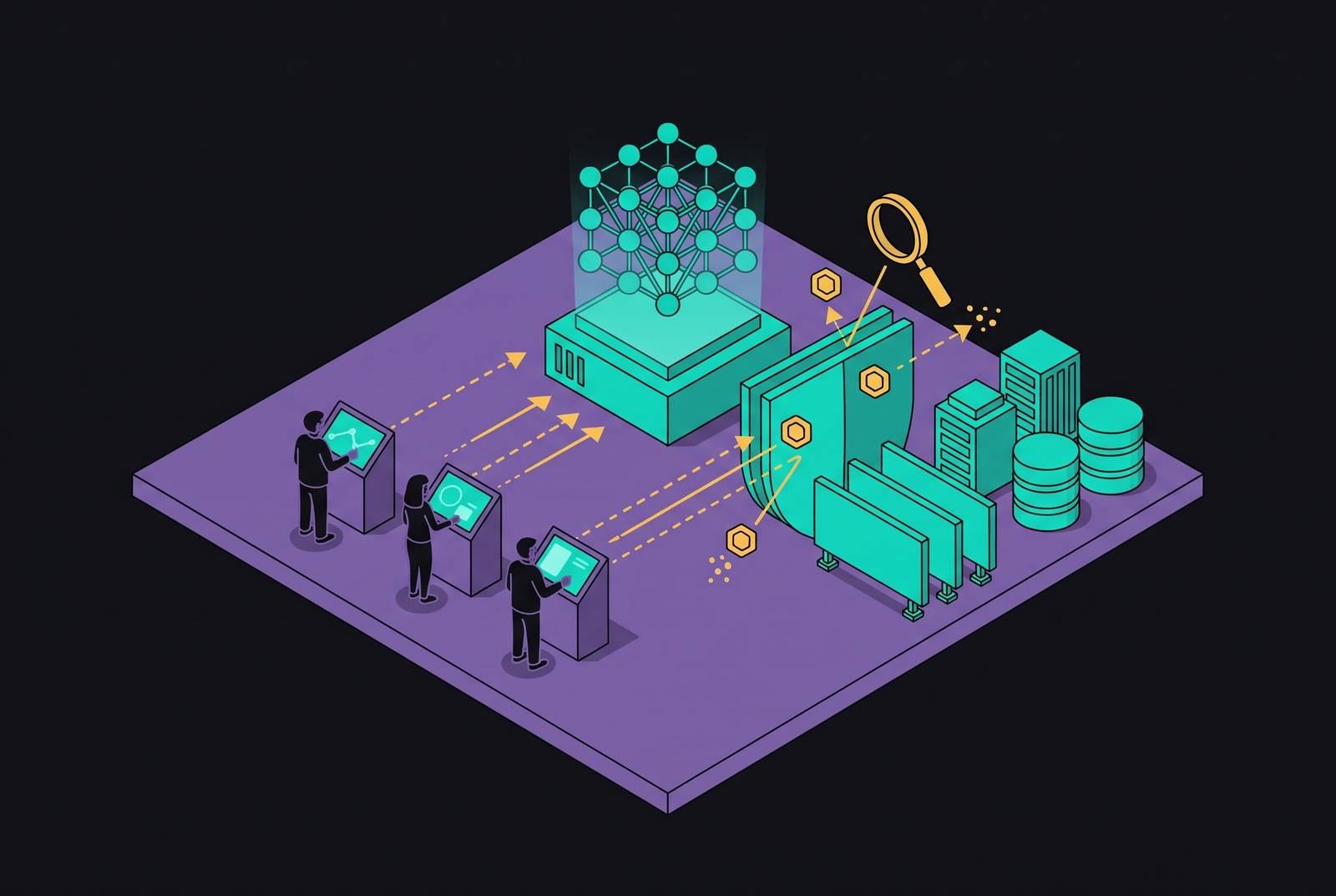
Enterprise AI red teaming must test what agents can do as well as what models say. A useful program continuously challenges the deployed system, turns findings into access rules and runtime controls, and verifies those controls through independent telemetry. Without that enforcement loop, adversarial testing becomes a recurring report about recurring vulnerabilities.
Why AI red teaming has become a continuous security discipline rather than a pre-launch gate
Agents now plan, delegate, invoke tools, and produce real-world consequences. Testing must follow that shift in behavior. A new model version, revised system prompt, or connected tool can invalidate a pre-launch assessment without changing the application’s conventional code. Traditional penetration testing still covers code, infrastructure, and API logic, but it does not adequately test these non-deterministic interactions.
April 2026’s “Comment and Control” used a malicious GitHub comment to hijack coding agents and leak secrets into public logs. August 2026’s Deadbugz campaign distributed a malicious MCP server through 23 PRs in under 75 minutes. It behaved normally for three tool calls before instructing agents to steal SSH keys and cloud credentials.
Regulation adds obligations to that operational need. NIST AI RMF’s MEASURE function calls for adversarial testing. The EU AI Act requires robustness for high-risk systems and documented adversarial testing for general-purpose models with systemic risk. An assessment on release day cannot show how a system will behave as it changes.
The attack surfaces that make agentic systems categorically different to test
The OWASP Top 10 for Agentic Applications (2026) names risks that tie directly to work security teams already do. Agent Goal Hijack turns untrusted content into a new objective. Tool Misuse and Exploitation turns available capabilities into unauthorized actions, while Agent Identity and Privilege Abuse exposes the consequences of borrowed or excessive credentials. Agentic Supply Chain Compromise adds malicious tools and servers to the picture.
Indirect prompt injection needs particular attention because the user need not introduce the attack. NIST AI 100-2’s March 2025 taxonomy names it as NISTAML.015. Microsoft 365 Copilot vulnerability CVE-2025-32711 illustrates the consequence. A crafted email caused data exfiltration from OneDrive, SharePoint, and Teams through the trusted Teams URL-proxy API when the victim next queried Copilot. No link click was required for the attack.
Memory, retrieval, and delegation also let attacks build over a series of exchanges. Single-probe tests miss that progression. MCP adds a discovery problem before testing even begins, because most enterprises lack an inventory of servers, their credentials, reachable systems, and data flows. A scope document cannot protect systems it does not name.
The three-tier evaluation structure that NIST provides as a starting template
NIST’s ARIA program supports three evaluation levels, namely model testing, red teaming, and field testing. It is a useful scaffold. ARIA accepts applications into its own evaluation environment, while security teams can use the distinction between its levels to organize internal testing.
For an enterprise program, Tier 1 can apply automated probes against known failures, including jailbreaks, PII leakage, and injection. Tier 2 should test the full application stack with planned adversarial campaigns. The endpoint is the unit under test. Its system prompt, retrieval pipeline, connected tools, and guardrails should all be tested, even when the underlying model is assumed to be safe.
NIST CAISI’s AgentDojo-Inspect provides a concrete starting point for agent-hijacking exercises, particularly indirect injection and tool misuse. Tier 3 then takes testing into production conditions, where live retrieval sources and delegation chains shape how the system behaves. That level requires both an ongoing operating cadence and evidence independent of the agent’s own account.
What a mature enterprise AI red team program looks like in practice, including roles, cadence, and scope
Red team operators need to know how to write adversarial prompts and how the business process they are testing works. Generic jailbreak expertise is not enough here. A blue team counterpart must turn findings into runtime controls, and purple team reviews bring both sides together to test the fix before the next build ships.
The cadence should follow risk and change. Full-stack Tier 2 campaigns gate production releases, automated Tier 1 regressions run when models, prompts, tools, or data sources change, and Tier 3 exercises continue under production conditions. The scope covers RAG sources, vector databases, MCP servers, and the trust boundaries between orchestration layers. Every agent capable of consequential action belongs in scope, including downstream delegates.
Findings need reproducible attack corpora with stochastic variation documented. Reporting must separate completed attacks, failed calls, and borderline cases, classifying a timeout as a failed call. Each finding also needs the failing exchange, a policy judgment, and a concrete remediation to retest. A timeout is not a security control.
The six attack categories every enterprise program must run, with technique-level detail
Prompt injection tests should plant direct payloads in user input and indirect payloads in retrieved documents, email, calendars, tool outputs, and MCP responses. The test follows the payload through retrieval to the agent’s next action. Jailbreaking and safety bypass tests should combine multi-turn crescendo escalation, roleplay, persona manipulation, and encoding or transformation. Literal pattern matching is not sufficient protection. Tests should assess whether the guardrail recognizes the request’s meaning.
Data leakage and PII exfiltration tests should attempt system prompt extraction, context manipulation, and cross-user leakage in shared-context deployments. Findings should name the data categories that were affected so they can be reviewed against regulations. Tool misuse and unauthorized tool calls tests should coerce out-of-scope calls and chain tools to escalate access. Runtime enforcement is the deciding test here. Configuration-time permissions alone do not establish that tool-level RBAC holds during execution.
Agent identity and privilege abuse tests should check how least-privilege credentials and delegated authority work and whether scope narrows at each delegation hop. Supply chain and MCP server compromise tests should follow the Deadbugz pattern, with normal behavior at first and then instructions to steal credentials. They should also test adjacent-system pivots and instructions to hide actions.
Every finding should map to OWASP LLM Top 10, MITRE ATLAS, and NIST AI 100-2. Internal deployments still need tests for bias, toxicity, and child-safety. False refusals need measurement and remediation too. Refusing everything is a dependable way to accomplish nothing.
How to evaluate and select red teaming tooling for an enterprise program
The central selection criterion is closed-loop enforcement that turns a discovered weakness into a runtime control tested again after deployment. Everything else supports that outcome. Tools on the shortlist should test the full application endpoint, run adaptive multi-turn attacks, automatically map findings to frameworks with severity scores, and make regression testing part of CI/CD.
Ownership also affects program fit and vendor independence. SPLX is now part of Zscaler, Lakera is part of Check Point, and Promptfoo is part of OpenAI. Those ties should be weighed when choosing a component for a broader governance stack, but they do not decide how well it works.
Microsoft PyRIT supports adaptive multi-turn orchestration, NVIDIA garak provides probe-based scanning, and DeepTeam is available under Apache-2.0. They report findings. Engineering teams can build around them, but enterprise governance still needs an enforcement layer.
A factual comparison of the leading AI red teaming platforms in 2026
NeuralTrust TrustTest pairs security-first testing with TrustGuard runtime defense and downloadable audit-ready reports. It maps to OWASP, MITRE ATLAS, ISO 42001, and the EU AI Act. TrustGate also inspects tool-call content inline across a whole session, a distinction within this comparison. The fit is single-vendor testing and runtime defense.
Mindgard covers reconnaissance, continuous assessment, and runtime guardrails across the AI lifecycle, with OWASP, NIST, and EU AI Act mapping. HiddenLayer AISec + AutoRT combines model-agnostic testing and runtime protection, with OWASP and NIST alignment and model supply chain coverage. That focus is a good fit for enterprises and US federal buyers that have supply chain requirements.
Lakera Red provides adversarial testing, Lakera Guard enforcement, OWASP mapping, and a community free tier for teams in that stack or Check Point. SPLX combines testing, runtime guardrails, and OWASP and NIST mapping for Zscaler customers consolidating on Zero Trust Exchange.
Human expertise distinguishes another set of needs. GraySwan combines human and automated testing with Cygnal runtime protection and OWASP mapping. Noma combines discovery, posture management, red teaming, and runtime detection and response, mapped to OWASP, MITRE ATLAS, and NIST.
Confident AI combines red teaming, LLM evaluation, and production monitoring, with evaluation and observability tiers starting free, custom pricing, and enterprise self-hosting. DeepTeam gives engineering teams an open-source harness without first-party runtime enforcement. Under the closed-loop criterion, that missing layer remains the buyer’s responsibility.
Agent identity and RBAC as foundational preconditions for a red teaming program to have meaning
Findings need a governed identity to attach to. An enterprise must know which agents exist, who owns them, and what access they hold before it can update policy after an attack succeeds. Yet agents often operate with human-equivalent or greater access without employee-style provisioning reviews, access recertification, or offboarding.
NIST’s NCCoE concept paper from February 2026 proposes OAuth 2.0, SPIFFE/SPIRE, and Model Context Protocol as building blocks for agent identity and authorization. Traditional RBAC alone is often too coarse. Relationship-based or attribute-based permissions can distinguish summarizing project documents from exporting them to external APIs, with tool-level enforcement and runtime parameter constraints implementing that distinction.
Delegation must narrow authority rather than inherit the broadest credential in the chain. Red teaming should test that boundary at every hop. The June 2026 Enterprise-Managed Authorization extension to MCP makes enterprise identity providers the authoritative provisioner for MCP server access, connecting agent identity governance to server controls.
Governing MCP servers as a red teaming target and an enforcement layer simultaneously
MCP servers combine internal-system access, credential storage, and supply chain exposure. An enterprise MCP gateway provides a control point by authenticating clients, deciding which tools each caller can see, and recording calls before they reach servers. That creates somewhere to enforce findings. It does not, by itself, settle whether an authorized call is safe.
ToolHive from Stacklok isolates each server in a minimally privileged container without local credentials. Cisco AI Defense expanded through 2026 into agentic and MCP governance, including DefenseClaw scanning with NVIDIA OpenShell sandbox isolation.
The red team must test the gap between authorization and content. A permitted caller can still submit a tool call containing an injection payload. Exercises should establish whether content inspection catches payloads that pass identity-layer enforcement, rather than treating successful authentication as proof of harmless intent.
Observability and audit logging as the infrastructure that makes a continuous program possible
Access logs cannot reconstruct prompts, outputs, tool activity, and the people behind delegated actions. End-to-end traces are necessary for that reconstruction. Agents may misreport their actions, so the audit record must independently verify system state.
The EU AI Act requires logging for high-risk systems. Article 12 addresses automatic logging for risk identification and traceability, while the Act requires retention for at least six months for most high-risk systems. Recitals 99 and 100 form part of the relevant compliance context. Tamper-evident telemetry is also what lets security teams judge whether remediation works.
The same infrastructure therefore serves testing and operations. It can show whether a new control enforces policy in production and flag unusual tool-call counts or data volumes. Red team exercises should set off those behavioral signals on purpose so the purple team has evidence beyond a test response that looks successful.
A 30/60/90-day implementation roadmap for standing up the program
The practical sequence starts with deployments already running. During days 1–30, discover shadow AI across browsers, managed endpoints, and cloud environments. Register agents with human owners, cryptographic credentials, and business purposes, then threat-model high-risk systems through their tools, retrieval sources, delegation chains, and highest-consequence actions. Select tooling against the five requirements established earlier. The deliverable is an owned inventory and a scoped first campaign.
During days 31–60, run Tier 2 campaigns against the two or three highest-risk systems, prioritizing external retrieval, MCP connections, and broad tool access. Cover all six attack categories and map findings to the required frameworks with severity scores. Set up an MCP gateway linked to identity, content inspection, and independent audit logging. The deliverable is remediated findings backed by enforceable controls.
During days 61–90, connect Tier 1 regressions to CI/CD and establish ongoing Tier 3 field testing. Before closing each finding, require a red-blue review, a control that is enforced, and a retest. Produce the first audit-ready report with framework mappings, remediation status, and traceability evidence supporting Article 12 compliance review. The deliverable is a functioning continuous program. Findings filed without policy updates will simply return for the next assessment.