Porting Your Shadow SaaS Control Plane to Cover AI Models, Agents, and Browser-Native Copilots
Extend your shadow SaaS controls to govern AI agents and embedded copilots.
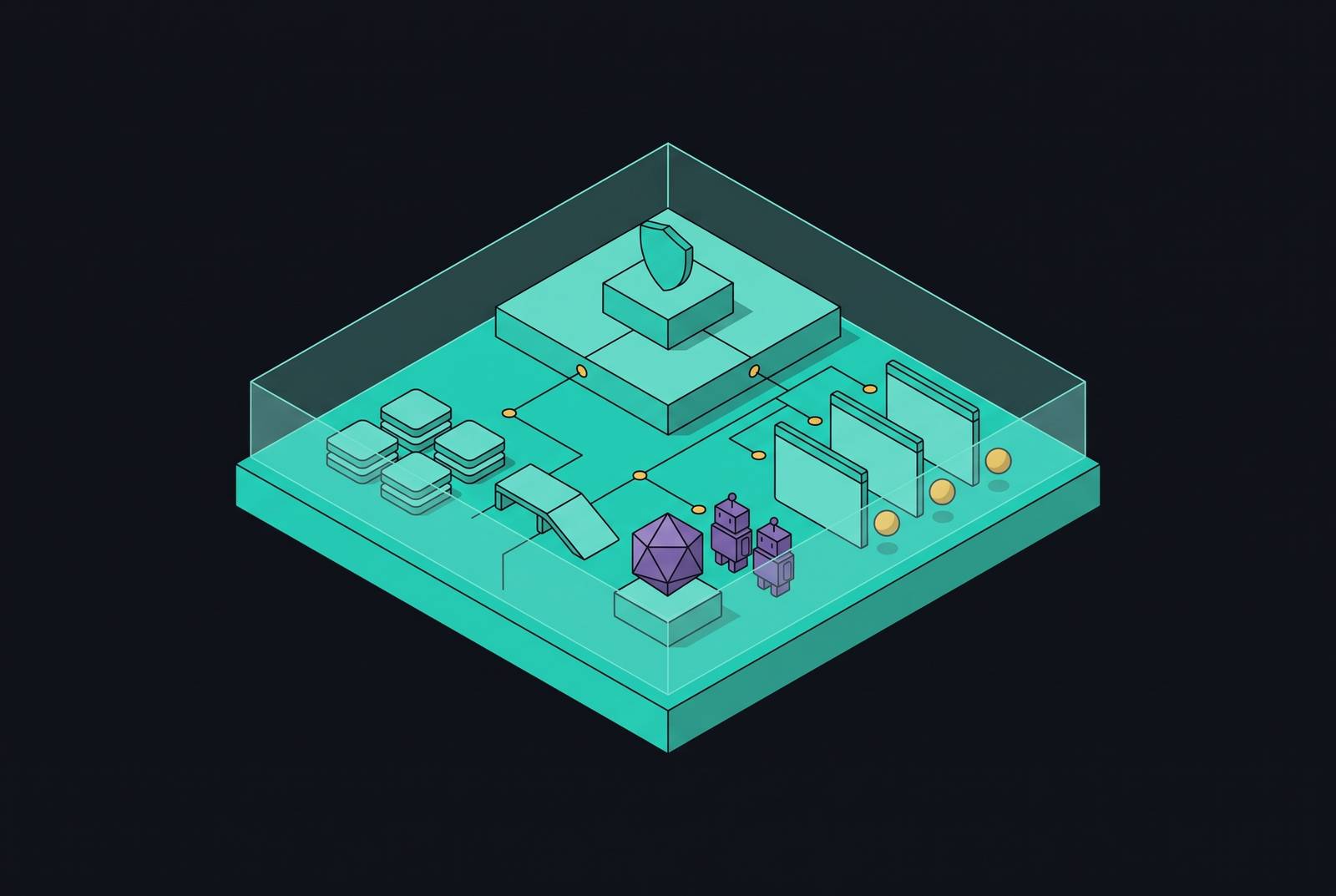
To find unauthorized AI use, enterprise security teams should combine network and DNS discovery with browser-extension inventory and shadow MCP detection through the DLP engine. The shadow SaaS control plane is the right foundation, but it must extend to agent identity, tool-call enforcement, and AI-specific telemetry. This porting exercise preserves existing controls while closing the gaps that let copilots read data and agents act without approval.
Why shadow AI is structurally different from shadow SaaS — and why that gap is widening now
The familiar shadow IT story begins with a person submitting corporate data to an unapproved tool. In that scenario, exposure is bounded by what the person chooses to send. An ungoverned AI agent changes the boundary. It can call internal APIs, traverse SaaS integrations, and trigger downstream actions without a human in the loop. Its reach is bounded by the permissions it inherited.
Agentic, browser-embedded, and MCP-connected AI can get information and act on it in ways that domain blocking alone cannot control. Shadow agents appear in internal automation, LLM platforms, SaaS-native automation, and developer-created workflows, precisely the environments built to remove friction. The controls must follow those workflows rather than assume that every new capability arrives through a new SaaS signup.
What the shadow SaaS control plane actually consists of — the four disciplines enterprises already built
The shadow SaaS control plane consists of four disciplines. Discovery uses network and DNS analysis, browser telemetry, and SaaS-discovery tools to identify the services employees reach. Policy enforcement pairs acceptable-use rules with technical controls, including DLP rules and domain allow/block lists. Identity-bound access ties permission to a verified identity under zero-trust principles rather than to assumed membership inside a trusted perimeter. Observability continuously feeds security monitoring through the SOC and SIEM, so anomalous data flows become security events before an audit.
Discovery establishes what exists, policy establishes what is permitted, identity establishes who may use it, and observability records what happens. Each has a direct AI-layer analogue. Porting requires assessing how much of its implementation survives when the actor is an agent or the tool is embedded inside an approved application.
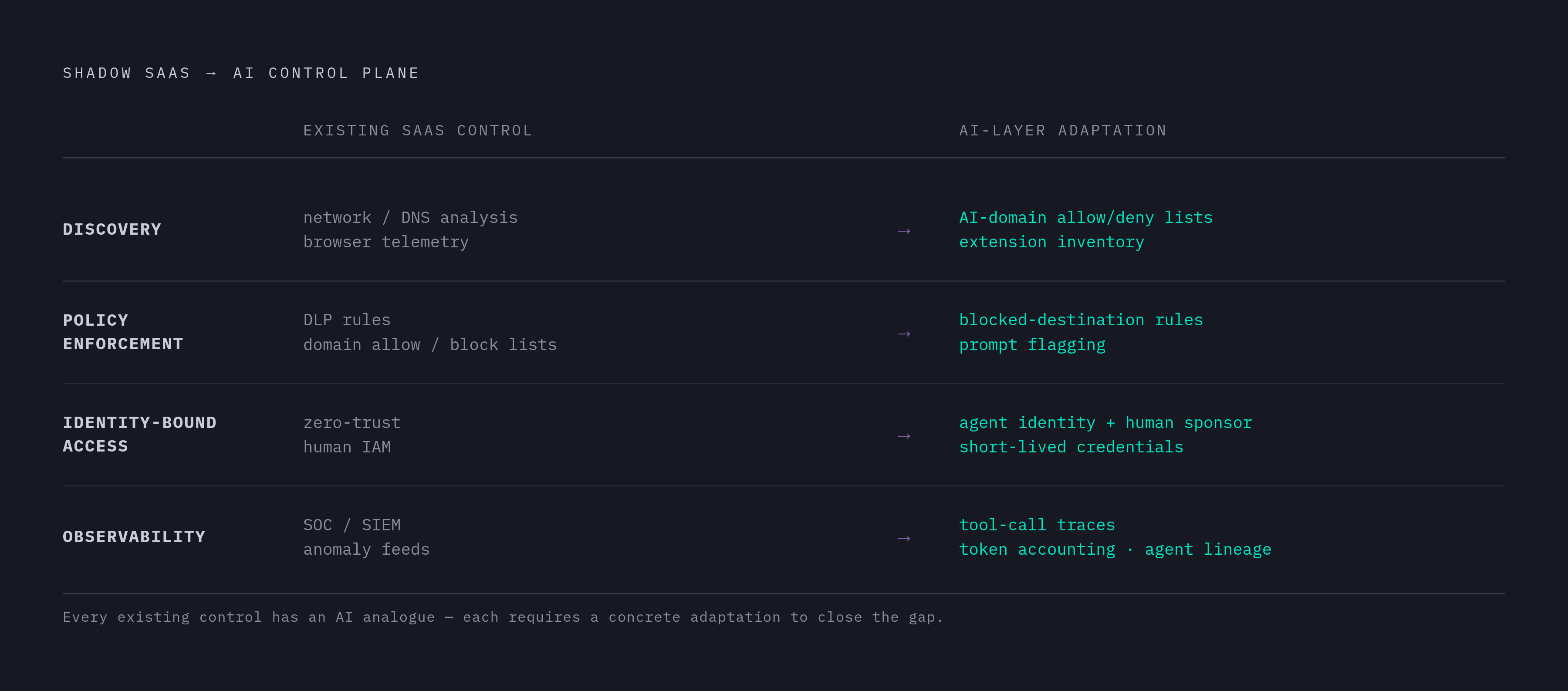
How do security teams find unapproved AI tools — and adapt discovery and policy enforcement?
Network and DNS discovery still work because browser-based AI tools connect to domains that teams can identify. Existing traffic analysis can therefore identify employees accessing ungoverned AI endpoints. That is the first practical foothold. Discovery can cover AI destinations using infrastructure already in place, so teams can see them without first adding a separate monitoring system.
DLP also retains much of its value because the sensitive data classes have not become exotic. Personally identifiable information, or PII, and intellectual property are already categories that enterprise DLP classifies. The adaptation is to include AI domains in blocked-destination rules and flag prompts containing those data classes. Policy can use the same two-category distinction as shadow SaaS governance. Corporate data submitted to personal AI accounts is risky use, with no audit trail, unknown data residency, and no offboarding, while personal productivity without sensitive input is accepted use.
Technical enforcement gives that distinction practical force. Teramind’s Shadow AI Behavior Report found that most organizations cannot see AI data flows and that a significant share of employees would keep using AI tools even if they were clearly banned. A policy document is not a force field. Yet even enforced domain rules have a boundary, because an extension or embedded copilot may operate within a service the enterprise already approves.
Where the existing control plane starts to break — browser-native copilots and the extension blind spot
A browser extension may work without connecting to the kind of new destination that makes unauthorized SaaS easy to find. It runs inside the same authenticated browser session as approved tools, and its traffic can look like ordinary browser activity. Embedded copilots introduce a related problem. A document editor, CRM, or messaging application may already be approved while its AI feature has never been independently evaluated. Approval of the container becomes accidental approval of the contents.
The detection surface therefore moves into the browser. Extension inventory identifies installed capabilities, page-level activity monitoring covers activity within pages, and clipboard-access logging exposes another route by which data enters those capabilities. These are not part of the classic shadow SaaS discovery stack. Without that coverage, an employee can paste a full contract into an embedded summarizer inside an approved SaaS product without the event appearing in network DLP, DNS monitoring, or standard SIEM rules. Browser and endpoint visibility address that blind spot, but identifying the capability still leaves the question of whose authority it uses.
What must be rebuilt — identity and access control for AI agents is not the same as IAM for humans or service accounts
Human IAM assumes interactive authentication, an accountable human sponsor, and permissions reviewed periodically. Agents operate continuously and non-interactively, accumulating access through inherited tools, service accounts, and connected workflows. The service-account model is also an awkward fit. Static, long-lived credentials may suit a specific integration, but a dynamic agent can invoke dozens of tools, call external MCP servers, and chain to other agents. A credential scoped for yesterday’s integration can become today’s persistent over-privilege risk.
CSA and Token Security’s survey found that unknown agents may inherit permissions through tools, service accounts, or connected workflows already in use. The same report found that only a minority of organizations apply the same security controls to agents as to people. Agent identity must therefore be explicit. The practical requirements are a human sponsor for every agent, short-lived credentials, and access enforcement that follows the agent from its initial authentication through its tool calls.
For an overwhelmingly Microsoft agent estate, Entra Agent ID is the path of least resistance. Microsoft’s documentation describes an agent identity as a specialized service principal with no credentials of its own, with its blueprint acquiring tokens on its behalf after user or tenant-admin consent. For an estate that uses multiple vendors, Okta’s neutrality is worth the cost because it avoids the need for identity stitching across clouds that were not designed to work together. Neither choice removes the need for a common enforcement point between agents and tools.
The MCP gateway as the AI-layer equivalent of the API gateway — and why it must sit inside the control plane
The Model Context Protocol, or MCP, makes that enforcement point an infrastructure concern. Supplying context to a model is different from letting an agent call tools, because each call can become a route for privilege escalation, data exfiltration, or lateral movement. Point-to-point connections become difficult to govern at scale. An MCP gateway centralizes authentication, access control, routing, observability, auditing, and policy enforcement, much as an API gateway does for service-to-service calls.
Gateway selection follows deployment requirements. Bifrost combines fine-grained RBAC and data access control with signed audit logs that cannot be altered, external secret management, and SSO/OIDC integration. Its deployment options include Docker, Kubernetes, on-premises, air-gapped, and VPC environments. Kong AI Gateway’s MCP Registry inside Konnect, announced February 2026, instead provides a clear catalogue-and-ownership rationale, versioning MCP servers with the APIs they depend on and inheriting policy.
IBM ContextForge suits a different infrastructure requirement. It is open-source and Kubernetes-ready, and its federation lets gateway instances find one another and merge tool registries across regions. Its protocol bridging exposes legacy REST and gRPC services as MCP tools without rewriting them. Tyk offers open-source MCP proxies under MPL-2.0 from 5.13, with access policies and rate limits per tool, resource, prompt, and method. Its REST-to-MCP conversion requires Enterprise from 5.15.
For air-gapped or regulated deployments, the selection logic points to Tyk’s documented offline installation or ContextForge’s Apache-2.0, self-managed model. Amazon Bedrock AgentCore Gateway is the AWS-native option, while Bifrost or Cloudflare fit an identity-first, multi-cloud evaluation. The gateway must stay inside the control plane already in place. It enforces the short-lived tokens issued by Entra Agent ID or Okta Agent SSO, keeps identity in the access path for each tool call, and writes an attributable audit record.
The net-new controls the AI layer demands — prompt injection defense, PII blocking, and secret detection at the gateway
Identity establishes authority, but it does not establish that an instruction is safe. Prompt injection embeds malicious instructions in retrieved content, an MCP tool response, or a user-controlled field to hijack the model’s instructions. Ordinary DLP cannot find it by checking for known sensitive-data patterns. The payload may look like normal text. EchoLeak, the Microsoft 365 Copilot vulnerability, demonstrated the consequence through zero-click prompt injection that exfiltrated data from OneDrive, SharePoint, and Teams without user interaction.
A clean input does not prevent a model from surfacing PII from training data or retrieved context, so scanning must cover both prompts and responses for phone numbers, emails, and government IDs. Agents can also expose API keys, tokens, or credentials while traversing internal systems. Secret detection must run before a response is sent back or written to a log. These controls belong at the gateway, where inspection can precede disclosure.
The prescribed practice stores prompt/response hashes and token counts rather than raw text, with PII and secrets redacted before logs are written. That supports audit requirements and data minimization together. OWASP’s GenAI LLM Top 10 for 2026 and companion Top 10 for Agentic Applications, released December 9, 2025, provide engineering checklists. Prompt injection also maps across OWASP, MITRE ATLAS, NIST, EU AI Act, ISO 42001, GDPR, and NIS2, giving the detection work a concrete compliance connection.
Observability as the control plane’s enforcement mechanism — turning agent behavior into auditable, attributable events
Traffic observability asks whether an employee sent data to an unapproved domain. Agent-behavior observability must also establish which tool an agent called, what it retrieved, whether it chained to another agent outside its authorized workflow, and whether it exceeded its cost envelope. Network logs cannot answer all those questions. Tool-call traces, token-level accounting, and agent-lineage records are needed to make behavior attributable and assess whether it remained within its sanctioned scope.
The telemetry has four complementary layers. Usage records show which agents called which tools, how often, and on whose behalf. Cost records allocate token consumption by agent, user, and workflow, exposing runaway activity and informing budget governance. Risk events record prompt injection attempts, blocked PII, and flagged secrets for the SOC. Immutable audit logs keep the human identity that authorized each agent action, giving teams evidence as well as a view of what happened.
Coverage must also extend beyond active sessions. The CSA report states plainly that an agent never formally onboarded is unlikely to be formally retired. Its distinction between operational visibility and assurance-grade oversight requires confidence that unauthorized agents, too, are identified, scoped, and subject to control pathways. That makes lifecycle tracking part of enforcement. The practical compliance window is the period available to establish those records before evidence is required.
How to run the porting exercise in practice — a sequenced rollout that starts with what enterprises already own
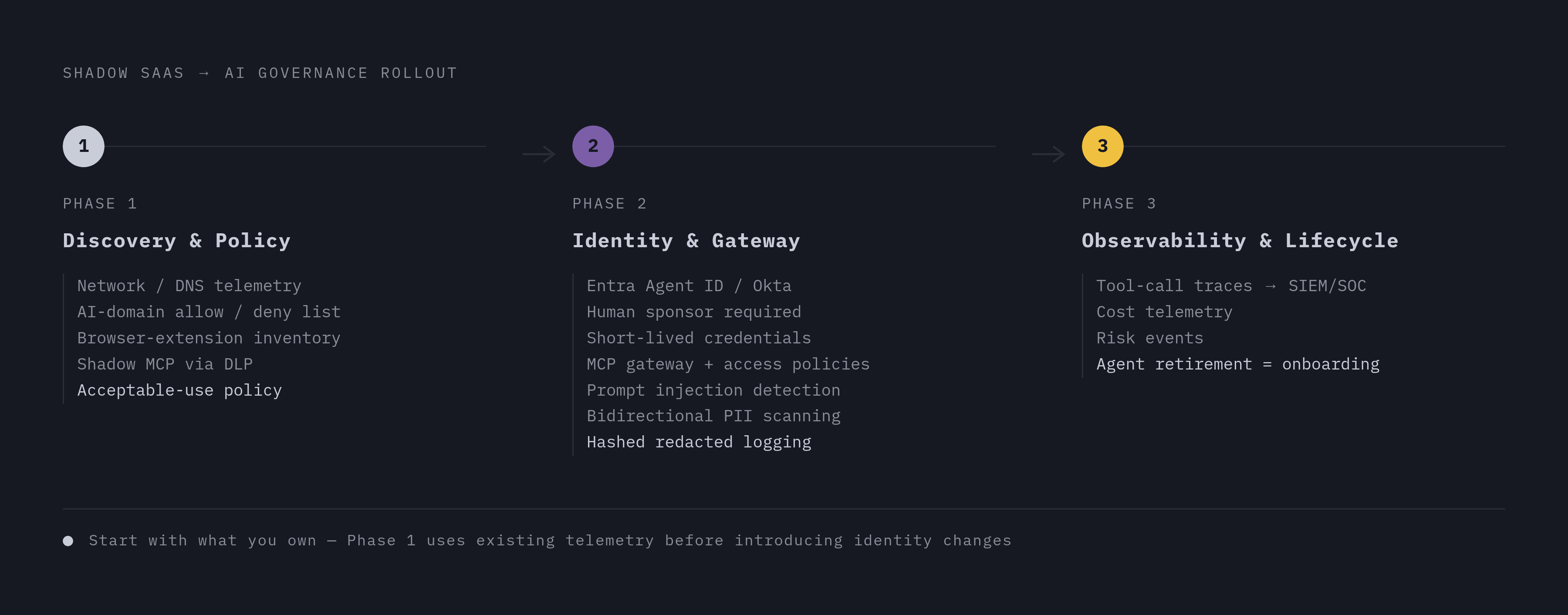
For teams undertaking the port, the sequence starts with discovery. Check the network and DNS telemetry already in place against an AI-domain allow/deny list, add browser-extension inventory, and use shadow MCP detection through the DLP engine as a third channel. Then update acceptable-use policy to distinguish corporate data in personal or unmanaged AI accounts from personal productivity without sensitive input. Pair that policy with technical enforcement. This establishes coverage and enforceable boundaries before introducing the harder identity changes.
Next, set up agent identity before deploying agents at scale. Select Entra Agent ID or Okta for AI Agents according to the estate, require a human sponsor, and enforce short-lived credentials from the outset. Then deploy the MCP gateway for the relevant environment, configuring access policies per agent, tool, resource, and method. Add prompt injection detection, bidirectional PII scanning, and secret detection at the gateway. Hashed, redacted logging belongs in the production configuration from the start.
Finally, connect AI telemetry to the existing SIEM. Feed tool-call traces, cost telemetry, and risk events into the SOC workflow already handling shadow SaaS anomalies, and track agent retirement as deliberately as onboarding. The operational finish line is not a dashboard showing that agents exist, but an access path in which their identities, permissions, actions, and retirement are governed.