Wiring a Central AI Control Plane Into Your Existing Developer Toolchain and CI/CD Pipelines
Central AI control planes enforce identity, policy, and audit across agent-powered CI/CD pipelines.
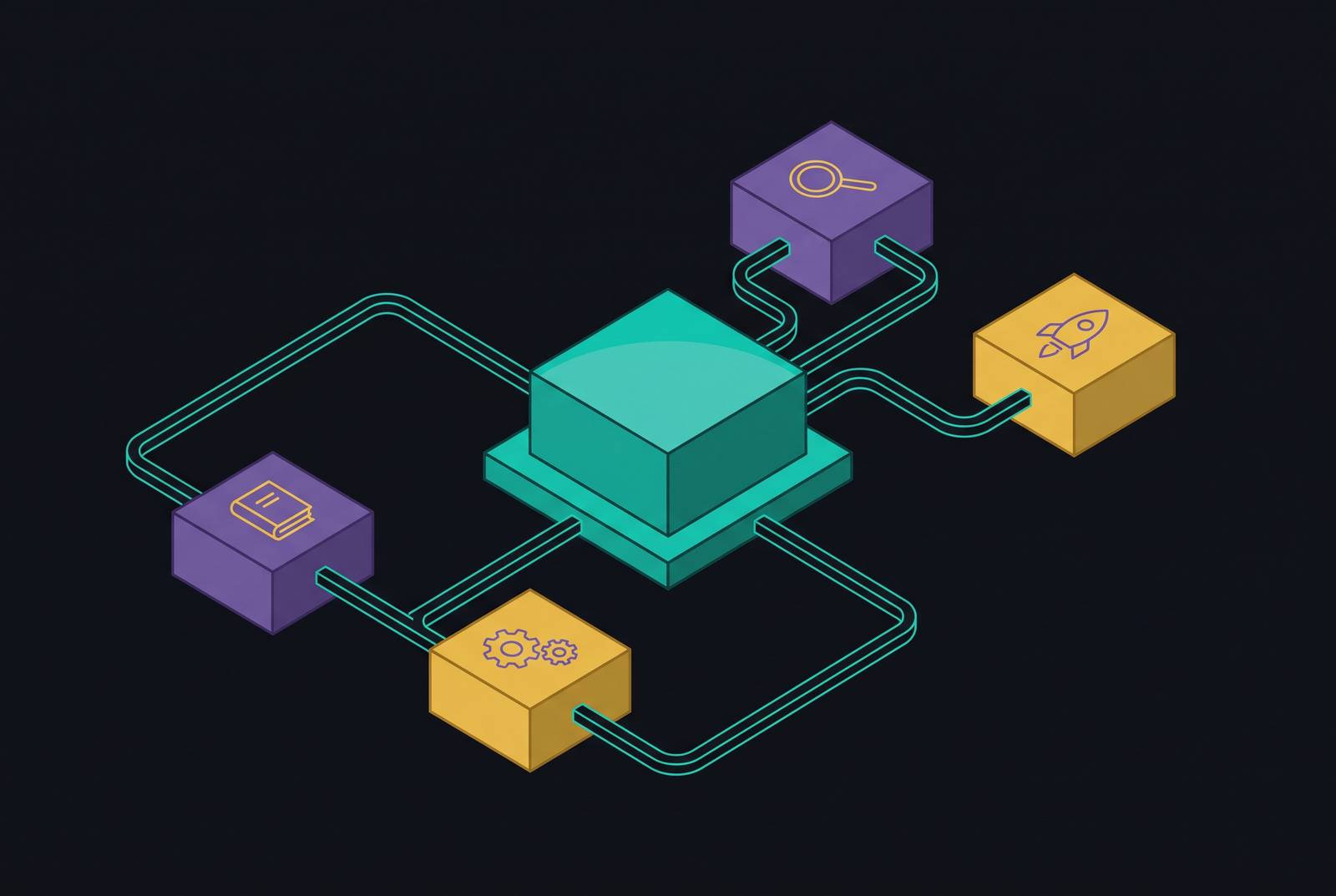
An enterprise AI control plane governs AI agents and MCP servers through a shared layer of identity, policy enforcement, threat detection, and audit logging. Wiring it into an existing developer toolchain is a layered integration. The controls belong where agents touch code, secrets, tools, and production systems, while governed templates make that path easier for engineers to use.
Why AI agents inside CI/CD pipelines are a governance problem, not just a tooling problem
An AI coding agent commits a pull request with credentials embedded in the code, running inside a CI runner with no agent-level audit trail. The credentials are now a security problem. But the missing record creates another one, because investigators cannot attribute the action to the agent session or the person who initiated it.
A pipeline agent is not simply a chatbot with better typing speed. It can open pull requests, provision cloud resources, read secrets, and deploy code unattended. Traditional CI/CD controls are built for actions with a set scope, such as a developer who triggers a build or a secrets manager that issues credentials scoped to a job. Agents can keep running, spawn sub-agents, and link tool calls across several systems.
BCG’s Enterprise AI Control Plane guide documents the resulting fragmentation, including inconsistent rules and agents accessing systems without consistent identity, permissions, or monitoring. A reused agent may inherit permissions its new team never reviewed, while sensitive data reaches external models without safeguards. The bottleneck is the enterprise’s ability to govern the agent’s actions.
How do you centrally govern AI agents and MCP servers with five control-plane primitives?
An AI control plane sits in the execution path, where it can enforce policy before an action proceeds. A dashboard alone cannot do that job. The architecture is easiest to picture as pipeline stages running left to right, from code through build, test, deploy, and runtime. A horizontal control-plane bar sits above them, intersecting each stage wherever an agent needs governed access.
Five primitives give that bar its substance. Discovery and inventory establish which agents, MCP servers, and skills exist, what they can access, and who owns them. Identity and access attach a verifiable actor and scope to each session, while policy enforcement decides whether a requested action can proceed. Threat detection checks for manipulation and sensitive-data leakage at execution boundaries. Observability and audit logging preserve the session context, initiating identity, and tool calls for investigation.
These functions share an architectural purpose, but MCP is not a substitute for them. MCP, or Model Context Protocol, tells an agent which tools are available and how to call them. The control plane decides whether a particular call is permitted, by whom, and under what conditions. That distinction lets teams use different development stacks without recreating governance separately on each one.
The discovery problem begins with finding the agents and MCP servers already running
Okta documents a large regulated asset manager that discovered thousands of agents, only a small fraction of which it considered valid. It also found more than 500 MCP servers against a handful that had been approved. The inventory exposed the distance between the approved environment and the one actually running.
For a platform or security engineer, discovery starts by enumerating the CI runner environments where agents execute, including GitHub Actions, Jenkins, and GitLab CI. The inventory must include MCP servers that are registered or can be reached from those runners, along with the credentials and secrets that agents use. It must also extend beyond CI to developer tools such as Cursor, Claude Code, and Copilot that may call internal APIs from laptops. Otherwise, agent activity beyond the pipeline boundary remains outside the inventory’s visibility.
GitHub’s Enterprise AI Controls, generally available as of February 2026, show how discovery can work within a platform by letting teams search agentic session activity, including that of third-party agents. That visibility contributes to an organization-wide inventory. The practical sequence is to map agents to the systems they touch before writing enforcement rules. Teams can then put controls on the highest-privilege access before general availability and account for differences in risk among the agents they find.
Agent identity at the pipeline boundary requires more than CI runner credentials
Discovery establishes what exists, but authorization needs to know who is acting. When an agent inherits the runner’s service account, its actions appear under a machine identity rather than the agent and the human who initiated the session. Access reviews, offboarding, and forensic investigation all lose the same attribution link.
The required model gives every agent session a unique, verifiable identity linked to its initiating human through an enterprise identity provider such as Okta or Entra ID. It also identifies the agent’s model, version, and system prompt scope. Session scope defines which tools and data are available, and for how long. Credentials that are short-lived and automatically rotated take the place of static keys sent to runners.
GitHub’s controls include an actor_is_agent identifier with user and user_id fields, while agent_session.task records session start, finish, and failure. Okta for AI Agents, generally available April 30, 2026, addresses access at the identity-provider layer through its Agent Gateway, with interactions logged for audit and observability. These provide distinct integration anchors with limited coverage.
Identity then makes fine-grained authorization possible. Rather than granting broad access or making the agent unusable, policy can limit it to documents with specific project and sensitivity attributes. Relationship-based access control is one model for that precision. An agent may be permitted to summarize a document without being permitted to export it.
Inserting policy enforcement at the four pipeline stages where agents touch sensitive systems
Policy belongs at consequential transitions. Each stage has its own risks and needs its own ways to enforce policy. The implementation map therefore has four boundaries, each with a distinct job. The review, scanning, and approval tools already in place still help, as long as agents cannot quietly go around them.
At code generation and commit, secret scanning at the infrastructure level checks every PR an agent generates before merge, so teams do not have to trust the agent to keep credentials out. Tool and session identifiers connect the PR to its originating session in SIEM, with a label such as agent:claude-code identifying the tool. License governance adds acceptable-license policy, scanning, and a remediation process.
At build and CI, agents that execute shell commands, install packages, or make network requests need sandbox isolation. MicroVM isolation, with a dedicated kernel per agent workload, is the recommended baseline for production deployments handling proprietary code. The control plane issues scoped session tokens without exposing underlying OpenAI or Anthropic provider keys to the runner. Agent PRs also pass owner review, coverage thresholds, lint, SAST, and secret detection, with every bypass assigned to a named role and logged. A pilot is not a diplomatic immunity program.
At tool calls and MCP interactions, a gateway or firewall intercepts each call and evaluates declarative policy. The call can be allowed, denied, or held until approval or justification is given. Pre-deployment scanning checks MCP tool metadata for malicious instructions, while runtime scanning checks sensitive data per tool and blocks flagged tools pending review. GitHub’s generally available MCP enterprise allow lists provide a platform-level anchor for controlling which servers agents can access.
At deployment and production access, agents provisioning cloud resources or touching production databases use the same change approvals as human-initiated changes. Records of file access, shell commands, PR creation, and API calls go into the enterprise SIEM and are kept for as long as the retention requirements call for. Incident response runbooks for agents round out this boundary because teams need a plan for responding to a compromised autonomous agent before production access begins.
Threat detection has to run in the pipeline, not after it
The EchoLeak vulnerability demonstrated in Microsoft 365 Copilot showed how zero-click prompt injection could access and silently exfiltrate enterprise data. An adversary could manipulate it into using permitted capabilities for an unauthorized purpose. That is why policy enforcement and threat detection address different failure modes.
Secret scanning in code does not cover secrets sent through prompts or API calls to external models. An agent can surface sensitive values from its execution context while using tools, even when its repository changes contain no credentials. Keeping provider keys inside the control plane keeps secrets safer because the agent can authenticate to a proxy without handling the underlying key. It does not remove the need to inspect other sensitive content crossing that boundary.
PII detection must thus check each tool as well as the initial model input. An agent may receive a clean prompt, read a document containing PII, and write that information into a PR comment. The exposure happens during the workflow itself. Runtime scanning at the MCP gateway can catch that transfer, whereas post-merge scanning arrives after the relevant action. Prompt injection detection belongs at the execution boundary for the same reason.
Audit logging and observability are prerequisites for pipeline governance
Detection identifies suspicious activity, but investigation needs an attributable record. A log entry saying that a runner called an API is insufficient. Governance must be able to establish what the agent did, on whose behalf, in what context, and why. That requirement shapes the integration from the start rather than becoming a logging project after deployment.
The record needs the initiating human identity, agent identity, session scope at the time of action, tool called, input provided, and output returned. Session-level telemetry also preserves the reasoning context associated with the action. Together, these details connect an observed change to the session that produced it. Without that chain, a successful API response says little about whether the action was appropriate.
Agent logs must reach the same SIEM as other access and change events, so security operations can correlate them with the wider environment. A separate AI observability interface does not replace that connection or the applicable compliance retention requirements. Cost telemetry also belongs in the control plane, where it serves a different need. Token consumption, provider costs, and department-level attribution make chargeback and operational accountability possible without displacing the security evidence record.
The golden path makes the governed pipeline the fast path
The burden eases when developers inherit these controls. BCG calls this the golden path, a pre-governed, production-ready agent or MCP scaffold. Authentication already connects to the enterprise identity layer, registration happens automatically, and telemetry streams to the monitoring stack. The developer customizes business logic instead of becoming a part-time governance integrator.
That changes the incentive to bypass the approved route. When every team must learn the governance stack from scratch, even sound controls create repeated setup work and encourage shadow AI. A governed starting point removes that repetition without removing the controls. It is an integration pattern that works with the existing developer toolchain.
GitHub’s custom agent policies put this into practice with enterprise standards kept under version control in .github-private/agents/*.md and a 1-click push rule that protects .github/agents/*.md. BCG describes the broader provisioning mechanism as a common intake form triggering an automated pipeline that creates a repository with the agent or MCP template and working infrastructure. The guide puts the setup comparison plainly, from weeks of governed setup to a single day.
What a phased rollout looks like without breaking existing pipelines
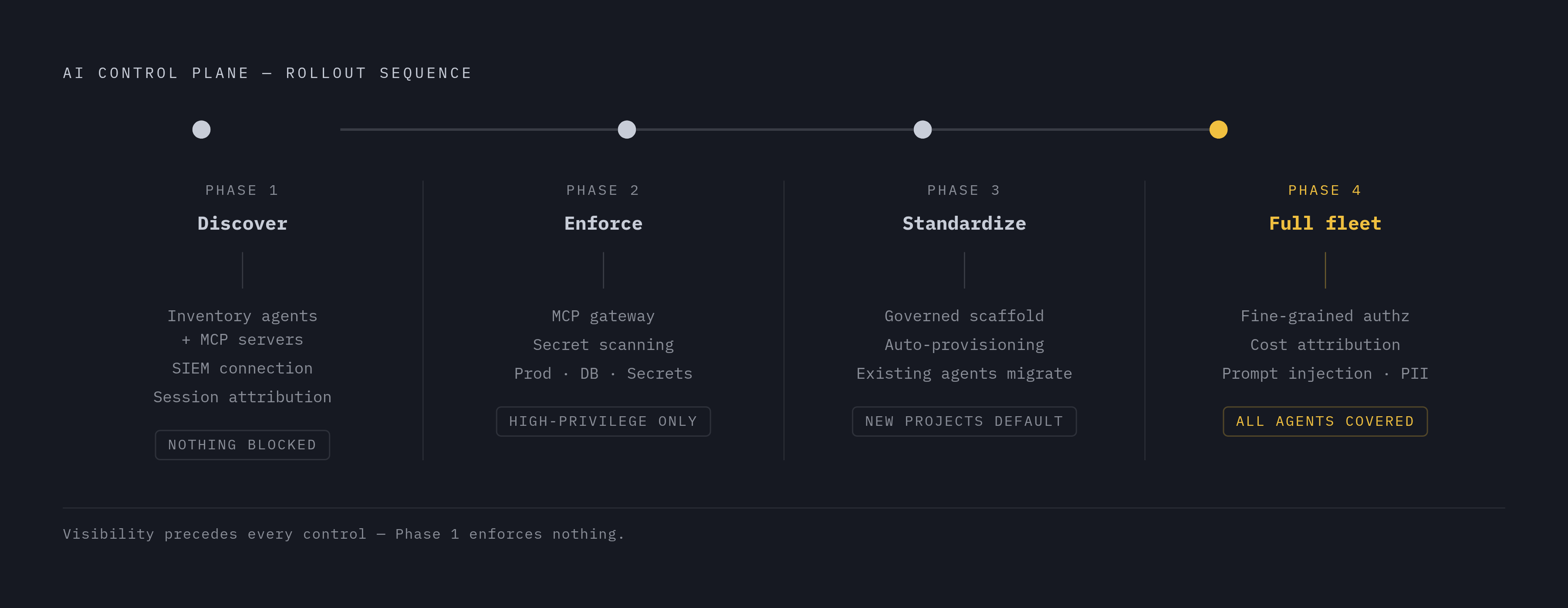
For a platform team putting this model into practice, the rollout begins with visibility before enforcement. The first phase discovers agents and MCP servers, establishes the inventory and SIEM connection, and implements session attribution to human identity. No agent is blocked at this stage.
The second phase enforces at the highest-privilege boundaries first. MCP gateway controls and secret scanning apply to agents that access production systems, databases, and secrets stores, so changes focus on where agents could do the most damage. The third phase publishes the governed scaffold as the default for new projects and connects intake to automated provisioning. Existing agents migrate on a schedule, while new agents start with controls already attached.
The fourth phase brings fine-grained authorization, department-level cost attribution, and prompt injection and PII detection to the whole agent fleet. By then, the supporting infrastructure is in place. Teams can then cover more actions with policy by changing configuration, without having to redesign the architecture again. This sequence avoids making a complete governance build-out the prerequisite for every initial integration, while preserving readiness requirements before general availability.
Each phase gate should use the deployment readiness checklist, and all seven controls must be in place before general availability. Those controls are SSO integration, SIEM-connected audit logging, secret scanning on agent PRs, PR policy gates, license governance, sandbox isolation, and incident response runbooks. They test the deployment infrastructure. This is the audit-ready baseline.