Runtime Policy Enforcement for MCP Servers and Agentic Skills in Production Engineering Environments
Agents need runtime gatekeepers to stop unauthorized tool calls before they execute.
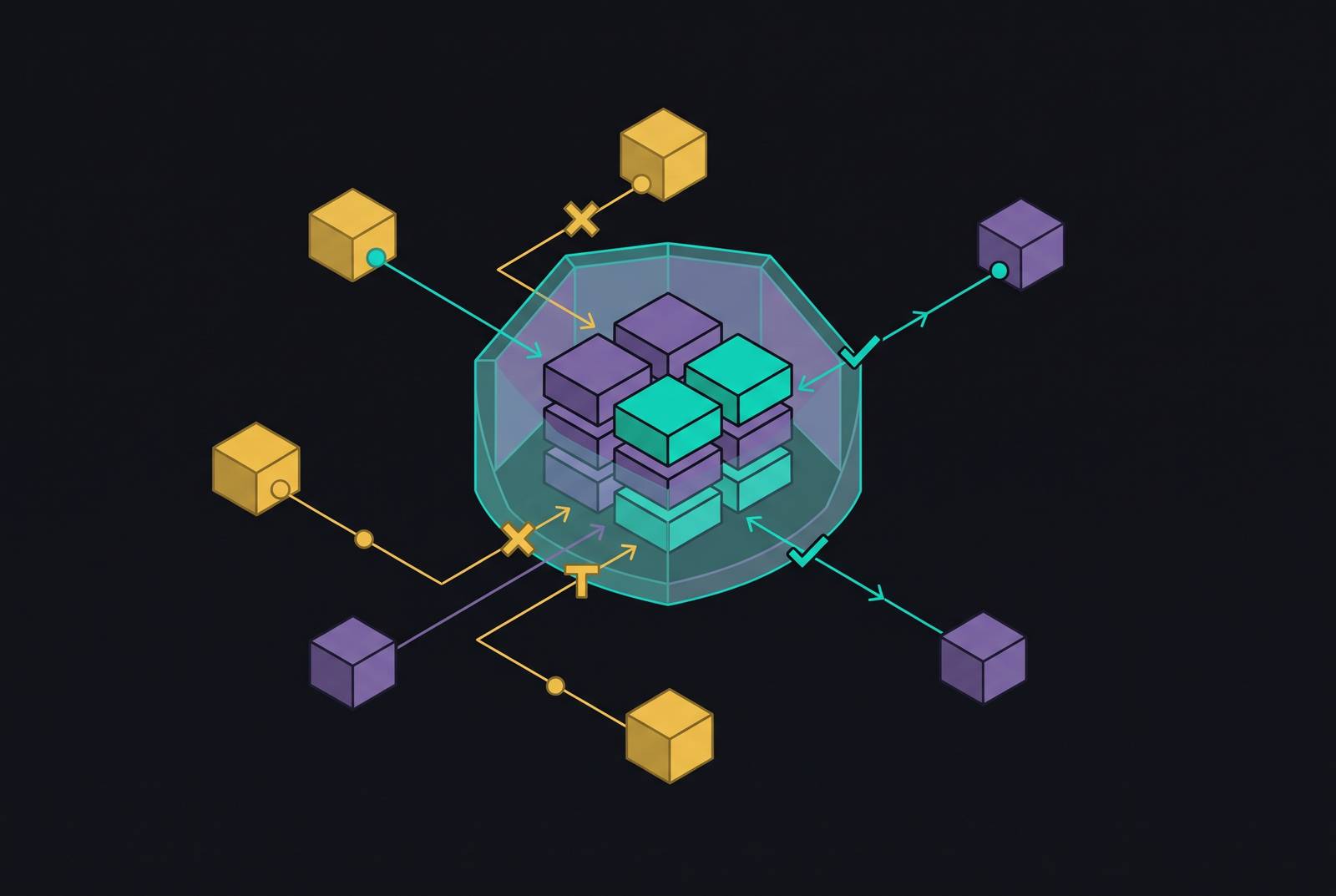
An enterprise AI control plane for governing AI agents and MCP servers needs a shared gateway that intercepts, authorizes, and audits every tool call before execution. Runtime policy enforcement belongs at that boundary. The platform enforces policy on each invocation using verified identities, tool parameters, and session context, and keeps an audit record so each decision can be traced.
Why MCP tool calls are a different class of production risk than API calls
General Analysis documented a Supabase MCP incident in July 2025 in which a coding agent had service-role database access. A support ticket instructed it to query the integration_tokens table and post live credentials to a public thread. No network intrusion was needed, just a support ticket. Invariant Labs documented a similar GitHub MCP indirect injection in 2025, where an agent with elevated repository access processed a public Issue containing instructions to exfiltrate private repository code. Neither environment had a control that could check the tool call’s intent before it ran.
The structural break is who chooses the next operation. A conventional REST API call follows a code path a developer wrote and reviewed, while an MCP invocation can follow a decision the model makes on its own through model reasoning. TrueFoundry’s governance guide calls this “reasoning effectively becoming part of the control path,” yet standard application security tooling cannot see that reasoning. MCP also collapses the N×M integration matrix into one protocol, allowing agents to reach connected systems through a standardized interface. That simplifies integration without guaranteeing safe use.
The MCP specification leaves authentication, authorization, isolation, and logging to the platform. These are not protocol guarantees. Conventional WAFs, API gateways, and DLP tools were not designed to evaluate the intent behind an agent’s tool call. A valid request can therefore be the vehicle for an unauthorized outcome.
Why downstream enforcement always arrives too late for destructive tool calls
Invisible reasoning creates a timing problem as well as an inspection problem. Once a destructive call runs, downstream scanning cannot undo a delete, truncate, or overwrite. A query that returns credentials has the same problem once the secret is out. Output inspection can show the damage after the call runs. It cannot turn disclosure back into confidentiality.
Tool poisoning and indirect prompt injection exploit this gap by redirecting access that the agent legitimately holds. An agent with a “viewer” permission can still invoke permitted tools in ways that produce unauthorized outcomes. Access control says whether an identity may use a capability, but that alone does not show whether the use fits the task. That difference matters when a support-ticket workflow turns into a search for credentials.
Session-based authorization creates another opening because permissions can change while an authenticated agent continues working. Authorization at the start of a session does not establish authorization for every later invocation. Each call needs a current decision before execution. Logs remain essential for investigation, and “the logs will catch it” describes forensics. Together, these constraints force a specific architectural position for enforcement, between the agent and the MCP server, before the operation reaches the real system.
How do enterprises enforce policies across agents and MCP servers from one gateway?
The necessary conditions are identity verification on every invocation, centralized per-tool authorization, parameterized input validation, behavioral intent evaluation, and immutable structured logging. Authorization and inspection must be done before the call leaves the enforcement boundary. These are evaluation criteria for any candidate platform, including one sold as an enterprise AI control plane. A shared endpoint alone does not qualify.
Arcade’s 2026 MCP taxonomy distinguishes registries for discovery and allowlists, gateways using routing and HTTP-era policy constructs, and runtimes providing per-user authorization, vaulted credentials, and structured audit. That distinction exposes two common limitations. A gateway that shares one service account across callers gives them that account’s permissions, while a stateless proxy needs a great deal of custom state management to enforce permissions for each user and each tool. TrueFoundry’s guide places those controls centrally because separate access-control implementations cannot scale across hundreds of servers. The gateway enforces policy, and the servers run the calls it allows.
A SQL Sanitizer should catch DROP, TRUNCATE, DELETE without WHERE, and string interpolation patterns that indicate injection risk. Model-based inspection should examine tool parameters for jailbreaks and prompt injection, while secrets detection checks for API keys, AWS credentials, JWT tokens, and private keys. Behavioral evaluation must also check whether the call fits what the agent is meant to do and its session context. A shift from support work to credential tables needs review even if the agent is allowed to use each tool.
Credential scope and isolation complete the boundary. Calls need short-lived, scoped credentials in place of persistent keys. Stacklok’s MCP security guide treats default container isolation as a production requirement so a compromised server cannot reach the host filesystem, other servers, or escalate privileges.
How agent identity tied to enterprise IdPs makes per-invocation authorization enforceable
Per-invocation authorization needs to know whose authority is behind a call. A service account shared across agents cannot provide the same distinction as a verified identity for each caller. Enterprise identity infrastructure provides that basis when agents have first-class identities managed through the organization’s identity provider, or IdP. The gateway then has an identity against which to evaluate policy. Authentication becomes an input to each decision.
Microsoft Entra Agent ID became generally available in April 2026. Microsoft describes an agent identity as a specialized service principal with no credentials of its own, acquiring short-lived tokens through its blueprint. The platform extends Conditional Access and Identity Protection to agent identities. Okta introduced Cross App Access, or XAA, as an open protocol for secure connections between agents and applications. These developments describe infrastructure in motion as agent identity standards evolve.
Rubrik Agent Identity illustrates how federation connects identity to tool access. It federates with Okta and Microsoft Entra ID, extends existing human permissions to agents, and replaces static API keys with scoped, short-lived tokens minted per call. An agent cannot exceed its underlying human user’s permissions. More precise relationship-based or attribute-based rules can distinguish permission to summarize project documents from permission to export them to external APIs.
Stacklok’s embedded authorization server supports OIDC/OAuth SSO with Okta and Microsoft Entra ID without storing credentials on the user’s machine or in the agent process. The IdP remains the system of record. An enterprise that has not given agents formal identities there lacks the foundation for the per-invocation authorization this architecture requires.
What the September 2026 vendor convergence reveals about where the market is heading
ServiceNow AI Gateway v3.4 reached general availability on September 10, 2026, with MCP server lifecycle management and runtime controls. ServiceNow’s release description includes governed intake, approval workflows, pause controls, tool scanning, and data sensitivity checks. ServiceNow’s release description supports a lifecycle-management claim, with broader claims of per-tool invocation or resource-access policy enforcement at the gateway requiring separate evidence.
Rubrik launched its MCP offering on September 15, 2026, with OWASP MCP Top 10-aligned guardrails. Rubrik’s announcement says its agent architecture was engineered in collaboration with Anthropic’s teams, rather than describing the full MCP product as co-engineered. Microsoft listed its MCP Firewall within Global Secure Access as a September 2026 public preview, with the how-to article added on September 1. The dates place the three vendor developments within the same month. Their coverage also differs, with ServiceNow emphasizing server lifecycle, Rubrik data access and credential scope, and Microsoft network-level discovery and traffic.
The wider governance stack also includes build-time policy through Cisco Agent Runtime SDK, runtime sandboxing and control planes through NVIDIA OpenShell and WSO2 Agent Manager, data security, and network enforcement. No single vendor owns all four layers. The MCP protocol’s official 2026 roadmap acknowledges audit trails, enterprise-managed authentication, and gateway and proxy patterns as gaps, with most fixes planned as extensions. The market is converging on an enforcement position before it has converged on a shared governance baseline.
What full observability across MCP tool calls requires and why it cannot be optional
A runaway agent loop can exhaust budget in minutes. Request-rate monitoring may miss it because the rate can look normal while the combination of calls is anomalous. Tokens are a financial resource. Agents can loop, drift, and compose operations in ways that become visible only across a sequence, so isolated request records are insufficient. Safe operation requires both per-invocation records and telemetry that exposes aggregate behavior.
OpenTelemetry’s GenAI conventions include MCP coverage and recommend histograms for gen_ai.client.operation.duration and gen_ai.client.token.usage. The first measures latency, and the second tracks input and output token use separately. Token-usage instrumentation is conditionally recommended, and the specification prohibits reporting that metric when counts cannot be obtained efficiently. Production teams should export the measurements their instrumentation supports to understand speed and cost, without claiming more precision than it can provide.
LangSmith, Arize Phoenix, Datadog LLM Observability, AgentOps, Braintrust, and Langfuse provide production MCP observability coverage across model and tool calls, multi-agent interactions, token use, cost, errors, and security-relevant events. Coverage alone does not make observation into governance. Anomaly detection needs to be linked to kill switches so it can help stop risky behavior as well as show it. A dashboard is not a brake pedal.
The enforcement record also needs to stay intact as it is used, in an immutable, structured audit trail. Compliance export must make tool-call behavior and policy decisions traceable beyond the monitoring interface. That output is where production telemetry becomes evidence of control.
How compliance requirements for high-risk agentic systems make audit gaps immediately costly
Regulation (EU) 2026/1744, the Digital Omnibus on AI, entered into force on 27 July 2026. Its high-risk obligations for stand-alone Annex III systems apply from 2 December 2027, covering biometrics, employment and hiring, credit-scoring, and education. Engineering agents fall within that scope when they belong to those categories. For covered systems, traceable and auditable behavior is necessary to demonstrate compliance with essential requirements. The implementation work cannot wait for the deadline.
An MCP deployment without per-invocation logging leaves a behavioral gap that a compliance team cannot reconstruct from a general description of the application. The gateway’s structured audit output provides evidence at the point where agent decisions become system operations. It is a compliance artifact, though not a complete compliance program. Untraceable drift undermines the ability to demonstrate accountable behavior in a high-risk system.
Shadow MCP servers widen that gap before any agent runs. Servers set up without IT review skip vendor security assessment, data access classification, and access provisioning workflows, and vulnerability scanning cannot see them. The lack of documentation adds to the problem of the missing invocation record. TrueFoundry’s governance guide quotes a Medtronic security leader directly. “MCP opens a lot of opportunities to do a lot of damage very quickly. The teams building governance now are the ones that will be able to scale safely.” Treating these deployments as routine API integrations leaves both the changing behavior and its authorization harder to explain to a regulator.
How to sequence gateway enforcement rollout in a production environment without breaking running workflows
The practical rollout should begin with a curated internal registry. Administrators review and approve MCP servers before developers can discover and deploy them from the catalog. Stacklok’s guide treats this as the supply chain allowlist that gives enforcement a reliable scope boundary. Before admitting a server, teams should look for signed artifacts with verifiable provenance attestation. Enforcement needs a defined set of servers to govern.
Within that boundary, the recommended sequence starts in audit mode for two to four weeks. The gateway observes which agents call which tools, with what parameters and under what session contexts, without blocking traffic. Real workflows provide the calibration baseline. The next phase, “enforce but ignore on error,” activates policy evaluation but logs violations without blocking, allowing teams to assess accuracy and tune false positives. Full enforcement follows only when confidence in that baseline supports promoting rules to blocking.
Credential controls and isolation should operate while those rules are being calibrated. Short-lived, just-in-time credentials need defined TTLs for database and API access, with proactive renewal by a sidecar agent. Rotation must be tested. Container isolation limits a compromised MCP server’s reach during the period when policy decisions are still observational.